White Label Branding for Social Apps: A Practical Guide
Published on
Tags:
Your OAuth token expires during a deploy. Meta still hasn't approved the app. A customer pings support asking why LinkedIn auth is “coming soon” for the third week in a row. If you've tried to ship social publishing inside your own product, that sequence probably feels familiar.
The hard part usually isn't the posting UI. It's the platform surface behind it. You're dealing with separate auth models, separate app-review processes, separate rate-limit behavior, separate media rules, and a steady stream of API changes that have nothing to do with the feature your users care about. White label branding matters here because it turns that mess into one branded layer your users experience as native to your product.
Table of Contents
The Build Night You Don't Want to Have
It's late, Slack is still active, and nobody on the thread is talking about product strategy anymore. The conversation has narrowed to survival.
One person is pasting OAuth error payloads. Another is checking whether a rejected platform permission means a second review cycle. Someone else is trying to answer a customer who keeps asking when the LinkedIn button will stop being disabled. The feature sounded simple in planning. “Add social publishing.” In practice, it became a rotating set of platform-specific failures.
What that night usually looks like
A typical build night goes sideways in boring, expensive ways:
Auth drift: One platform refresh flow changes, or a token expires at the worst possible time, and your scheduler starts failing jobs.
Review limbo: You submit an app for platform approval and sit there waiting while your roadmap stalls.
Schema mismatch: Media payloads, post formats, and account models don't line up cleanly across networks.
Sandbox churn: A rejected feature or permission can force another round of test setup and revalidation.
Policy anxiety: You go into the weekend wondering whether a terms or API change will break Monday's publish queue.
None of this is exotic engineering. That's the problem. It's work that eats good teams because it's operationally noisy and strategically uninteresting.
You rarely lose time on the happy path. You lose it in the long tail of platform exceptions you didn't plan to own forever.
Why developers end up looking at white label
If social publishing is supporting your core product instead of being the product, building every integration yourself can be a bad allocation of attention. You're taking on API maintenance, token storage, hosting concerns, user support for third-party failures, and platform review cycles just to expose a button that says “Publish.”
That's where white label branding starts making sense. Not as a marketing trick. As a way to collapse the backend chaos into a single branded surface so your team can ship the customer-facing feature without becoming a part-time platform-compliance shop.
What White Label Branding Actually Means
In software, white label branding is a delivery model that splits responsibilities cleanly across three parties. The vendor builds and runs the product. The reseller puts its own brand, pricing, and customer relationship around that product. The end customer uses the feature as part of the reseller's app. That is the core structure described in Morgan Lewis on white-label technology arrangements.
For teams trying to ship social publishing, that structure matters because it changes what you have to own. Instead of maintaining separate integrations for Meta, LinkedIn, X, TikTok, YouTube, and whatever changes next quarter, you buy a system that already handles the messy parts, then present it inside your product as your own publishing surface.
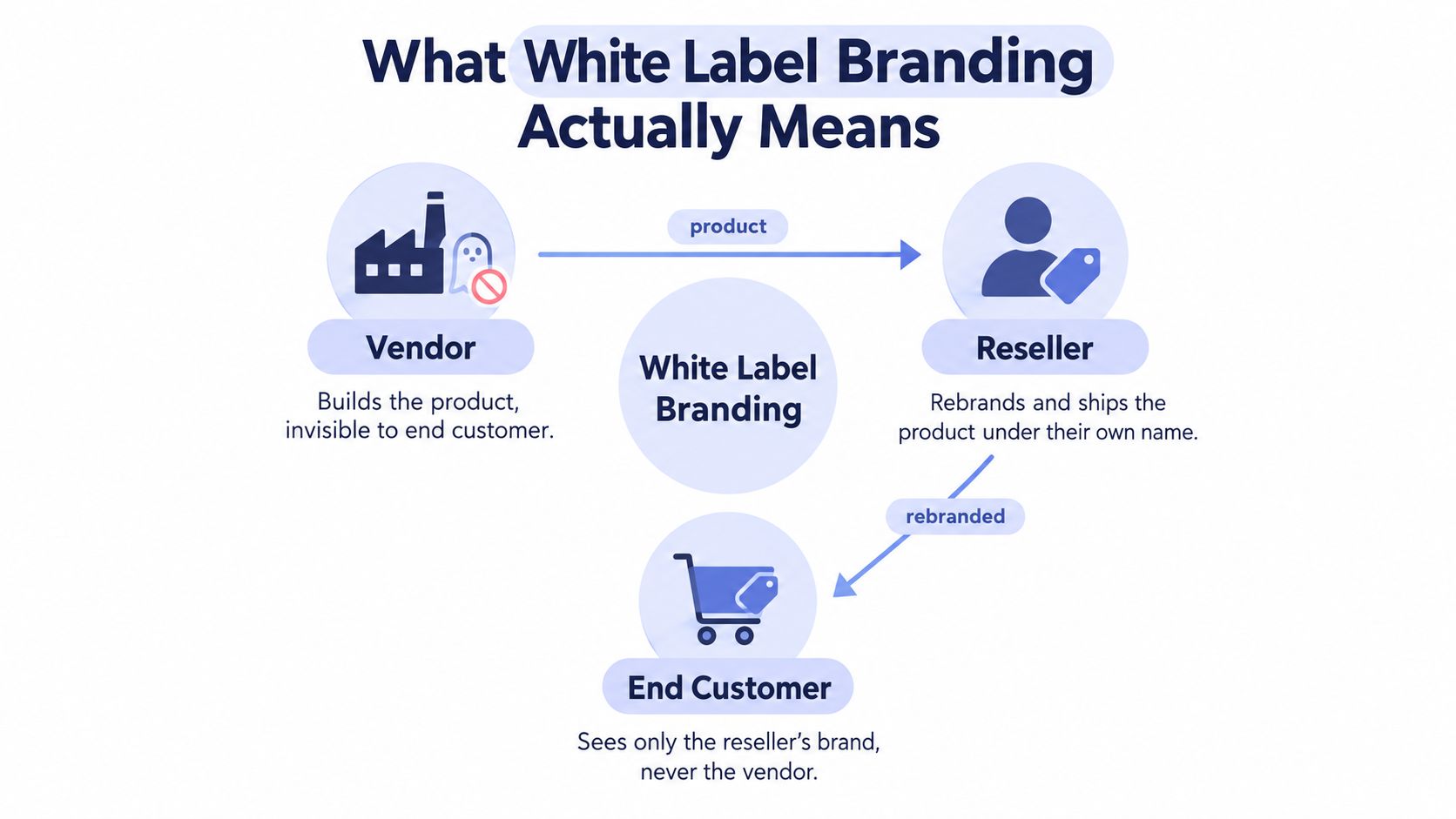 A diagram explaining the white label branding process involving a vendor, a reseller, and an end customer.
The software version developers deal with
The important detail is not the logo swap. It is the boundary of responsibility.
Vendor side: Owns the social API connections, token refresh logic, hosting, queueing, platform-specific behavior, and release work when networks change requirements.
Reseller side: Embeds or launches the experience inside its own app, controls packaging and pricing, manages onboarding, and supports the customer relationship.
Customer side: Uses a feature that appears to belong to your product, even though the underlying publishing stack is operated by someone else.
That is why white label can remove so much engineering drag. You are not buying generic software with a custom theme. You are offloading a category of operational maintenance that would otherwise sit on your team forever.
White label versus private label versus OEM
These terms blur together, and that leads to bad scope assumptions during procurement.
Model | What it usually means | Best fit |
White label | A reusable product or service sold under another company's brand | Fast rollout when the feature is useful but not a core differentiator |
Private label | A product configured more specifically for one seller's offering or channel | More differentiation, more control, usually more effort |
OEM | A manufacturer or builder produces something to another company's specification | Cases where you need deeper customization and tighter ownership over the final product |
The retail comparison is still useful here because the commercial model is familiar. U.S. store-brand sales grew from $176 billion to $236.3 billion between 2020 and 2024, according to Statista's private-label market overview. Different market, same operating logic. The company with the customer relationship owns the brand surface, and the producer handles the underlying product.
For social publishing, the practical definition is narrower than the generic branding version. A white-label provider is the team taking on the integrations, auth churn, and platform maintenance, while your users see one branded workflow inside your app. If that publishing layer supports your product instead of defining it, that model usually deserves a serious look.
Real Benefits and the Trade-Offs Nobody Mentions
The pitch for white label usually sounds clean. Faster launch, less engineering, your brand on top. That part is real. The missing part is what you give up to get it.
Where the model earns its keep
For teams shipping social publishing, these are the benefits that matter:
Benefit | Trade-Off |
Skip app-audit pain for platform access you'd otherwise manage yourself | Margin compression on every customer account you run through the vendor |
Push token handling to the vendor instead of building refresh and recovery logic in-house | Vendor dependency when uptime, auth bugs, or API lag hit production |
Expose one surface across many platforms instead of maintaining separate SDKs and schemas | Support ambiguity when users hit platform-specific bugs but only see your brand |
Own the branded experience your users interact with | Contract and liability risk if branding, IP, or customer ownership terms are sloppy |
The benefits are operational, not theoretical
The strongest benefit is focus. You stop spending roadmap time on platform plumbing and put it back into your actual product.
A white-label software arrangement also shifts a lot of backend responsibility to the vendor. The vendor typically owns infrastructure, security, hosting, and product development, while the reseller owns the brand and customer relationship, which is why these models can reduce engineering burden compared with building the same stack yourself, as outlined in the earlier Morgan Lewis reference.
Practical rule: If your team keeps calling the integration layer “just plumbing,” that's a signal to stop owning so much of it.
For economics, the model can work, but only if you understand the resale spread. In white-label SaaS, pricing often uses platform fees, per-seat pricing, usage-based pricing, or revenue share. One industry benchmark notes that mature reseller books can reach roughly 60 to 75 percent margins once fixed platform costs are spread across enough clients, according to Refgrow's white-label software pricing overview.
The trade-offs are where teams get surprised
The first surprise is lock-in. When your users live inside a branded wrapper on top of someone else's stack, switching later can be ugly.
The second surprise is support. White label doesn't remove support burden. It changes its shape. Your users still come to you first, because your name is on the UI.
The third surprise is classification. If you haven't separated branding rights, support obligations, pricing, exclusivity, and end-customer ownership in the contract, you're not doing white label safely. If you want a fast side-by-side framing of adjacent models, compare it against white label vs private label.
Who White Label Branding Fits Best in 2026
White label isn't for everyone. It fits best when the integration surface matters more than deep ownership of the underlying stack.
Recent industry coverage points to a shift toward specialized white-label niches, outcome-driven service expectations, and AI-driven automation in agency environments, which is a useful clue about where buyers are getting stricter on execution quality in this industry trend roundup. The common theme is simple. Buyers don't just want something they can rebrand. They want something they can operate.
Four personas that usually benefit
Persona | Integration Shape | Why White Label Wins | Watch Out For |
SaaS developers | Embedded widget or REST API | Hides platform auth complexity and keeps the publishing flow inside the app | Limited control over niche publishing behavior |
No-code builders | Embeddable component or connector | Lets operators wire publishing into Bubble, Glide, or Retool-style workflows without living in OAuth land | Debugging gets harder when the connector is a black box |
AI agent builders | Server-side posting endpoint | Keeps the agent from holding refresh tokens and pushes rate-limit handling to the vendor | You need clear guardrails around posting permissions and failure handling |
Agencies | Multi-tenant console | Centralizes branded client operations across many accounts and portals | Support escalations multiply if tenant boundaries are weak |
What the tell looks like in each case
For SaaS teams, white label is a fit when social is one feature among many. If your roadmap keeps getting delayed by third-party integration chores, you probably don't need another in-house platform team.
For no-code operators, it fits when the people running the workflow aren't engineers. If a non-technical ops person has to understand token refresh edge cases, the integration shape is already wrong.
For AI agents, it fits when the agent needs to publish on behalf of users without owning fragile auth state itself. The cleaner pattern is a managed server-side endpoint with permissions and posting controls abstracted behind it.
For agencies, it fits when scale comes from repeatable client delivery, not custom integration work. That's also why agencies often study how other service firms package branded delivery. Lists of top creative agencies are useful not because they teach API design, but because they show how mature firms productize trust, presentation, and handoff.
A concrete example in this category is white-label social media management, where the goal is to ship publishing under your own brand instead of exposing yet another third-party tool in the client workflow.
Implementation Checklist Before You Sign Anything
Most white-label mistakes happen before the first API call. They happen when a team signs a contract based on a demo and assumes the ugly details will sort themselves out later.
They won't.
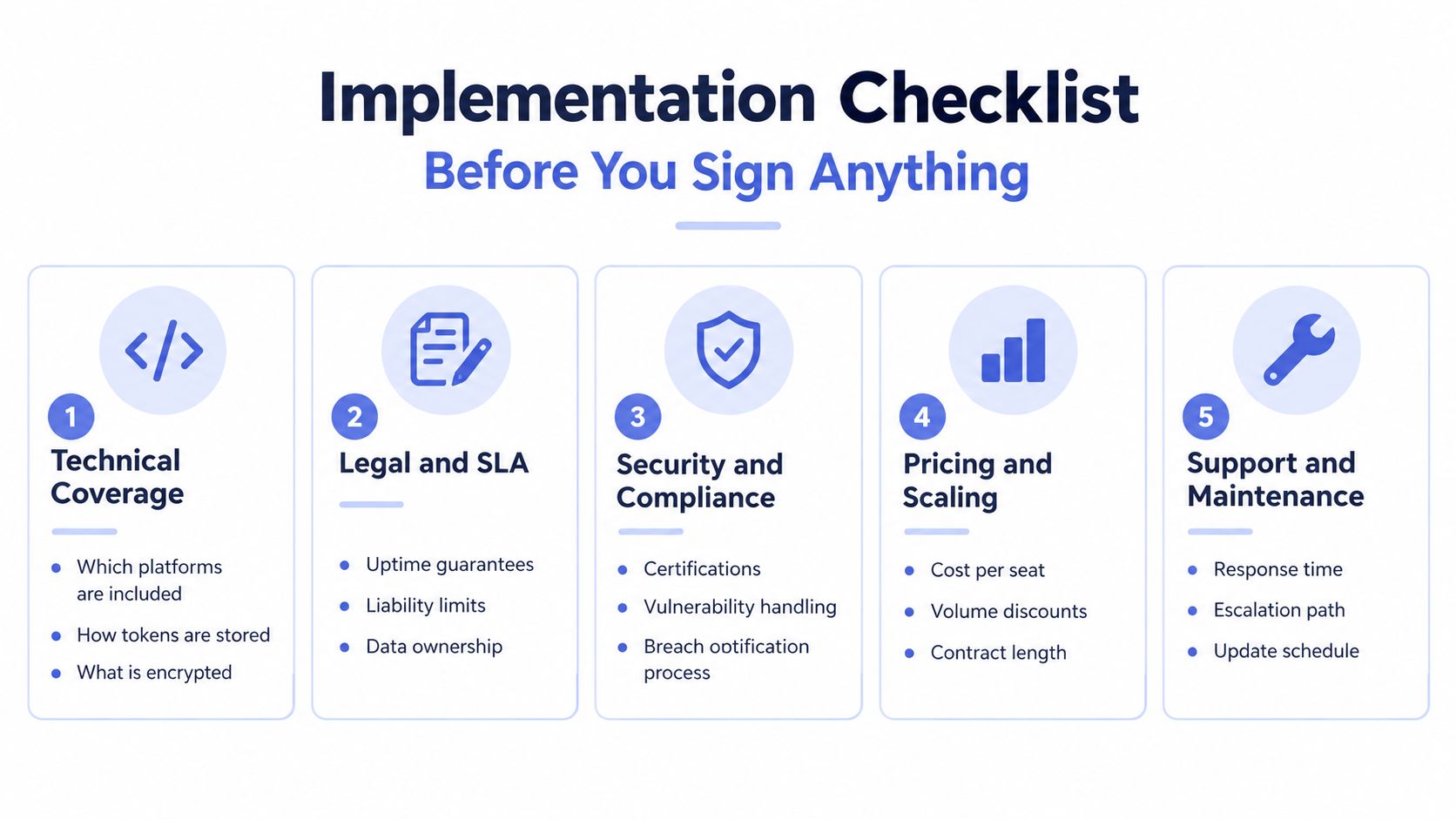 A five-point checklist outlining key considerations for technical implementation before signing any business service contract.
Technical coverage
Start with the integration surface, not the sales deck.
Platform scope: Which networks are included right now, and which are “planned”?
Token lifecycle: Who stores tokens, how are they rotated, and what happens when refresh fails?
Change management: When a platform changes its API or permissions, who patches the breakage and how are partners notified?
Environment support: Do you get a sandbox, staged rollout path, or tenant-level test environment?
Reliability: What uptime commitment exists, and what's the escalation path when publishing fails?
Kill the deal if they can't explain what happens the week a platform changes auth behavior.
Legal ownership
White label branding is a contractual boundary as much as a product choice. A white label agreement typically covers branding rights, IP licensing, support obligations, pricing, exclusivity, and end-customer ownership, as summarized in this white label agreement reference.
Ask directly:
Customer ownership: Who owns the end-customer relationship and account data?
Takedowns and abuse: Who handles DMCA requests, policy complaints, or fraudulent use?
Liability split: If a platform suspends access or disputes usage, who carries what exposure?
Termination terms: What survives contract exit, and what stops immediately?
If the answer to customer ownership sounds fuzzy, stop there.
UX and branding depth
Some vendors call it white label when they only mean “we'll add your logo.”
Check the theming surface:
Area | Questions to ask |
Visual branding | Can you change logo, colors, fonts, and domain? |
User touchpoints | Are email templates, error pages, and notifications skinnable? |
Embed model | Is it an iframe, JS SDK, native SDK, or API-only flow? |
Vendor visibility | Does the vendor appear in emails, headers, consent screens, or support links? |
If the vendor shows up in support emails or auth flows, your users will notice. “White label” ends where the original brand becomes visible under stress.
Pricing and scaling
Pricing models vary more than teams expect. Common structures include flat platform fees, per-seat charges, usage-based pricing, and revenue share, which is the practical menu you should expect before negotiating.
Also ask:
Overages: How are unexpected usage spikes billed?
Active versus connected accounts: Are idle accounts charged?
Contract length: What happens if you need to exit early?
Custom work: What is configuration, and what is paid implementation?
For a concrete implementation-oriented perspective, how to white-label an app is the kind of checklist worth comparing against a vendor's claims.
Support boundaries
Support is the place where weak partnerships fall apart fastest.
Ask who handles:
End-user tickets
Partner-only incidents
Platform-specific failures
After-hours escalations
Documentation and changelogs
Kill the deal if the vendor has no clear partner portal, no escalation path, and no ownership line for production incidents.
Three Myths That Get White Labelers Burned
The teams that get hurt by white label usually don't misunderstand the code. They misunderstand the business model.
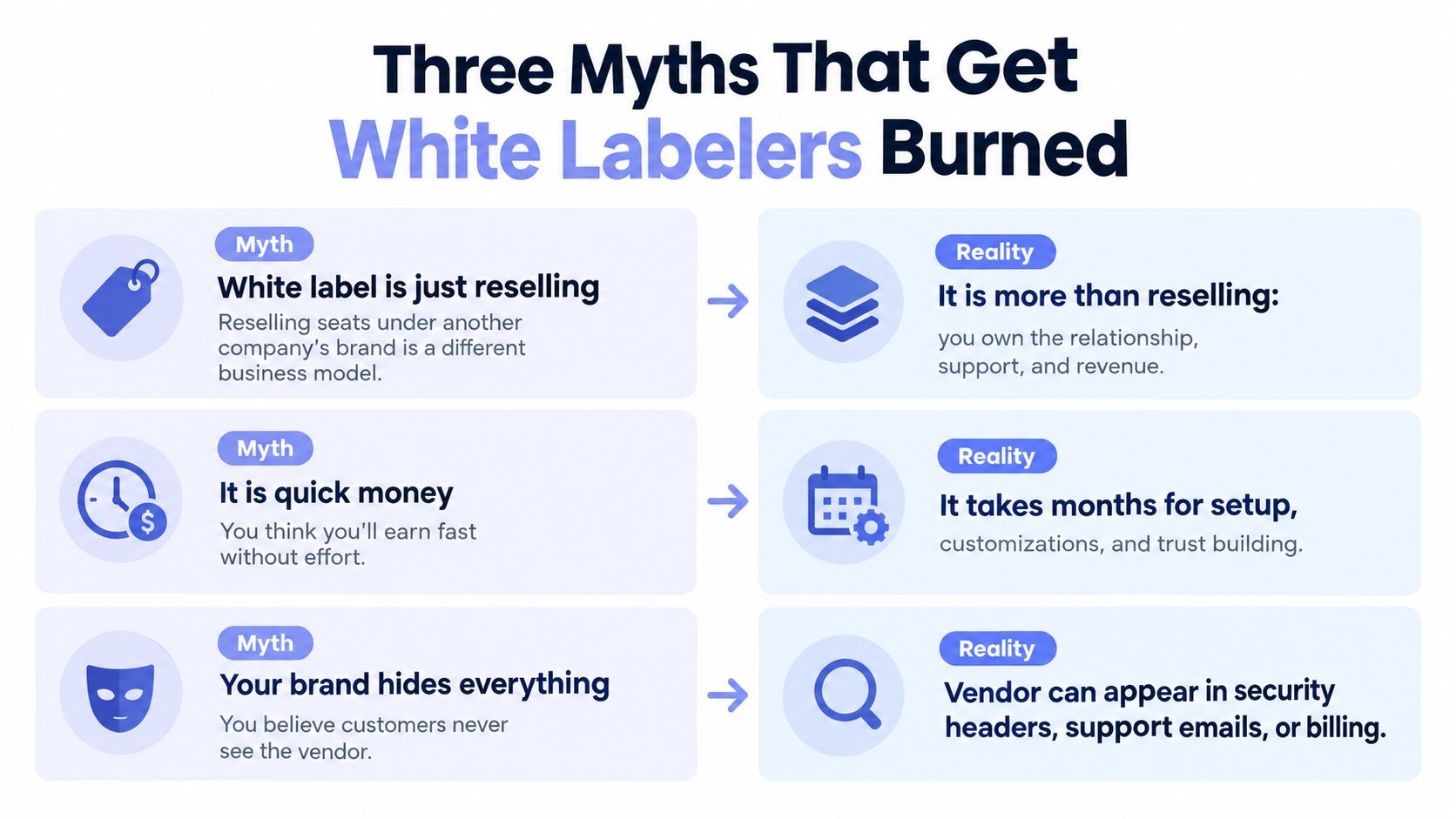 An infographic detailing three common myths and realities regarding the white label business model for entrepreneurs.
Myth one says it's just reselling
It isn't. Reselling seats under another company's brand is different from operating a branded experience where the customer sees you, pays you, and expects you to solve the failures.
A white label product agreement also makes the branding boundary formal, not cosmetic. In product contexts, the agreement exists specifically because the manufacturer or producer and the reseller need explicit boundaries around branding use, as noted in this white-label product agreement reference.
Myth two says it's always cheaper than building
Sometimes it is. Sometimes it absolutely isn't.
If the vendor's pricing compounds faster than your customer revenue, or if you need deep customization the vendor won't support, white label can become the expensive middle ground. Building is costly, but so is paying for a fit that never quite becomes native.
Here's a quick explainer that captures the common misunderstandings well:
Myth three says white label removes support burden
It doesn't. It reroutes it.
Your customer still blames your product when publishing fails. Your billing team still gets the refund conversation. Your support inbox still fills up when a vendor outage lands inside your branded experience.
The vendor may own the backend, but you own the apology.
The accurate mental model is this: white label branding lets you outsource infrastructure and platform maintenance, not accountability. If you treat the vendor like a black box and never design incident handling, status communication, and escalation rules, you'll discover very quickly that brand ownership includes failure ownership too.
How to Decide if White Label Is Right for You
The wrong call here costs months, not dollars. You can recover from a bad tool purchase. Recovering from a quarter spent building and maintaining the wrong integration strategy is harder.
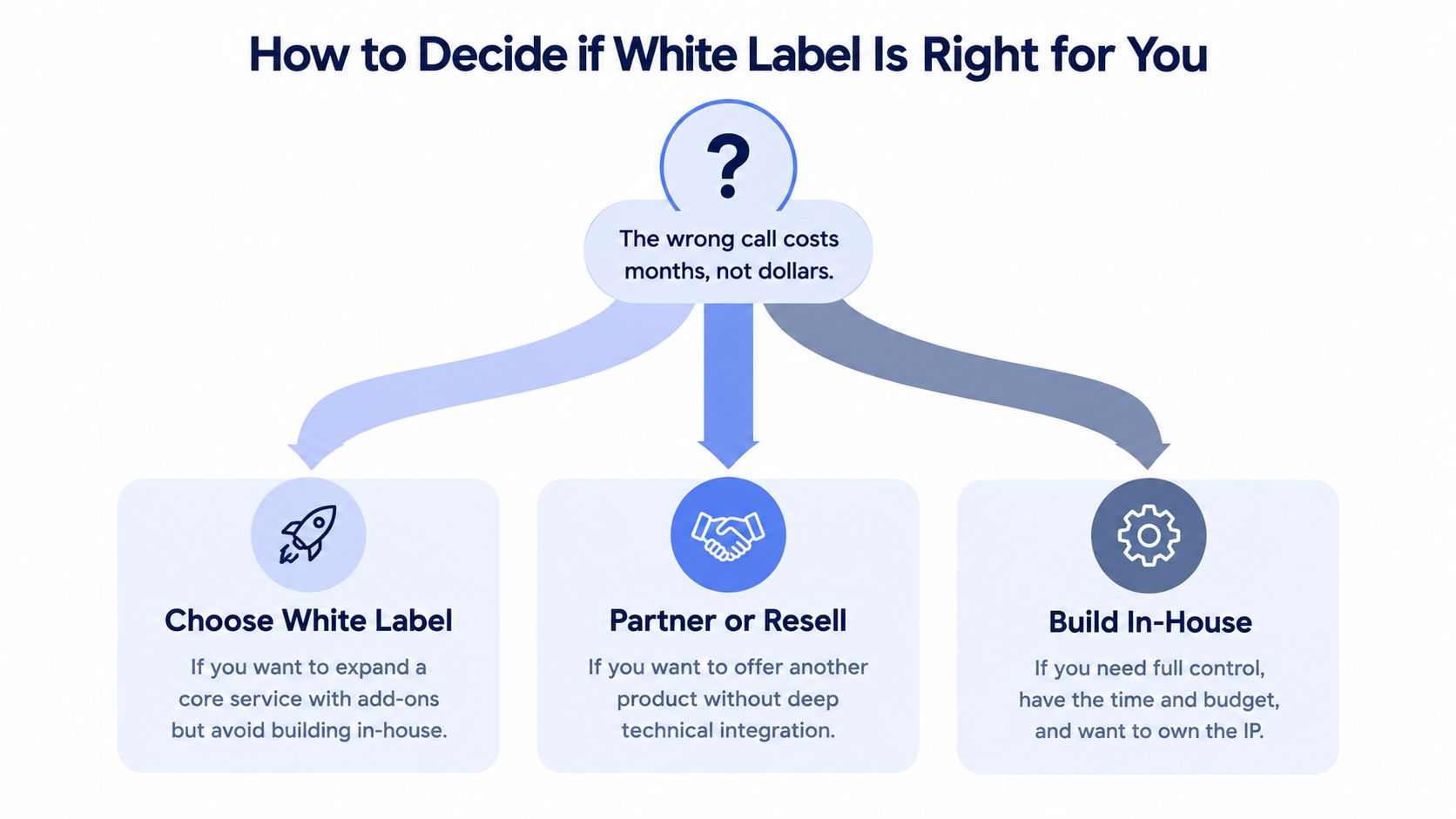 A decision flowchart illustrating when to choose white labeling, partnering, or building a solution in-house.
Choose white label when speed beats control
White label is the sensible default when social publishing supports your main product but doesn't define it. You want the feature in-market quickly, your team has no appetite for babysitting platform reviews and OAuth edge cases, and your users care more that publishing works than who built the backend.
A lot of newer tooling also points in this direction. Some market commentary describes the next generation of white-label products as a mix of model-driven functionality, brand removal, and configurability, especially in AI-native and cloud multi-tenant products, which is the framing discussed in this white-label tools overview.
One factual example in this category is PostPulse. It offers a branded social publishing layer for apps, automations, and AI agents through a single integration surface, including REST API, automation nodes, and an MCP server, while keeping the user-facing experience under the partner's brand.
Choose private label when differentiation matters
Private label is the better route when your value depends on workflow differences the vendor won't build for everyone else. If your scheduling logic, analytics model, approval flow, or vertical-specific UX is the reason customers buy, a more specific arrangement matters.
The tell that you picked wrong is constant frustration with vendor roadmap gaps. If every strategic request turns into a workaround, you didn't buy enough control.
Build in-house when social is the product
Build it yourself when the publishing and integration layer is your core IP. That usually means the product itself lives or dies on its social feature set, enterprise clients need deep assurance around how the full stack is handled, or your team is staffed to maintain platform integrations as a permanent function.
The tell that you picked wrong is simple. If you keep saying “we could have shipped three other customer-facing features by now,” you probably shouldn't have built it from scratch.
For most app developers, no-code builders, and AI agent teams entering social publishing, white label is the safer default. Not because it's glamorous. Because it keeps platform maintenance from becoming the company you accidentally started.
Quick Answers Before You Start
How is white-label pricing usually structured
Usually some mix of platform fee, per-seat or per-account pricing, usage-based billing, or revenue share. The inconvenient part is overages, so ask what triggers them and whether “connected” accounts are billed differently from active ones. If the pricing model is hard to simulate on your own customer base, assume margin surprises later.
What contract terms matter most
Check term length, termination rights, customer-data ownership, support obligations, and SLA language first. Make sure the contract says what happens to user data and tokens at exit, not just during normal operation. If those clauses are vague, the rest of the deal details don't matter much.
How deep can the rebrand go
Sometimes it's only logo and color swaps. Better implementations let you skin email templates, auth touchpoints, admin views, error states, and custom domains so the experience stays coherent when something breaks. Ask for screenshots of failure states, not just polished dashboards.
What does exiting look like
Teams get trapped. Data export is one thing. Token portability is harder, and in many setups you should assume auth connections will need some level of reconnection or migration planning. Get the export format, shutdown timeline, and post-termination support terms in writing before launch.
PostPulse is one option if you want to add social publishing without building nine separate integrations yourself. It gives apps, automations, and AI agents one integration surface for publishing, and it can be white-labeled so users stay inside your brand experience. If that's the problem you're trying to solve, take a look at PostPulse.
About the Author

Founder of PostPulse — a social media scheduling platform for creators and teams. Software engineer with a passion for building developer tools and simplifying complex API integrations across social media platforms.