
How to White Label an App: A Developer's Technical Guide
Published on · Updated on
Tags:
Your token expires after an hour. A carousel container stays “in progress” with no useful error. One platform changes an endpoint, another introduces a new review requirement, and your team spends the sprint maintaining integrations instead of improving the product. That's the point where how to white label an app stops being a branding question and becomes an infrastructure decision.
A white-label app uses a pre-built application or shared software platform that another company rebrands for its own customers. The buyer controls the customer relationship and product presentation, while the provider maintains the underlying technology. In social publishing, that separation can prevent every reseller or SaaS team from building its own OAuth flows, token storage, rate-limit handling, publishing queues, and platform-specific adapters.
The commercial case is substantial. The white-label SaaS market was estimated at $235.9 billion in 2025 and projected to reach $278.0 billion in 2026, implying a 16.2% CAGR, according to the 2026 white-label SaaS market report. Those figures don't prove that every app should be white-labeled, but they do show that the model has moved beyond a narrow agency tactic.
Table of Contents
Why Building Social Integrations From Scratch Fails
Most integration projects begin reasonably. You connect one platform, implement authorization, publish a post, and move on. Then the second platform needs a different consent flow. The third uses another token model. A fourth reports publishing status asynchronously, so your application needs a queue, polling logic, retries, and reconciliation.
The first failure usually isn't the API call itself. It's the operational surface around the call.
A developer may start the morning debugging an expired access token and end it investigating why a media container never reached a terminal state. Meanwhile, product requirements keep growing. Customers want branded login, custom domains, account switching, scheduled publishing, analytics, permissions, and useful error messages. Each feature multiplies the number of platform-specific paths your team has to test.
The maintenance burden hides in the edges
A social integration has several layers that users never see:
Authorization: Consent screens, redirect URIs, scopes, account selection, and revoked permissions.
Credential lifecycle: Short-lived tokens, refresh tokens, expiration handling, encryption, and disconnect flows.
Publishing state: Uploads, processing, retries, partial failures, duplicate prevention, and final status.
Platform policy: App review, approved products, account eligibility, and changing API requirements.
Operations: Rate limits, observability, support tooling, audit logs, and tenant isolation.
The API documentation tells you how to make a request. Production tells you what happens when the request succeeds but the downstream job fails, when the user revokes access, or when two workers retry the same publication.
Practical rule: Treat every external platform as an unreliable dependency, even when its API looks simple in development.
That maintenance work is why white-labeling often makes sense for social publishing products. A specialized provider can maintain the shared integration layer while you focus on your interface, workflows, customer ownership, and distribution. The broader software development outsourcing market was estimated at $618.38 billion in 2026 and forecast to reach $977.04 billion by 2031, with a 9.6% CAGR, as reported in the software development outsourcing market overview. White-labeling is a more structured version of that idea. You're buying a maintained capability instead of assembling every engineering function internally.
When building in-house still wins
In-house development can be the right choice when your product needs unusual platform behavior, exclusive ownership of the integration code, or a deeply customized publishing workflow. It also gives you direct control over incident response and roadmap priorities. The trade-off is that your team becomes responsible for every platform change and every customer-facing failure.
A white-label provider becomes more attractive when repeated integration work is expensive and your differentiation sits elsewhere. The industry case is strongest when you can monetize a shared codebase while investing your own effort in brand, distribution, customer relationships, and domain-specific workflows. For a broader discussion of ways to build a mobile app faster in 2026, compare the provider's ownership and customization terms carefully rather than assuming every white-label product has the same architecture.
Technical Integration Layer and OAuth Token Management
The integration layer should make platform differences invisible to your customers without hiding them from your operations team. That requires a deliberate separation between your branded application and the provider's connector services.
Start with a tenant-aware authorization flow. Your application should know which tenant initiated the connection, which user owns the connection, what platform is being connected, and which redirect destination is valid. Store a signed state value with the authorization request, validate it on callback, and reject callbacks that don't match the expected tenant and user context.
Build the flow around token states
Don't model a connection as “connected” or “disconnected.” Use explicit states such as authorization pending, active, refresh required, revoked, failed, and disconnected. Your database should store encrypted credentials or provider references, expiration metadata where available, granted scopes, platform account identifiers, and the last successful API activity.
Token refresh belongs in a controlled service, not inside arbitrary request handlers. A publishing request should ask the token service for a usable credential. If the credential is near expiration, the service refreshes it, updates the record atomically, and returns the current value. Concurrent refreshes need locking or an equivalent coordination mechanism, otherwise two workers can overwrite each other or trigger avoidable failures.
Meta's default token behavior is a common source of confusion, particularly when developers test with a short-lived token and assume the same credential will work indefinitely. Use the platform's documented exchange process for the token type your product requires, then make expiration and revocation visible in your support console. For a focused implementation reference, keep Meta's OAuth token lifecycle guide beside your authorization code.
The same discipline applies to other platforms. LinkedIn documents rate limits over a 24-hour period, with resets at midnight UTC, and separates application-level and member-level usage counters in its official rate-limit documentation. Don't put one global throttle in front of every customer. Track usage by platform, application, member, tenant, and endpoint where the provider exposes those dimensions.
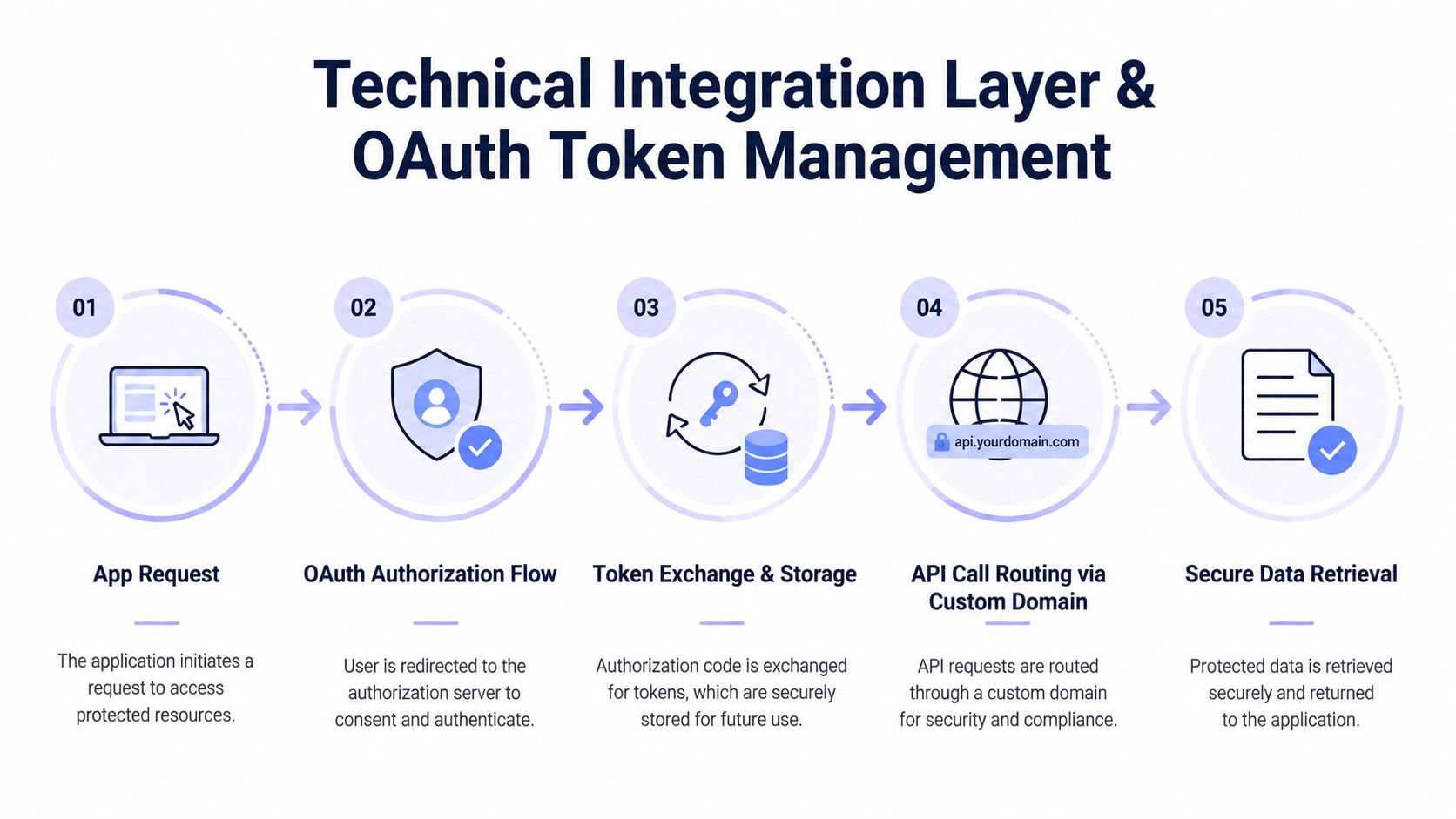 A five-step technical integration diagram illustrating the secure OAuth token management and API call routing flow.
Route through a stable product interface
Your frontend should call your own stable endpoints, not expose platform-specific routes directly. A useful internal shape might include:
Create an authorization session.
Complete the callback and persist the connection.
Validate media and permissions.
Enqueue a publication.
Report normalized status and platform-specific diagnostics.
Use an adapter per platform behind that interface. The adapter translates your canonical publication model into the destination format, while the queue and status model remain shared. This keeps your product contract stable when one provider changes an endpoint.
For example, YouTube's official OAuth documentation specifies that a refresh token is exchanged through an HTTPS POST to https://oauth2.googleapis.com/token, including grant_type=refresh_token and the refresh token returned during authorization-code exchange. Implement the documented request rather than copying a generic OAuth example, and review API integration guidance for founders when defining ownership between your application and the integration provider.
Custom domains should terminate at the branded application layer. The browser should remain on your domain while your backend routes authenticated requests to the integration service. Keep secrets server-side, validate webhook signatures according to each provider's documentation, make webhook processing idempotent, and record the raw event alongside the normalized status. That combination gives users a clean branded experience without sacrificing the evidence your support team needs.
Multi-Tenant Architecture Decisions That Actually Scale
The most expensive white-label mistake is creating a separate application pipeline for every client. It feels safe because each customer appears isolated, but it duplicates deployment logic, integration configuration, monitoring, migrations, and incident response. A new platform change then becomes a rollout across every codebase.
The scalable alternative is shared infrastructure with tenant-specific configuration. Each tenant receives a branded experience, but the core services remain common. The tenant record controls appearance, domains, feature flags, connected accounts, billing rules, support contacts, and policy settings. The application code doesn't fork just because a logo or color changes.
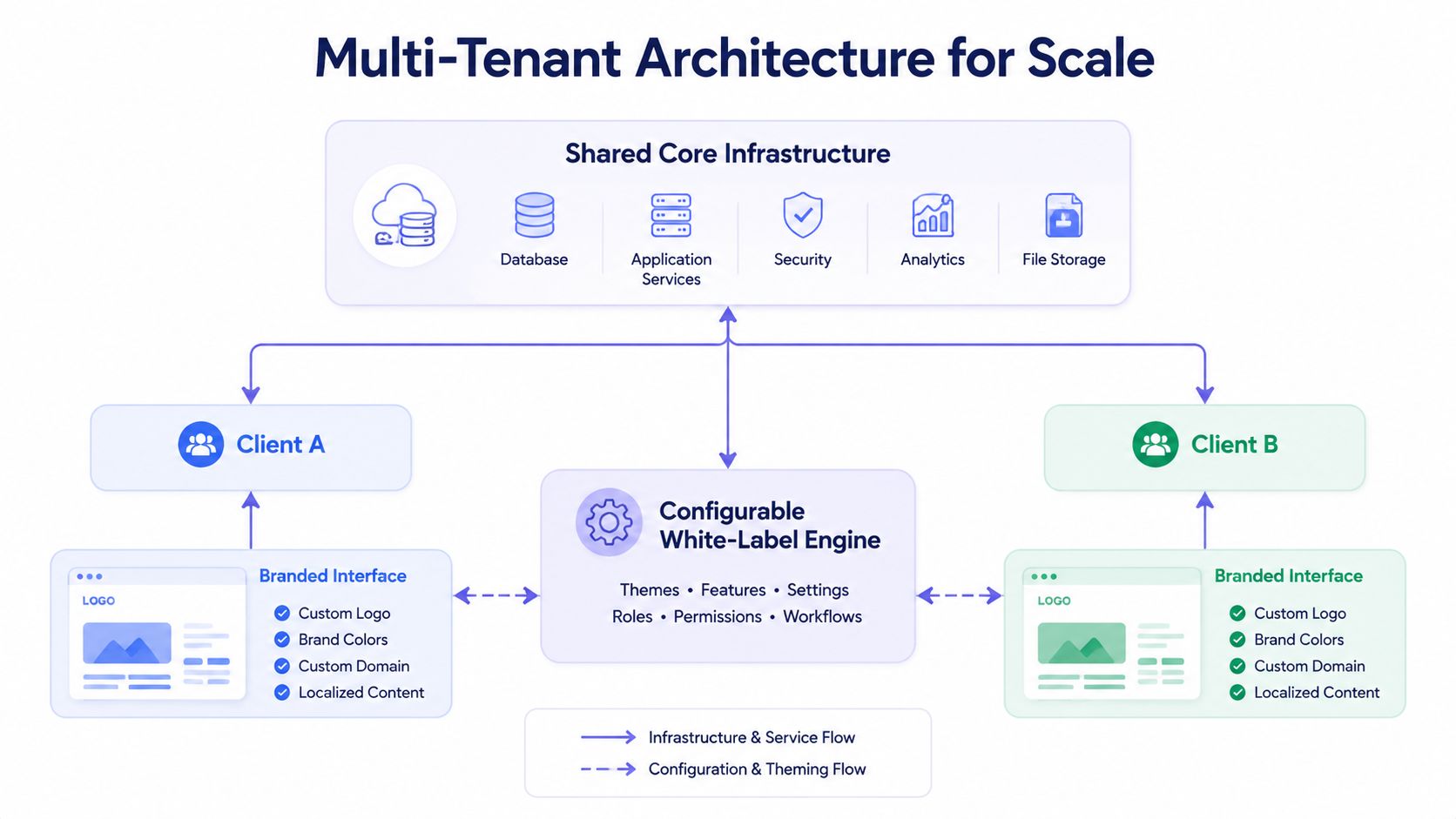 A diagram illustrating a multi-tenant software architecture using a shared core infrastructure with white-label configuration engines.
Configuration should replace custom code
Use a tenant configuration service that returns a validated, versioned configuration object. It can include:
Branding: Logos, colors, typography, favicon, email identity, and help links.
Capabilities: Enabled platforms, scheduling, analytics, team roles, and content rules.
Routing: Custom domain, callback destinations, webhook targets, and environment.
Commercial terms: Subscription status, usage limits, active-account rules, and renewal owner.
Support metadata: Escalation path, service tier, customer administrator, and incident contacts.
The configuration must be safe to change. Validate it before activation, keep an audit history, and separate tenant data from provider credentials. A brand update shouldn't require a deployment, but a dangerous permission change shouldn't become live without review.
The same principle applies to publishing templates. Independent guidance on white-label reporting systems warns that separate pipelines create a growing maintenance burden because each client needs rebuilt connections, transformations, and validation rules. The modular white-label reporting architecture guidance recommends configurable templates rather than client-specific codebases, and it correctly prioritizes reliable data over visual polish.
Isolate data without multiplying services
Shared infrastructure doesn't mean careless sharing. Every request should carry a tenant identifier established by trusted authentication context, not by a user-supplied parameter alone. Enforce tenant scope in service methods, database queries, object storage paths, cache keys, background jobs, and logs.
A practical event record might include tenant ID, user ID, platform, destination account, publication ID, action, status, error category, and timestamps. That lets you answer operational questions such as:
Which tenants have activated at least one connection?
How many publications were accepted, completed, retried, or rejected?
Which customers are accumulating authentication failures?
Which integration errors are increasing across tenants?
Is usage growing in a way that changes support or billing requirements?
Monitor at both aggregate and tenant level. Aggregate metrics reveal system health. Tenant-level metrics reveal customer impact and support urgency. Avoid exposing internal workspaces directly to customers, since that creates unnecessary data-leak and confusion risks. Give each tenant a purpose-built interface backed by the same core services.
You can also separate noisy or high-risk tenants through queues, concurrency controls, or service quotas without maintaining entirely separate products. The architecture described in this multi-tenant architecture reference is useful for thinking about that boundary: share the platform primitives, isolate tenant context, and make exceptions explicit rather than letting custom forks spread.
Pricing Models and Usage-Based Economics
Pricing determines whether a white-label integration remains healthy after customers connect more accounts and publish more content. A fixed license is easy to explain, but it can become unprofitable when support, API usage, storage, compliance work, and integration complexity rise with adoption. Usage-based billing is more closely aligned with cost, though it introduces measurement and forecasting questions.
Model | Structure | Best For | Trade-offs |
Pay-as-you-go per publication | Charge for each accepted or completed publication | Customers with irregular publishing volume | Simple alignment with usage, but revenue can vary and retries need clear billing rules |
Subscription per connected account | Charge for each connected social account | Products where account management is the main value | Predictable revenue, but idle accounts can create disputes unless “active” is defined |
Platform fee with usage tiers | Charge a base fee plus usage bands | Agencies and SaaS products with varied customer sizes | Supports margin planning, but tier boundaries need transparent upgrade behavior |
Fixed license | Charge a recurring or one-time platform fee | Stable, predictable programs with controlled usage | Easy budgeting, but the provider carries more variable infrastructure and support cost |
Define the billable event
“Active account” must have a precise definition. It could mean an account connected during the billing period, an account that successfully publishes, or an account that consumes a paid feature. Those definitions have very different economics. If idle connections are billed, customers may disconnect accounts they aren't currently using. If only successful publications count, failed attempts and support costs need another treatment.
A good billing model records the event that created the charge and preserves an audit trail. For publications, distinguish between an accepted job, a successful downstream publication, a retry, and a duplicate prevented by idempotency. Decide whether a retry is billable before customers encounter it.
Match the model to the customer
Usage-based pricing works well when customer volume varies widely or when your infrastructure cost follows activity. Account-based pricing fits products where connected destinations require meaningful credential, monitoring, and support work even when the customer publishes infrequently. A platform fee can protect the economics of a reseller relationship while usage tiers preserve a connection between customer value and cost.
Market coverage also points to a shift toward usage-based and value-based pricing, while identifying integration complexity as a major delay factor and AI, no-code, and API-first capabilities as standard expectations. The white-label CRM market guide supports a practical conclusion: don't choose pricing in isolation from architecture. If every additional tenant requires manual integration work, a low platform fee can turn growth into a support liability.
Implementing White-Label With PostPulse
A concrete implementation starts by deciding what your users should experience. They should enter your branded application, authorize their social accounts through your interface, and receive publishing status without being redirected into an unrelated product. The provider should remain behind your product boundary.
PostPulse is one example of a social publishing platform that supports a white-label flow through a unified API. Its documented product positioning covers Instagram, TikTok, YouTube, LinkedIn, X, Threads, Bluesky, Facebook, Telegram, and Pinterest through one integration surface. Treat that list as a capability to verify against your own account types, media requirements, scopes, and customer use cases before launch.
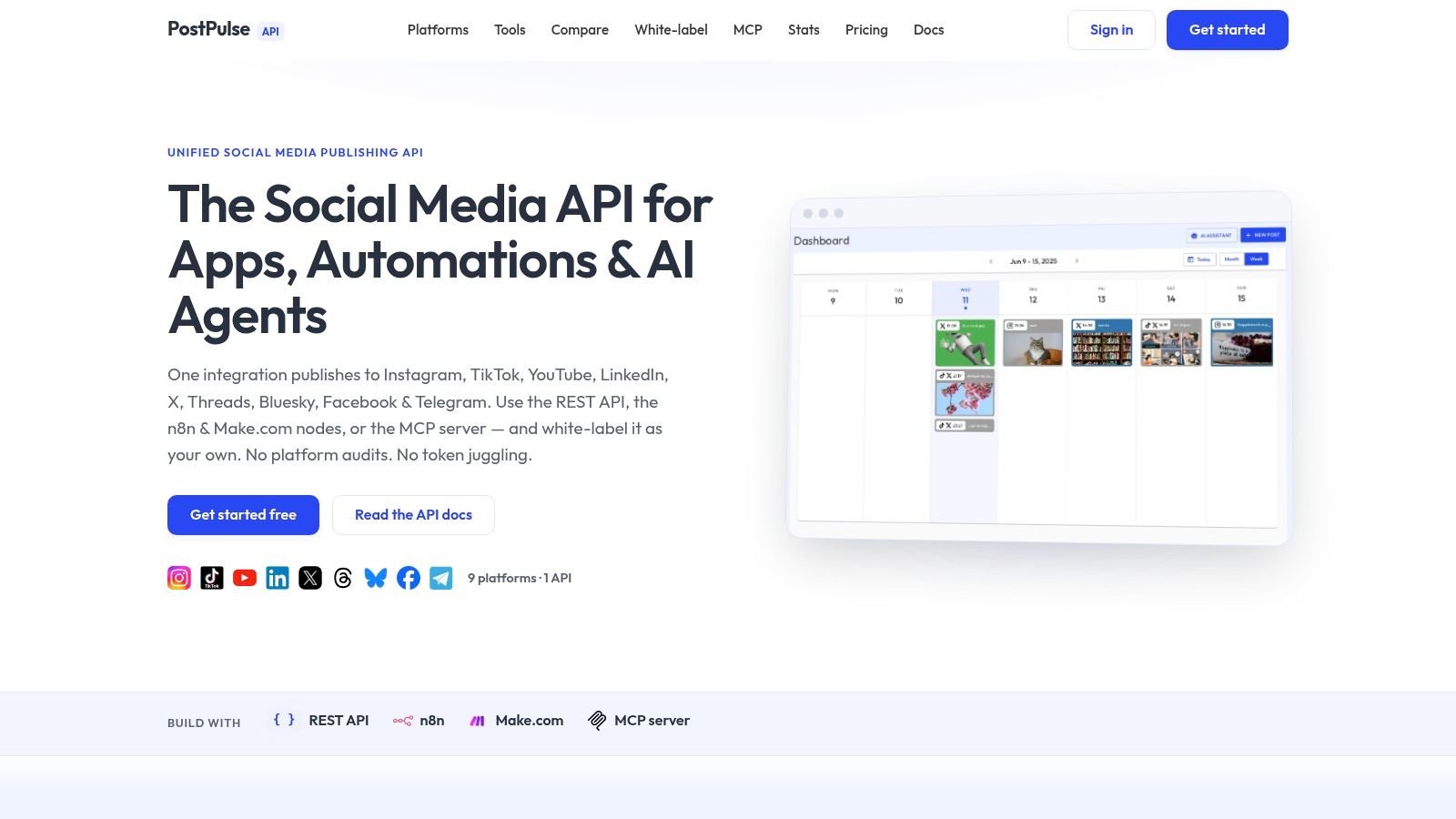 Screenshot from https://post-pulse.com
Configure the branded connection flow
Begin with a tenant record and a branded domain mapping. Store the tenant's display name, visual identity, callback configuration, enabled platforms, and support contact. Your backend should create a connection session for the authenticated tenant user, then return the authorization URL or embedded connection context to your frontend.
The callback handler must validate state, identify the tenant, and persist the resulting connection under the correct user and workspace. Never trust a tenant identifier supplied only by the browser. After connection, show normalized account information while preserving the provider's platform identifier internally for publishing and reconciliation.
Your application can then expose a canonical publication endpoint. A request might contain tenant context, destination account IDs, media references, caption text, scheduling information, and an idempotency key. The routing service maps that request to the appropriate platform adapter, queues the work, and returns a stable publication ID that your UI can poll or receive through a webhook.
For implementation patterns, use PostPulse integration guides alongside the provider's API documentation. The important design decision isn't the exact endpoint name. It's keeping your product's request and status model stable while the integration layer handles platform-specific behavior.
The following walkthrough shows how the flow should feel operationally. A user connects an account, your backend records the connection state, the user submits content, a worker validates the destination and credentials, and the status service translates provider events into states your interface understands. Errors should tell the user what action to take, while your logs retain the provider response and correlation identifiers needed for support.
PostPulse's stated integration model provides a single REST API, official n8n and Make.com options, and an MCP server for AI-agent workflows. It also describes handling OAuth, refresh behavior, rate limits, and API changes within the integration service. Those claims should still be tested against your required platforms and compliance obligations, especially if your product promises a specific publishing guarantee.
For commercial planning, the published private-label options include $0.20 per publication with no subscription and $5 per account per month, or $48 per year per account, while the white-label option includes a $200 per month platform fee plus $1 per active social account. The source defines an active account as one that publishes at least one post during that month, with connected but idle accounts free. Confirm current terms directly before committing them to customer contracts. The startup support program states that fees can be waived until launch while a product remains in development or beta, with arrangements discussed individually.
Launch Operations and Avoiding App Store Rejection
A branded interface doesn't automatically create a launch-ready product. App-store ownership, legal responsibility, support boundaries, and review metadata can block release even when the underlying application works correctly.
Clone-like white-label apps can be flagged for duplicity, and Apple requires submission from the developer's own Apple Developer account, according to recent guidance on white-label and native apps. Decide early who owns the store listing, signing credentials, metadata, privacy disclosures, support URL, and customer-facing terms. “We'll sort that out before submission” is how launch dates become technical debt.
Make ownership explicit
Your reseller or partner agreement should define who owns the customer relationship, who handles first-line support, who pays for platform usage, who approves feature requests, and who controls renewal. It should also explain what happens when a tenant leaves, a connected account is revoked, or a platform changes its rules.
Use a launch checklist that mirrors the operating model.
Legal and reseller agreements: Document branding rights, data responsibilities, support boundaries, renewal ownership, and termination handling.
Support channel setup: Give customers a clear route for authentication failures, publishing errors, billing questions, and urgent incidents.
App-store submission and metadata: Assign the developer account owner, prepare accurate descriptions, and ensure the branded experience isn't presented as a misleading clone.
Brand consistency review: Check login, authorization, emails, error screens, help content, notification text, and store assets.
Post-launch monitoring: Track activations, executions, errors, usage trends, revoked credentials, queue delays, and tenant-specific failures.
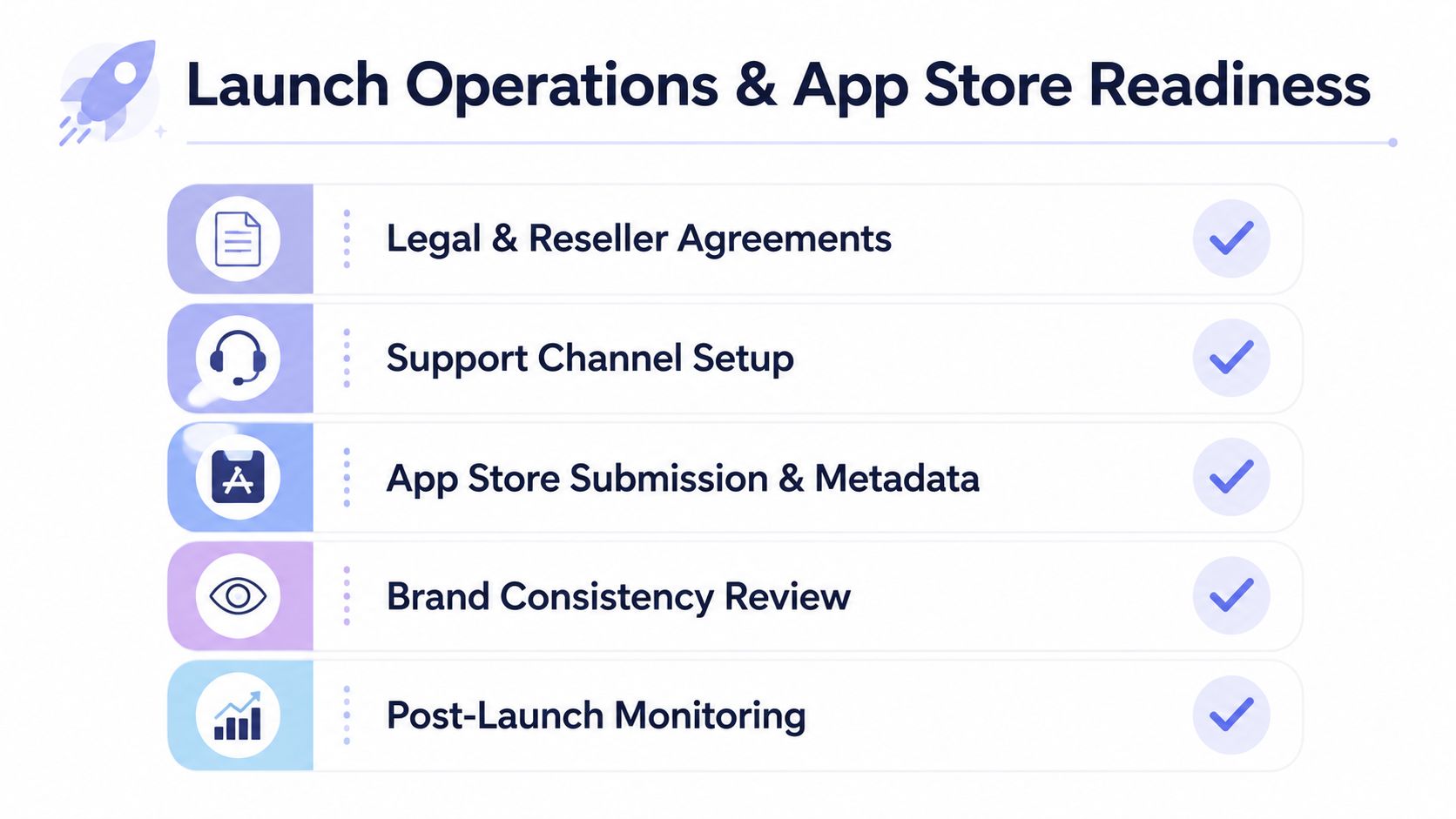 A checklist infographic titled Launch Operations and App Store Readiness, highlighting five essential steps for app distribution.
Run a controlled partner launch before opening the program widely. Provision a small cohort, observe connection completion, test revocation and retry paths, validate billing events, and confirm that support staff can identify tenant context without accessing unrelated customer data. This staged approach addresses the recurring failure modes of over-customization, unclear expectations, weak integration planning, and unreliable reporting.
PostPulse gives app developers a branded social publishing layer with OAuth connections, API-based publishing, and support for ten social platforms without exposing its brand to your users. If you're replacing separate social integrations with a multi-tenant, usage-aware architecture, visit PostPulse to review the white-label setup and decide whether it fits your launch model.
About the Author

Founder of PostPulse — a social media scheduling platform for creators and teams. Software engineer with a passion for building developer tools and simplifying complex API integrations across social media platforms.