What Is Shadow Banned: A Developer Guide
Published on
Tags:
Your publishing request succeeds, the media container processes, and the post appears on the profile. Then your dashboard reports no meaningful discovery traffic from people who don't already follow the account. The API says everything worked, but distribution says otherwise. That gap is where developers start asking, “What is shadow banned?”
The useful answer isn't a conspiracy theory or a universal platform switch. A shadow ban is a suspected or documented reduction in visibility that leaves content technically published while limiting its appearance in feeds, search, replies, hashtags, or recommendations. For an integration, the important question is not whether a post exists. It's which distribution surfaces accepted it, which rejected it, and why.
Table of Contents
The 200 Response With Zero Reach
A successful publish request proves that the platform accepted an operation. It doesn't prove that recommendation systems will show the resulting post to non-followers.
That distinction matters in automated workflows. Your application can receive a successful response, store the post ID, and display a live profile URL while the platform separately decides that the content isn't eligible for Explore, For You, search, or other discovery surfaces. The creator sees a normal post. Followers may still find it. Everyone else encounters nothing.
Shadow banning is a form of covert or low-transparency content moderation in which a platform reduces the visibility of a user, post, reply, or profile without fully removing it or clearly notifying the creator. The academic literature describes the concept as a reduction in discoverability rather than a complete deletion, including interventions that demote content in rankings, recommendations, replies, or feeds (research on shadow banning and visibility moderation).
The state your API doesn't expose
A typical publishing pipeline models a post as something like created, processing, published, or failed. Recommendation systems introduce another state that many APIs don't expose cleanly: published but distribution-limited.
That state can affect one post, a content category, an audience segment, or a particular surface. A post may remain available through the author's profile while receiving little recommendation traffic. This is why an impressions report such as how Instagram impressions work needs surface-level context rather than a single reach total.
Platforms have practical reasons to prefer distribution controls over immediate deletion. They can keep borderline or low-quality material off recommendation surfaces without removing every copy from the author's profile. They can also apply different standards to followers, search users, recommendation audiences, and younger viewers.
What this means for publishing systems
Treat successful publication and successful discovery as separate events. Store the post identifier, publication timestamp, processing outcome, policy notices, audience eligibility, and impressions by surface where the platform provides them.
Practical rule: A live URL confirms availability. It doesn't confirm recommendation eligibility.
The phrase “shadow ban” is still useful when a creator describes the symptom, but it isn't a standardized technical status. Your system should translate that symptom into testable questions: did search visibility change, did non-follower delivery disappear, did an account-status warning appear, or did ordinary ranking become less favorable?
Visibility Moderation Versus Account Suspension
An account suspension is a hard enforcement state. The user may lose the ability to publish, authenticate, or access platform functions. Visibility moderation is softer and harder to observe. The account remains active, publishing may succeed, and the content remains on the profile, but recommendation systems reduce its chance of reaching new viewers.
Shadow banning is best understood as visibility moderation, not necessarily account suspension: content remains published on the author's profile but is selectively excluded or down-ranked in discovery surfaces such as feeds, search, hashtags, or recommendations (Yale analysis of visibility moderation).
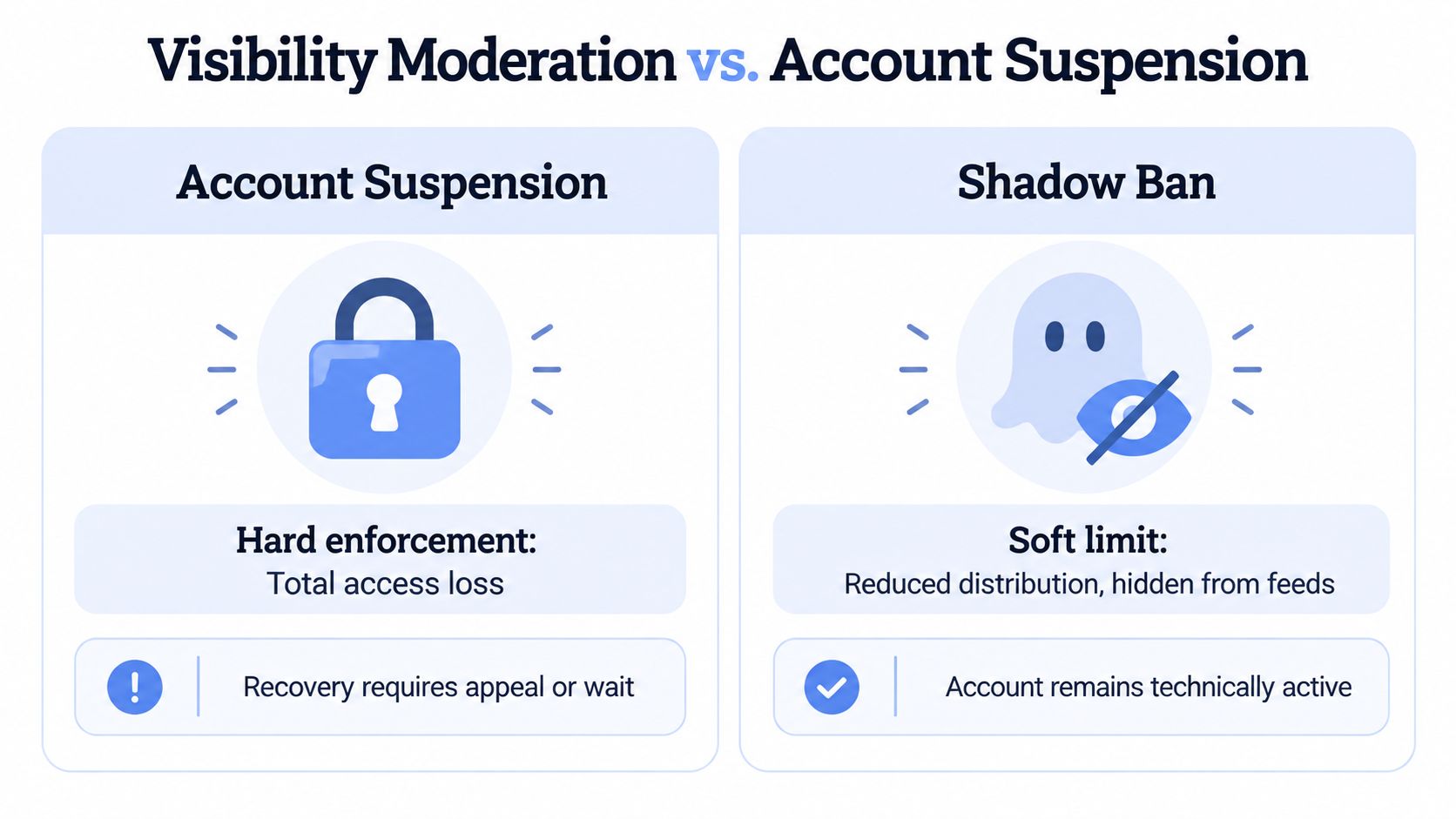 A comparison infographic between account suspension as a hard enforcement and shadow ban as a soft limit.
Map product states instead of labels
Your error handling should reflect evidence, not the user's chosen label.
Observed state | What it can mean | Engineering response |
Publish request fails | Authentication, validation, permissions, or platform enforcement problem | Record the error, preserve the request payload, and surface remediation |
Content is removed | A post-level policy or integrity action occurred | Store the notice and expose appeal information where available |
Content stays on the profile but discovery falls | Recommendation ineligibility, search filtering, ranking change, or audience mismatch | Compare distribution surfaces and account status |
Followers see content but non-followers don't | Recommendation or discovery limitation, or normal audience ranking | Compare follower delivery with non-follower reach |
One post underperforms | Content-level ranking variance is possible | Don't infer an account-wide restriction |
A platform may call these states recommendation ineligibility, reduced distribution, reply downranking, or search filtering. Those terms are more useful than “shadow ban” because they point toward a specific surface and an observable mechanism.
The same distinction helps when investigating community platforms. A practical guide to shadow banned Reddit comments is useful because comment visibility can differ between the author, moderators, followers, and ordinary readers. The diagnostic principle carries across systems: confirm who can see the object and through which route.
Account suspension and visibility moderation also demand different user experiences. A suspension workflow should explain access loss and recovery options. A visibility workflow should show eligibility, affected surfaces, notices, and comparison data. Your social media compliance workflow should preserve both paths rather than treating every distribution complaint as an authentication failure.
The critical limitation is that a reach decline alone can't prove intentional covert moderation. Audience interest, timing, competition, content eligibility, ranking predictions, and viewer settings can produce the same output. A reliable integration records the evidence needed to separate those possibilities.
How Major Platforms Handle Recommendation Eligibility
A post can return a successful publish response, remain visible on its profile, and still receive little or no recommendation traffic. Major platforms generally describe that state through eligibility, ranking, search quality, account status, and distribution controls rather than the phrase “shadow ban.” An apparent shadow ban often reflects content or account ineligibility for recommendation after policy-sensitive signals, not a complete posting block (TikTok account recommendation guidance).
Platform | Official terminology | Primary trigger |
Meta | Recommendations Guidelines, recommendation eligibility, reduced distribution | Content can remain available while being excluded from recommendations because it is low-quality, sensitive, objectionable, or unsuitable for younger viewers |
TikTok | For You feed eligibility, account not being recommended | Content under review or repeated material unsuitable for the For You feed can reduce appearance in recommendations and search |
X | Search filtering and search-quality enforcement | Duplicate or near-duplicate posts, automated replies, bot-driven keyword posting, and similar messages across accounts |
YouTube | Personalized recommendations, performance and relevance | Viewer-specific ranking signals, audience response, and eligibility for recommendation |
Meta separates publication from discovery
Meta identifies recommendation surfaces such as Instagram Explore, Reels, Suggested For You posts, and suggested accounts. A post may stay available on the service while being excluded from those surfaces. Viewer controls also change what appears, so one account's Explore result cannot establish platform-wide eligibility.
Publishing and discovery require separate fields in an integration. Store the publish result, processing state, recommendation eligibility, and affected surface independently. A system that records only a successful API response cannot explain why a live post stopped reaching non-followers.
TikTok makes the eligibility chain explicit
TikTok states that content under review can become ineligible for the For You feed. Repeatedly posting material unsuitable for that feed can also affect how an account and its posts appear there, while search discovery may become harder. TikTok describes recommendation ranking through user interactions, content information, and user information. Those signals matter only after the content is eligible for recommendation.
The practical sequence is straightforward: a policy or safety classification reduces eligible inventory, reduced eligibility removes recommendation impressions, and fewer impressions limit downstream engagement. This indicates a distribution condition, not a universal penalty timer or one permanent “shadow ban” status.
X focuses on search quality
X documents narrower search restrictions for behaviors that degrade search results. Repeated duplicate links, automated posts or replies, keyword-driven bot activity, and similar messages across accounts can cause posts or accounts to be filtered from search.
X does not publish a fixed threshold, duration, or percentage reduction for these restrictions. Monitoring systems should record the observed surface and behavior instead of assigning an invented rule.
YouTube ranks for each viewer
YouTube describes recommendations as personalized ranking based on signals such as watch history, search history, subscriptions, likes, dislikes, feedback, and satisfaction surveys (YouTube recommendation documentation). Lower Home or Up next exposure can therefore reflect audience relevance or performance rather than an account-level restriction.
Across all four platforms, the implementation task is the same: store the official state available for the affected surface, then compare it with actual discovery data. A successful publish call proves delivery to the platform, not eligibility for every recommendation route.
A Diagnostic Framework for Reach Failures
When someone reports a shadow ban, don't begin by changing hashtags or stopping publication. Begin by creating a reproducible observation.
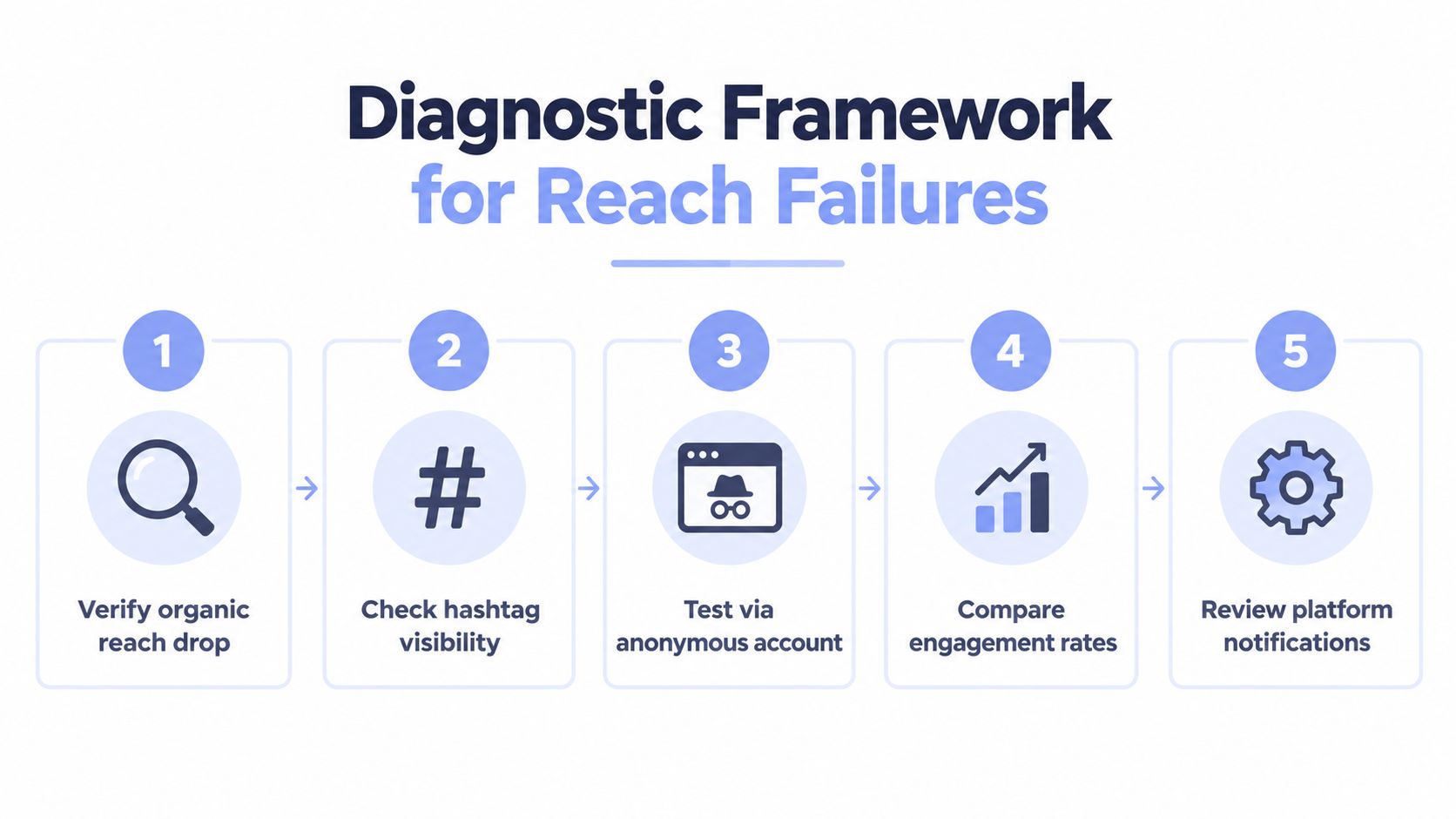 A diagnostic framework infographic showing five numbered steps to troubleshoot organic reach failures on social media platforms.
Capture the baseline
Choose several recent posts that share a comparable format and audience. Record publication status, processing result, account notices, follower delivery, non-follower reach, search appearance, recommendation eligibility, and the affected surface.
Don't use one unusually weak post as proof. Visibility restrictions are stronger candidates when a broad change appears across comparable posts and surfaces.
Test discovery directly
Run controlled checks without treating them as conclusive on their own.
Check the account status. Record any post-level or profile-level recommendation notice, including its date and stated reason.
Compare audiences. Look at follower delivery against non-follower recommendation reach. A sharp separation is more informative than a general fall in impressions.
Test search. Search for an exact phrase, hashtag, or post identifier from an account that isn't the creator. Search results can vary, so repeat the test and record the surface.
Separate surfaces. For You, Explore, Reels, Home, Up next, subscriptions, and search are different systems. A restriction or ranking change on one doesn't prove a platform-wide block.
Preserve evidence. Save screenshots, timestamps, notices, post IDs, content categories, repeated hashtags, automation patterns, and posting cadence.
Interpret the result conservatively
A platform-wide collapse in recommendation reach paired with an eligibility notice is stronger evidence of a visibility restriction than a fall in likes. A clean status screen doesn't prove equal distribution, but it does weaken claims that a documented account-level restriction is active.
Don't call it a shadow ban until you can name the missing surface.
For an engineering dashboard, use explicit labels such as published, removed, recommendation_ineligible, search_filtered, status_unknown, and normal_variance. Keep “shadow ban” as a user-facing search phrase or support category, not as an undocumented API state.
When Algorithmic Volatility Mimics a Penalty
A post can return a successful API response and still lose recommendation reach. That feels punitive because delivery is visible while ranking decisions remain hidden. Personalized systems can change distribution without applying an enforcement action to the creator.
YouTube describes recommendation as an ongoing learning process built from many signals and pieces of information, as noted earlier. The operational consequence matters more than the exact figure: two viewers can receive different recommendations for the same video. A lower impression count alone does not establish that the account has been hidden.
Audience controls change the result
Meta's systems also depend on viewer settings. Instagram Reels, Explore, and Facebook Feed help people discover accounts they do not follow, while recommendation guidelines exclude some sensitive or objectionable material even when it does not warrant removal. Sensitive Content Control can reduce how much sensitive content a viewer sees. Teen accounts use stricter defaults, and younger users may need parental permission to change them (Meta's age-appropriate content policy).
One tester's feed therefore provides weak evidence. A post can remain eligible for one audience and absent from another because age settings, sensitivity controls, and recommendation eligibility differ.
Use competing explanations
Before escalating a suspected restriction, test explanations that fit the same symptom:
Audience mismatch: The content changed, but the existing audience did not respond to it.
Ranking variance: Early viewers generated weaker satisfaction or interaction signals.
Surface change: Home, search, recommendations, and subscriptions use different delivery behavior.
Viewer filtering: Age or sensitivity settings reduced exposure for part of the audience.
Eligibility reduction: The account or post received a documented recommendation limitation.
Treat these as competing hypotheses, not proof of intent. Your analytics product should avoid converting every decline into a moderation alert. Show the affected surface, comparison period, and available evidence. A useful report can state that non-follower recommendation reach declined while follower delivery remained stable. It should leave the hidden cause unresolved unless the platform documents an eligibility change. That distinction keeps algorithmic volatility separate from an actual visibility restriction.
Automated Publishing and Search Quality Filters
Automation doesn't automatically equal abuse. The risk comes from repetitive behavior that resembles low-quality or coordinated activity, especially when an application publishes the same material across accounts or generates replies from keyword triggers.
X provides a concrete example. Its search policy says the platform may filter accounts from search for repeatedly posting duplicate or near-duplicate links or posts, sending automated posts or replies, using bots or applications to post similar messages based on keywords, and posting similar messages across multiple accounts (X search policies).
 A robotic arm sorts various digital content types through a Quality Filter net, producing high-quality output.
Design for variation and observability
A resilient publisher should keep content provenance and delivery context. Store the source item, destination account, generated text, media reference, publication time, and response. If several accounts receive effectively identical messages, you need to know that before a support complaint arrives.
The safe engineering response isn't to promise that a verified application guarantees reach. Official integration status and recommendation eligibility are separate concerns. Instead, reduce repetitive patterns where the platform's rules explicitly identify them, and make every automated action auditable.
Useful controls include:
Duplicate detection: Compare text, links, media, and reply templates before delivery.
Cadence visibility: Record publishing intervals and burst patterns for each account.
Reply review: Treat automated replies as a higher-risk workflow than scheduled original posts.
Surface monitoring: Watch search discovery separately from profile availability.
User controls: Let account owners pause a campaign without deleting queued work.
A publishing platform such as automated social media posting infrastructure can simplify token and delivery management, but no integration layer can guarantee recommendation placement. The application still needs a policy-aware content model and a way to distinguish an API failure from a distribution decision.
Avoid unsupported thresholds
Don't tell users that a specific number of repeated posts creates a restriction unless the platform publishes that threshold. X's documentation identifies behaviors and possible actions, but it doesn't provide a universal cutoff or fixed recovery duration.
That uncertainty is a product requirement. Use “possible search filtering” when evidence is incomplete, show the policy behavior that matches the observation, and avoid claiming that a reach change proves intent.
Recovery Strategies and Long-Term Monitoring
Recovery starts with evidence, not folklore. If the platform shows a recommendation notice, preserve it, review the affected content, and use the available appeal path when the decision appears incorrect. If the account has no notice, don't promise that deleting the app, switching account types, or taking an arbitrary break will restore distribution. Those actions don't test the cause.
Change one variable at a time
Pause the behavior that matches the documented risk. Remove or revise affected content where appropriate, stop duplicate or keyword-driven automation, and avoid launching another burst while the diagnosis is still unclear.
Then use controlled comparisons. Publish materially different content formats, vary the cadence within a normal operating pattern, and compare the same surfaces you measured before. The purpose isn't to “hack” a recommender. It's to discover whether eligibility, content classification, audience fit, or distribution volatility explains the result.
A clean account-status screen also isn't proof that recommendation reach has returned. Record the date of each notice, appeal, status change, and recovery signal. If an appeal doesn't restore distribution, keep that outcome separate from the fact that the account is technically active.
Build monitoring into the pipeline
A durable social integration treats distribution as an observable product metric.
At publication: Store the post ID, processing result, timestamp, destination, and content classification.
After publication: Collect impressions, follower delivery, non-follower delivery, search appearance, and recommendation status where available.
During investigation: Attach screenshots, notices, appeal results, repeated hashtags, automation patterns, and test-account observations.
In the dashboard: Separate confirmed platform notices from inferred reach anomalies.
In support workflows: Give users a concrete explanation of what was tested and what remains unknown.
The outcome you want isn't a magical shadow-ban checker. It's a system that can answer whether content was published, whether it remained accessible, which discovery surface changed, and whether the platform supplied an eligibility explanation.
PostPulse gives apps, automations, and AI agents one publishing layer for Instagram, TikTok, YouTube, LinkedIn, X, Threads, Bluesky, Facebook Pages, and Telegram, with REST API, n8n, Make.com, and MCP options. Use PostPulse to centralize publishing and token maintenance, then pair it with surface-level eligibility and reach monitoring so a successful API response never gets mistaken for guaranteed distribution.
About the Author

Founder of PostPulse — a social media scheduling platform for creators and teams. Software engineer with a passion for building developer tools and simplifying complex API integrations across social media platforms.