
Social Media Compliance: A Developer's Guide
Published on
Tags:
A scheduled sponsored post is sitting in a queue. The worker wakes up, creates an Instagram container, and gets a successful response. Then the account token fails, the container remains unpublishable, and nobody notices until the campaign window has passed. In another queue, an AI-generated reply goes live before a reviewer sees it. The copy doesn't disclose the brand relationship, and the audit trail contains only “published successfully.”
These aren't abstract legal problems. They're token lifecycle bugs, race conditions, missing validation, weak permissions, and incomplete event logging. Social media compliance becomes real inside refresh jobs, approval gates, retry handlers, webhooks, and database schemas.
Table of Contents
The Compliance Headaches Every Developer Actually Faces
Toy integrations usually fail loudly. Production integrations fail in ways that look successful until someone investigates the result.
A token expires while scheduled content remains valid in your database. The queue still contains the post, the worker still runs, and the API client still returns a structured response. If your system doesn't distinguish between “queued,” “submitted,” “processed,” “published,” and “rejected,” operators may see a green job status while the audience sees nothing.
Instagram is a good example of why this happens. Its content-publishing workflow is asynchronous. A container can be IN_PROGRESS, FINISHED, PUBLISHED, or ERROR, and it can become EXPIRED if it isn't published within 24 hours. The official Instagram content-publishing documentation makes the operational requirement clear: container creation isn't the same thing as publication.
Three bug classes appear repeatedly
Credential drift: A user revokes access, an administrator changes permissions, or a refresh path breaks. The scheduler keeps accepting work because it doesn't check account health before enqueueing.
Approval bypasses: An asynchronous worker treats API acceptance as permission to publish. A regulated post, reply, or campaign asset can pass through because the approval state isn't enforced at the final execution boundary.
Disclosure loss: An AI agent drafts sponsored or synthetic content, but the disclosure exists only in an internal prompt, a profile bio, or a field that the destination never renders. The published message lacks the information consumers need to notice and understand the relationship.
The FTC says an unexpected material connection, such as payment, employment, a family relationship, or free products, must be disclosed with the endorsement. Its Disclosures 101 guidance for social media influencers also says the disclosure should be clear, conspicuous, and difficult to miss.
Production rule: A post isn't compliant because the payload contains a disclosure token. It's compliant only when the rendered message presents the disclosure where the audience can see it.
Treat each failure as a software defect with an owner, a test, and an observable state. Legal review still matters, but a policy document won't repair a queue that publishes after approval is revoked.
What Social Media Compliance Really Means
Social media compliance is the intersection of external law, platform policy, and corporate governance. Each layer imposes different conditions, and each leaves different evidence in your codebase.
External law defines obligations that don't disappear when an API changes. In the United States, the FTC expects a material connection between an endorser and a brand to be disclosed with the endorsement, not hidden somewhere users may miss. In the European Union, the Digital Services Act creates duties around illegal content, user appeals, transparency information, and systemic-risk management for covered services. The European Commission says the DSA became broadly applicable on 17 February 2024, with its largest obligations applying to services generally reaching more than 45 million monthly active users in the EU. See the Commission's DSA enforcement overview.
Platform policy is a separate contract. A destination can reject media, require an AI label, restrict an automation scope, or change a review process even when the content is lawful. TikTok's Content Posting API documentation shows why a generic upload function is fragile. Video posting requires an approved video.upload scope, user authorization, an access token, and an Open ID. Local files and remote media use different upload approaches, while photo posts use a different endpoint and request fields.
Corporate governance adds your customer's own controls. A financial client may require human approval for public communications. A healthcare organization may prohibit an AI agent from replying to messages containing sensitive information. A public-sector team may need to preserve records and provide accessible communications. Those requirements belong in policy configuration, not in a developer's memory.
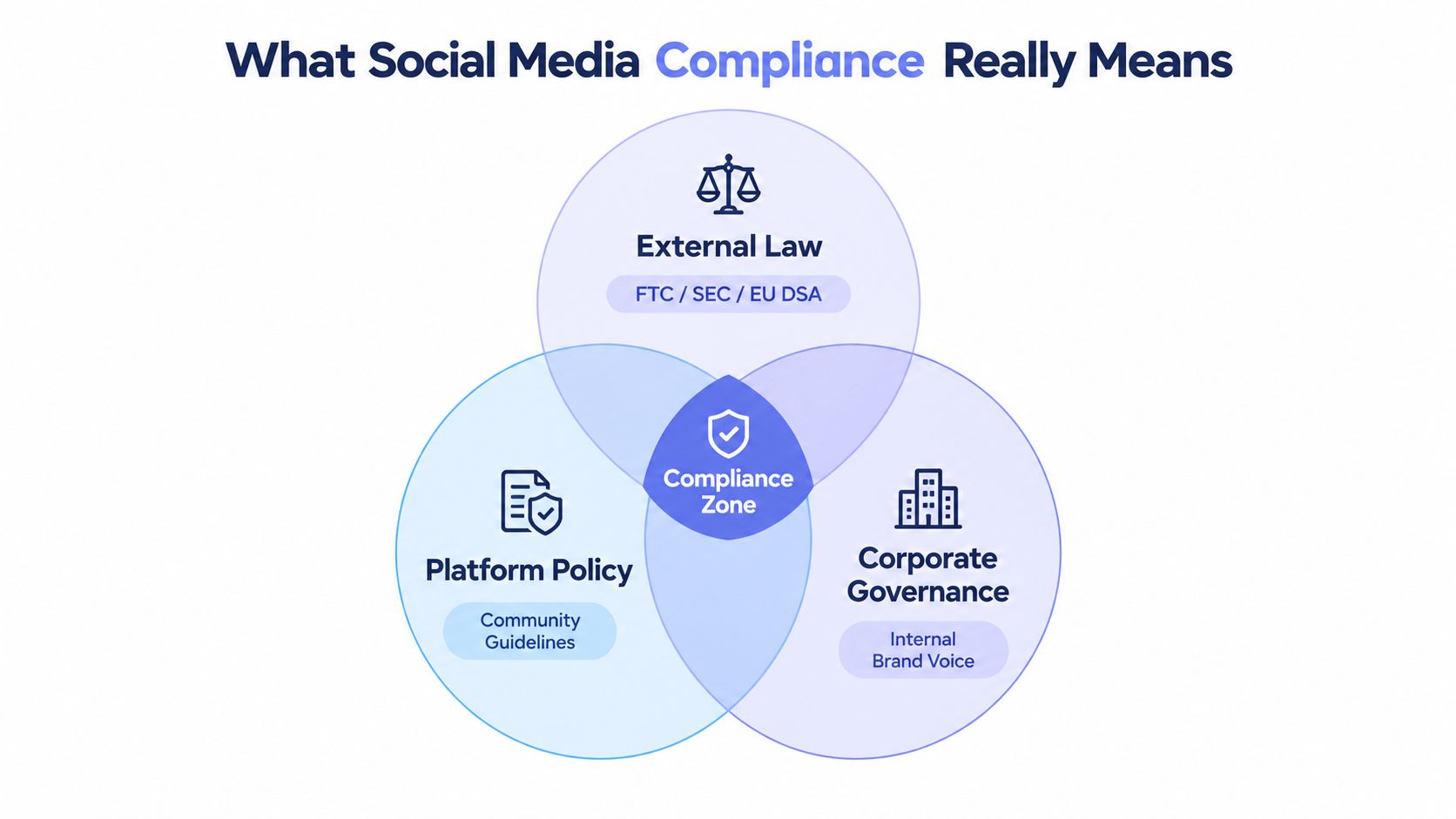 A Venn diagram showing that social media compliance involves external law, platform policy, and corporate governance intersections.
A useful reference for operational policy design is this social media compliance playbook from Advisor Momentum. Use resources like it to identify policy questions, then translate those questions into enforceable states, required fields, and review events.
The publish pipeline should evaluate all three layers before the network request:
Classify the content. Record whether it's organic, sponsored, synthetic, political, regulated, user-generated, or a reply.
Resolve the destination policy. Select rules for the platform, account type, media format, and jurisdiction.
Apply governance gates. Require the right reviewer, disclosure, archive behavior, and escalation path.
Store the decision. Preserve the inputs, policy version, reviewer, rendered content, and platform response.
The common mistake is to build only the first layer. That produces a legally informed workflow that still fails because it can't prove what happened or enforce a platform-specific rule at the last possible moment.
The Laws and Platform Rules That Shape Your Code
Regulatory text becomes useful to engineers only when it becomes a schema, validator, queue decision, or immutable event. A publishing service must enforce the obligation at the point where content, destination, and account state meet.
The Digital Services Act shows why. Covered services must provide transparency information, user appeal mechanisms, and processes for handling systemic risks. Hosting services must notify users when content is removed or restricted and provide specific reasons. Very large online platforms and search engines face additional risk-assessment, audit, and reporting obligations. The Commission's explanation of DSA transparency requirements identifies the records and user-facing events an implementation must support.
The operational volume is substantial. In the first half of 2025, platforms reported more than 9 billion content-moderation decisions under the DSA framework, with 99% taken proactively under their own terms and conditions. EU users appealed more than 165 million moderation decisions made by VLOPs and VLOSEs since 2024, and almost 30% of those appeals resulted in a reversal. The Commission reports these figures in its DSA impact report.
A compliant system therefore preserves the decision context, not just the final post body.
Regulation or Policy | Operational Obligation | System Requirement |
EU Digital Services Act | Transparency, moderation explanations, appeals, and systemic-risk controls | Policy versions, decision reasons, jurisdiction, user notifications, appeal states, and durable event logs |
FTC endorsement guidance | Clear disclosure of an unexpected material connection with an endorsement | Structured sponsorship metadata, rendered-copy validation, and an approval record containing the final disclosure |
Platform content rules | Destination-specific permissions, formats, labels, and upload workflows | Platform adapters, capability checks, scope validation, and separate success states for processing and publication |
AI disclosure requirements | Labels may vary by platform and by whether media is realistic or substantially altered | Media classification, platform-specific disclosure routing, human review for ambiguous cases, and stored platform responses |
The FTC requirement is easy to implement badly. A boolean such as is_sponsored cannot capture the evidence an audit may require. Store the advertiser, relationship, disclosure text, destination, timestamp, final rendered copy, and approver. Validate the disclosure where users will see it. Text hidden by truncation or placed only in a profile biography creates a failed publication record, even if the field exists in your database.
AI-assisted publishing adds destination-specific routing. Meta requires labels for photorealistic AI-generated or altered video and realistic-sounding audio. TikTok requires disclosure for realistic AI images, video, and audio. YouTube requires disclosure for realistic, meaningfully altered, or synthetic content. A universal ai=true flag cannot represent those differences. The analysis of AI disclosure requirements and platform rules describes this divergence and the state-level political disclosure environment.
Model each obligation as a decision with evidence:
Content classification: sponsorship, synthetic media, political content, regulated claim, or ordinary post.
Required action: disclose, block, route to review, archive, or publish.
Evidence: source asset, model or editing steps, policy version, reviewer, and platform result.
Recovery state: rejected, expired, removed, appealed, reversed, or published.
Technical Controls Your Publishing System Needs
A dependable system has four control planes. Build them in the order the production failures usually appear.
Account and token management
Store account identity separately from credentials. Keep scopes, expiry information, refresh status, destination, owner, and last successful use as first-class fields. Encrypt secrets, restrict access to the worker that needs them, and make account health visible before a campaign enters the queue.
A scheduler should ask whether an account is publishable now, not merely whether a token exists. When refresh fails, pause affected jobs, notify an operator, and preserve the failure reason. Don't retry credential failures with the same invalid secret.
YouTube has a different kind of operational trap. Google assigns projects a default quota of 10,000 units per day, while videos.insert costs 1,600 units per call, so the nominal quota supports six full-cost insert calls before the remaining 400 units are insufficient for another insert. Google also says invalid requests consume quota, each request costs at least one unit, and quotas reset at midnight Pacific Time. The YouTube quota-cost documentation should shape your admission control and retry policy.
Content approval and pre-flight checks
Approval must be enforced immediately before publication. A post approved yesterday should return to review if its destination, disclosure, audience, media, or rendered copy changes.
Use role separation. Authors create content, reviewers approve it, and workers publish only an approved immutable version. For regulated customers, add multiple stages rather than allowing a generic “approved” flag to bypass the workflow.
The validator should check:
Required disclosure metadata and visible rendered placement.
Media format, dimensions, duration, and destination capabilities.
Restricted content classes and jurisdiction tags.
Account permissions and current authorization.
Whether the requested action is a post, reply, edit, deletion, or takedown.
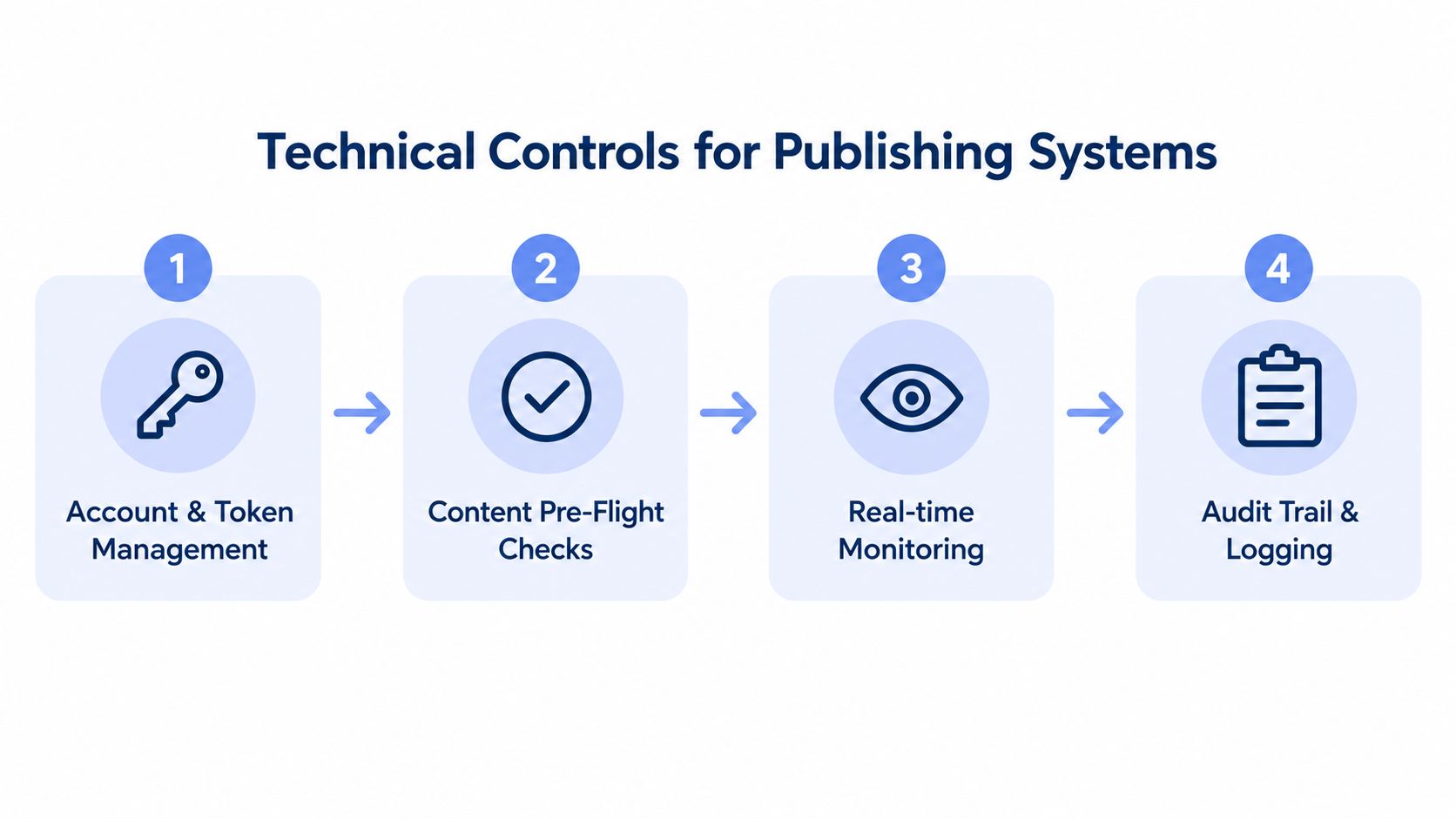 A four-step infographic illustrating the technical controls for publishing systems including management, checks, monitoring, and logging.
Archiving and audit trails
Record the event, not just the final object. An event should include the content identifier, account, destination, policy version, decision basis, rule or model version, timestamp, jurisdiction, actor, request status, rendered copy, and platform response.
Use append-only storage or another integrity control that makes silent alteration detectable. Retention must survive platform deletion, because a takedown changes the network state but shouldn't erase your record of publication, decision-making, or appeal.
For implementation details around separating account roles and permissions, the permission management guide is a useful design reference. The important principle is simple: a person or agent that can draft content shouldn't automatically be able to publish it.
Jurisdiction-aware routing
Attach jurisdiction before the post enters the execution queue. A global allow/block rule will eventually misclassify a post because disclosure, political-content, privacy, or archiving requirements may vary by destination and region.
Keep the policy decision explainable. If the system blocks a post, an operator should see which rule fired, which version was active, and what change would make the content eligible. If the platform removes a compliant post, preserve the publication receipt, rejection reason, account context, and appeal outcome. The 2025 scoping review of automated moderation transparency supports measuring automated detection, user reports, accuracy, errors, and language or geographic coverage rather than treating automated decisions as infallible.
Industry-Specific Requirements You Cannot Ignore
The same publishing architecture can be acceptable for a retail brand and inadequate for a financial firm. The difference isn't only the copy. It's the evidence required before and after publication.
Financial-services teams should involve compliance counsel in mapping communications rules, supervision procedures, and recordkeeping obligations to the workflow. A post may require review before publication, and employee activity may need supervision and preservation. Don't assume that archiving the brand page captures every relevant employee interaction.
Healthcare teams need a stricter boundary around patient information. The system should detect or require review for patient mentions, sensitive direct messages, testimonials, and replies generated by an AI agent. A customer-service queue should never give an autonomous worker permission to infer that a person has consented to public discussion.
Public-sector teams have a different burden. Records-retention and freedom-of-information obligations can make posts, replies, edits, deletions, and moderation actions discoverable. Accessibility also belongs in the pre-flight stage, not as a later design audit.
Industry | Key Regulation | Pre-Approval Required | Retention Floor | Special Controls |
Financial services | FINRA and SEC obligations may apply to public communications, supervision, and electronic records | Determine through the firm's written supervisory procedures | Set by the applicable recordkeeping rule and legal review | Supervision, immutable archives, employee coverage, and escalation |
Healthcare | HIPAA may apply when protected health information is involved | Require review for patient-related content and sensitive replies | Set by the organization's records policy and applicable law | PHI detection, consent controls, restricted AI replies, and DM handling |
Public sector | Records-retention, public-records, and accessibility requirements may apply | Route official communications through the agency's approval process | Set by the relevant public-records schedule | Capture edits and comments, preserve takedowns, accessibility checks, and export |
This table is a planning model, not a substitute for counsel. The exact obligation depends on the organization, role, jurisdiction, communication, and channel. Teams handling sensitive inputs should also review practical guidance on handling sensitive data before allowing content into prompts, queues, or analytics stores.
The tighter the vertical, the earlier compliance must intercept the pipeline.
Why One API to Publish Everywhere Is a Compliance Risk
A unified API cuts integration work, but it does not create a unified compliance contract. The abstraction becomes risky when it hides the destination behavior that operators must inspect during failure recovery.
Each platform defines its own authorization, media, processing, disclosure, and failure semantics. Instagram can leave a container processing after creation. TikTok separates video and photo posting, requires a specific posting scope, and distinguishes local uploads from media retrieved from a verified location. YouTube's quota model makes careless retries expensive. A wrapper that reduces all of this to publish(post) conceals the information needed to decide whether to poll, refresh credentials, pause, or escalate.
The same asset can also require different treatment at different destinations. An AI-generated video may need a label on one platform, a separate disclosure flow on another, and human review when its political or regulated classification changes by jurisdiction. The analysis of cross-platform AI disclosure requirements reinforces the engineering rule: one API call must not force one policy decision everywhere.
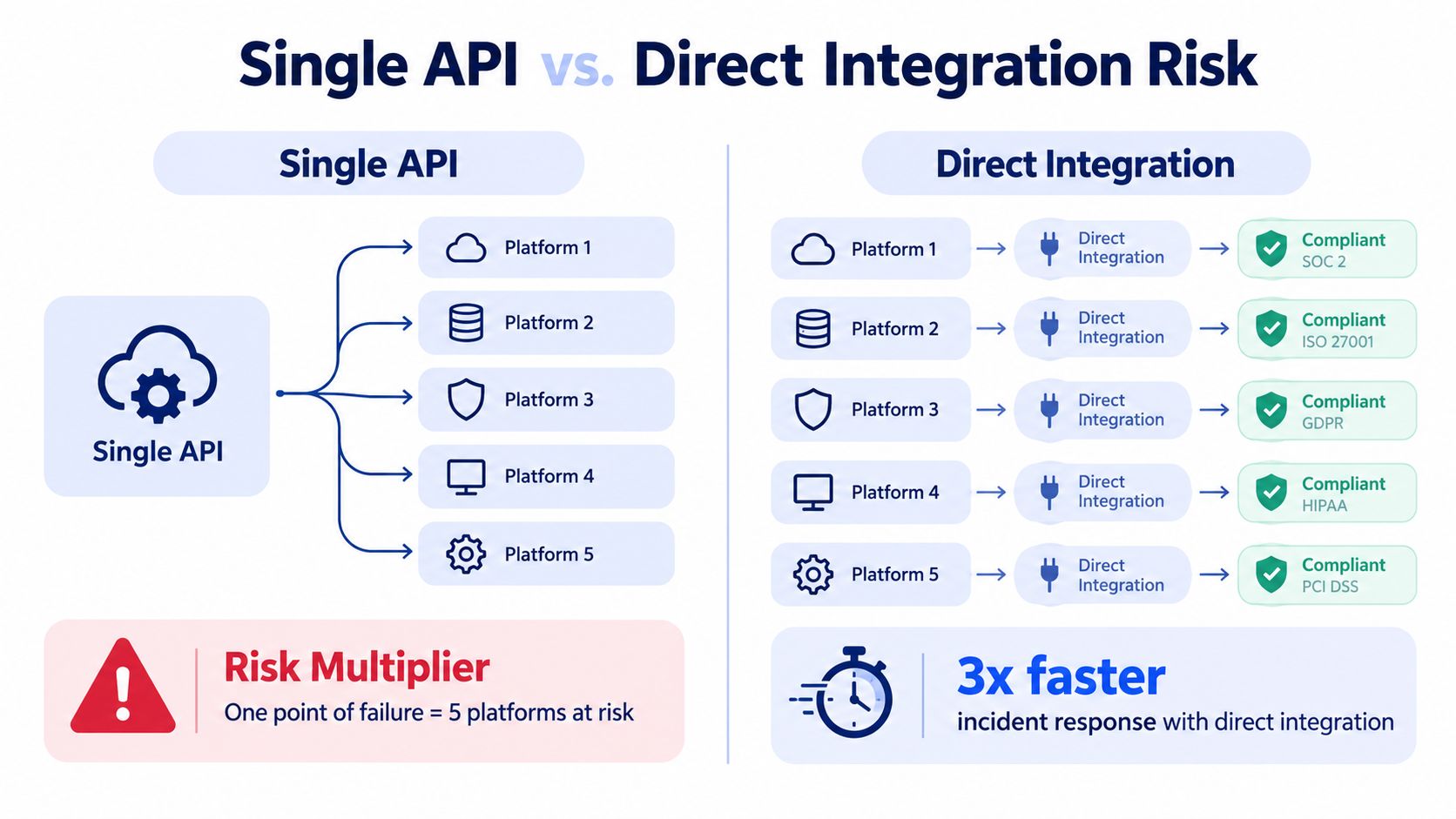 A comparison infographic showing the risks of single API integration versus the compliance benefits of direct integration.
Use a policy-aware routing layer:
Assign the platform, region, account, and content class.
Resolve destination capabilities and disclosure requirements.
Validate the rendered destination payload after approval.
Submit through a platform adapter.
Normalize responses while retaining platform-specific details.
Store the receipt, state transitions, and recovery instructions.
This preserves a simple developer interface while keeping each platform's policy contract visible. A post-publication hook cannot reliably fix a missing disclosure, unauthorized scope, or expired container. A shared retry policy is just as unsafe. One failure may require credential refresh, another polling, human review, or a permanent block.
Rate limits belong in the adapter. The API rate-limit guidance helps structure backoff and request coordination, but avoiding throttling is only part of compliance. Record whether the request was rejected before publication, accepted for processing, published, or removed later. Those states determine the next action and the audit record.
Your Implementation Checklist and Common Questions
Before launch, run this checklist against the actual workers and queues, not just the dashboard:
Token lifecycle: Refresh credentials before scheduled work, detect revoked scopes, encrypt secrets, and pause jobs when account health is unknown.
Approval separation: Keep author, reviewer, and publisher roles distinct. Publish only an immutable approved version.
Disclosure fields: Require sponsorship and synthetic-media classification in the content object. Validate the rendered destination output, not only the API payload.
Audit retention: Store publication receipts, policy decisions, reviewer identity, platform responses, takedowns, appeals, and reversals.
Jurisdiction tags: Require a region and regulatory scope on every post, reply, asset, and moderation event.
Async state handling: Poll processing states, set expiration deadlines, and expose stuck jobs to operators.
Quota and retry controls: Track destination-specific costs, reject unsafe retries, and distinguish credential errors from transient processing failures.
AI provenance: Log the model or agent, source inputs, editing steps, generated draft, approval decision, final copy, and destination response.
Common questions
How long should audit logs be retained?There isn't one universal period. Retention can range from one to seven years, depending on the applicable regulation and organization. Treat that range as a legal and records-management decision, then encode the approved retention policy as a timer that prevents premature deletion. Don't use the platform's deletion behavior as your retention policy.
Do webhooks count as a compliance signal?They count as one signal, not as proof of final state. Store the webhook payload, receipt time, signature-validation result, and related request ID, then reconcile it with polling or a platform read-back where the official API supports that workflow.
What should an AI agent log?Log the instruction context that matters, the source material, model or agent identity, generated draft, classification result, disclosure decision, reviewer, final rendered content, and platform response. Avoid storing unnecessary sensitive input, and route uncertain or regulated cases to a human.
What happens after a takedown?Preserve the original content, publication receipt, reason, policy version, notification, account context, and appeal state. Don't automatically repost. First determine whether the platform action was correct, whether the content changed, and whether another destination has a different policy.
When is scraping legally exposed?Treat scraping as a legal-review issue, not a fallback integration strategy. Terms, privacy rules, access controls, copyright, and jurisdiction can all matter. Prefer documented APIs and approved data-access paths. If a required record isn't available through an official interface, document the gap and get counsel's view before building around extraction.
The strongest systems make compliance observable. An operator can answer what was published, under which policy, with whose approval, to which account, using which credential, and what the platform did next. That evidence is more valuable than a static checklist because it survives the incident that caused you to need it.
PostPulse provides a unified publishing layer for apps, automations, and AI agents, with REST API, n8n, Make.com, and MCP access across supported social destinations. If you're tired of maintaining token refresh, rate-limit handling, platform-specific validation, and asynchronous publishing states yourself, visit PostPulse and evaluate whether its workflow fits your compliance architecture.
About the Author

Founder of PostPulse — a social media scheduling platform for creators and teams. Software engineer with a passion for building developer tools and simplifying complex API integrations across social media platforms.