Social Media Multi Posting: How It Works
Published on
Tags:
Your publish function returns 200, your logs look clean, and then someone opens Instagram and finds nothing there. That gap between an accepted request and a live post is where social media multi posting lives, and it's why a simple fan out loop keeps disappointing people who build it.
Table of Contents
Why Your Post Everywhere Call Comes Back Empty
Say you're shipping a launch post from your app, an n8n or Make scenario, or an agent loop. One source video, one caption, seven destinations. Your code fires the calls, gets success back from the first hop, and marks the job done.
Then reality shows up in pieces. Instagram accepted something but never published it. YouTube doesn't show the upload at all. LinkedIn returns an auth error that your generic retry logic treats like a timeout, so it hammers the same dead grant three more times.
What a 200 Actually Means
On most networks, a successful first response means we accepted work, not the post is live. Uploads process asynchronously. Containers sit in progress. Tokens expire or get revoked. Quotas run out for the day. If your model is a single boolean, you'll report success for posts nobody can see.
That's the core misunderstanding to drop early. Social media multi posting isn't pasting the same caption into seven composer boxes. It's taking one source item, producing an adapted variant for each destination, and tracking each destination through its own states until you have a post ID, a public link, or a real error.
A publish call that returns success for the batch and silence for each account isn't finished. It's just unexamined.
You'll get more value from thinking in per destination state machines plus an adaptation layer than from thinking in simultaneous API calls. That framing explains the empty feed, the stuck container, and the token that worked yesterday. It also tells you what to build, whether you wire each platform yourself or put a maintained layer like PostPulse between your code and the networks to absorb those mismatches.
Either way, the mechanics below stay useful. You'll compare one integration against a client per platform, look at why audiences force you onto about seven networks, check what has to change in media and copy, meet the official API behaviors that punish a naive loop, and get a rule for skipping a destination that isn't worth its moderation cost.
Why Reach Now Means About Seven Networks
Stakeholders love asking why you can't just pick one network and be done. The January 2025 numbers answer that pretty directly, and they're worth having in the room before you argue architecture.
The snapshot below sums up why one composer can't cover the audience anymore.
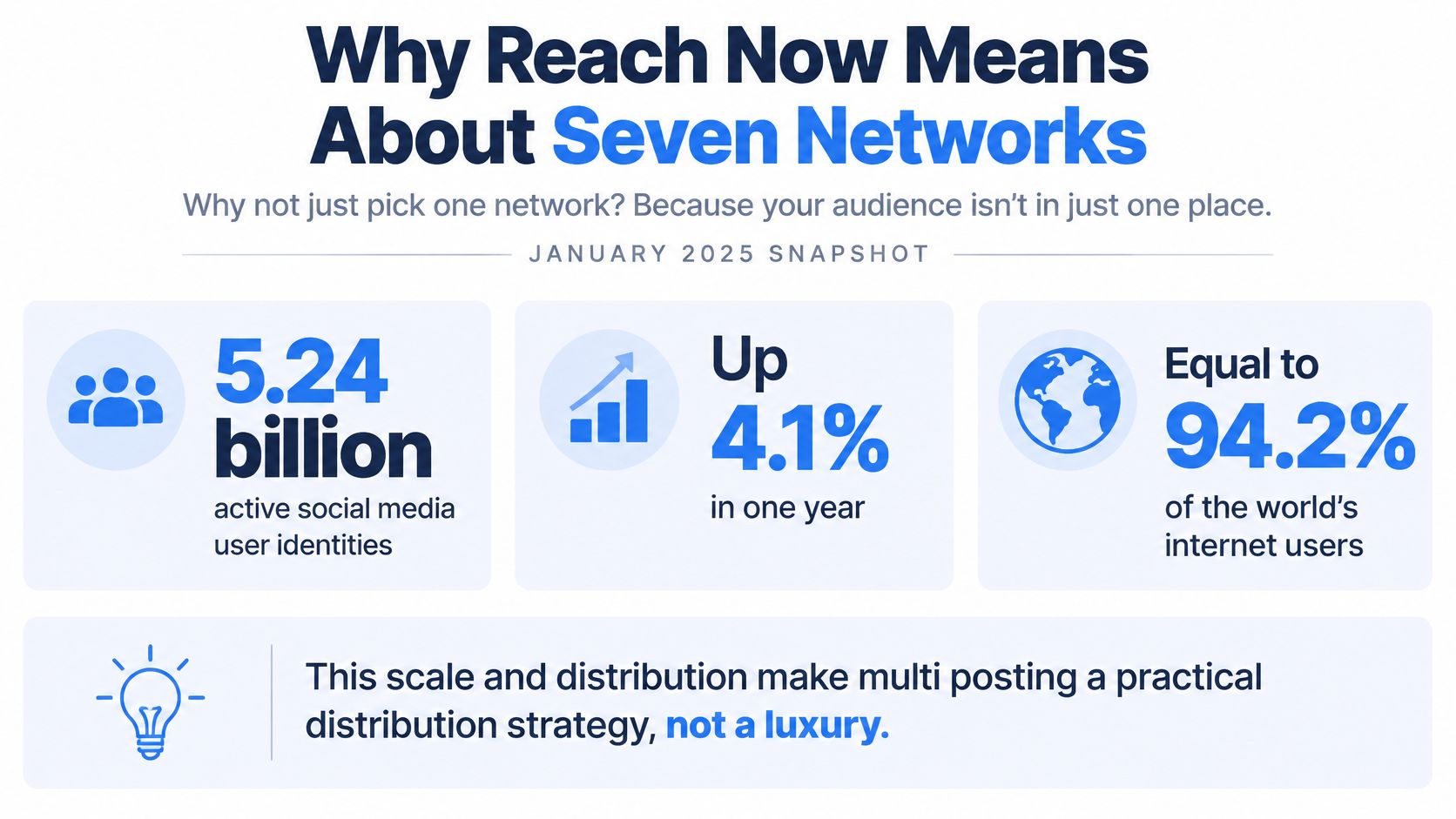 An infographic showing that 5.24 billion social media users represent a 4.1% increase and 94.2% of internet users.
The DataReportal Digital 2025 Global Overview Report counted 5.24 billion active social media user identities worldwide in January 2025, up 4.1% over the preceding 12 months. Those identities represented 94.2% of the world's internet users, and 97.3% of connected adults used at least one social network or messaging platform each month.
Scale alone doesn't force multi posting, though. Fragmentation does.
The typical internet user used an average of 6.83 social platforms per month.
Quote that back to anyone who says you'll just post to X. A post meant for a broad audience is a distribution job across roughly seven places, each with its own format, account system, and publishing interface.
Fragmented, Not Winner Take All
DataReportal identified six platforms with more than 1 billion monthly active users and 15 with at least 500 million. YouTube was assessed as the most used platform at the start of 2025, while Facebook's mobile app still attracted approximately 2.3 billion users per month. No single winner absorbs the rest.
For a concrete sense of how source material stretches across that many endpoints, podcasters face the same math when they maximize your podcast's social media potential by cutting one recording into many platform specific pieces. The recording is one asset. The audience is not in one place.
The video below walks through that fragmentation in practical terms.
The engineering consequence is straightforward. Your publisher has to add or drop a destination without rewriting the source post, because the portfolio keeps shifting. Identical reach everywhere isn't the goal. Showing up where that audience already spends time, in that network's format, is. One source item, adapted once per destination, scheduled in one workflow, with a separate result returned per account so you can see exactly where it landed.
One Integration Versus a Call Per Platform
Here's my verdict up front. Call each platform yourself when you need deep, network specific features and you can staff app review, token refresh, and quota management indefinitely. Use one publishing integration when the job is create, adapt, schedule, and learn per destination, and nobody on your team signed up to babysit seven OAuth implementations.
That sounds like a pricing decision. It's really an ownership decision, and our overview of how social media publishing fits together lays out the moving parts. The table reads best as a list of jobs somebody has to own forever.
Job | A client per platform | One multi post integration |
Account connection | Separate OAuth app, scopes, and token store per network | One authorization flow per connected account |
Publish request | Different endpoint, payload, and success signal on each API | One create call that fans out to chosen accounts |
Instagram done means | Container ID from media create; publish only after the container is ready | Per destination state, not a single HTTP 200 |
YouTube capacity | Default 100 videos.insert calls per day per Google Cloud project; reset midnight Pacific | Quota still applies and must be surfaced as capacity, not blind retry |
LinkedIn auth | OAuth 2.0 member grant with w_member_social; no bare server to server post | Member must approve; a revoked scope fails only that account |
Content shape | You build the derivative, caption, and CTA per destination | A rules layer emits a variant from one source |
Partial failure | You reconcile which networks are live | Each account returns a post ID and link, or an error |
OAuth Is a Grant, Not an API Key
Account connection surprises people first. You're not dropping a key into an env file. You're running an authorization workflow per network per user, storing the result securely, refreshing it, and handling refusal and revocation.
LinkedIn makes this explicit. The LinkedIn authentication documentation requires OAuth 2.0 for user authorization, and posting on behalf of a member uses the documented self service permission w_member_social, which allows an application to post, comment, and like for that member. There's no unauthenticated server to server shortcut. If the member never granted that scope, or later revokes it, that destination fails. Correctly. Your system should fail that one account and keep going, not abort the batch or retry the grant back into existence.
LinkedIn also distinguishes member authorization from application authorization, and not every API supports the application flow. A generic token strategy across endpoints is how you end up debugging permission errors at launch time.
Instagram Is Two Steps and a Wait
Instagram punishes the single call assumption harder than most. The Instagram media publish reference describes a two step container workflow. You call POST /{ig-user-id}/media to create a container and get a container ID, then you pass that ID as creation_id to POST /{ig-user-id}/media_publish.
A container ID doesn't mean the video upload succeeded. Video uploads are asynchronous, so you need to verify media state before you attempt publication. Track container created, upload complete, publish requested, and published as separate states. The stuck carousel container that sits at in progress forever is usually your code treating step one as the finish line.
Practical rule: If a platform gives you an intermediate ID, it is telling you the job isn't done. Poll the state, don't publish on hope.
YouTube Is a Quota, Not an Endpoint
YouTube breaks the unlimited insert fantasy. Google's YouTube quota cost documentation puts the default at 100 videos.insert calls per day in their own bucket at one quota unit each, while the broader project quota is 10,000 units per day for other endpoints. Quota resets at midnight Pacific Time.
So count inserts separately from other traffic, scope the counter to the Google Cloud project, read actual usage in Google Cloud, and treat exhaustion as a scheduling condition. Don't schedule more uploads on this project today. Retrying a quota error as if it were a timeout just burns the same empty bucket. And that 100 figure is a documented default, not a platform wide promise for your project.
Partial Failure Is the Normal Case
Put those three together and the design requirement writes itself. Failure in social media multi posting is partial by default. Store a status, post ID, public link, or error per account, and classify errors before you retry anything.
Permission and quota errors: Stop, surface, reschedule or reconnect. Retries don't fix grants or daily buckets.
Transient failures: Retry with backoff, within the destination's own state machine.
Validation failures: Fix the variant, don't resubmit the same binary.
Teams that also run paid distribution hit the same ownership question from the other side, which is why guides on how to manage Advantage+ campaign workflows spend so much time on who owns account access and approvals. Organic publishing deserves the same honesty.
If nobody on your team owns token refresh, app review, and quota, the per platform column costs more than it looks. It just bills you later, in empty feeds.
Media Normalization Before You Fan Out
One vertical video can't be uploaded everywhere unchanged. Platforms set different media rules, and a fan out loop skips over that work without warning until uploads get rejected or text gets cropped out of the frame.
Keep a master asset at the highest quality you have. Build every per destination derivative from that master. Never re encode the previous derivative, because each generation throws away detail you can't get back and bakes in the last platform's compromises.
The Pipeline That Prevents Rejected Uploads
Check these properties per destination before anything leaves your system. Read the values from each platform's current official media documentation at run time, not from a cached list someone pasted into your codebase two years ago.
Probe the master: Read container, video codec, audio codec, frame rate, bitrate, dimensions, and duration from the file's actual metadata.
Look up the destination's rules: Pull the current limits for that endpoint, including aspect ratio and image size or type limits. If you're unsure what a given network expects for vertical framing, our explainer on TikTok aspect ratio basics shows how much composition changes with the canvas.
Build the derivative: Transcode from the master and record its checksum and dimensions against the canonical post record.
Validate before submit: Compare the derivative against the destination's rules while you can still fix it cheaply.
Refuse cleanly: If validation fails, skip that destination, report exactly why, and let the other accounts proceed.
Common baselines people reuse, such as MP4 or MOV containers, H.264 video, AAC audio, and 4:2:0 chroma, make a reasonable starting point for your encoder presets. They're a starting point to verify against each endpoint, not a guarantee that every destination accepts the same file.
Tie each derivative back to the canonical record with its source checksum and transform settings. When someone edits the source later, you can rebuild every variant cleanly instead of wondering which platform got which hand exported file from someone's desktop.
What Must Change Before You Fan Out
Multi posting looks like one HTTP call fanned out to every connected account. Each destination runs its own small state machine: transform the canonical post, validate the derivative, publish, record success or failure per account. The adaptation layer feeding those state machines is where a single upload wins or loses.
Content that travels gets reshaped on the way. A 2025 study of cross platform virality found that content spreads through stages in which it is reshaped for the norms of X, TikTok, and Instagram rather than copied identically.
The diagram below shows why the single file, single caption approach breaks against those norms.
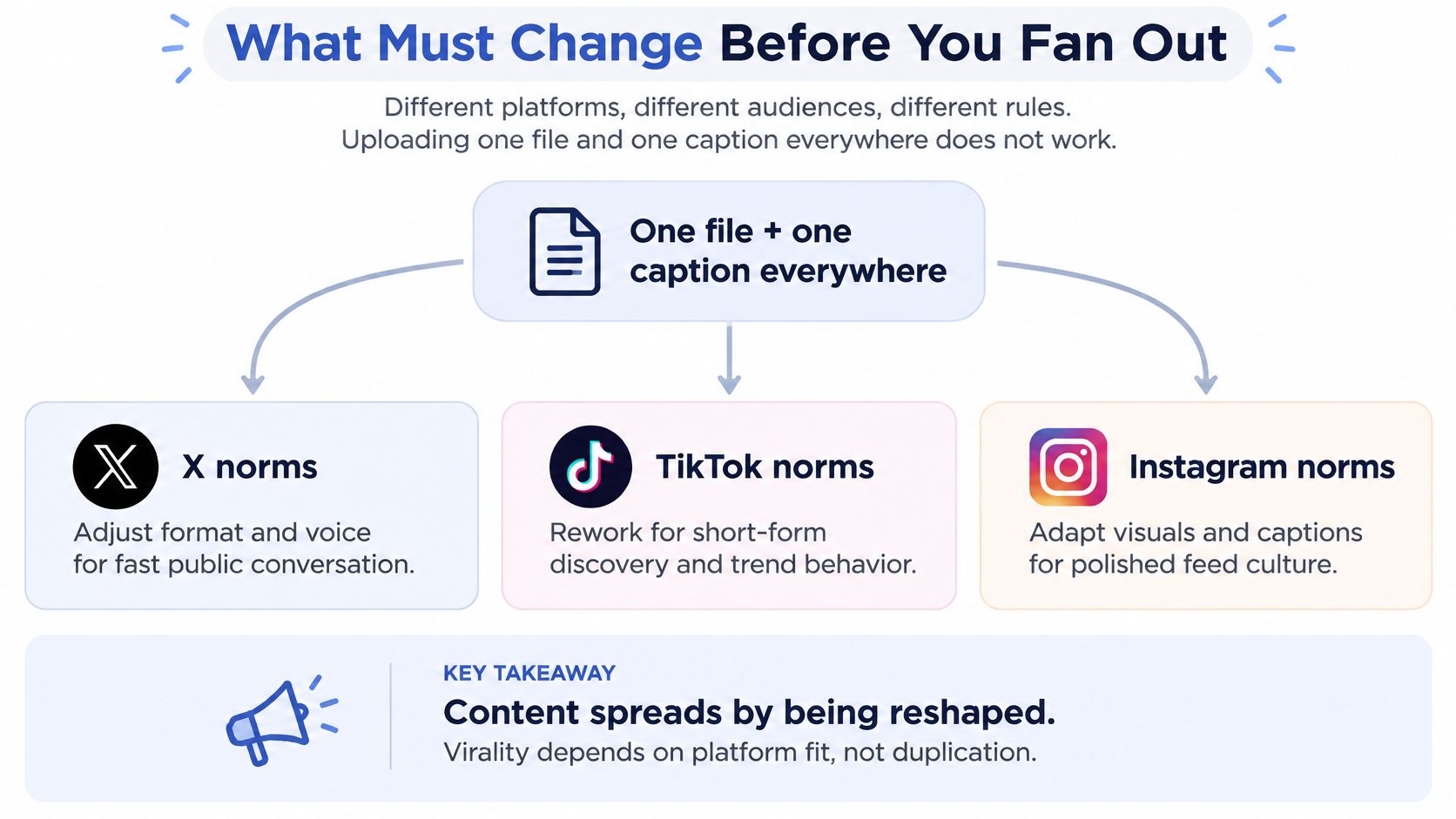 A diagram illustrating why content must be tailored for different social media platforms instead of duplicating posts.
Performance data points the same way: format and presentation choices move engagement enough that identical republishing leaves real reach on the table.
The gap shows up per destination, so a blended average across networks hides exactly where a post underdelivered.
The Transform List
Treat your canonical post as structured source content, then let the pipeline apply documented transforms per destination. For a deeper look at validating those variants before they ship, see our notes on testing posts across platforms.
Hook length and caption structure: A longer explanatory opening can work where readers expand text. Compact copy wins where the feed moves fast.
Aspect ratio and safe zones: Keep on screen text and faces clear of the areas each player covers with overlays, buttons, and captions.
First frame design: The opening frame is your thumbnail in most feeds. Design it. Inheriting whatever frame zero happened to be means the feed picks your thumbnail for you.
Links and subtitles: Decide per destination whether a link belongs in the post at all, and whether burned in or platform subtitles serve viewers better.
Hashtag density, tags, and CTA placement: Match local conventions instead of exporting one network's habits to all the others.
Keep factual claims, links, campaign IDs, and required disclosures stable across every variant. Wording, line breaks, and CTA placement can move. The facts can't drift, or your variants stop being the same post and start being a compliance problem.
Transform definitions belong in configuration, and the rules they encode belong to the platform, not your codebase. Hardcoding byte limits or aspect ratio caps into transform code guarantees silent drift the next time a network changes its requirements. When one destination's rules shift, you update one transform and leave the rest of the fan-out alone.
Store the Variant, Judge the Variant
Store the canonical ID, transformed caption, asset variant, publication time, and platform, then attach reach, retention, saves, shares, and conversions to that record later. That lets you judge whether a specific transform worked, instead of concluding a whole network is weak because it received the worst fitting variant.
Measure platform specific reach, retention, saves, shares, and conversions. A count of destinations published tells you your loop ran, not that your post worked.
On AI rewriting, stay skeptical in a useful way. An academic evaluation of cross platform customization compared 30 pairs of AI created and human created posts across Facebook, Instagram, and X with 892 participants, and AI customized posts were preferred overall with stronger calls to action, though effects were weaker for shorter posts on X and Instagram. I would treat AI rewriting as a test against a human authored control. Keep human approval on anything compliance sensitive, and let the stored variant data settle the argument.
When Another Destination Is Not Worth It
The ninth network rarely fails at publish time. It fails later, when the same item needs a different cut, a different caption, a reply thread, and a decision about why it exists there. Multi posting is a per-destination state machine plus an adaptation layer, so each added network creates another path that can draft, wait on media, schedule, publish, fail, or need review.
Before adding that path, look at how loud the existing ones already are. The Hootsuite posting frequency guide reports Q1 2025 data showing businesses publishing approximately 18.1 times weekly on X, 14.2 on Facebook, 9.3 on Instagram, 5.5 on LinkedIn, and 3.7 on TikTok.
How often businesses already post each week
Platform | Posts per week, Q1 2025 |
X | 18.1 |
14.2 | |
9.3 | |
5.5 | |
TikTok | 3.7 |
High cadence is already normal on mature networks. Matching that volume on every extra network mostly multiplies edits, media variants, approvals, and comment queues; volume alone is not a strategy.
Don't turn that into a new frequency prescription either. Run a marginal value check before a destination joins a given item.
The Five Point Go or No Go Check
Estimate the qualified action: Name the signup, save, share, or reply you want; raw impressions alone do not count.
Subtract audience overlap: If most of that network's audience already saw the post elsewhere, incremental reach is smaller than the follower count suggests.
Cost the variant: Add editing, thumbnail, caption work, and tomorrow's comment responses, because somebody answers those.
Price the risk: Add brand and compliance exposure, and whether a human must approve before it ships.
Compare: If incremental qualified actions don't clear that total cost, leave the destination off this item.
Two patterns show how this plays out. A launch can justify every connected account, because the message is time bound and extra reach is the point, even with overlap. A routine tip should go only where saves, shares, or signups are still moving, and pause where they have gone flat, even if publishing there costs one extra click.
Route comments and anything disclosure sensitive to a review branch instead of an agent auto publish path. Conditional branching, everywhere for launches and a selected subset for routine updates, turns social media multi posting into resource allocation. Judge it as qualified outcomes per destination, with each destination carrying its own state, cost, and error path.
Publish Through One Maintained Integration
The build versus buy split is now clear. If your product is the platform specific feature, keep the direct clients and budget for app review, token refresh, and quota. If your product is the app, the automation, or the agent, stop owning nine publishing implementations as a side hobby.
In that second case, a maintained layer earns its place. With PostPulse, a single POST sends content to every connected account, handles each platform's media rules, and calls your webhook on success or failure. One integration publishes to 10 platforms, Instagram, TikTok, YouTube, LinkedIn, X (Twitter), Threads, Bluesky, Facebook, Telegram, and Pinterest, and scheduling can target one account or many in the same post.
You can call the REST API, use the official n8n or Make.com nodes, or publish through the MCP server, which lets Claude, Cursor, and any LLM or agent publish inside their tool loop. Teams comparing their wider stack may also find these creative tools and workflow comparisons useful for sorting out where publishing ends and production begins.
Two product boundaries are worth knowing before you design around any integration, ours included. In private label, users connect their accounts inside PostPulse while you publish through your chosen surface. White label is the path when end users must never see the vendor at all.
The Only First Run That Proves Anything
Don't start with a nine network big bang. Do this instead:
Connect two accounts on different networks with different rules.
Send one source post with a deliberately different caption variant on each.
Confirm you receive a per account result, a post ID and link or a specific error, rather than one boolean for the batch.
Remember two operational truths while you test. Deleting a record later doesn't pull an already published post off the network, and a destination that's still in progress can't be casually removed from the post. If the two account test gives you clean per destination state, scaling to the rest is configuration. If it gives you a single success flag, you've learned something cheaper now than at launch.
Stop debugging empty feeds and stuck containers one platform at a time, and publish from one integration that tracks every destination to a post ID, a link, or an honest error. Visit PostPulse, connect two accounts, and run the two variant test described above with your own content today.
About the Author

Founder of PostPulse — a social media scheduling platform for creators and teams. Software engineer with a passion for building developer tools and simplifying complex API integrations across social media platforms.