
Cross Platform Testing: A Developer's Guide for Social APIs
Published on · Updated on
Tags:
Your post looks fine in staging, then one platform swallows it, another leaves the media container stuck in IN_PROGRESS, and a third kills the request because the token aged out mid-run. That's the core challenge of cross platform testing for social APIs: it's not “does the function return 200,” it's “does the same publish flow survive nine different systems, each with its own auth rules, async media handling, and platform quirks.”
The hard part is that the failure usually isn't loud. A payload can pass local validation, look correct in logs, and still break later when a token expires, a container never finishes processing, or a rate limit trips on the third retry. That's why structured cross platform testing matters for social publishing work, especially when the cost of a bad release is a user-facing failed post.
Table of Contents
Why Your Post Works on LinkedIn and Breaks on Instagram
The ugliest bugs in social publishing show up after you've already convinced yourself the integration is done. The payload validates, the request returns successfully on one platform, and then Instagram or TikTok behaves differently enough to make the same post fail or look wrong in production. That's where cross platform testing stops being a web-app checkbox and turns into a real integration discipline.
A backend team usually discovers this the hard way. One API accepts a media object immediately, another starts an asynchronous processing flow, and a third wants a slightly different shape for the same content type. You do not just test whether your code can send a request, you test whether the full publishing lifecycle survives the platform boundary.
For social products, the best mental model is simple. If the post must be accepted, transformed, processed, and rendered on multiple surfaces, then the test must follow that path end to end. The platforms are the product surface, not just a transport layer.
Practical rule: if your test doesn't check the full publish lifecycle, it's only checking the easiest part of the problem.
Instagram exposes the gap between request success and publish success very clearly. The publishing flow can move through container states, media processing, and final publication before anything is visible, so a passing API response does not tell you whether the post made it through the whole path. The Instagram Graph API details are useful here because they show why container status checks belong in your tests, not just your production logs.
That's why the first pass at this work should look more like integration testing than unit testing. It should validate auth, payload shape, async status changes, and the user-visible result. If you are building this around Instagram, the practical edge cases start showing up fast, and a useful reference point is how the social media API works when you need to map your own flow against a real implementation.
What Makes Social APIs Especially Hard to Test
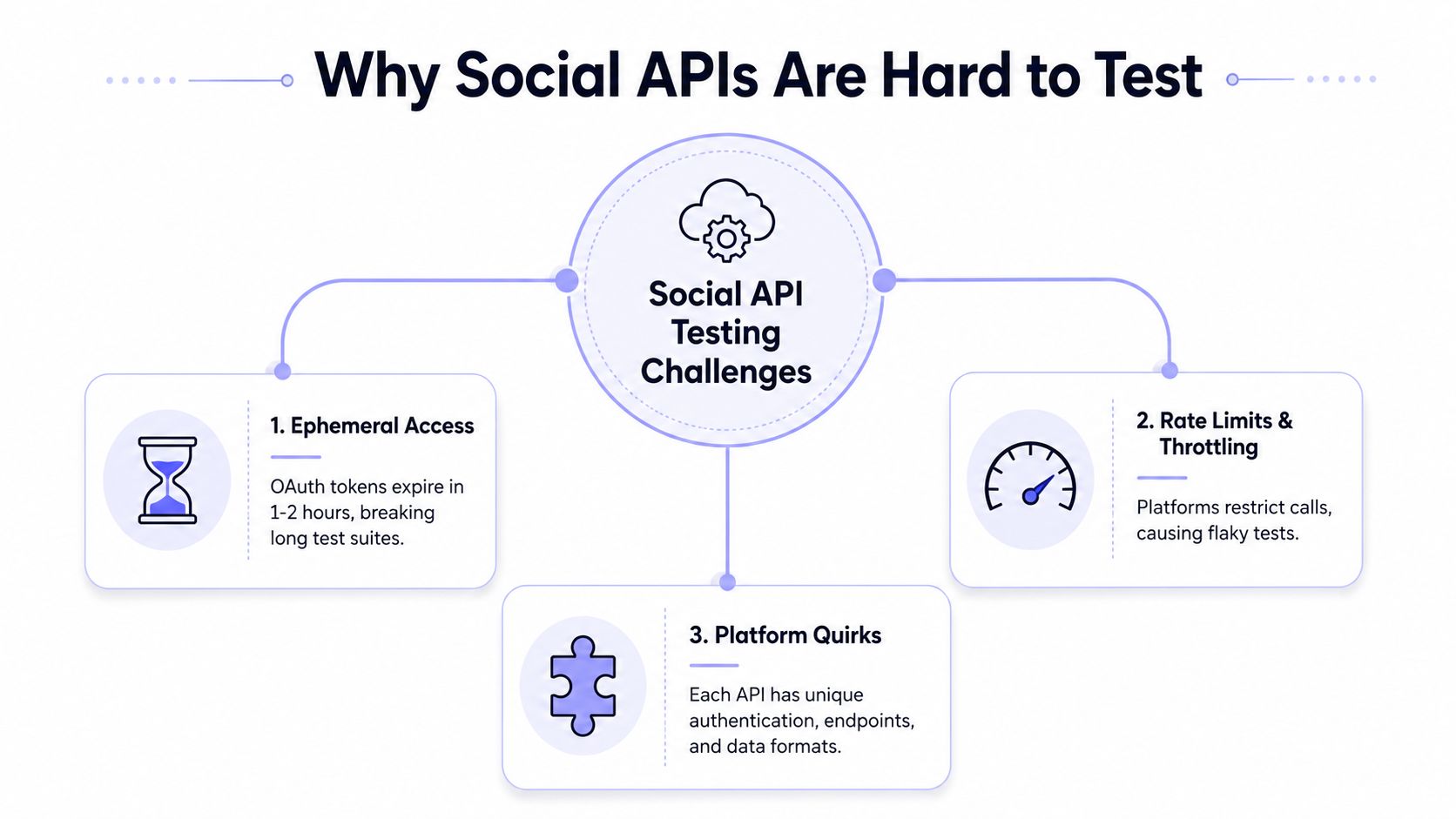 A diagram illustrating three major challenges in social API testing: ephemeral access, rate limits, and platform quirks.
The token problem never stays solved
Social APIs are brutal because auth isn't a one-time setup. Meta's documented flow includes a short-lived access token that can be exchanged for a longer-lived one, and the practical testing implication is obvious, your suite can pass at 9 a.m. and fail at noon if token refresh isn't part of the scenario. That's exactly why token lifecycle coverage belongs in the test matrix, not in a separate ops checklist. Meta's own docs on the short-lived and long-lived token exchange spell out that this is a distinct phase of the flow, not an implementation detail you can ignore Meta access token types.
Instagram's publishing flow also makes this worse because media handling is not just “send post, get result.” Carousels go through a multi-step container process, and container states can sit in IN_PROGRESS while the platform finishes processing. If your suite only checks the initial response, you miss the actual failure mode.
TikTok adds another kind of pain. Video upload issues often don't show up at request time, they surface later in the processing and validation stages, which means a naïve success assertion gives you false confidence. Across platforms, the true test is whether your automation can follow the lifecycle, not just the POST.
Rate limits and version drift behave differently
Platforms also throttle in different ways, and they don't all fail loudly. One API may delay, another may reject, and another may make the next call look fine while changing behavior after a version update. The testing burden is to catch those differences before your users do.
If the only thing your regression suite proves is that a request can be sent, you're testing the transport, not the integration.
That's why social API testing gets harder as the product grows. You're validating authentication, asynchronous processing, media-specific behavior, and API drift across platforms that don't share a common contract. A general-purpose webhook test won't catch that. A full publish-flow test will.
The challenge is not unique to any one vendor. It's the combination that hurts, short-lived auth, throttling, async media, and platform-specific quirks all stacked together. Once those are in play, the suite needs to model reality instead of ideal conditions.
Manual Testing Versus Automation for Social Integrations
Manual testing still earns its place when the thing you're checking is subjective. A designer wants to know if a Reel thumbnail crops correctly, a content lead wants to inspect a carousel order, or someone needs to eyeball whether a caption wraps awkwardly on mobile. Those are judgment calls, and human review is better at them than a brittle assertion.
Where humans beat scripts
For social publishing, manual checks are strongest in the edge cases that don't map cleanly to pass or fail. Visual rendering, brand-sensitive layout, and the final look of a post on a real surface are all good reasons to keep some human validation in the loop. If the question is “does this feel right on the platform,” automation usually won't answer it well.
Automation wins everywhere the system has to behave the same way every time. Token refresh, retry logic, idempotency, and regression coverage across multiple endpoints are all better handled by scripts. Once your team supports nine platforms, hand-testing every flow becomes expensive noise.
What to automate first
A good rule is to automate anything that would hurt if it broke.
Token refresh flows: catch expired credentials before a release ships.
Status polling: verify that async containers move out of waiting states.
Payload validation: ensure platform-specific required fields are still present.
Retry behavior: confirm the integration doesn't spam a rate-limited API.
Core publish paths: protect the flows users hit every day.
The hybrid model works best in practice. Let automation cover the repeatable lifecycle, then use manual review for the visual and editorial edge cases. That keeps the suite honest without turning every release into a human QA marathon.
Once you're supporting recurring social publish flows, the trade-off gets pretty clear. Manual testing is great for quality judgment, but it doesn't scale as the number of platforms grows. Automation is what keeps the integration from rotting under its own maintenance weight.
Designing a Test Matrix That Fits Your Users
A real test matrix starts with the platforms people use, not the ones that look complete in a planning doc. For cross platform testing, the practical rule is simple: cover the combinations that drive most traffic and most failure risk, then widen the matrix only when the added coverage earns its place test matrix guidance analytics-driven prioritization. That keeps the matrix defensible when someone asks why a path is in or out.
Build the matrix around publishing risk
For social publishing, the useful variables are the ones that change how a post is created, uploaded, processed, or rendered.
Platform: Instagram, TikTok, LinkedIn, X, YouTube Shorts.
Device class: desktop for authoring, mobile for capture-heavy flows.
OS family: at least two, because browser and device behavior still diverge.
Network condition: slow, flaky, and normal conditions matter for media uploads.
Media type: image, video, carousel, because each one exercises a different path.
The cross-platform guidance also recommends building combinations from operating system, browser, device type, screen resolution, and network conditions instead of trying to test everything matrix variables. That fits social publishing because the same content behaves differently once media type and device constraints enter the picture.
What to do when analytics are weak
Early-stage products and enterprise rollouts often do not have trustworthy usage data. In that case, market-share proxies and explicit assumptions are better than pretending the answer is already clear. The gap in current guidance is real. The ideal approach is data-driven, but the available material also admits that exhaustive testing is not practical sparse analytics gap.
Sample Test Matrix for a Social Publishing Product | TikTok | X | YouTube Shorts | ||
Image post from desktop | Yes | Yes | Yes | Yes | No |
Short-form video upload from mobile | Yes | Yes | No | Yes | Yes |
Carousel publish flow | Yes | No | No | No | No |
Slow-network upload retry | Yes | Yes | Yes | Yes | Yes |
Token refresh before publish | Yes | Yes | Yes | Yes | Yes |
The table stays small on purpose. Focus beats breadth here, because the goal is not exhaustive coverage. The goal is the right coverage on the flows that tend to break.
Teams that are mapping product requirements to platform-specific behavior can use social media platform integration as a practical reference point. It helps keep the matrix tied to real publishing behavior instead of drifting into abstract completeness.
Toolchains, Device Clouds, and Real Devices
A workable toolchain for social API testing has three layers. First, API-level validation. Second, scripted regression. Third, real-device or browser-cloud coverage for the platforms that need it. Teams usually get into trouble when they blur those layers, because a browser tool can tell you a request failed, but it cannot tell you whether OAuth, media upload, and platform rendering all survived the same publish flow.
Pick the right layer for the job
For ad hoc request checks and contract testing, Postman, Hoppscotch, and Insomnia are the right blunt tools. Use them to inspect headers, replay payloads, or confirm that a token exchange works before you wire the flow into code. They are useful for narrowing down failures fast, but they stop short of end-to-end publish regression.
For scripted runs, Playwright, Cypress, and pytest + requests cover different parts of the problem well. Playwright fits flows that touch browser-based auth, while pytest + requests is a cleaner choice for pure API regression and status polling. Cypress can still work, especially if the team already lives in frontend-heavy workflows, but it is rarely the first tool I would pick for backend-heavy social publishing checks.
When real devices matter
Browser clouds like BrowserStack, Sauce Labs, and LambdaTest fit the cases where you need cross-OS validation without maintaining your own hardware farm. The verified guidance says practical test matrices should include real devices for critical mobile scenarios, because emulators can miss hardware- and OS-specific failures under real-world constraints real device guidance. Broader cross-platform guidance also points to validation across smartphones, tablets, desktops, multiple operating systems, and common browsers, which is the right scope to keep in mind once a social publishing flow leaves the lab broader scope.
Real devices are how you catch the bugs emulators smooth over.
For social publishing, that matters most when media processing, camera-originated content, or device-specific rendering is involved. If your team is small, start with API tools and a regression harness, then add device-cloud coverage for the platforms where users publish from mobile most often.
 A hand-drawn illustration showing a laptop, tablet, and smartphone for cross-platform development and testing.
Wiring Cross Platform Tests Into CI/CD
A cross-platform suite that only runs before release is just a fancy final check. The better pattern is to wire it into CI/CD so failures show up while the change is still cheap to fix. That keeps the team closer to CI/CD best practice, where pull requests get checked early instead of waiting for a release window.
A cadence that won't bankrupt the team
A layered rhythm works better than one giant gate. Run smoke tests on each pull request, keep daily smoke runs on the main paths, schedule full regression for broader coverage, and push the least-used device combinations into planned exploratory passes when time and budget allow. That is the practical shape of a repeatable workflow when device-cloud minutes are real money and flaky failures can eat a sprint.
For social APIs, the priority order should be:
Cheap checks first. Validate auth, payload shape, and core publish paths locally or in lightweight CI.
Parallelize the expensive runs. Spread platform tests across workers so the suite does not block releases.
Tier the cloud runs. Use the device cloud for the combinations that justify it, not every commit.
Keep flaky tests visible. Do not disable them forever, isolate them and fix the root cause.
The core workflow stays the same, define the scenarios, set up the relevant devices and OS versions, execute, analyze discrepancies, then retest after fixes. That loop matters because social APIs drift, and the next release can fail in a place your local mocks never exercised.
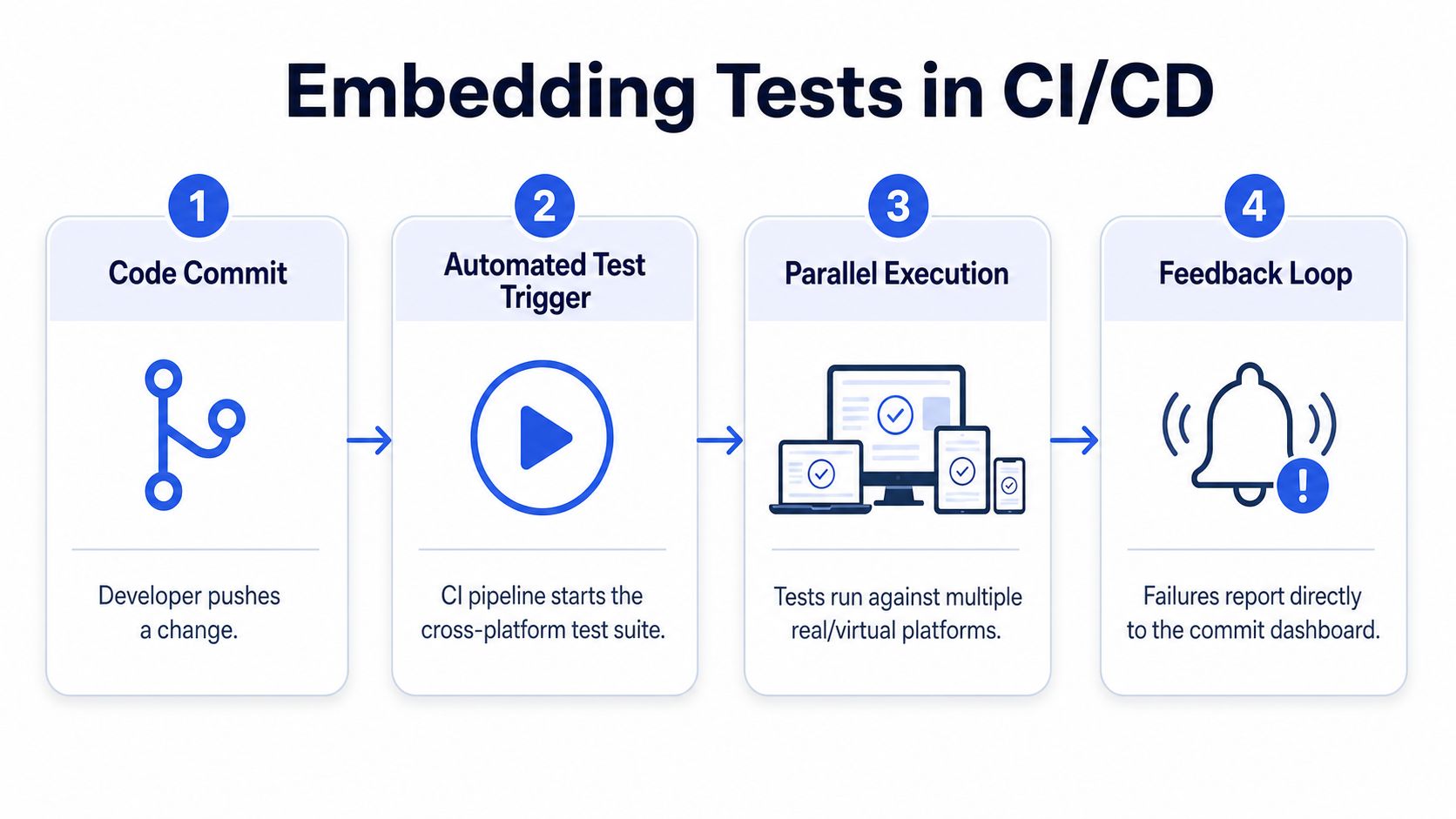 A diagram illustrating the four steps of embedding automated testing into a CI/CD development pipeline.
The thing to avoid is fake confidence. If your pipeline only proves that tests can run, not that failures are actionable, you have just moved the manual pain earlier in time. A good CI/CD setup gives you fast feedback on the cheap path and strong coverage on the expensive path.
For teams that are already tired of wiring and re-wiring platform quirks, a managed layer such as white-label social media management can be the cleaner path. It cuts down the amount of CI/CD plumbing you own and leaves your engineers focused on the parts that differentiate the product.
When the Smart Move Is Not Building It Yourself
There's a point where cross-platform testing stops being a testing problem and becomes a permanent integration tax. That shows up when your team spends more time chasing OAuth refresh bugs, polling media containers, and patching platform-specific quirks than improving the product itself. At that stage, the honest question isn't “can we build this,” it's “should we own all of it.”
The maintenance cost is the real bill
Every platform adds ongoing work. You have to track auth changes, keep up with API version drift, handle status polling, and retest the same publish path whenever one vendor changes behavior. Even if the first integration is straightforward, the long tail never stays simple.
A unified layer is often the cleaner answer for SaaS teams, AI agent builders, no-code automators, and white-label agencies because it turns a ten-platform problem into one API surface. The business logic stays in your product, while the platform-specific churn gets absorbed elsewhere. That's also why white-label social media management is often a better fit than wiring and maintaining every endpoint yourself.
A practical build-versus-buy filter
Build it yourself if platform behavior is a core differentiator and you're prepared to own the ongoing maintenance.
Delegate it if your product just needs dependable publishing and your team would rather ship features than babysit integrations.
Delegate it sooner if the test matrix keeps growing faster than the product value it protects.
The escape hatch isn't about avoiding engineering work. It's about spending that work where it compounds. If the core problem is testing and maintaining nine different social surfaces, then a unified publishing layer can be the more rational choice.
 Screenshot from https://post-pulse.com
A CTA for PostPulse.
About the Author

Founder of PostPulse — a social media scheduling platform for creators and teams. Software engineer with a passion for building developer tools and simplifying complex API integrations across social media platforms.