How to Handle Sensitive Data in Apps and AI Workflows
Published on · Updated on
Tags:
You've probably seen the failure pattern already. A CRM record enters a Zapier automation, an AI summarizer turns it into a digest, Slack receives the result, and the workflow appears finished. Then you discover that the original email address sits in plaintext logs, a service-account token is cached in a GitHub Actions secret with broad access, and a webhook payload containing user IDs has been copied into an analytics platform.
That isn't a rare architecture mistake. It's a normal integration chain that nobody mapped end to end. Learning how to handle sensitive data means securing the movement, transformation, and deletion of data, not just encrypting the database where it started.
Table of Contents
Why Sensitive Data Breaks in Real App and Automation Stacks
A social publishing workflow makes the problem easy to see. Your application retrieves connected-account details, sends content and metadata through an automation layer, calls an AI service for formatting or moderation, and then publishes through one or more platform APIs. Each handoff can create a new copy in request bodies, retries, error queues, tracing systems, support dashboards, or vendor logs.
The system of record may be well protected while the surrounding tools persistently preserve the same data in less controlled locations. TLS protects data while it travels between services, but it doesn't prevent a middleware component from logging the decrypted payload. Encryption at rest protects a stored object, but it doesn't decide whether a service account should have been allowed to retrieve that object.
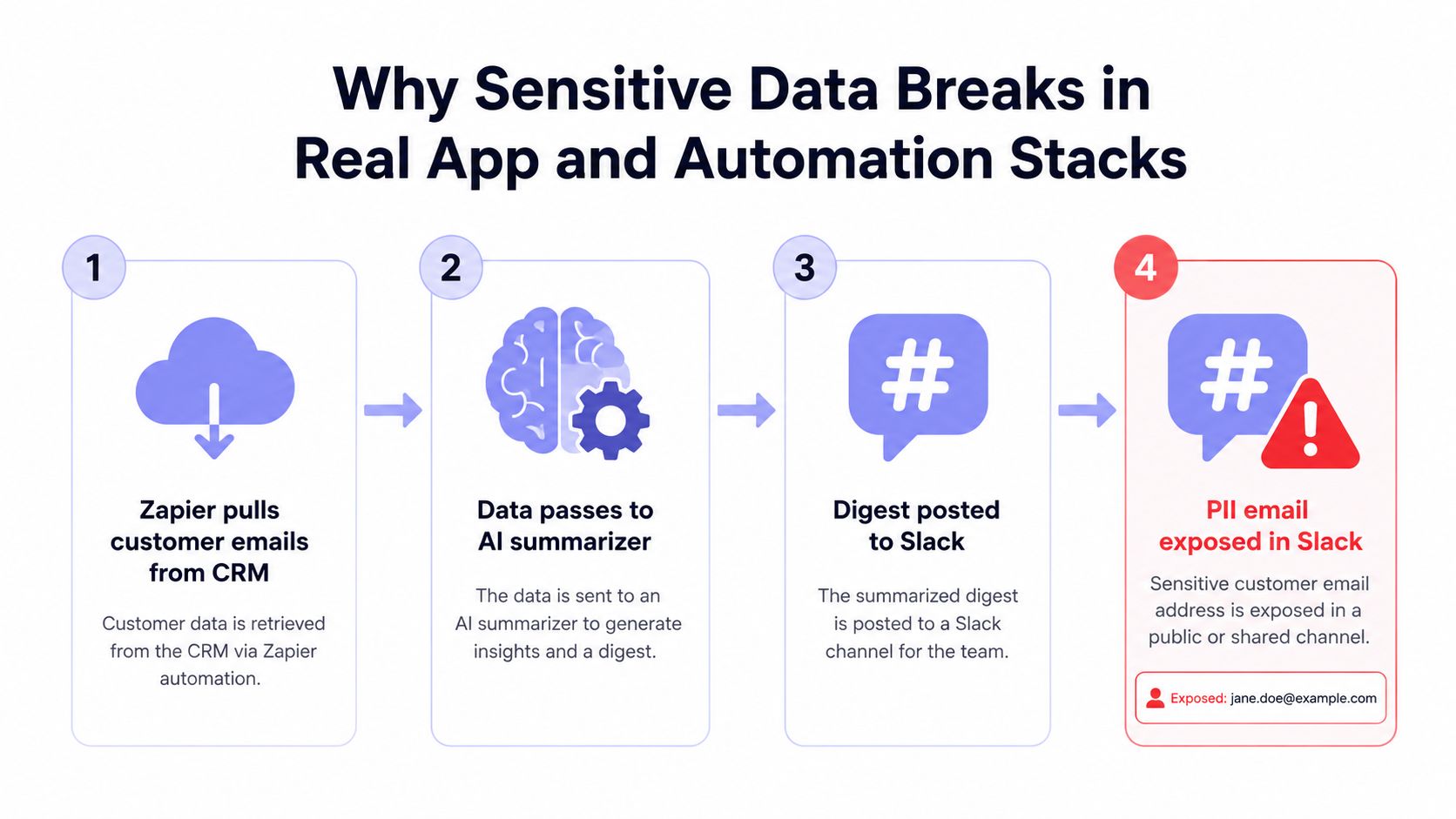 A four-step diagram showing how sensitive customer data can be exposed through automated AI summarization workflows.
Follow the payload, not just the database
Take the example chain:
A CRM API returns customer emails and account context.
Zapier forwards selected fields to an AI summarizer.
The summarizer response enters a Slack message.
Observability, analytics, and retry tooling retain parts of the request.
The exposure isn't limited to a compromised CRM. A leaked token can enable credential abuse, an overly broad OAuth grant can expose more records than the workflow needs, and a Slack or analytics integration can become an unintended destination for personally identifiable information. When one automation touches many downstream systems, every extra copy increases the number of identities, vendors, and retention policies you must understand.
NIST guidance recommends prioritizing data-loss controls by factors such as prior breaches, communication and data volume, likelihood of breach, and the number of users with access, rather than trying to protect every path identically. That's a better production approach than applying the same DLP rule to every webhook and hoping the system remains usable. The platform integration architecture guide is useful background for seeing how quickly a single integration surface can expand.
Treat AI governance as a flow-control problem
AI adds another transformation boundary. The model may receive raw text, retrieve context from connected systems, and return content that gets posted externally. Cisco's 2025 Data Privacy Benchmark Study found that 64% of respondents worry about accidentally sharing sensitive information publicly or with competitors, and nearly half acknowledged entering personal employee or non-public data into GenAI tools, as summarized in this AI governance compliance best practices guide.
The practical response is to map every input, output, cache, log, and identity. Redact before the AI request, restrict retrieval to the minimum dataset, prevent the agent from holding production-wide credentials, and require approval before generated content reaches an external audience.
IBM's reported breach figures show why this deserves engineering attention. The average breach cost was USD 4.44 million in 2025, compared with USD 4.88 million in 2024, and breaches taking longer than 200 days to identify and contain averaged USD 5.01 million. These figures are reported in recent data breach cost and volume statistics. Detection and containment aren't paperwork tasks. They're controls on the blast radius created by every connected workflow.
Classify and Minimize Data Before It Spreads
Classification should change a developer's decision at an API boundary. If a label does not determine access, logging, retention, or permitted destinations, it remains documentation rather than a control.
Use four practical tiers for app and automation workflows:
Tier | Examples | Handling Rule | Storage Requirement |
Public | Post timestamps, content IDs | May be shared when business context permits | Approved public or internal systems |
Internal | User preferences, scheduling configurations | Limit to authenticated staff and approved services | Managed business systems with access logging |
Confidential | OAuth tokens, API keys, email addresses | Minimize, redact in logs, and restrict by purpose | Encrypted stores and controlled service access |
Restricted | Passwords, payment information, government IDs | Avoid moving unless essential, isolate access, and monitor every use | Dedicated protected systems with strict retention |
Apply the classification to the data itself, not the product name. A routine social-publishing workflow can contain connected-account tokens, direct-message content, audience segment lists, and scheduling credentials. Each may cross several tools, even when the user sees one simple action. Pair the tiers with clear permission management strategies so service accounts and integrations receive only the access their tasks require.
Minimize at every handoff
Before sending a payload to an analytics vendor, remove names, email addresses, message text, and fields unrelated to the metric. An automation that only correlates events should use a surrogate identifier instead of a customer email address. A publishing call that creates a post should not request account data or permissions it never uses.
GDPR Article 5(1)(c) requires personal data to be adequate, relevant, and limited to what is necessary for its processing purpose, as explained by the ICO guidance on data minimisation. Use that requirement during design reviews: which exact fields does this service need, and what changes if the rest are removed?
Apply the rule in schemas and contracts:
Define the purpose: Write the business action before selecting fields.
Constrain the schema: Reject unknown or optional sensitive fields at service boundaries.
Use surrogate values: Keep raw identifiers inside the system that needs them.
Set retention behavior: Specify when temporary payloads, logs, and retries disappear.
Review the path: Confirm that the receiving vendor gets no more data than the contract permits.
Minimization also applies to retries, dead-letter queues, and observability systems. A payload removed from the primary database may persist in a queue or log, where wider access makes later exposure easier. The ICO storage limitation guidance recommends periodic review and erasure or anonymisation of personal data that is no longer needed. Avoid collecting information for hypothetical future use. Indefinite retention increases the impact of compromise and complicates deletion requests.
For further context on cross-tool movement, UTMStack's modern data exfiltration guide examines outbound paths. Enforce the minimum at the producer, validate it at the consumer, and inspect logs to confirm the policy operates in production.
Choose Protection Controls That Fit the Workflow
A protection control is successful only if developers can use it without bypassing it under delivery pressure. The right choice depends on what can leak, who can reach it, how many systems handle it, and whether the workflow can tolerate transformation or latency.
Encryption in transit is mandatory for service-to-service communication, but it doesn't solve plaintext logging after termination. Encryption at rest protects databases, queues, and object storage, yet an over-permissioned worker can still decrypt and export the contents. Apply both, then add field-level controls where downstream systems don't need the original value.
Tokenization is often a better fit for automation than passing raw PII. Replace an email address with a stable surrogate before sending the event to a third-party processor, and keep the lookup table inside a controlled service. Hashing can help with correlation, but it isn't automatically anonymous. If another system can reverse, join, or infer the value, continue treating the result as sensitive.
Match the control to the failure mode
Control Method | Best For | Risk Mitigated | Implementation Effort |
Encryption in transit and at rest | APIs, queues, databases, object storage | Interception and unauthorized storage access | Moderate |
Field redaction | Logs, prompts, analytics events | Accidental persistence of PII and secrets | Low to moderate |
Tokenization | Cross-tool correlation and external processing | Exposure of raw identifiers | Moderate |
Vault-backed secrets | Service accounts and production integrations | Secret sprawl and long-lived credentials | Moderate to high |
Short-lived tokens | AI agents and temporary workflows | Credential replay and extended access | Moderate |
DLP and egress inspection | High-volume exports and SaaS connections | Unauthorized transfer to downstream tools | High |
Environment variables can be adequate for a simple deployment when access to the runtime is tightly controlled, but they often become visible through debugging, process inspection, CI output, or misconfigured support tooling. A secrets manager provides a clearer ownership boundary, and dynamic credentials reduce the time available for token abuse.
For masking and tokenization pipelines, published benchmark data illustrates a real trade-off between workflow friction and control performance. One cloud-native masking study reported tokenization at 8 ms latency, 88% usability, and 100% compliance success, static masking at 12 ms, 90%, and 100%, dynamic masking at 20 ms, 85%, and 98%, and encryption masking at 35 ms, 95%, and 100%. These figures appear in the NIST-published masking study. Treat them as benchmark results for that study, not universal promises.
The useful decision is not “encrypt everything” or “mask everything.” It's to benchmark the specific path, choose the least disruptive control that prevents disclosure, and still manage keys, access, monitoring, and notification readiness. The data security practices for 2026 resource offers additional implementation context, but your own payload traces and access reviews should determine the final design.
Stop Leaks Through Identities and Connected Tools
Encrypting a database doesn't protect a workflow whose service account can read the database, call an external webhook, and write the response into a shared log. In integration-heavy systems, the identity path is often more important than the storage location.
A Zapier connection with excessive OAuth scopes may retrieve customer emails when it only needs post metadata. A GitHub Actions job can expose an API key through an environment-variable mistake or verbose command output. A Slack bot with a persistent token can remain authorized after the employee who configured it leaves the organization.
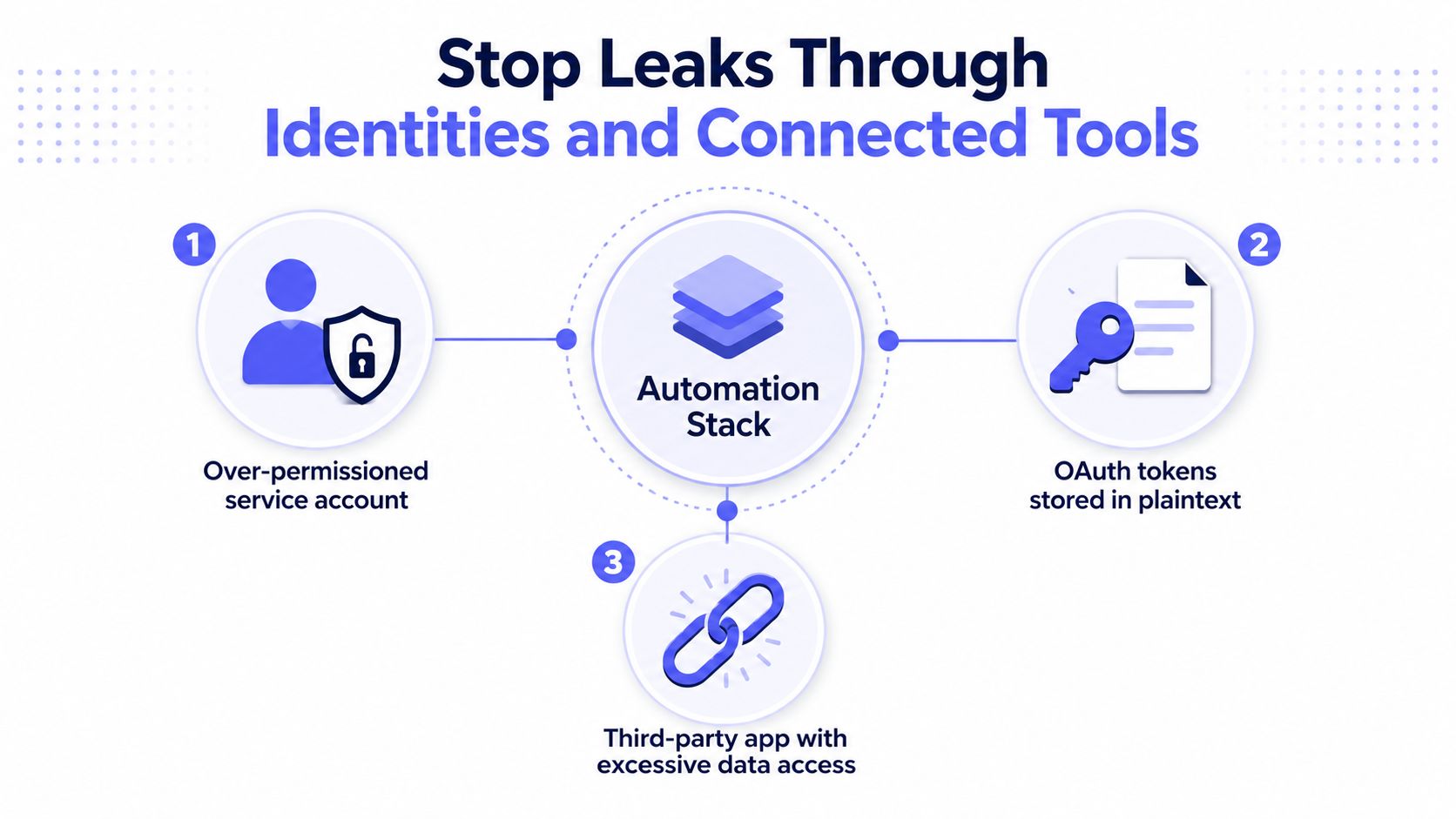 A diagram illustrating how to prevent security leaks through identities, automation stacks, and connected third-party tools.
Build around least privilege
Start with separate identities for separate jobs. A worker that publishes content shouldn't also read direct messages, export audience lists, or administer connected accounts. Give each OAuth client the narrowest documented scopes required for its operation, and reject requests that attempt to use a broader identity than the workflow needs.
NIST SP 800-171 Revision 3 is the current NIST publication for protecting Controlled Unclassified Information in nonfederal systems and organizations. NIST says it supersedes Revision 2 and was published in May 2024, making the official SP 800-171 Revision 3 publication the appropriate baseline for those environments.
Use an identity review that follows the actual path:
Inventory connected apps: Record which service owns each token and what data it can read or write.
Separate runtime identities: Don't reuse a human administrator token inside a background worker.
Rotate automatically: Make token replacement a scheduled operation, not an emergency-only procedure.
Inspect egress: Alert when a service sends sensitive fields to a destination outside its approved contract.
Redact at the proxy: Strip emails, tokens, and identifiers before requests reach analytics, support, or AI vendors.
Revoke on change: Remove tokens when a user disconnects an account, a workflow is retired, or ownership changes.
The most useful test is deliberate failure. Revoke a service token, disable a connected app, and simulate a leaked webhook secret. If the workflow keeps operating with unexplained access, your identity boundaries aren't clear enough. Assume one integration will eventually be compromised, then make sure it can reach only the data and actions assigned to it.
Handle Sensitive Data Safely in AI and Productivity Tools
A support ticket can move from a CRM to a help desk, then into an AI assistant and finally into a public reply. Each handoff creates another place where sensitive data can be copied, cached, logged, or exposed. Cisco found that nearly half of respondents admitted entering personal employee or non-public data into GenAI tools, according to the 2025 Data Privacy Benchmark Study summary. Deloitte's research also indicates that willingness to share sensitive financial, biometric, and communications data remains low, with more than half of respondents unwilling to share even for improved experiences.
Keep assistants available, but place sanitization and authorization between the workflow and the model.
Redact before retrieval and generation
A controlled request pipeline should:
Inspect the source: Identify which CRM fields, tickets, documents, messages, and databases can enter the prompt.
Classify the fields: Apply sensitivity tiers to emails, access tokens, credentials, customer messages, and proprietary documents.
Replace raw values: Convert direct identifiers into placeholders or surrogate IDs before retrieval.
Constrain retrieval: Give the agent only the smallest approved collection needed for the current task.
Validate the output: Scan generated content for secrets, PII, internal URLs, and restricted business material.
Require approval: Hold content for external audiences until a human or policy gate approves it.
Do not give an AI agent a production database credential for convenience. Use a read-only service identity, a narrow query interface, and explicit tools for approved actions. Redaction must run before the prompt is sent, because removing data after the model receives raw content is too late.
Review the AI vendor's retention, training, caching, access, and deletion controls before sending customer data. For highly sensitive tasks, a private deployment or local processing boundary may fit the workflow, but it still requires access control, key management, monitoring, and deletion rules.
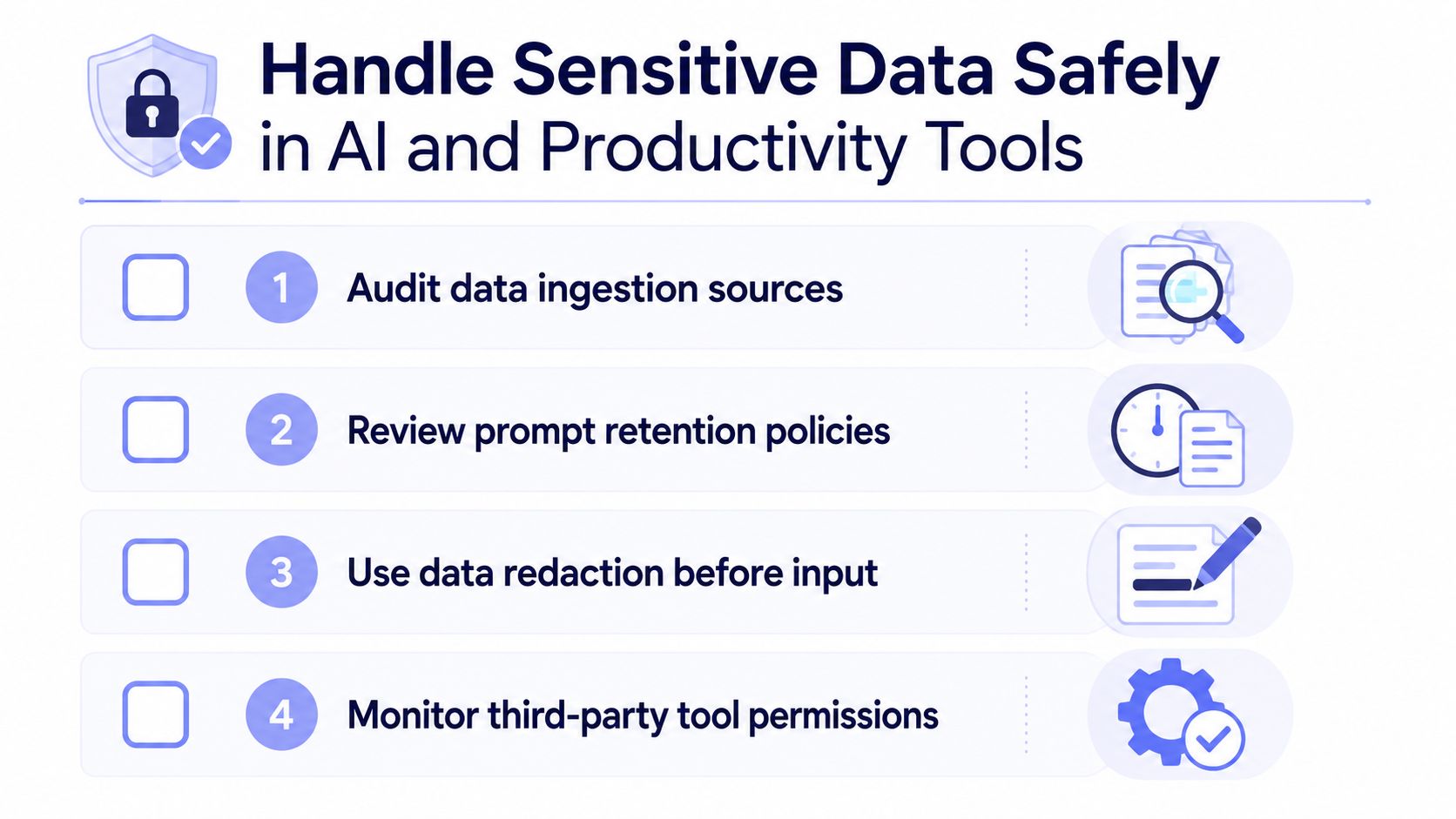 A checklist infographic illustrating four essential steps for handling sensitive data safely in AI and productivity tools.
Let the agent propose an action, then have a separate policy service decide whether it can execute. That service can check the destination, data class, identity, approval status, and account ownership without exposing the full record to the model.
For autonomous publishing workflows, the guide to creating an AI agent offers product-oriented context. Keep publishing permission separate from permission to read source systems, and log both the input classification and final action.
Make Compliance and Incident Response Part of the System
Compliance fails when evidence exists only in spreadsheets and memory. A durable automation stack records why a service accessed data, which identity made the request, what fields crossed the boundary, where the result went, and when temporary copies were removed.
GDPR has made this operational responsibility global since it took effect on 25 May 2018. Cumulative GDPR fines reached about EUR 7.1 billion by 10 January 2026 across surveyed jurisdictions, and Europe averaged 443 personal data breach notifications per day in 2025, up 22% year over year, according to the DLA Piper GDPR fines and data breach survey. Customer PII was the most frequently breached category in 2024, at about 48% of global breach incidents, in the same survey.
Turn requirements into observable controls
Control | Regulatory Alignment | Implementation | Detection Method |
Data minimization | GDPR purpose limitation and data minimization | Schema allowlists and field-level contracts | Rejected fields and boundary alerts |
Retention and deletion | GDPR storage limitation and data-subject rights | Automated purge jobs with approval for exceptions | Deletion logs and stale-record reports |
Access control | GDPR integrity and confidentiality, SOC 2 access principles | Least-privilege roles and separate service identities | Access reviews and anomalous-use alerts |
Audit trails | Accountability and SOC 2 evidence expectations | Immutable records for access, export, and policy decisions | Evidence queries and review dashboards |
Incident playbooks | GDPR breach response obligations | Revoke, isolate, assess, and notify procedures | Exercises, alert tests, and response timestamps |
The breach workflow should be executable, not aspirational. For a leaked token, revoke it, identify the services and accounts it could reach, inspect recent use, replace the credential, and preserve the relevant evidence. For PII exposure, stop the pipeline, block the destination, identify all copies, remove unauthorized records where possible, and involve the people responsible for legal and customer communications.
GDPR's 72-hour breach notification rule makes detection and response time operationally important, as reflected in the NIST guidance cited earlier. Your logging needs enough context to support a decision, but it shouldn't record the sensitive payload merely to prove that the request happened.
Retention automation deserves the same engineering care as ingestion. Define deletion behavior for queues, retries, logs, analytics events, AI caches, and exported reports. Then test it. A policy that says “delete after the purpose ends” is weaker than a scheduled job that removes the record and emits an auditable result.
Run tabletop exercises around the paths people use: an OAuth token copied into a ticket, a service account sending customer data to an unapproved webhook, and an AI agent generating a post that contains private content. The result should be a short, rehearsed sequence with named owners, automated containment, and clear escalation.
PostPulse can fit one part of this architecture as a publishing layer for apps, automations, and AI agents. It provides a unified publishing surface for ten platforms through a REST API, official n8n and Make.com integrations, or an MCP server, while using OAuth 2.0 for connected accounts. Treat it like any other processor: minimize what enters the workflow, restrict identities, and verify the vendor's retention and security controls before sending sensitive material.
Build one end-to-end data-flow map this week, starting with a real automation rather than a policy document. Then remove unnecessary fields, narrow every connected identity, and add redaction before logs, analytics, and AI requests. If your product needs governed social publishing across connected accounts, visit PostPulse to evaluate its API, automation nodes, and MCP-based workflow against your own access and retention requirements.
About the Author

Founder of PostPulse — a social media scheduling platform for creators and teams. Software engineer with a passion for building developer tools and simplifying complex API integrations across social media platforms.