REST API Integration Testing: A Step-by-Step Guide
Published on
Tags:
Your publish endpoint returns 200, your dashboard turns green, and nothing posts. Or the carousel container sits at IN_PROGRESS forever, the token that worked an hour ago is suddenly rejected, and one destination in a four-platform fan-out drops the media while the other three succeed.
That's the normal failure mode for social publishing integrations, and it's why REST API integration testing can't stop at status codes. You need tests that prove the business outcome, not just the transport. A 2xx response is not success if the platform never accepted the content, the async job never finished, or your client retried itself into a duplicate post.
Table of Contents
Which Test Layer Catches Which Integration Bug
A mocked publish succeeds, but the provider rejects the live request because it expects another media type. Or the container ID returned by the first call fails in the third. Those failures come from interactions between requests, authentication, and provider behavior, so a passing unit test cannot rule them out.
Each test layer exposes a different class of bug. A unit test can verify your client's serialization or retry calculation. A contract test can catch a request or response shape that no longer matches the OpenAPI specification. Neither proves that a real publishing sequence completes or that the destination accepted the content.
Test Layers Compared for REST API Integrations
Layer | What It Verifies | Catches Best | Relative Cost |
Unit | Serialization, backoff calculation, token refresh logic | Bugs in your own client code | Lowest |
Contract | Request and response shape against the OpenAPI spec | Schema mismatches and drift | Low |
Integration | Real request chains across auth, dependent calls and status codes | Sequencing and data-handling failures | Medium |
Live probe | Real permissions, token refresh, rate-limit headers | Vendor behavior no mock can reproduce | Highest, run on a schedule only |
The table is a guide to trade-offs, not a reason to choose only the cheapest test. Contract tests run quickly and check whether fields exist and keep the expected types. They cannot show that a token refresh fails against real OAuth, that a later call rejects an ID returned earlier, or that your client marks a rejected publish as successful.
Integration tests exercise those chains with provider-like behavior and the actual dependencies between calls. They are the layer most likely to catch a sequencing bug before release. They still cannot reproduce every vendor change, permission difference, or live rate-limit response, so scheduled probes cover behavior mocks and test environments may miss.
Practical rule: Run contract tests on every commit, integration tests on every merge, and live probes on a schedule. Each layer catches failures the others can miss.
Generated tests can help expand a test suite, but they need review against publishing workflows. A generated request may be valid in isolation while missing the sequence that creates a media container, submits it, and checks the resulting status. A platform can return a 2xx response and still leave content unpublished, so tests should assert the business outcome as well as the response.
For a fan-out, assert each destination's result independently. If three platforms accept a post and the fourth quietly rejects it, an overall success flag hides the failure. Keep that outcome check in an integration test, then use a live probe to confirm the actual provider path on a schedule.
How to Build a Layered Test Pipeline Step by Step
A publishing request can return 2xx and still fail its business purpose. A platform may accept the request, then silently reject the content, or one destination in a fan-out may fail while the others succeed. Build each pipeline stage to catch a different failure, from a stale API specification to an incomplete publishing outcome.
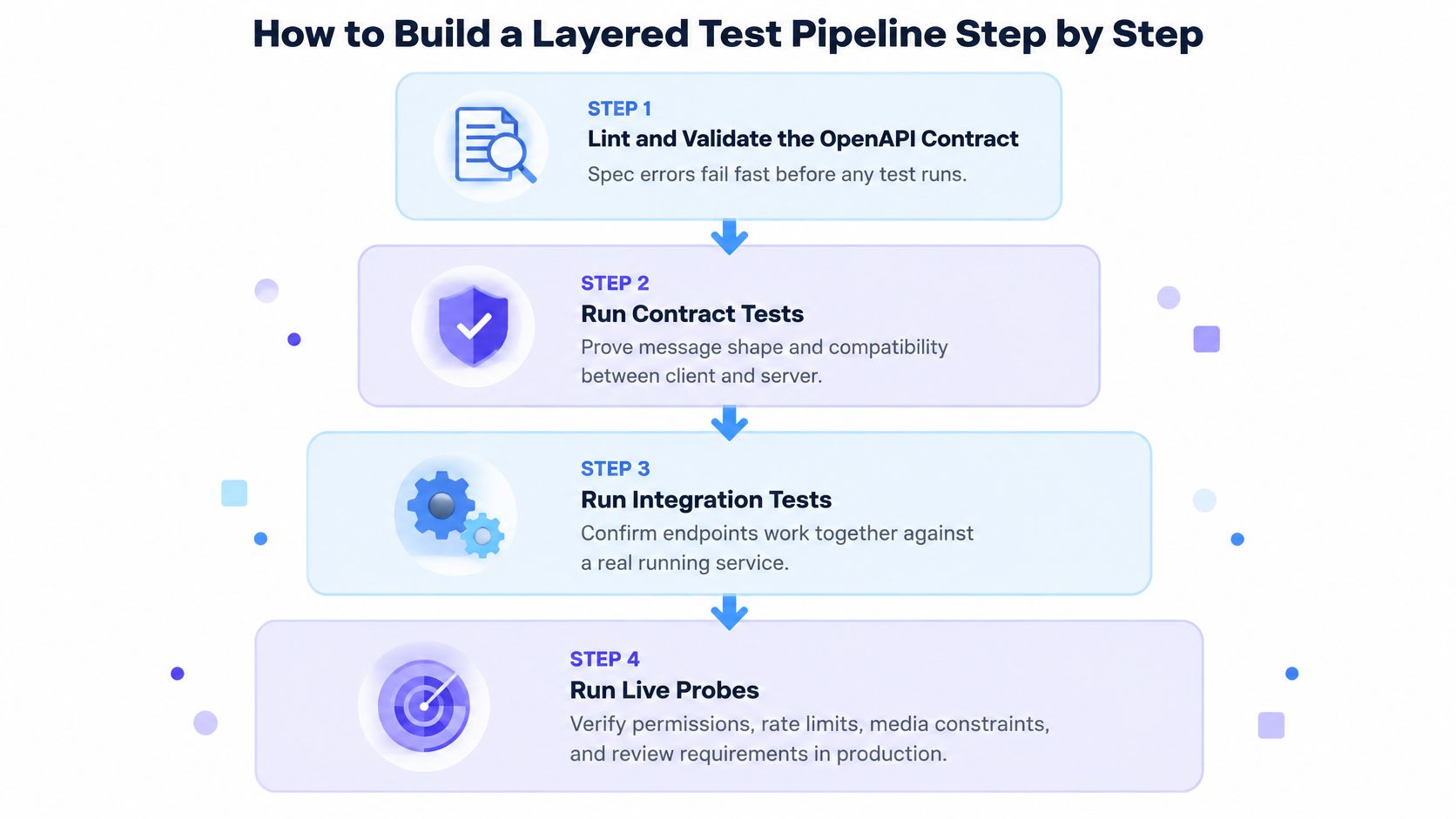 A four-step diagram illustrating how to build a layered test pipeline for software development processes.
The Five Steps in Order
Lint and validate the OpenAPI contract. Run this before other tests so specification errors fail quickly. A common failure is a spec that has drifted from the implementation, leaving tests to rely on a document nobody ships.
Test core behavior in a production-like environment. Cover authentication, authorization, request schemas, status-code mappings, headers, pagination, idempotency, retries, and error bodies with real authentication and policy enforcement enabled. Mocked authentication can make tests pass even though production policy would reject the request.
Run provider-consumer contract tests in CI. These check that the client and provider still agree on message shape. They cannot confirm that content was published. Treating a valid payload as proof of a successful publish leaves silent rejection undetected.
Run deploy-time smoke tests after each release. Use a small, safe set of calls against the actual integration path. Verify that the deployed build, environment, and credentials can complete the request chain.
Schedule runtime synthetic checks. Vendors can change behavior between your releases. Checks against the live integration catch changes your deployment tests could not have seen.
Use mocks selectively. Mock only unstable or costly third-party dependencies, and keep other behavior real, especially authentication. A mock encodes an assumption about how a dependency behaves. When that assumption goes stale, a green test run can hide a production failure.
What Gates a Merge and What Doesn't
Block merges on deterministic contract, authorization, and core integration tests. They should be stable enough that a failing build points to a defect worth investigating. Run fuzzing, dependency scanning, and load tests on a separate schedule. If noisy failures block every merge, developers may stop trusting the results.
The RESTest evaluation examined six APIs across 41 endpoints, reached approximately 56% overall API coverage, and identified nine potential faults in five APIs. It found that constraint-based, adaptive-random, and random test-generation strategies outperformed fuzzing for finding faults in those APIs, as reported in the RESTest evaluation on arXiv. Those results describe test-generation strategies, not a layered pipeline. Generated tests are useful candidates, but add designed negative cases to check specific failure paths rather than assuming generated requests cover them.
For a publish call, trace the result beyond request acceptance. Check the returned status through to completion, then confirm the business outcome on the destination. A 2xx response alone cannot tell you whether the content appeared, and in a fan-out, each destination needs its own verified result.
Fixtures Every Publishing Integration Needs
A mock that always returns 200 is a test that can't fail. It proves your client can parse a success response you wrote yourself, which you already knew. Fixtures earn their keep by reproducing the failure states that happen at 2 a.m.
Build them per destination, because platforms fail differently. One rejects your aspect ratio, another throttles you, a third accepts the upload and fails during processing.
Fixtures to Build for Each Publishing Destination
Fixture | Simulates | Key Assertion |
OAuth state | Expired or revoked token | Client refreshes, or fails with a clear permanent error |
Token refresh | Refresh succeeds, then fails | New token is stored and used on the next call |
Media constraints | Unsupported format, size or aspect ratio | Rejected before publish, with the provider's reason kept |
Rate-limit response | HTTP 429 with retry hints | Waits, backs off, and stops at the retry ceiling |
Duplicate publication | Same logical post sent twice | Only one live post exists |
Partial success | One destination publishes, another rejects | Result reports per-platform status, not a blanket success |
Provider 5xx | Transient server failure | Classified as retryable, with bounded retries |
The partial success fixture is the one teams skip and regret. In a fan-out, "the publish call succeeded" is a meaningless statement. Your result object needs a status per platform, and the fixture should assert that a rejection on one destination doesn't get flattened into overall success or overall failure.
A short walkthrough of fixture-driven test setup is worth watching before you build your own set.
Three habits keep fixtures useful. Record real responses once with secrets redacted and replay them deterministically, so you're testing against what the provider really sends. Keep one fixture for every provider-specific failure mode you've seen in production. Name fixtures after the failure, not the endpoint, so a red test tells you what broke before you open the logs.
Fixtures also go stale. Vendors change error bodies and behavior, and your recordings slowly become fiction. Refresh them from your live probes on a schedule.
Every defect you find in production gets a permanent fixture. If it happened once, the suite must keep detecting it forever.
Contract Tests and Live Probes Working Together
A publish request returns 200, but the platform rejects the post without saying so. A contract test may pass because the request matches the expected schema. It cannot prove that permissions, account settings, media rules, or the provider's production behavior allow the content to publish.
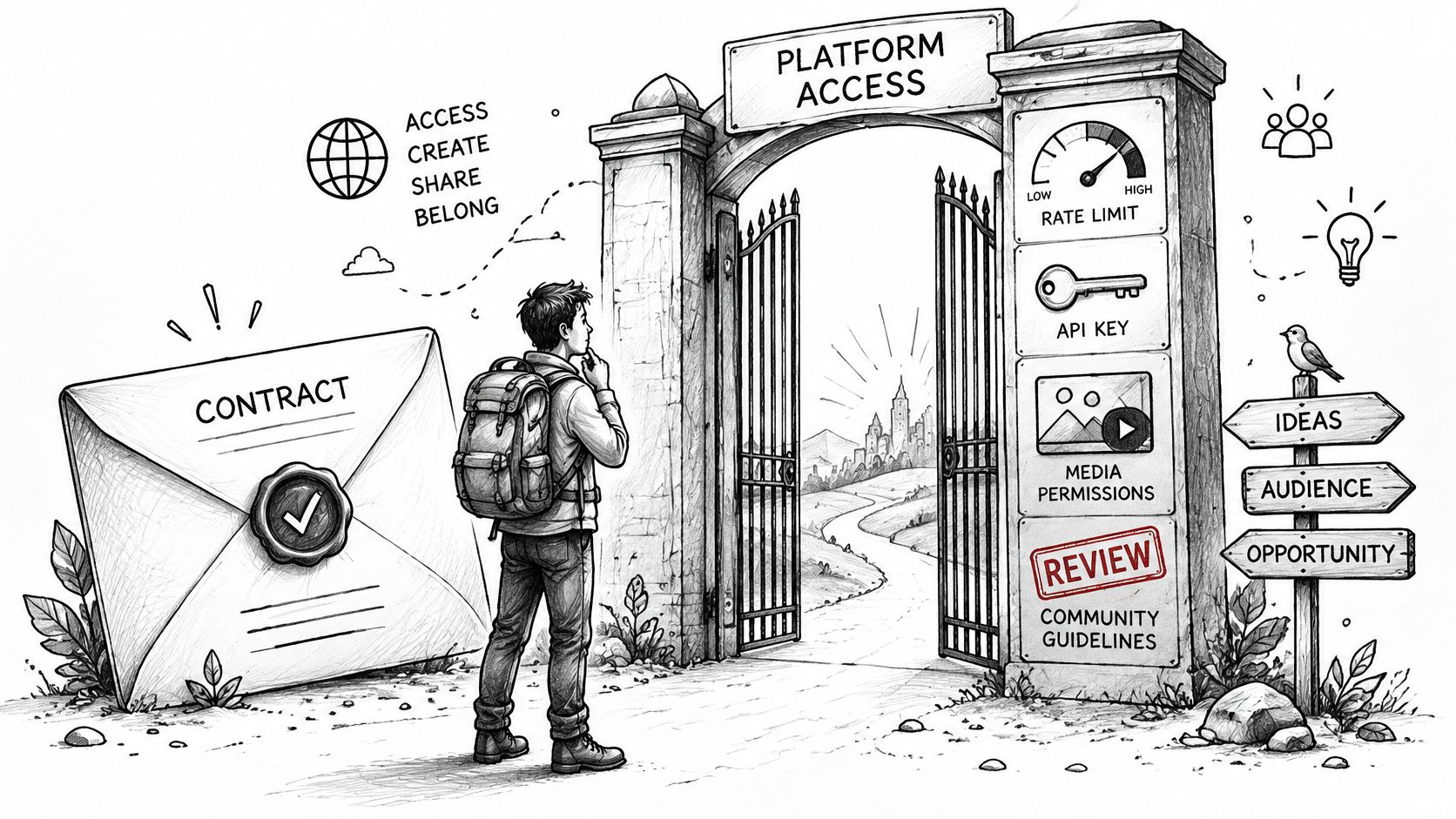 A traveler stands before a gate representing platform access, depicting API integration concepts and community guidelines.
That gap calls for two test layers. Contracts catch incompatible request and response changes before release. Live probes check whether real credentials and platform behavior still support the workflow. Neither layer proves the business outcome alone.
A Hybrid Operating Model That Works
Contracts in CI: Run provider-driven and consumer-driven contract tests on each change. Use synthetic or recorded fixtures to keep results deterministic.
Schema-drift checks: Compare the live specification with your stored copy, so vendor changes trigger a test failure before users report them. Clear API documentation practices make those comparisons easier to maintain.
Scheduled live probes: Test each important dependency with authenticated calls. Verify permissions, token refresh, rate-limit headers, and version changes.
Success and failure paths: For each platform, probe a valid publish and a rejection path. In a fan-out, assert that the result reports each destination's status separately. A successful response from one platform must not hide a rejection or silent failure at another.
Keep probes side-effect free. Use a private test destination and clean up afterwards, or use validate-only calls when the provider supports them. Check the resulting post or platform status, not just the HTTP response: a 2xx alone does not confirm publication.
Run the live set daily without exhausting quota. Keep it small enough to run consistently, and choose probes that verify outcomes your contracts cannot observe. Contracts catch shape and compatibility changes; probes expose expired access, provider-side restrictions, and failures that appear only against the actual service. A useful hybrid suite makes each layer's limits clear and covers the gaps between them.
Testing Rate Limits, Retries and Async Status
A carousel can remain at IN_PROGRESS for minutes. A 429 can also arrive midway through a fan-out: two destinations accept the post, two do not, and a careless retry creates duplicates on the successful destinations. A 2xx response is not proof of a business outcome. Test each destination's result and the final state users see.
The Retry Model to Test Against
Retry logic needs bounded delays, jitter, and a clear stopping point. Google's Admin SDK Directory API documentation describes waiting 1 second plus a random number of milliseconds after a retryable error, then increasing the backoff when retryable errors continue. It identifies distinct quota failures, including userRateLimitExceeded, quotaExceeded, and rateLimitExceeded, and advises clients to slow down rather than keep resending. See Google's Admin SDK Directory API quota documentation.
Apply those mechanics to the provider's documented behavior: retry only failures classified as retryable, increase the delay, add jitter, and stop at a configured attempt or time limit. Delays differ by API, so check the provider's current limits before encoding them in tests. This guide to evaluating API limits can help structure that review.
Retry and Async Scenarios to Test
Scenario | Expected Client Behavior | Assertion to Write |
Retryable quota error (userRateLimitExceeded) | Delayed retry with 1 second plus random jitter | Second attempt does not share a timestamp with the first |
Persistent throttling | Retries stop at the configured count or elapsed ceiling | Request ends as failed, with no loop |
Daily quota exhausted | Not treated as a backoff case | Fails permanently with the quota error preserved |
Pending async task | Polls with increasing intervals | Stops at the done state, or fails at the timeout |
Terminal task error | Stops polling immediately | Error reaches the caller, and no success is recorded |
Quotas Have More Than One Scope
Model project and user quotas separately. The current per-project and per-user figures can change, so confirm them on Google's Calendar API quota documentation before writing tests against specific thresholds. Test both scopes and inspect the structured error body, not only the status code. A 403 quota error and a 429 rate-limit error can require different operational responses.
Exercise multiple users sending requests concurrently, then test one user sending a burst while others stay idle. These cases reveal whether one account's throttling blocks unrelated accounts. They also catch a platform rejecting content without any visible error: assert the documented result, not just that the request returned.
For async work, poll at increasing intervals until the documented done state or a timeout. Google's Display & Video 360 guidance recommends exponential backoff when polling a long-running task, stopping when its done state is true or a maximum time has elapsed, as described in Google's Display & Video 360 quota guidance. Test immediate completion, pending then success, terminal error, and a task that never completes.
Never record success because the submission returned 2xx. Record it only after the documented completion signal, and verify the outcome for every destination.
CI Gates and Metrics That Show Real Coverage
A publish request can return 2xx while a destination silently rejects the content, or one platform can fail while the others succeed. Track outcomes per destination, not just API responses. That distinction is central to cross-platform testing.
CI Gates and Quality Metrics for REST API Integration Tests
Metric or Gate | Example Gate | Why It Matters |
Unexplained contract violations | Zero | Catches silent schema drift |
Authentication and authorization tests | 100% pass | Blocks merges that break access control |
Seeded-fault detection | Every planted fault flagged | Shows the suite can detect failures |
Retry amplification | No more than 2 retries per failed request, unless the provider contract specifies less | Limits request storms during throttling |
Failure classification | Every tested failure classified as retryable or permanent | Prevents duplicate posts and wasted retries |
p50, p95, p99 latency | Set per endpoint from its service objective; fail when a percentile exceeds that limit | Surfaces slow providers before users do |
Treat those retry and latency values as starting examples, not universal limits. Set the retry cap no higher than the provider's documented policy, then verify it with throttling tests. For latency, establish a baseline for each endpoint under representative test conditions and define limits against the time your publishing workflow can tolerate. Record the limits in CI so a change cannot weaken them without anyone noticing.
Seeded Faults Beat Execution Coverage
Plant faults on purpose: wrong status codes, omitted fields, stale tokens, duplicate deliveries, malformed media metadata, and platform-specific throttling. Require a specific test to detect each one. Code execution coverage can show which lines ran, but it cannot show whether the suite catches a destination that accepts a request and then rejects the post.
The principle in automated REST testing research is that generated tests can exercise an API without detecting its failures. The research indexed in the OpenAIRE record for automated REST testing supports treating test generation as a starting point, not proof of coverage. Review generated cases against observed defects, then keep a stable regression test for each production failure.
Report results per platform, separating partial-failure recovery from full success. Attach a correlation ID to each downstream request so one logical publication can be traced across destinations when an integration breaks. Track escaped defects and time to diagnosis too. A failing test that gives no useful context still leaves the on-call engineer searching logs.
Define the test matrix before reporting an aggregate pass rate: valid requests by platform, invalid media, expired tokens, insufficient scopes, timeouts, provider 5xx responses, retries, idempotency, and partial fan-out failures. A 2xx is only one signal. Confirm the business outcome on every destination.
Confirm Your First Five Tests This Week
You don't need a testing platform migration to start. Five tests, wired into CI, will catch the failures that hurt most.
Lint the OpenAPI file in CI so spec errors fail before anything else runs.
Add one contract test on the publish request schema, covering required fields and the success response shape.
Write an authorization test with an expired token and assert the client refreshes or fails permanently and clearly.
Simulate a 429 and assert backoff happens, timestamps spread out, and retries stop at the ceiling. Google's Docs API documentation notes that exceeding quota generally returns HTTP 429 and recommends retrying with exponential backoff, per Google's Docs API limits documentation.
Seed a duplicate delivery and assert only one live post exists afterwards.
Judge the first run skeptically. If all five pass immediately, break one on purpose. Change a status code, drop a field, expire the token harder. A test you've never seen fail is a test you don't yet trust.
Once the core five are stable, add scheduled live probes for the destinations you really publish to. That's when REST API integration testing starts catching vendor changes before your users do, instead of explaining them afterwards.
And keep the rule taped to the monitor. A 2xx response is not proof of publication. The finished post, confirmed on the destination, is.
If you're publishing to several platforms and tired of testing token refresh, rate limits, and retries separately for each one, PostPulse gives you one REST API that publishes to nine platforms with OAuth, refresh, and quota handling maintained for you. You still test the observable behavior, throttled, retried by policy, and reported as failed when a limit persists, but you test it against one integration instead of nine.
About the Author

Founder of PostPulse — a social media scheduling platform for creators and teams. Software engineer with a passion for building developer tools and simplifying complex API integrations across social media platforms.