
API Documentation Best Practices for Real Developers
Published on · Updated on
Tags:
You authenticate successfully, send a request that looks right, and get a 403 Forbidden. The response doesn't explain whether your token expired, the scope is wrong, the account belongs to a sandbox, or production applies a different rule. You search the documentation, find an endpoint page, and discover that the prerequisite was buried in an authentication paragraph three screens away.
That isn't a developer failure. It's a documentation failure.
API documentation is an operational contract, not a marketing page. It tells integrators what the service accepts, what it returns, which permissions apply, how failures behave, and what will change later. When the docs omit those details, integrations stall, support tickets multiply, and developers start treating the API itself as unreliable.
The useful standard is simple: a developer should be able to authenticate, make a first successful request, understand the response, recover from an error, and assess compatibility without opening a support ticket. The practices below are built around that standard, with OpenAPI, runnable examples, docs-as-code, release-aware versioning, and machine-readable contracts treated as one working system.
Table of Contents
The Moment Every Developer Knows Too Well
The request has all the familiar pieces. The bearer token is present. The endpoint path matches the reference. The JSON body validates locally. Yet the server returns a 403, and the documentation offers no breadcrumb back to the missing rule.
Maybe the access token expired. Maybe a scope rotated during a platform change. Maybe the account was created in a sandbox while the request went to production. Maybe the endpoint requires a permission that appears only in a separate OAuth guide. Those are different problems with different fixes, but a vague error and scattered docs make them feel identical.
Practical rule: Every failure response should help the reader identify the next action, not merely confirm that the server rejected the request.
This is why API documentation has to describe behavior, not just surface area. A list of endpoints says what exists. It doesn't tell an integrator how authentication behaves over time, whether retries are safe, how pagination ends, or which response fields are stable enough to store.
The strongest docs sites answer the developer's immediate question at the moment it arises:
Why did authentication fail?
Which scope does this operation require?
What does a successful response look like?
Can this request be retried safely?
What changed since the version I integrated?
The problem is widespread. A 2025 Postman survey summarized by independent API documentation guidance found that 55% of development teams struggle with inconsistent API documentation, making inconsistency the top collaboration barrier for API teams. The same guidance reports that 93% of developers say documentation quality is the most important factor in API adoption decisions, which explains why a polished reference page can't compensate for missing auth details or examples that fail at runtime.
This article treats documentation as something engineers ship, test, review, and operate. OpenAPI provides the contract, examples prove the contract, and the release process keeps both honest.
The Structural Pillars of a Docs Site That Works
A developer doesn't approach your docs in the order your organization built the API. They arrive with a task and a sequence of questions. Structure the site around those questions, not around internal service boundaries.
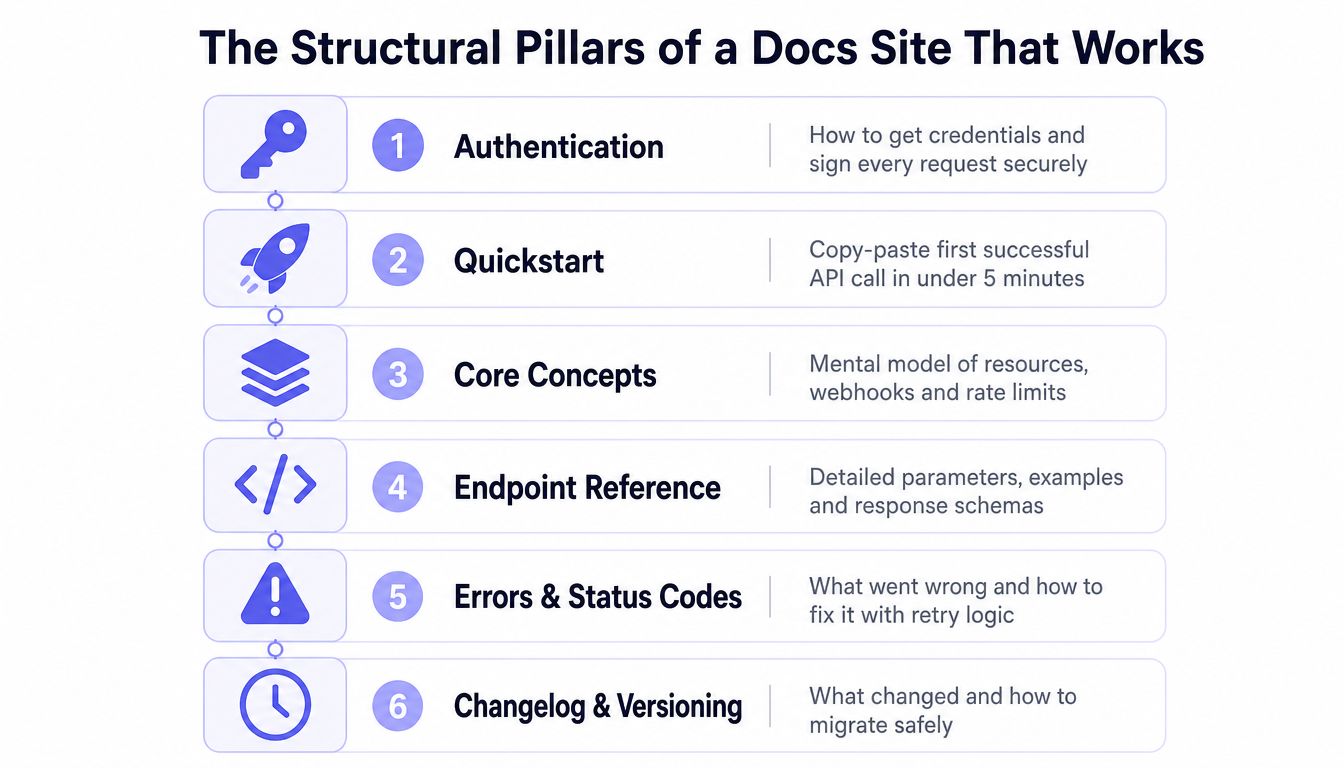 A diagram outlining the six essential pillars for building effective and user-friendly API documentation websites.
Authentication comes before reference
The first page must explain how to obtain credentials, where to place them, which environments exist, and how scopes map to operations. Show a complete request with the correct header. Explain token expiration, refresh behavior, revocation, and the distinction between test and production credentials.
Don't make readers infer security requirements from a 403. Put required scopes directly beside the endpoint operation, where the developer is deciding whether the request is ready to send.
Quickstart must end in success
A quickstart isn't complete because the reader cloned a repository or installed an SDK. It ends when the reader makes a successful API call and can compare the returned payload with an expected result.
Use a short path:
Create or obtain credentials.
Set the credential through an environment variable.
Send one minimal request.
Show the response and explain the important fields.
Point to the next task.
The page should make the first successful call obvious above the fold. This page structure, overview followed by a first-request code block, authentication, quickstart, reference, guides, errors, and changelog, is also recommended in API documentation guidance for 2026.
Concepts provide the mental model
Reference pages tell readers how to call an operation. Concept pages explain how resources relate, how webhooks are delivered, how pagination works, and which limits affect architecture. Keep these pages task-oriented. A concept is useful when it answers a design decision an integrator has to make.
Endpoint reference describes the contract
Every operation needs its method, path, purpose, required and optional parameters, accepted values, authentication requirements, request example, response schema, response example, status codes, and relevant errors. Mark required fields visually and distinguish omission from an explicit null value.
Errors and status codes should shorten debugging
Document the status code, stable machine-readable error identifier, human-readable explanation, likely cause, and corrective action. Include retry behavior where it applies. An error catalog without recovery guidance forces developers to search through unrelated guides.
SDKs and release information complete the loop
SDKs should mirror the request shape shown in curl, not conceal important behavior behind undocumented helpers. The changelog should identify additions, changes, deprecations, removals, fixes, security work, and migration requirements.
A useful external reference is Docs, Best Practices, especially for thinking about documentation as a navigable working surface rather than a static endpoint list. For a unified publishing integration, keep the same discipline in the PostPulse API documentation, where authentication, endpoints, and getting-started material need to support the actual integration path.
Leading with reference pages and hiding authentication is a common structural mistake. It optimizes for the team that owns the API, not the developer who has to use it.
Designing the OpenAPI Spec as the Single Source of Truth
OpenAPI should be the substrate from which your reference pages, validation, SDK inputs, mock responses, and contract tests are produced. It isn't a decorative JSON or YAML file added after the endpoint is finished.
Start with schemas that express the contract. Use oneOf for resources with distinct variants and pair it with a discriminator where clients need to select the correct shape. Use enums for finite fields rather than describing allowed values only in prose. Add format strings for dates, timestamps, and identifiers when the format carries meaningful validation information.
Reusable components matter because inconsistency usually enters through repetition. Put shared addresses, pagination objects, authentication errors, and error envelopes under components/schemas. Then reference those components instead of rewriting similar structures across operations.
A consistent error envelope is especially important. Every endpoint shouldn't invent a different location for the error code, message, request identifier, or documentation URL. Pin the shape in the spec so SDK generators, client validators, and automated agents can depend on the same structure.
Schema decisions that prevent drift
Field or Pattern | Recommended Approach | Drift Failure It Prevents |
Variant resources | Use | Clients guessing which fields apply to a resource type |
Finite values | Define enums in the schema | Prose listing values that code accepts differently |
Dates and IDs | Use precise format strings | Consumers treating timestamps or identifiers as arbitrary text |
Shared objects | Reference reusable components | Similar shapes diverging across endpoints |
Errors | Use one component for the error envelope | Each operation returning a different error structure |
Pagination | Define cursor fields and terminal behavior | Clients assuming offset pagination or missing end conditions |
Security | Declare schemes and apply them to operations | A scheme existing in the spec but not being enforced |
The dangerous failures are often small. An example contains a field the schema rejects. A field is required in production but marked optional. An SDK generator treats an optional parameter as mandatory because the schema uses the wrong composition. A security scheme is declared globally but omitted from a particular operation.
Run schema validation and example validation in CI. Don't rely on a renderer accepting the document. A page can render cleanly while its example request is impossible.
The spec is generated from code, or the code is generated from the spec. Never edit both independently by hand.
Teams also need to decide how humans and automation will use the contract. If your API integrates with AI-assisted workflows, a practical guide to using Claude via SupportGPT offers useful context for thinking about structured tool interactions. The same principle applies to your own API: explicit schemas beat implied behavior.
OpenAPI became a durable foundation partly because the specification moved toward open governance. The Swagger specification was donated to the OpenAPI Initiative under the Linux Foundation in 2015, and the OpenAPI Specification 2.0 donation date is listed as 2015-12-31 in this historical overview. By 2018, Swagger described OpenAPI 3.0 as the first major release since that donation. The important engineering consequence is not the date itself. It is the ability to define endpoints, schemas, and examples in a machine-readable form that tools can validate and render.
Writing Code Examples and SDK Snippets People Actually Run
Most API examples are decoration. They show a plausible request but leave out the detail that decides whether the request succeeds, such as the correct scope, content type, cursor parameter, signature calculation, or idempotency behavior.
A useful snippet follows three rules. It covers one concept, it runs as written, and it produces a response the reader can compare with their own output. Use environment variables for secrets instead of asking readers to paste placeholder credentials into a header.
Start with curl because it exposes the wire contract. Then provide Node.js, Python, and Go versions with the same method, path, headers, body, and expected response. If one language changes the request shape, developers can't tell whether a failure comes from the API or the SDK.
curl | Node.js | Python | Go |
Shows the exact HTTP request | Uses the platform's standard request client or official SDK | Keeps authentication and JSON handling visible | Shows explicit request construction and response decoding |
Reads credentials from the environment | Reads the same environment variable | Uses the same variable name and payload | Uses equivalent headers and body |
Displays the raw response | Prints parsed response data | Prints parsed response data | Decodes into a named structure |
Makes cursor or idempotency headers visible | Preserves those headers explicitly | Preserves those headers explicitly | Preserves those headers explicitly |
Four areas deserve extra scrutiny:
Authentication headers: Show the actual scheme, header name, and environment-variable pattern.
Pagination cursors: Use the returned cursor exactly as documented. Don't replace an opaque cursor with an invented offset example.
Idempotency keys: Demonstrate where the key goes, when it should remain the same, and what response the client receives on replay.
Webhook signatures: Show the raw body requirement, signing header, verification step, and failure response. Parsing or reserializing JSON before verification can change the bytes being checked.
For cursor pagination, use the provider's stated semantics rather than assuming offsets. The Webhook API documentation specifies opaque keyset cursors, allows up to 200 items per page, returns a nextCursor, and uses a null cursor to indicate the end of the list. Those details are documented in the Webhook API introduction.
Keep examples short enough to inspect. The practical target is under 20 lines per snippet, then run every example in CI against a mock server, sandbox, or controlled test account. The provider-perspective study linked in this API documentation usability research reported a SUS score of 85.8 for advanced documentation versus 75 for basic documentation, and its recommendations emphasize examples that cover common usage scenarios as concise, combinable units of functionality.
For teams building publishing integrations, consistent examples matter across REST calls and SDK wrappers. The social media SDK guide is a useful internal reference point for deciding whether an SDK example mirrors the underlying request.
Running Docs as Code Without Letting It Rot
Docs-as-code isn't just putting Markdown in Git. It means the documentation follows the same ownership, review, validation, and deployment path as the service it describes.
A workable repository keeps the service and its documentation close enough that a pull request can change both:
/docscontains guides, concepts, and migration notes.The OpenAPI document is generated from annotations or hand-authored and linted.
Snippet files live beside the pages that explain them.
The build pipeline renders the site and validates links.
CODEOWNERSnames an engineer and a documentation reviewer.
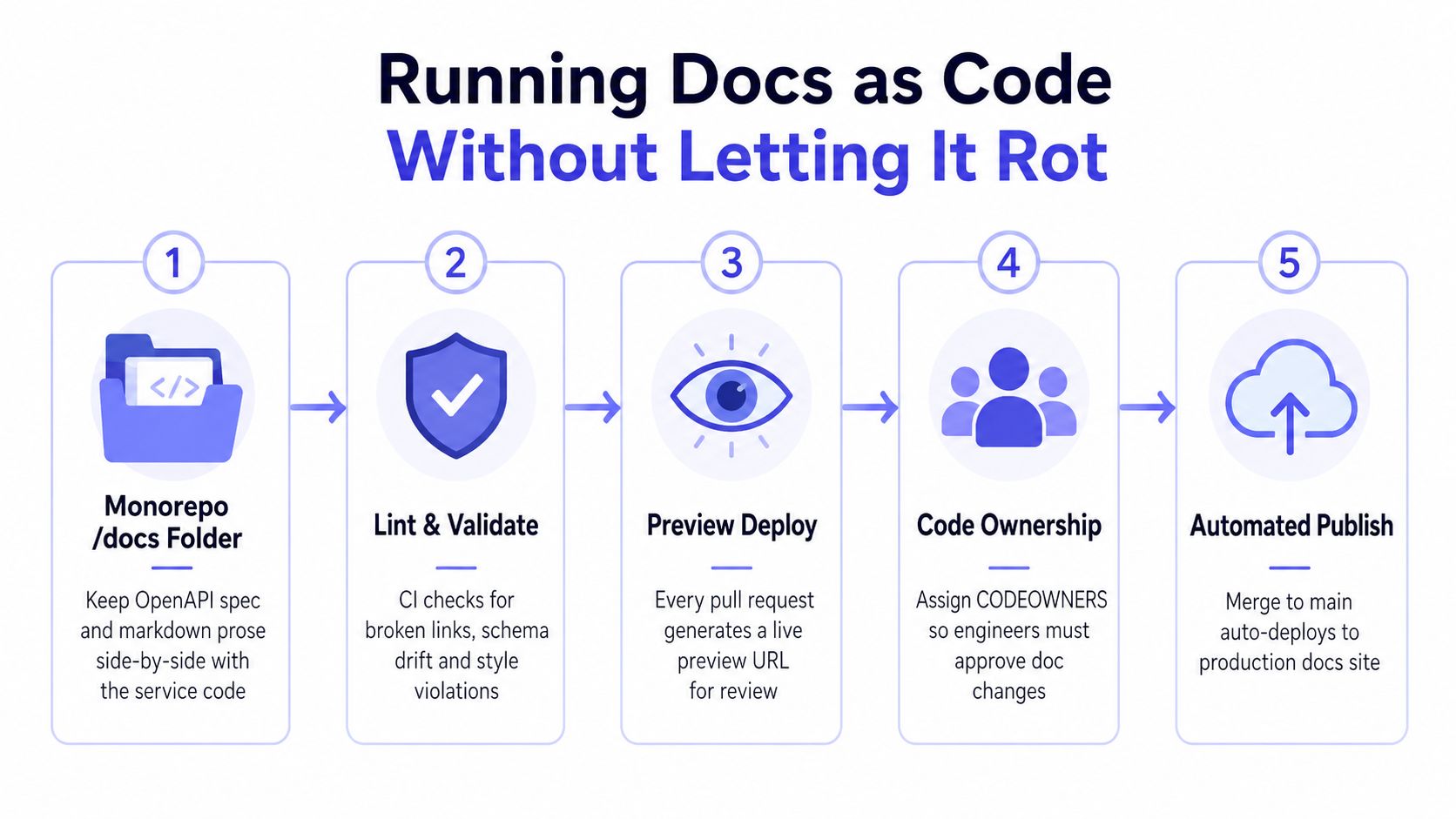 A five-step flowchart illustrating a Docs as Code workflow to maintain updated software documentation effectively.
CI should catch specific kinds of rot
A general “docs build passed” check isn't enough. Add gates that correspond to real failures:
OpenAPI linting: Use Spectral or an equivalent linter to catch missing descriptions, inconsistent operation IDs, invalid references, and weak schema definitions.
Link checking: Fail the build when internal or external links return 404 responses.
Snippet execution: Extract code blocks and run them against mocks, fixtures, or a safe test environment.
Prose checks: Run spellcheck and style checks, while allowing technical terms through a reviewed dictionary.
Schema validation: Confirm that examples validate against request and response schemas.
Preview deployment: Publish a live preview for every pull request so reviewers can inspect navigation, rendering, and generated reference pages.
The merge rule should be explicit: a spec change requires a corresponding guide, example, or migration update when user behavior changes. A CODEOWNERS review prevents a service change from merging while every documentation reviewer is asleep or unaware.
The docs repository should also preserve the review context. A future maintainer needs to see why a field changed, which version it belongs to, and whether the change is backward compatible. That information belongs in the pull request and changelog, not in an unreliable memory of a release meeting.
Versioning, Changelogs, and Deprecations Done Right
Versioning isn't a URL prefix. It's a compatibility promise.
URI versioning such as /v2/ is easy to discover and cache, but it can create duplicated references and encourage teams to treat the version as the only compatibility signal. Header versioning keeps URLs stable but hides behavior from casual inspection and can complicate debugging. A calendar-based version stance can communicate release timing clearly, but it requires disciplined migration language and a clear support policy.
Choose the model based on how integrators discover, test, and operate the API. Then document the compatibility boundary in terms users can act on.
A deprecation notice must answer five questions
Field | Example | Why it matters |
Affected operation |
| Lets readers identify the exact contract |
Announcement date | Date the deprecation was published | Establishes when the migration clock began |
Replacement | New operation or version | Gives the integrator a destination |
Sunset date | Planned removal date | Allows release planning |
Migration example | Old request beside the new request | Converts policy into implementation work |
Response signal |
| Lets clients detect the change programmatically |
Use the Deprecation and Sunset response headers where appropriate, and explain their meaning in the reference page. The notice should remain visible on the old operation until removal, with a direct link to the migration guide.
A changelog entry such as “API improvements” isn't useful. Organize entries under Added, Changed, Deprecated, Removed, Fixed, and Security, and include the affected operationId so readers can search their integration quickly. A migration note should identify request changes, response changes, authentication changes, behavior changes, and rollback considerations.
For auth lifecycle constraints, exact documentation is the standard. GitHub Enterprise Server, for example, documents a limit of ten tokens issued per user, application, and scope combination and a rate limit of ten tokens created per hour in its token expiration and revocation guidance. The lesson isn't to copy those limits. It's to publish the actual limits for your own service instead of saying “tokens are limited.”
Teams can study how products communicate feature updates and fixes when designing their own release pages. For API consumers, the useful unit is not a marketing announcement. It's a searchable operation, a compatibility statement, and a migration path. A practical versioning reference is also available in API versioning best practices.
Writing Docs for Humans and for AI Agents
An API page now has two readers. One is a tired developer trying to solve a production problem. The other is an LLM agent assembling a request, selecting a tool, validating arguments, and deciding whether a failure is retryable.
They use the same surface differently. Humans skim headings, copy examples, and infer relationships from narrative. Agents parse schemas, operation descriptions, enums, examples, error identifiers, and tool metadata. Designing separate human and machine sites sounds tidy, but the two versions diverge quickly and create twice the maintenance problem.
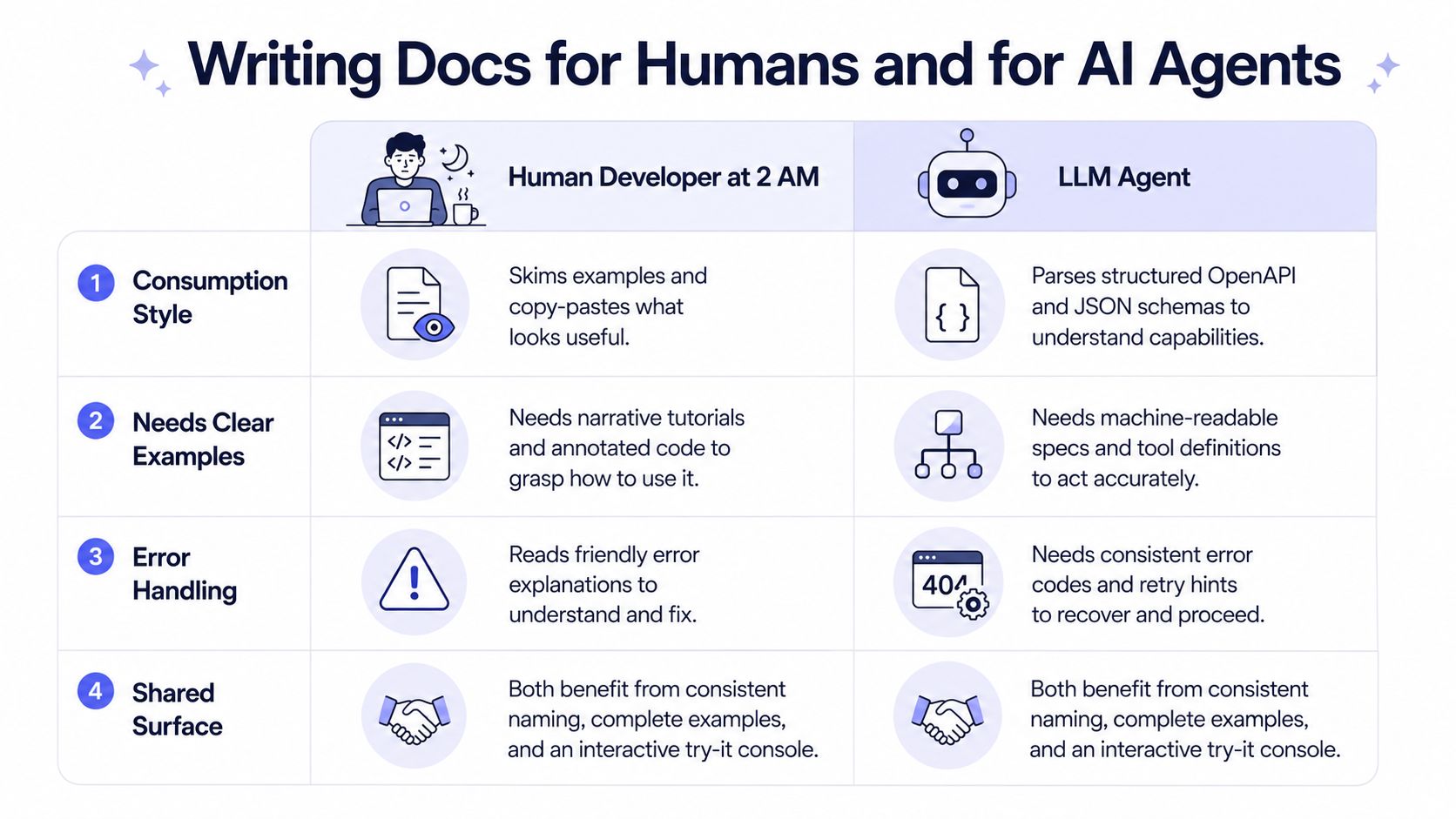 A comparison chart showing how to write documentation for human developers versus AI LLM agents effectively.
What machine-readable documentation changes
Error messages need stable identifiers, not only friendly prose. insufficient_scope is something a client can branch on. “You aren't allowed to do that” isn't.
Request and response schemas should round-trip through JSON Schema without undocumented fields appearing in examples. If an example contains fields outside the declared contract, an agent may copy them, a validator may reject them, or an SDK may discard them.
Examples should be valid and executable. If the SDK supports Node.js, Python, and Go, provide equivalent examples in those languages so an agent doesn't have to infer how a request maps from one ecosystem to another. Include the same authentication, pagination, retry, and idempotency behavior in each version.
Rate limits and retry semantics belong in headers, schemas, and explicit specification extensions where possible. A paragraph saying “please retry later” doesn't tell a client whether to retry, how long to wait, or whether repeating the request can create a duplicate.
The 2025 State of the API coverage from Theneo identifies machine-readable schemas, detailed OpenAPI examples, error codes, and uniform patterns as increasingly important because AI can parse them. The same source reports that 79% of respondents have adopted or plan to adopt AI in their API workflows, and stresses that documentation should explain when and why to use an endpoint, not just how. You can read that analysis in the 2025 API documentation best-practices guide.
Agent-readable docs checklist
Stable names: Use consistent resource, operation, field, and error identifiers.
Complete schemas: Declare required fields, nullable fields, enums, formats, and additional-property behavior.
Explicit intent: Describe when an operation should be used and when it shouldn't.
Executable examples: Validate request and response examples in CI.
Recoverable errors: Provide machine-readable codes and clear retry or correction guidance.
Visible limits: Document pagination, rate limits, timeouts, and idempotency in structured fields.
One shared surface: Render human explanations and machine-readable contracts from the same source.
This approach also helps human developers. A precise error code gives a person a search term. A complete schema prevents guesswork. A valid example lets someone copy the request without wondering which details were invented for illustration.
A usability-focused study found that developers valued documentation that was up to date, complete, easy to explore, and free from poor structure. It also reported that optimized documentation helped developers make fewer errors and complete tasks faster, while readers of developer-created annotations completed 67% more of the task than the baseline. Those findings are summarized in the API documentation usability study.
A pragmatic 30-day rollout
Week 1, audit the surface. Check authentication, quickstart, concepts, reference, errors, SDKs, changelog, and versioning. Compare the public pages with the OpenAPI document and record every mismatch.
Week 2, freeze the contract. Decide whether code or the spec is authoritative. Add schema validation, example validation, operation ID rules, and security checks to CI.
Week 3, establish the workflow. Put guides beside the service code, add preview deployments, configure link checking and snippet execution, and assign reviewers through CODEOWNERS.
Week 4, publish the release surface. Ship versioned docs, a searchable changelog, deprecation rules, migration templates, and visible freshness signals on changed operations.
Then keep one habit: a weekly 30-minute documentation standup where the on-call engineer brings one confused integrator ticket and the team fixes the page that caused it. Tooling catches syntax and drift. Only a feedback loop catches explanations that are technically accurate but operationally useless.
For PostPulse integrators, that operational model matters because a unified integration surface can concentrate upstream authentication, publishing, and platform behavior into one place. The docs still need to expose the contract clearly, but integrators shouldn't have to reconstruct every provider's token lifecycle and endpoint variation from disconnected portals.
PostPulse provides a unified publishing surface for apps, automations, and AI agents through a REST API, official n8n and Make.com integrations, and an MCP server, with one integration covering ten social platforms. If you're building a white-label workflow or need release-aware API guidance for social publishing, visit PostPulse and evaluate the documented integration path against your own docs-as-code standards.
About the Author

Founder of PostPulse — a social media scheduling platform for creators and teams. Software engineer with a passion for building developer tools and simplifying complex API integrations across social media platforms.