
How to Reduce Development Time Without Cutting Corners
Published on
Tags:
You add one social publishing feature, then discover it isn't one feature at all. The first API call succeeds, but the next week brings an access token that expires after 1 hour, a media upload that remains in progress, an account that needs separate setup, and an app review that blocks the intended workflow. Soon, the team is maintaining authentication, retries, status polling, provider-specific payloads, and release checks instead of improving the product.
The practical way to reduce development time isn't to push developers to type faster. It's to remove repeated work from the path between an integration request and reliable production behavior. A long-run analysis of software delivery describes a shift from projects taking over a year in the early 1980s to most projects completing in the 7- to 8-month range since 2000, a 45-year trend associated with better tooling, reuse, and processes documented in the Antenna code-time analysis. Social integrations are a useful example because the visible endpoint is small while the maintenance surface keeps expanding.
Table of Contents
Why Social Publishing Consumes More Time Than Expected
A social publishing integration often starts with a deceptively simple requirement: accept text and media, send it to a platform, and show success in the dashboard. The first successful request reinforces the wrong assumption. The endpoint works, so the feature appears nearly finished.
Production exposes the missing work. Meta documents that short-lived Instagram user access tokens last 1 hour, while an exchange can produce a long-lived token lasting 60 days in its Instagram access-token reference. That isn't merely an authentication detail. It creates storage, refresh, reconnection, error-handling, and support responsibilities for the application team.
TikTok introduces a different kind of delivery friction. Its official App Review FAQ says unaudited API clients are restricted to private viewing mode, and those visibility restrictions can be lifted only after the integration is audited through TikTok's App Review documentation. The code may be ready while the product workflow still can't operate as intended.
The first request hides the recurring work
A reliable feature needs to account for more than the request body:
Account connection: Store the right account association and make reconnection understandable to the user.
Credential lifecycle: Detect expired or invalid credentials instead of treating every failure as a publishing error.
Media preparation: Validate files and preserve enough context to diagnose provider-side rejection.
Asynchronous state: Represent processing, success, failure, and retryable conditions separately.
Operational recovery: Give support and engineering teams a traceable publication identifier.
Platform maintenance: Keep provider-specific behavior behind a boundary that can change without forcing a rewrite through the product.
Meta's Instagram Login documentation distinguishes business-login tokens that are short-lived for 1 hour from App Dashboard tokens that are long-lived for 60 days in its getting-started guide. Meta's refresh reference also specifies that a long-lived token must be at least 24 hours old, must not already be expired, and produces a token valid for 60 days from the refresh date after refresh in the refresh-token documentation. These rules belong in a credential service, not scattered through destination-specific handlers.
Practical rule: Treat authentication, publishing state, and provider review as product dependencies. Don't estimate only the function that sends the post.
Measure the whole path
Developer activity is a poor proxy for delivery speed. A global code-time report based on data from 250,000+ developers found a median of 52 minutes of coding per day, about 4 hours and 21 minutes across a normal Monday-to-Friday workweek in the published code-time report. The fragmented schedule explains why eliminating setup, review queues, integration debugging, and deployment friction can matter more than squeezing another few minutes from code generation.
Measure from the integration request to verified production behavior. Record where time accumulates, then decide whether the delay represents valuable product work or repeated platform maintenance that should be centralized or delegated to a managed integration layer.
Designing an Architecture That Reuses Work
The second platform shouldn't require a second copy of every behavior. Before implementing another destination, define the internal contracts that remain stable even when a provider's request format, authentication sequence, or publication status changes.
A useful boundary separates four responsibilities:
Account connection manages authorization, account identity, credential storage, refresh, and reconnection.
Content preparation validates text, media references, destinations, and application policies.
Content delivery translates a normalized publication request into provider-specific operations.
Application orchestration owns permissions, scheduling, user feedback, retries, and business rules.
The application should submit a publication request to a stable service rather than repeat OAuth refresh logic and media-container handling inside every destination adapter. A typed payload might include a content identifier, selected destinations, media references, scheduling information, and an idempotency key. The exact fields depend on the product, but the contract should describe the application's intent, not expose every provider's implementation detail.
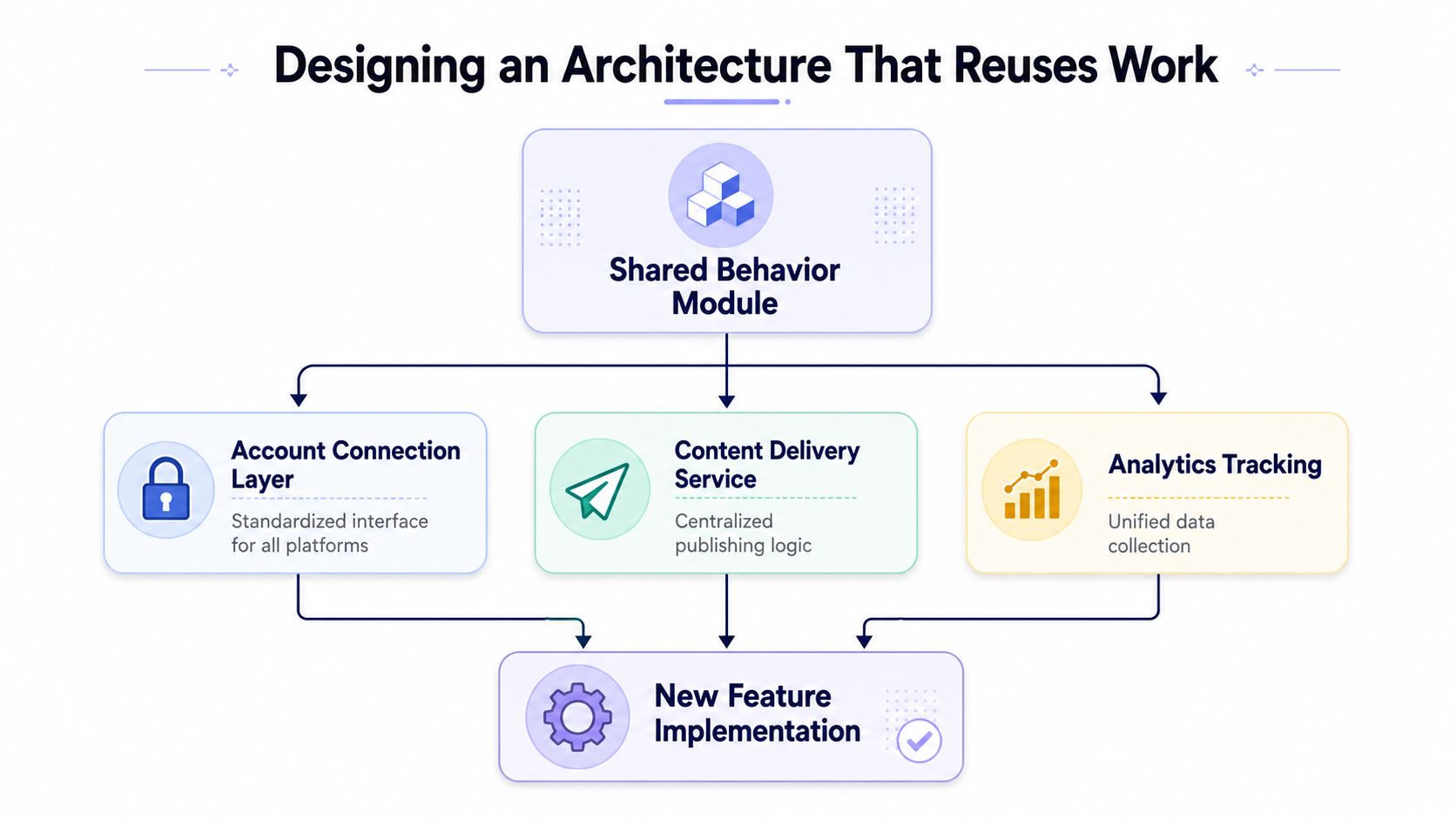 A diagram illustrating a shared behavior module architecture to reduce development time by reusing core functional components.
Centralize behavior that changes repeatedly
Shared clients, typed payloads, feature flags, and reusable UI components all reduce duplicate implementation, but only when the boundary is deliberate. A shared client should own transport and common error normalization. An adapter should own destination-specific translation. The dashboard should render a common publication state while allowing destination-specific feedback where the user needs it.
Don't centralize unrelated business decisions merely because they appear in several files. For example, a rule that determines whether a customer may publish belongs in the application. A rule that converts a normalized media request into a platform operation belongs at the delivery boundary.
Before coding, make four decisions:
Build: Keep product-specific permissions, scheduling rules, editorial review, and user-facing workflows in your codebase.
Centralize: Put credential lifecycle, request normalization, provider adapters, and common publication states behind stable interfaces.
Buy or delegate: Evaluate a managed integration layer when provider maintenance isn't part of your product differentiation.
Expose deliberately: Use a REST surface for application features, automation nodes for workflow builders, and an MCP surface when an agent needs explicit publishing tools.
This design also improves replacement cost. If a destination changes its integration requirements, one adapter or managed boundary absorbs the change instead of every product screen, job worker, and test fixture.
Automating Delivery With CI/CD
A fast architecture still ships slowly if every release waits for manual setup. A practical pipeline records the version-control event, builds once, runs focused checks, deploys to a controlled environment, verifies the result, and then releases through an explicit gate.
The important detail is the timestamp chain. DORA defines deployment frequency as how often code reaches production and lead time for changes as the time from commit to successful production release in its metrics guide. The guide describes elite delivery as on demand or multiple deployments per day, with lead time under one hour, while low performers can deploy less than monthly with lead times of 1 to 6 months. Those benchmarks show why a team should measure elapsed flow rather than count commits, pull requests, or hours spent coding.
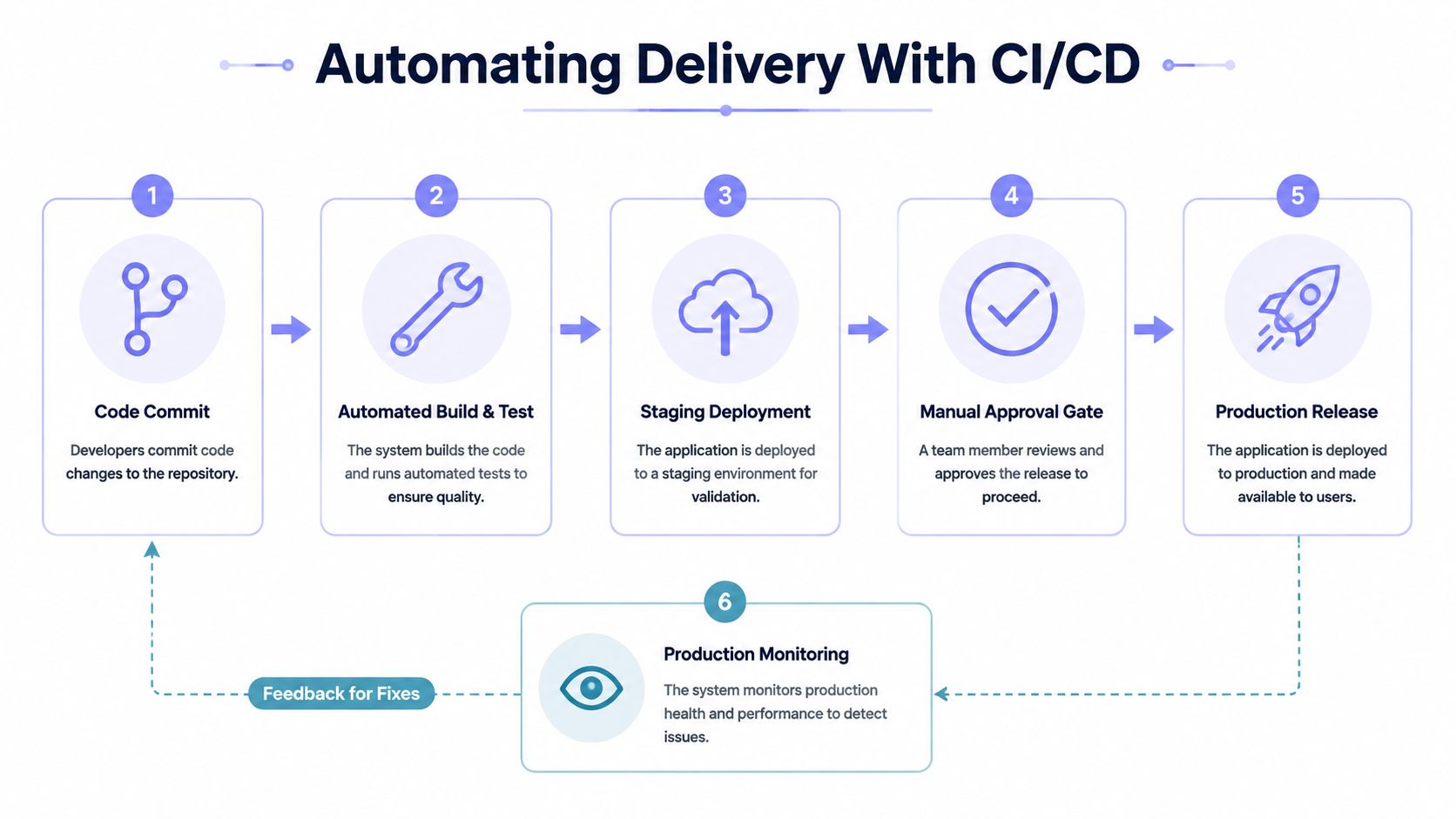 A diagram illustrating a five-step CI/CD pipeline for automating software delivery with continuous production monitoring and feedback.
A pipeline social integrations can tolerate
Start with a small, repeatable sequence:
Code commit: Capture the commit identifier and associate it with the release.
Automated build and test: Build the artifact once, then run type checks, unit tests, contract tests, and focused integration-boundary tests.
Staging deployment: Apply environment configuration through the deployment system, not through local assumptions.
Approval gate: Require a human decision when the change affects credentials, publishing behavior, or customer-facing workflows.
Production release: Deploy the tested artifact, run a health check, and verify a representative application path.
Tests should cover expired credentials, malformed media metadata, duplicate submissions, rejected requests, and asynchronous status transitions. A happy-path test proves only that the easiest request works. It doesn't prove that the system can tell a credential problem from a provider rejection or a still-processing publication.
Use dependency caching and parallel jobs to reduce queue time, but don't let optimization obscure correctness. A rollback path and post-release health check matter more than shaving time from a build that produces an unsafe artifact.
Coordinated code agents in AuricIDE can be useful when a team is organizing AI-assisted development around shared tools and repeatable tasks. The same discipline applies here: let automation handle predictable work, then keep review focused on boundaries, failure behavior, and changes that affect production.
The common mistake is measuring only developer activity. Instrument commit, merge, build, deploy, and production-verification timestamps, then remove the longest queue or manual stage first.
Choosing the Right Social Publishing Integration
A SaaS product with its own dashboard may need application-controlled permissions and a REST call. An operations team may value a visual automation node. An AI-agent builder may need tool-oriented access instead of another custom client. Choose the publishing surface according to who owns approvals, credentials, retries, and customer-facing error handling.
Direct provider integrations offer the most control over destination-specific behavior. They also preserve the recurring work that slows delivery: separate authentication flows, request translation, review requirements, API-version updates, tests, error mapping, and operational responses. That approach makes sense when one destination drives the product or exposes functionality unavailable elsewhere. It creates rework when the team is repeating the same publishing workflow across several platforms.
A unified REST API gives the application one publishing contract. The integration layer translates that request for each destination, so the team does not repeatedly maintain provider clients and credential paths. Official n8n and Make.com nodes suit workflow teams that want visual orchestration without embedding destination code in the application. An MCP server suits an agent that needs publishing operations available through its tools.
PostPulse is described as supporting publishing to 9 platforms through one REST API, official n8n and Make.com nodes, or an MCP server. It also offers a fully branded white-label option on its product site. Supported destinations include Instagram Business and Creator accounts, TikTok, YouTube Shorts and video, LinkedIn personal profiles, X, Threads, Bluesky, Facebook Pages, and Telegram channels and chats.
Social Publishing Integration Options
Approach | Best fit | Main implementation benefit |
Direct provider integrations | Products needing destination-specific control | Preserves destination control while requiring separate authentication and maintenance |
Unified REST API | SaaS dashboards and internal applications | Reuses one application-facing publishing contract |
Official n8n or Make.com nodes | No-code and low-code workflows | Removes custom workflow plumbing while retaining visual orchestration |
MCP server | AI agents using tool-oriented actions | Exposes publishing as an agent-accessible operation |
White-label integration | Products needing a branded publishing experience | Keeps the customer-facing flow under the product's brand |
Use this social media API aggregator guide to compare a unified surface with direct destination work. Evaluate ownership, failure visibility, review responsibility, and provider-specific maintenance, not only the feature list. The cheaper initial integration can become the slower delivery strategy if every new platform adds another authentication flow, approval cycle, API change, and workflow to maintain.
Connecting PostPulse Without Rebuilding the Stack
Consider a SaaS product that already has a content editor and approval workflow. The product team owns drafts, permissions, scheduling decisions, and audit history. It can let users connect supported accounts through a centralized connection flow, then send an approved publication request through the REST API instead of building a separate publishing client for every destination.
The application still needs to validate its own content and preserve its own business rules. A managed surface doesn't decide whether a post is approved, whether a user has permission to publish, or how the dashboard should explain a failure. It removes repeated integration plumbing so the product can focus on those decisions.
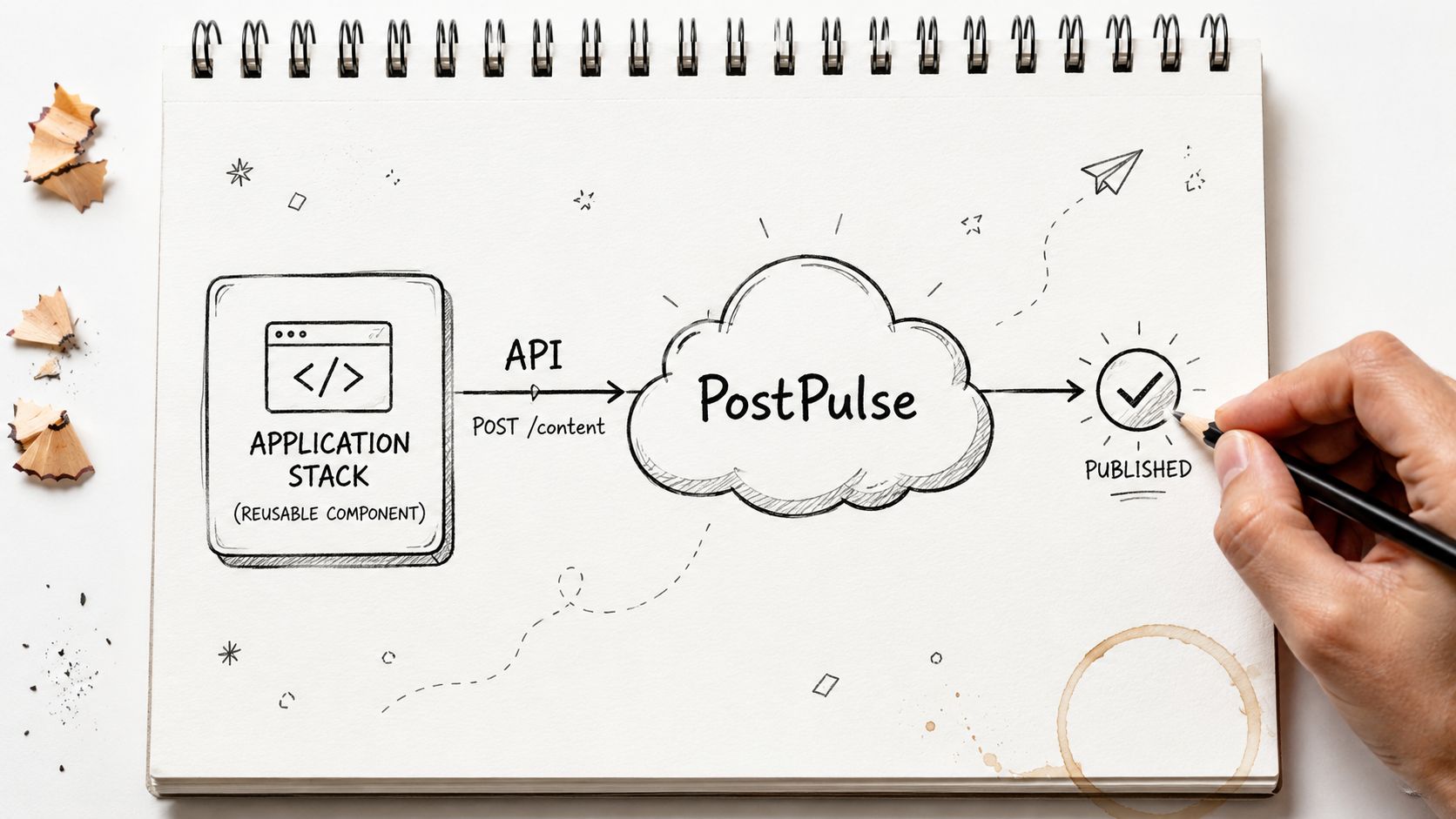 A hand-drawn diagram illustrating a software workflow using an application stack to publish content via PostPulse API.
Three implementation shapes
An internal operations team might take a different route. Approved content can move through an n8n or Make.com workflow, where the automation platform handles triggers, approvals, and downstream actions while the publishing node provides the delivery step. The team doesn't need to turn its internal process into a bespoke application before it can automate routine distribution.
An AI-agent builder has another responsibility. The agent may generate content after an event, but it should not receive unrestricted authority by accident. Expose publishing through the MCP server, then place application-level approval, destination selection, content validation, and audit requirements around the tool call.
A product that wants customers to experience publishing entirely under its own brand can evaluate the white-label option. The important architectural boundary remains the same. Your application owns the product experience, while the publishing layer owns the recurring destination integration work.
PostPulse supports the account types and destinations listed above, including Instagram Business and Creator accounts, TikTok, YouTube Shorts and video, LinkedIn personal profiles, X, Threads, Bluesky, Facebook Pages, and Telegram channels and chats. Teams should confirm that the supported account type matches their intended user flow before committing to the integration.
For destination-specific setup and implementation details, the social publishing integration guides provide a starting point. Keep provider assumptions out of your domain model. Store your own publication ID, requested destinations, approval state, and user-visible status, then map the delivery result back into that model.
Testing and Monitoring the Complete Publishing Flow
Reducing development time isn't valuable if the saved effort reappears as production debugging. Social publishing needs tests at the application boundary because failures can occur before a request leaves your system, during provider processing, or after a provider response reaches your worker.
Start with contract checks. Verify that the application sends a valid normalized payload, rejects missing required content, and preserves an idempotency key where duplicate publication would be costly. Mock the delivery boundary for unit tests, then use controlled integration checks for authentication, account selection, media handling, and status interpretation.
Observe state, not just requests
A request can appear unsuccessful while the underlying publication is still processing. If the application treats every non-final response as failure, it may show the wrong message, retry too aggressively, or create duplicate work. Represent intermediate states explicitly and make the worker responsible for polling or receiving the final outcome according to the integration's documented behavior.
Retain enough context to diagnose the path:
Application publication ID: Connect the user action to every worker attempt.
Destination and account reference: Identify where the request was intended to go without exposing sensitive credentials.
Correlation ID: Follow the request across API, queue, worker, and status events.
Attempt and retry reason: Separate transient transport problems from validation or authorization failures.
Timestamps: Measure queue delay, delivery duration, and time to final state.
Sanitized provider response: Preserve useful error context while excluding secrets.
Alert on sustained failure patterns rather than every isolated event. A single rejected post may reflect user input. Repeated authorization failures, growing queue time, or a cluster of final-state errors indicates an operational issue that deserves investigation.
The cross-platform testing guide can help teams shape destination coverage without coupling every test to internal provider implementation details. For content operations, a digest can also make recurring outcomes easier to review. Statiko's digest of any channel is one example of a way to summarize channel activity without asking engineers to inspect raw event logs.
The useful metric is not “did the request return?” It's “how long did an approved publication take to reach a trustworthy final state, and why?”
A Practical Plan to Ship Faster
Start with the ownership boundary. Keep permissions, editorial approval, scheduling rules, and customer-facing status in the product. Move account connection, credential lifecycle, normalized publishing, and destination translation into one shared layer. That prevents each new platform from creating another authentication flow, review process, API-version upgrade, and workflow-maintenance burden.
Choose the smallest interface that fits the workflow:
REST API: Use it when your application owns the dashboard and needs a stable publishing call.
n8n node or Make.com app: Use one when a visual automation should manage triggers and routing.
MCP server: Use it when an AI agent needs publishing as an explicit tool.
Direct platform work: Keep it when destination-specific behavior is a product advantage or the shared surface lacks a required capability.
Automate the release path, test failure states, and measure commit-to-production lead time with change failure rate. DORA pairs throughput with stability, so deployments that move faster but create rework do not show real progress as described in Google Cloud's DORA guidance.
Three planning errors appear often. Coding activity can hide review and queue delays. Batched releases make failures harder to isolate when verification is weak. AI adoption can also create false confidence if teams do not measure net time by task, repository familiarity, and developer experience. Google's 2025 DORA report says 90% of software professionals use AI and over 80% report higher productivity, while the METR study found experienced developers in familiar codebases were 19% slower with AI and still believed they were 20% faster afterward, a gap discussed in Google's DORA report coverage.
Use a realistic implementation timeline to decide what to remove, centralize, automate, or measure before adding another destination. Each work session should improve product value, reusable integration behavior, or operational feedback. Otherwise, it may add activity without reducing delivery time.
PostPulse provides one publishing integration for apps, automations, and AI agents, with REST API access, official n8n and Make.com nodes, MCP access, and white-label options. If repeated platform maintenance is slowing the roadmap, evaluate whether a shared publishing surface fits the product's ownership model.
About the Author

Founder of PostPulse — a social media scheduling platform for creators and teams. Software engineer with a passion for building developer tools and simplifying complex API integrations across social media platforms.