Distribution Automation: A Developer's Guide
Published on · Updated on
Tags:
You've wired the publish flow for Instagram, LinkedIn, TikTok, YouTube, Threads, Facebook, Pinterest, Bluesky, and X. The demo works. Then a token expires, a media container sits in IN_PROGRESS, a rate-limit header forces a retry queue, and one platform's webhook sends a payload your generic handler can't parse. By the time the campaign reaches production, the hard part isn't sending a POST request. It's owning nine different failure models during every on-call shift.
That's the practical meaning of distribution automation in a modern software stack. It's a way to turn one publishing intent into reliable, observable delivery across several destinations without making your application understand every platform's authentication lifecycle, upload protocol, quota rule, and callback format.
Table of Contents
What Distribution Automation Actually Means for a Software Stack
APIs, Tokens, Rate Limits and the Real Implementation Headaches
Three Real-World Patterns for Apps, No-Code Flows and AI Agents
Why Wiring Nine Social APIs by Hand Still Hurts in 2026
The first integration usually feels manageable. You exchange an authorization code, store an access token, upload media, publish a post, and record the response. The second platform exposes a different media model. The third changes how refresh works. By the time the ninth connector is live, your application has become a collection of platform-specific state machines.
The failures are rarely dramatic in development. A background worker discovers that a token expired after an hour. A carousel container remains IN_PROGRESS far longer than the request timeout. A rate-limit header arrives just before a scheduled publishing window, so the job needs to pause without losing the content. A webhook may sign its request differently from another platform, use a different event envelope, or omit the field your shared handler expected.
The production cost sits outside the SDK
An SDK can simplify request construction, but it doesn't remove the operational work around the request. Your team still needs:
Credential ownership: Decide whether your application, customer, or integration provider stores and refreshes each account's authorization.
State tracking: Persist upload containers, publish IDs, attempts, statuses, and platform responses.
Retry behavior: Distinguish a temporary platform response from a permanent validation failure.
Observability: Give support and engineering one place to see why a post failed.
Callback handling: Verify signatures, deduplicate events, and replay missed notifications safely.
That's why the cost grows faster than the line count suggests. Every connector adds another dashboard, another alert policy, another test matrix, and another set of production assumptions that can break independently.
The problem also affects content teams. A useful overview of social media scheduling workflows 2026 can help teams think through calendars and approval flows, but the underlying delivery system still has to reconcile each platform's API behavior. Scheduling is a product feature. Reliable distribution is an integration discipline.
AI agents multiply the ownership problem
AI agents make publish access more useful, but they also make fragmented infrastructure harder to maintain. An agent may need to choose a destination, attach media, request publication, and check whether delivery completed. Asking one model-driven workflow to remember nine SDK idioms, nine error taxonomies, and nine authentication patterns creates unnecessary control-plane complexity.
Practical rule: Treat publishing as a durable workflow with state, retries, and audit history, not as a single API call hidden behind a button.
Distribution automation exists to centralize that control plane. The platforms remain different, but your application doesn't need to expose every difference to every caller.
What Distribution Automation Actually Means for a Software Stack
Start with the simplest possible system. Your application receives a post, selects one connected account, calls that platform's publish endpoint, waits for the response, and stores the result. That direct integration is useful when you support one destination and can afford to model its behavior closely.
A unified layer changes the boundary. Your application submits a normalized post object containing content, media, destination accounts, scheduling information, and metadata. The layer validates the payload, maps it to each platform's requirements, performs the required uploads, and aggregates the resulting statuses.
Think of it as a postal sorting hub
A postal sorting hub accepts one parcel at intake, reads its destination, and sends it through the appropriate carrier route. Your application shouldn't need to know whether one carrier wants a multipart upload, another wants a staged container, and another requires a status check before publication. It should receive a consistent outcome for each destination.
The core objects usually look something like this:
Normalized post: Text, media references, destination intent, schedule, and client metadata.
Account registry: Connected social identities, scopes, token state, and tenant ownership.
Delivery record: A publish ID, platform mapping, current status, retry history, and error details.
Response aggregator: One API response that reports accepted, pending, successful, and failed destinations.
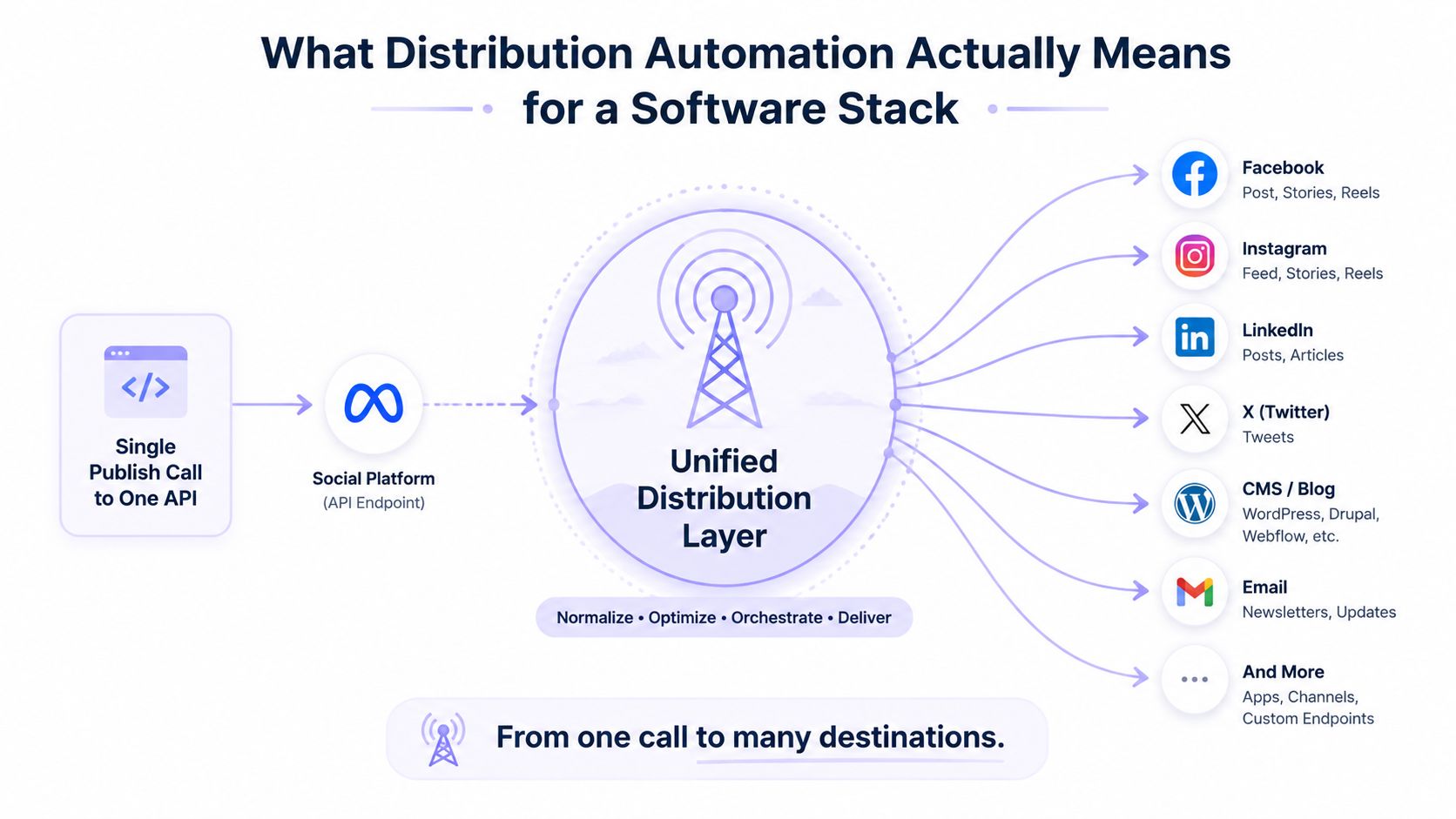 A diagram illustrating distribution automation, showing one API call being distributed to multiple social media platforms.
From one call to many destinations.
Three surfaces serve three operators
A REST API gives engineers a stable contract for publishing, scheduling, account management, and status retrieval. It fits SaaS products and internal services that already have their own user interface and job infrastructure.
No-code nodes expose the same capabilities to operations teams through tools such as n8n or Make. The node can own field mapping, credential selection, and failure routing without asking an operations user to write a custom connector.
An MCP server gives AI agents a tool-oriented interface. The agent can submit a publication request, receive a publish identifier, and check status through explicit tool calls. That keeps the model focused on intent while the integration layer owns platform-specific execution.
The abstraction isn't magic. You still need to decide how to handle unsupported formats, account permissions, moderation failures, and partial delivery. What changes is where that complexity lives. Instead of distributing it across every product surface, you place it behind a contract your application can test and monitor.
Push Versus Pull Workflows and When to Use Each
A push workflow starts with your system. A scheduler, queue, or cron process selects due content and sends it to the distribution layer. A pull workflow starts with an event. A webhook, inbound mention, approval action, or agent decision causes your system to retrieve context and initiate the next operation.
Neither pattern is universally superior. The right choice depends on whether predictability or reaction time matters more, and whether your team can build durable event handling.
Dimension | Push, cron or scheduler | Pull, webhook or event |
Primary trigger | A planned time or recurring job | An inbound event or platform signal |
Strength | Predictable batching and controlled release windows | Fast reaction to changing context |
Main risk | Empty polling windows and delayed discovery | Duplicate events, missed callbacks, and replay complexity |
Recovery model | Re-run due jobs from durable records | Replay signed events or process stored event envelopes |
Best fit | Editorial calendars and scheduled campaigns | AI-agent actions, approvals, and community replies |
Quota behavior | Can spend requests checking for work | Uses activity to drive ingestion, but still needs safeguards |
Push works best for planned delivery
A content calendar normally has known publication times. A scheduler can select all due posts, group them by destination, and apply a deliberate concurrency policy. That makes batching, approval checks, and operational reporting easier.
The scheduler shouldn't assume that acceptance means completion. It should create a delivery record before making the request, attach an idempotency key, and let a worker advance the record from queued to submitted, pending, completed, or failed. If a worker crashes after the remote platform accepts the request, the record lets the retry process investigate instead of blindly publishing twice.
Pull works best for event-driven intent
Community replies and AI-agent decisions don't fit neatly into a fixed calendar. A webhook can trigger enrichment, moderation, routing, and publication while the context is still relevant. The trade-off is that your handler must tolerate duplicates, out-of-order events, delayed delivery, and replays.
Store the raw event before processing it. Derive a stable event key, make each side effect idempotent, and separate acknowledgement from long-running work. That way, the webhook handler can respond quickly while a queue performs the actual distribution.
For scheduled calendars, choose push with durable job records. For agent-triggered posts and community responses, choose pull with replay-safe event storage. Many mature systems use both, but they keep the contracts separate so a webhook doesn't inherit the assumptions of a cron job.
APIs, Tokens, Rate Limits and the Real Implementation Headaches
Multi-platform publishing becomes difficult at the boundaries. OAuth, media ingestion, quota accounting, and asynchronous status transitions all look similar from a distance, but they behave differently enough to punish a generic implementation.
A background job needs more than an access token. It needs a token record with account ownership, scopes, expiry metadata, refresh state, and the last known authorization error. Refreshing only when a user clicks “publish” is too late for scheduled delivery.
Build token handling as a service
Keep credentials outside ordinary post records. Encrypt them, associate them with a tenant and connected account, and make refresh operations concurrency-safe. Two workers should not refresh the same credential simultaneously and overwrite each other's newest token.
The same principle applies to media. Some platforms use staged containers and asynchronous processing. Others use direct uploads or different multipart requirements. Your normalized layer should expose a stable media contract while retaining the raw platform response for debugging.
The documented constraints below illustrate why one universal quota assumption fails:
Platform | Token model | Rate limit window | Quota cost |
Threads | Profile publishing through the Threads API | 250 API-published posts in a moving 24-hour period, with carousels counted as one post, according to the official Threads API overview | Platform-specific |
TikTok | Unaudited API client publishing | Up to 5 users in a 24-hour window, and accounts posting through that client must be private at posting time, according to TikTok's official content-sharing guidelines | Platform-specific |
YouTube |
| Daily project quota behavior | 100 calls per upload, with the upload costing 1 quota unit in the Video Uploads bucket, according to the official |
The YouTube documentation also states that uploads can be up to 256 GB. That limit is a concrete reminder that media handling belongs in a deliberate upload subsystem, not in a request handler that assumes every file is small.
Defensive patterns that survive production
Exponential backoff: Increase wait time for temporary failures and cap retries so a provider outage doesn't create a retry storm.
Per-account token stores: Keep authorization state isolated by tenant and social account, not in one application-wide credential.
Idempotent retry keys: Give each intended publication a stable key so recovery logic can determine whether it already submitted work.
Status polling with limits: Poll asynchronous media states with a bounded policy, then move the item to manual review or failure.
Signature verification: Validate webhook signatures before accepting an event, then persist the verified envelope for replay.
Quota-aware queues: Maintain separate queues or budgets when one destination's limits differ from another's.
Rate-limit behavior deserves its own operational surface. A small guide to API rate limits is useful background, but your implementation still needs provider-specific counters, response headers, and retry-after handling. A single global “sleep and retry” function won't tell you which account is blocked, which request can proceed, or whether the failure is permanent.
Three Real-World Patterns for Apps, No-Code Flows and AI Agents
The same distribution capability changes shape depending on who owns credentials and who initiates the request. A SaaS product, an operations workflow, and an AI agent need different boundaries even when they publish identical content.
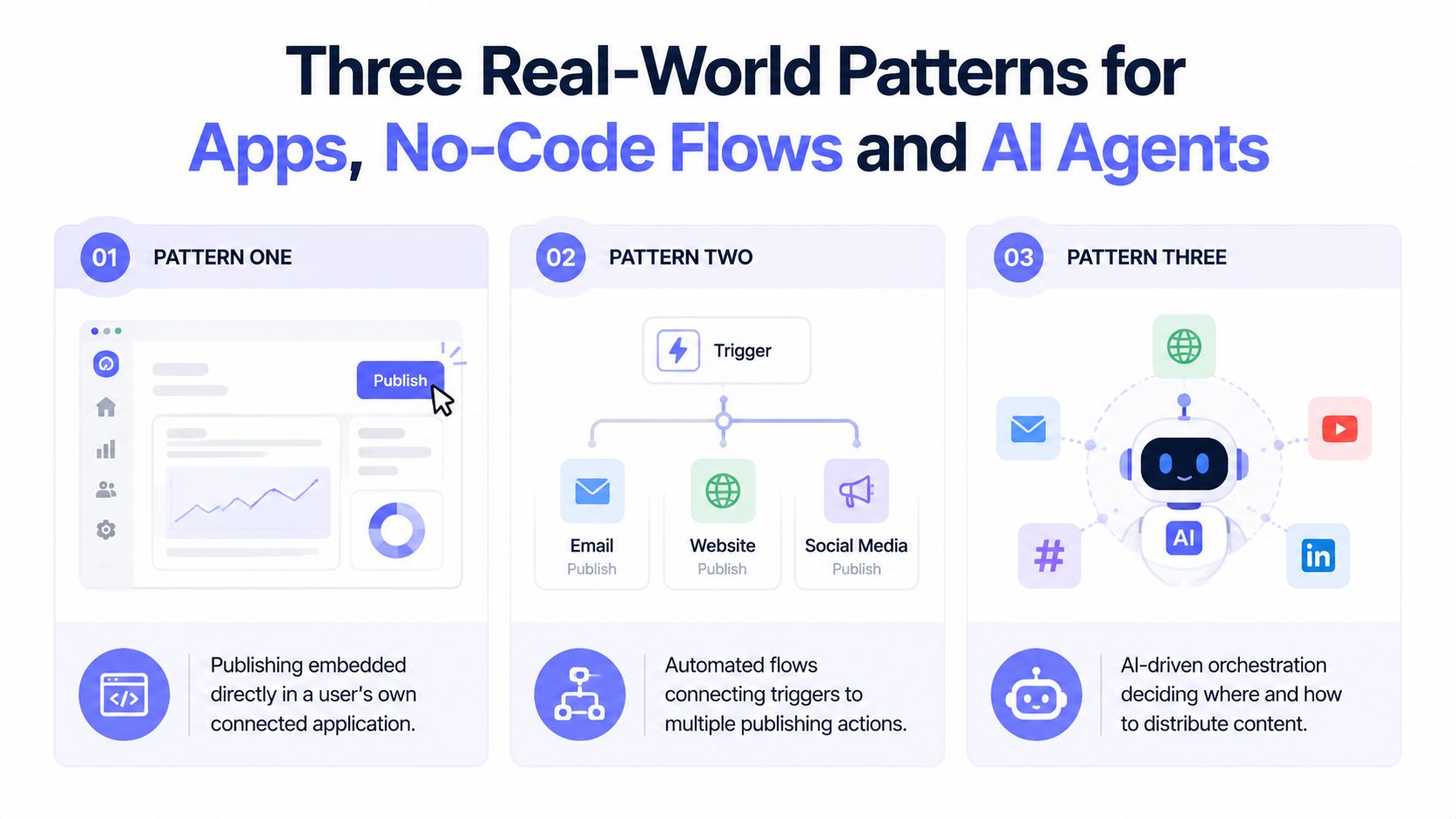 An infographic illustrating three distinct patterns for content distribution automation, including embedded apps, automated flows, and AI agents.
Pattern one embeds publishing inside a SaaS product
The SaaS customer connects a social account inside your product, so your application owns the relationship with the tenant while the user authorizes access. The product needs tenant-scoped OAuth records, branded callback pages, account-selection rules, and usage attribution tied to the end user.
The trigger might be a user clicking Publish, an internal approval event, or a scheduled campaign. Failure means the product needs to show a useful state, such as expired authorization, unsupported media, pending processing, or partial delivery, without exposing raw provider jargon as the entire user experience.
This pattern gives you the most control over presentation and policy. It also makes you responsible for isolation, audit history, and support tooling.
Pattern two connects no-code automation flows
In an n8n or Make workflow, the automation owner may not be a developer. A trigger node receives a form submission, RSS item, approval, or database event. Subsequent nodes map fields, select connected accounts, publish, and route errors to a notification or review queue.
Credentials belong to the workflow owner or the connected integration account, depending on the platform's model. The flow owns the trigger, while the distribution service owns provider-specific execution. Failure appears as a node error, a failed operation, or a branch that needs human intervention.
This approach trades low deployment effort for less flexibility. Visual mappings are quick to change, but complex branching, tenant isolation, and custom reconciliation can become awkward.
Pattern three gives an AI agent an MCP tool
The agent receives a goal such as “publish the approved announcement to the connected channels.” An MCP server exposes a constrained publish tool, returns a publish_id, and provides a status operation the agent or supervising workflow can call later.
The agent triggers intent, but it shouldn't own raw credentials or implement provider-specific retries. The MCP service owns authorization boundaries, validation, rate-limit handling, and delivery state. Failure should return structured information the agent can act on, not a vague exception that encourages repeated publishing.
The key design decision is control. Apps favor deterministic workflows, no-code tools favor visual composition, and agents favor intent-based calls. A unified distribution layer can support all three, provided it keeps credentials and delivery state outside the caller.
How a Unified Platform Collapses the Distribution Stack
The consolidation becomes clear when you map each recurring problem to the layer that should own it. Instead of nine SDKs, your application talks to one REST contract. Instead of nine refresh routines, one authorization boundary tracks connected accounts. Instead of nine rate-limit dashboards, one delivery system exposes normalized status while retaining provider-specific diagnostics internally.
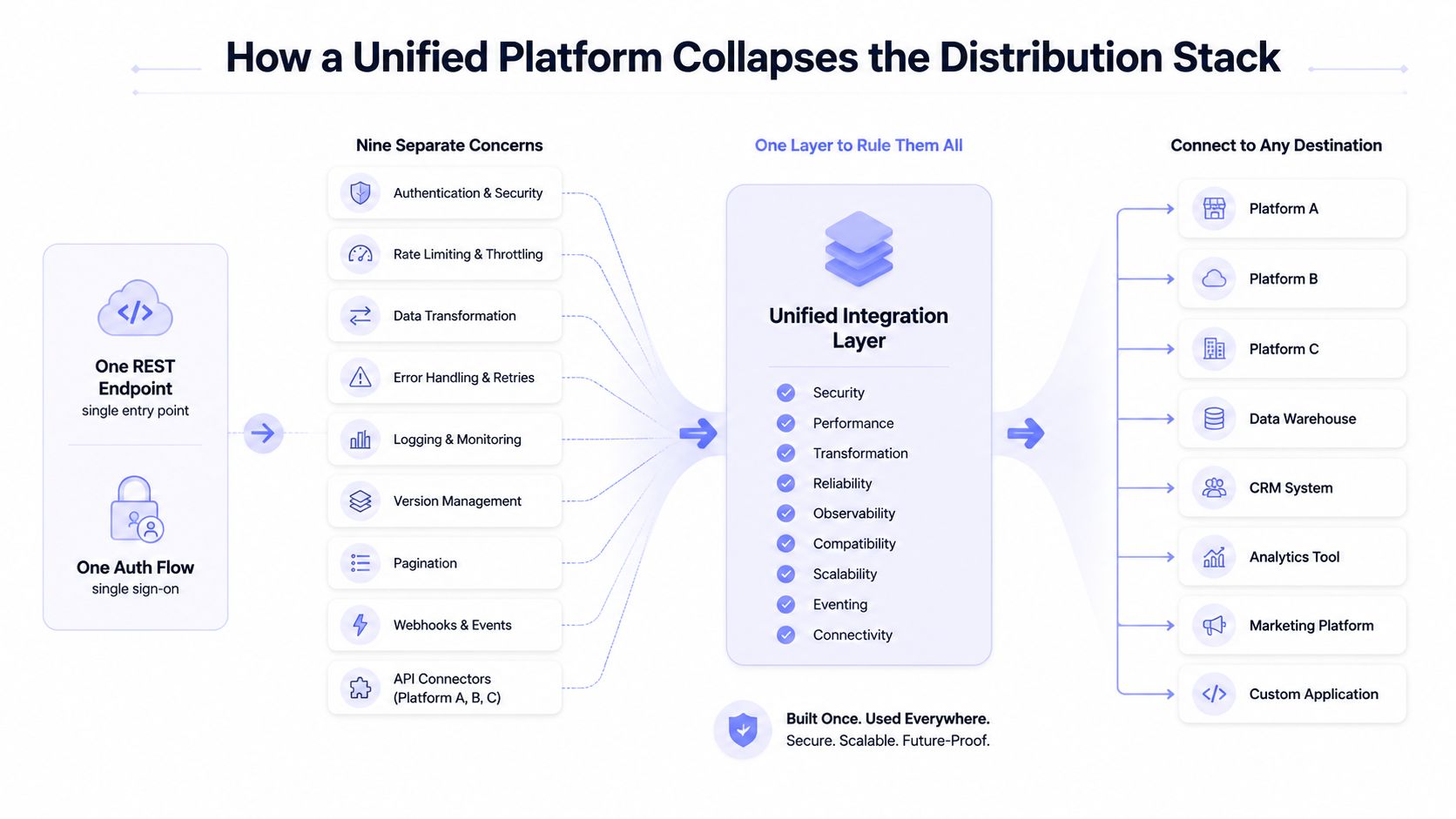 A diagram illustrating how a unified integration layer simplifies API management and distribution across multiple external platforms.
The trade-off is real. A normalized payload can't expose every platform-specific feature without becoming another collection of special cases. You may give up direct control over features such as Instagram Reels templates, YouTube chapter markers, or LinkedIn article formatting in exchange for a stable cross-platform contract.
What a unified layer should own
Authentication: Connection flows, token refresh, scopes, revocation, and account selection.
Media handling: Upload preparation, format validation, asynchronous processing, and provider mapping.
Delivery: Queueing, retries, idempotency, scheduling, and partial-success reporting.
Integration surfaces: REST endpoints, automation nodes, callbacks, and agent tools.
Diagnostics: Raw provider responses, normalized errors, correlation IDs, and audit records.
PostPulse is one example of this architecture. It provides one REST API, an MCP server, and official n8n and Make.com surfaces for publishing to ten platforms, while allowing teams to present the flow under their own brand. Its private-label model uses active-account pricing, so the commercial unit is connected account activity rather than a seat license. The specific pricing and commercial terms should be evaluated against your account volume, support requirements, and need for native platform features.
A front-end team choosing integrations may also benefit from an integration marketplace for front-end teams, particularly when it wants reusable connection patterns rather than another isolated SDK. The important architectural question is ownership. The unified layer collapses provider plumbing, but your application still owns content policy, approvals, tenant permissions, analytics, and the user experience.
You can visualize the operating model here:
A useful social media API aggregator overview can help compare this model with direct integrations. The decision isn't “API access versus no API access.” It's whether your team wants to own the full provider-facing control plane or consume a normalized one and focus engineering effort elsewhere.
The Hidden Lever Is Orchestration, Not More Tools
Teams often describe distribution automation as a volume problem. They want to publish more frequently, add more channels, or let an AI agent create more output. That framing misses the expensive part. A team running native integrations for nine platforms isn't automatically nine times more effective. It may be spending more time refreshing tokens, reconciling webhook events, debugging media states, and explaining quota failures.
The same integration principle appears in broader distribution operations. A 2026 survey found that 55% of distributors had invested in ERP, CRM, ecommerce, and analytics without integrating them, while high-maturity firms used and integrated an average of 28 technologies, compared with 5 for low-maturity peers in the same survey (Distribution Strategy research). The lesson applies directly to social publishing. Tool count is a poor substitute for connected workflows.
Orchestration creates one operational boundary
Maturity means treating distribution as one concern in the stack:
One authorization boundary for connected accounts and refresh state.
One delivery model for queued, pending, completed, and failed work.
One retry policy with platform-specific behavior hidden behind provider adapters.
One audit trail that shows who initiated a publication and where it went.
One measurement surface for delivery outcomes and downstream content analysis.
This doesn't mean flattening every platform into identical behavior. A good orchestrator preserves meaningful differences in diagnostics and capabilities while keeping callers from depending on undocumented quirks.
The survey also identified skills gaps at 57%, poor data quality at 52%, and unclear ROI expectations at 51% as top barriers, according to the same distribution technology research. Those findings point to an organizational constraint, not just an API constraint. If nobody owns the canonical content object, account mapping, or failure queue, adding another connector won't repair the workflow.
The goal isn't to ship more posts at any cost. It's to stop hand-rolling the same delivery machinery nine times.
AI agents make the case stronger. A model can decide that an approved asset belongs on several channels, but it shouldn't carry nine incompatible SDK conventions in its context or hold long-lived credentials. Give the agent a narrow publish tool, a structured result, and a status operation. Keep execution, policy, and recovery in the orchestration layer.
For a practical distinction between isolated actions and connected processes, workflow automation fundamentals provides a useful frame. The implementation choice should follow the same rule: centralize the repetitive integration work, preserve application ownership where your product has differentiated value, and measure whether the resulting system is easier to operate.
PostPulse gives app developers, no-code builders, and AI-agent teams one publishing layer with a REST API, official n8n and Make.com integrations, and an MCP server for distributing content across connected social accounts. If you're tired of maintaining separate token refreshers, upload handlers, and retry queues, visit PostPulse to evaluate a unified distribution workflow for your stack.
About the Author

Founder of PostPulse — a social media scheduling platform for creators and teams. Software engineer with a passion for building developer tools and simplifying complex API integrations across social media platforms.