What Is a Content Automation Platform a Dev's Guide
Published on
Tags:
You've probably lived this already. You wire up publishing for one network, get a post through, and think the hard part is done. Then the token expires sooner than expected, the media upload sits in a pending state with no useful explanation, or a platform changes the endpoint behavior you were relying on. By the time you add a second network, your clean integration has turned into a pile of exceptions, retries, polling jobs, and platform-specific edge cases.
That's where a content automation platform stops being a marketing category and starts looking like infrastructure. If you're building a SaaS product, an internal tool, a no-code workflow, or an AI agent that needs to publish content, the core problem isn't “how do I send a post.” The core problem is how to survive auth churn, async media flows, inconsistent payload rules, and the operational tax of maintaining all of it over time.
Table of Contents
The Real Problem With Social Media APIs
The frustrating part of social API work isn't getting the first happy-path request to succeed. It's everything that happens after that.
You add one platform, then discover its auth lifecycle doesn't map cleanly to the next one. You build a media flow, then learn that a successful upload request doesn't mean the media is publishable yet. You add scheduling, then realize your job runner now needs to understand platform-specific content types, retries, and failure states. If you've been neck-deep in this, social media API integration complexity probably sounds familiar.
The pain isn't one bug, it's the stack of them
Teams hit the same set of problems:
Authentication drift: OAuth looks standard until you start handling provider-specific scopes, refresh behavior, reconnect flows, revoked access, and accounts that partially disconnect.
Asynchronous media: Some platforms don't treat upload and publish as one action. You create a container, poll for readiness, then publish only if the media finishes processing.
Rate-limit uncertainty: Even when the docs are clear, your app still needs backoff, queueing, and account-level isolation so one noisy tenant doesn't break everyone else.
App review overhead: Official access often means policy review, permissions review, branding review, and recurring maintenance when requirements change.
Practical rule: If your social publishing code lives entirely in a controller action, it isn't done. You've only implemented the demo.
The deeper issue is architectural. Every network wants slightly different media fields, account types, permission models, and publication rules. Your product roadmap starts bending around external APIs that aren't your core business.
What usually doesn't work is building thin wrappers around each platform and hoping the differences stay manageable. They don't. You end up with integration code that leaks platform details into your database schema, job system, UI copy, and support playbooks.
A content automation platform exists because this problem keeps repeating. Not as a scheduling app. As a way to move the unstable parts of social publishing behind a stable interface.
The Abstraction Layer You Wish You Had
The easiest way to think about a content automation platform is this: it's an abstraction layer over raw social APIs.
You already accept this idea in other parts of the stack. We use Prisma, SQLAlchemy, and similar tools because writing and maintaining raw database-specific queries everywhere is a bad use of engineering time. The same logic applies here. You could integrate every platform directly, but then your application becomes the place where all those differences accumulate.
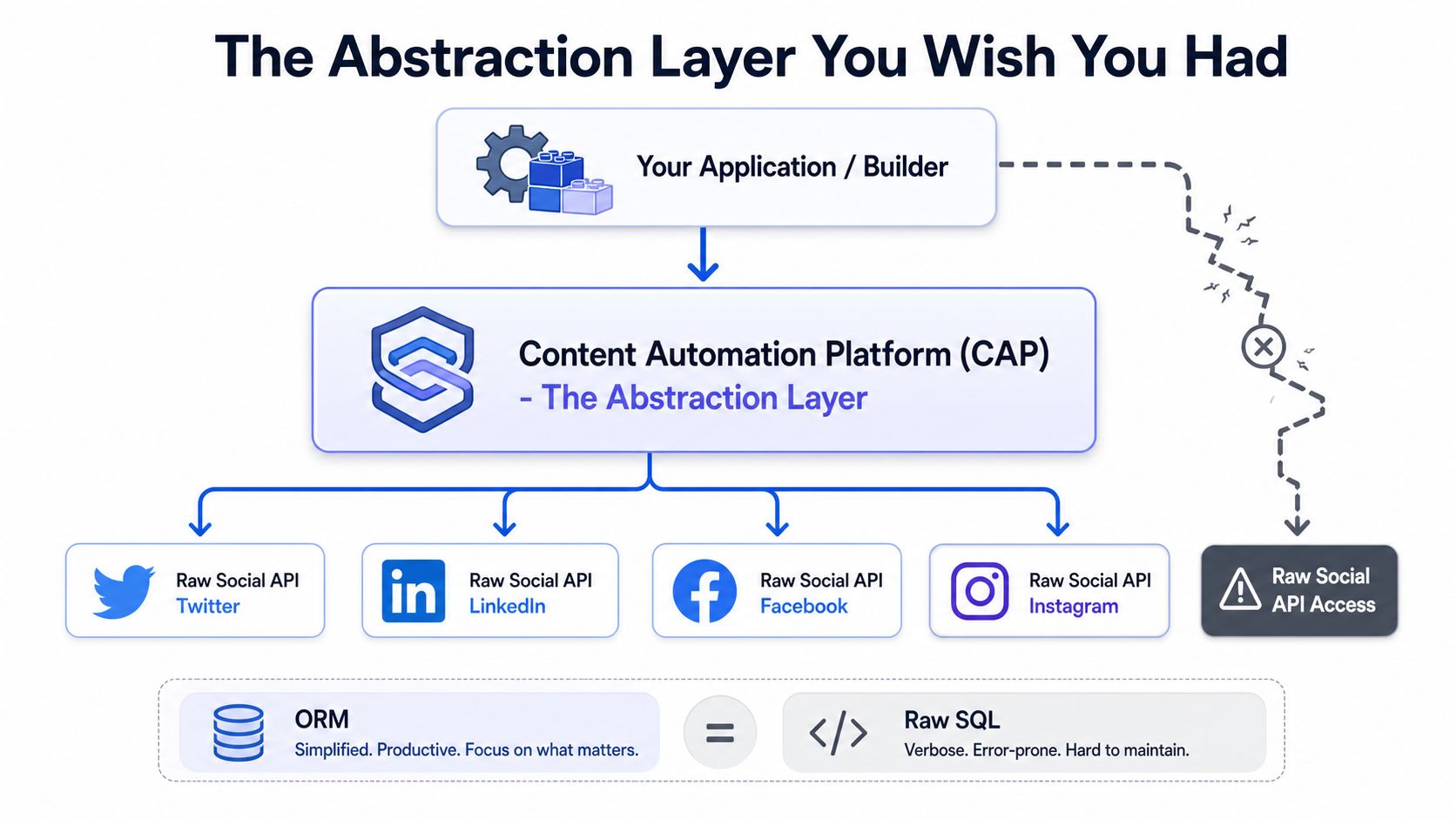 A diagram illustrating how a content automation platform acts as an abstraction layer for social media APIs.
One interface, many translations
A good content automation platform gives you one surface area for common actions:
connect account
refresh or validate auth state
upload media
create draft or scheduled post
publish now
receive status updates
handle failures predictably
Under the hood, it translates those actions into the exact calls each platform expects. That translation layer matters because “publish a video post” is not one thing across networks. The payload shape changes. The media preparation rules change. The publishing workflow changes.
That's why API proxy service patterns for external integrations show up so often in systems that need to survive vendor churn.
The abstraction is valuable because the APIs are not symmetrical
Developers often underestimate this point. The goal isn't to erase every platform difference. That would be fake simplicity. The goal is to contain the differences so your app doesn't absorb them.
A solid abstraction layer usually does three things well:
Concern | Raw platform approach | Content automation platform approach |
Auth | Separate OAuth logic per network | Unified connection model with provider-aware handling |
Media | Per-platform upload and publish sequence | One workflow that maps to platform-specific media steps |
Errors | Provider-specific messages and states | Normalized errors and statuses your app can act on |
A useful abstraction doesn't pretend all platforms behave the same. It gives you a consistent contract while still exposing the differences that actually matter.
That distinction matters when teams complain that a unified API “hides too much.” Bad abstractions hide critical constraints. Good ones keep the integration surface stable while exposing capability flags, supported post types, and clear failure reasons.
A lot of teams arrive here after trying to build “integrate once, publish everywhere” themselves. That usually works for text-only posts and falls apart once you add media, scheduling, reconnect flows, and support burden. At that point, a content automation platform stops looking like convenience and starts looking like the missing middle layer your architecture needed from day one.
Under the Hood Core Architecture and Features
If the abstraction layer is the visible part, the core work takes place behind it. A content automation platform only feels simple to the caller because it's carrying a lot of operational complexity internally.
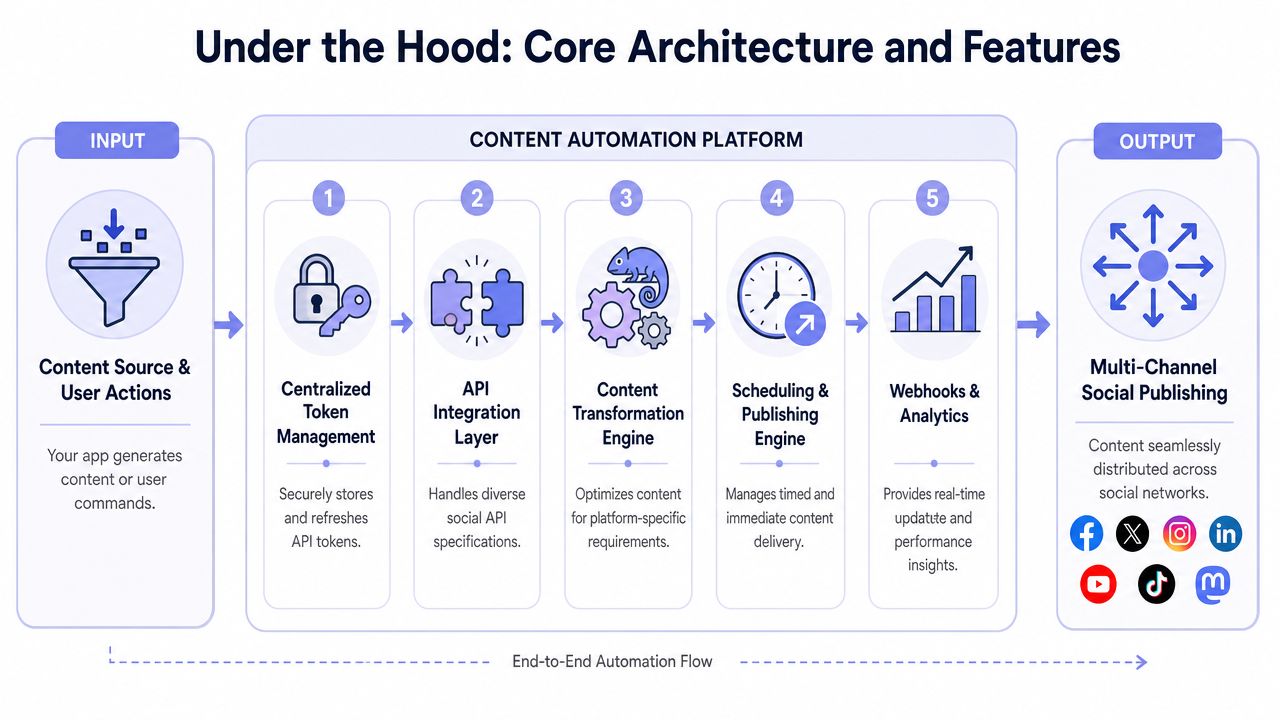 A diagram illustrating the end-to-end workflow of a content automation platform from input to social publishing.
Token handling is its own subsystem
Many in-house builds go wrong when teams treat tokens like records on a user table and add refresh logic later. That approach doesn't hold once multiple providers enter the picture.
A robust platform needs token lifecycle management with secure storage, refresh orchestration, reconnect detection, scope awareness, and provider-specific edge-case handling. It also needs to keep auth concerns out of your app logic so your product code isn't constantly asking, “is this token still valid?”
What works is centralized state. One service owns connection status, refresh attempts, invalidation, and recovery paths. What doesn't work is letting every worker or endpoint perform its own ad hoc token checks.
Media publishing needs a queue, not a request handler
Text posts tempt you into synchronous thinking. Media posts punish it.
When a platform requires upload, processing, readiness checks, and a later publish step, you need a job-driven architecture. That means enqueueing work, persisting state transitions, retrying safe operations, and surfacing terminal failures clearly to the caller.
A reliable media pipeline usually includes:
Preflight validation: Check media type, format assumptions, and post intent before spending time on upload work.
Stateful jobs: Store each stage so retries don't duplicate work or lose track of whether you're uploading, polling, or publishing.
Backoff logic: Polling loops need sensible intervals and stop conditions. Tight loops waste capacity. Loose loops hurt latency.
Idempotency controls: If a worker crashes mid-flight, rerunning the job shouldn't create duplicate posts or conflicting publish attempts.
If your system can't answer “what state is this post in right now?” you're going to debug production issues by reading logs and guessing.
Normalized errors save your support team
Raw provider errors are often too cryptic for product use and too specific for end users. If your platform forwards them untouched, you've moved the problem, not solved it.
Error normalization means converting provider responses into a stable contract your app can understand. That contract should include a machine-readable category, a user-safe message, retryability, and provider context for debugging. Your frontend, support team, and automation layer all benefit from this.
Here's the difference in practice:
A raw response might tell you a media object is invalid in provider-specific language.
A normalized response tells your app this is a validation failure, the post is not retryable as-is, and the likely next action is replace media or adjust format.
Webhooks matter more than polling
Polling has its place, but it becomes a liability if it's your only visibility model. Webhooks let the platform push status changes back to your system when account connections change, media processing finishes, or publication succeeds or fails.
That changes how you build product features. Your UI can reflect real status. Your automations can branch based on actual publish outcomes. Your support team can inspect event history instead of asking engineering to grep logs.
A capable content automation platform is really a collection of subsystems: auth broker, queueing layer, capability mapper, error translator, and event delivery mechanism. The API endpoint is just the front door.
Key Use Cases for Modern Builders
The interesting part of this category is that different builders need the same infrastructure for different reasons. The app developer wants a product feature. The no-code operator wants a workflow that doesn't break on reconnect. The AI builder wants an agent that can take a publishing action without custom glue for every network.
 A digital illustration of a tablet displaying a content publishing interface, connected to various social media icons.
For app developers shipping publishing inside a product
Say you're building a SaaS tool for content teams, creators, or local businesses. Your users expect to connect accounts and publish from inside your product. They do not care that each network has different auth requirements or media flows. They expect the feature to feel native.
That's where white-label and embedded publishing matter. The useful architecture is one where your app owns the user experience while a backend integration layer handles the platform mechanics.
A practical pattern looks like this:
your app stores content objects and scheduling intent
users connect accounts through a managed auth flow
your backend sends one publish request through a unified API
webhook events update post status in your UI
For teams building that kind of workflow UI, it's worth looking at interface patterns like Discover DOM Studio's components, especially if you need ideas for approvals, schedule states, and automation-oriented screens.
One example in this space is PostPulse, which exposes social publishing through a REST API, official n8n and Make.com integrations, and an MCP server, with support for white-label flows when you want the publishing experience under your own brand.
For no-code builders automating a workflow
A different builder starts in Airtable, Notion, Google Sheets, or a form tool. They're not trying to invent a publishing product. They're trying to automate a content pipeline.
The pattern here is usually event-driven:
A row changes status to approved.
An automation tool picks it up.
Media and captions are mapped into a publishing step.
The workflow waits for success or routes failures for review.
Official nodes or apps matter more than generic HTTP modules. You can brute-force publishing with raw requests in Make.com or n8n, but then you end up rebuilding account connection handling, credential refresh behavior, and response parsing inside the automation layer. That gets fragile fast.
What works better is using a provider-specific integration that already understands account models, media inputs, and publish actions. Your automation should orchestrate business logic, not impersonate an API client.
After you've built the trigger side and approval path, this kind of walkthrough helps frame the publishing action in practice:
For AI agents that need to take publishing actions
This is the newest use case and the easiest one to overhype. An agent that “posts to social” sounds simple until you ask basic questions.
Can it discover which accounts are available? Can it tell whether a platform supports the requested content type? Can it receive a structured failure and decide whether to retry, ask for a new asset, or stop? If not, the agent isn't autonomous. It's just calling a webhook blind.
Give agents structured actions, constrained inputs, and explicit post states. Don't make them infer platform behavior from free-form error text.
That's why protocol-based access matters. An MCP-compatible publishing surface gives an agent a cleaner way to request actions and inspect results than hand-rolled prompt glue. The agent can operate against a defined tool contract while the content automation platform handles the messy provider translation underneath.
Three very different builders. Same recurring problem. Social publishing isn't hard because sending HTTP requests is hard. It's hard because the surrounding platform behavior is inconsistent, stateful, and operationally annoying.
How to Evaluate a Content Automation Platform
Most product pages evaluate themselves on convenience. That's not how you should evaluate infrastructure. You need to look at the places where these systems usually fail under real usage: auth, state management, capability mapping, and developer ergonomics.
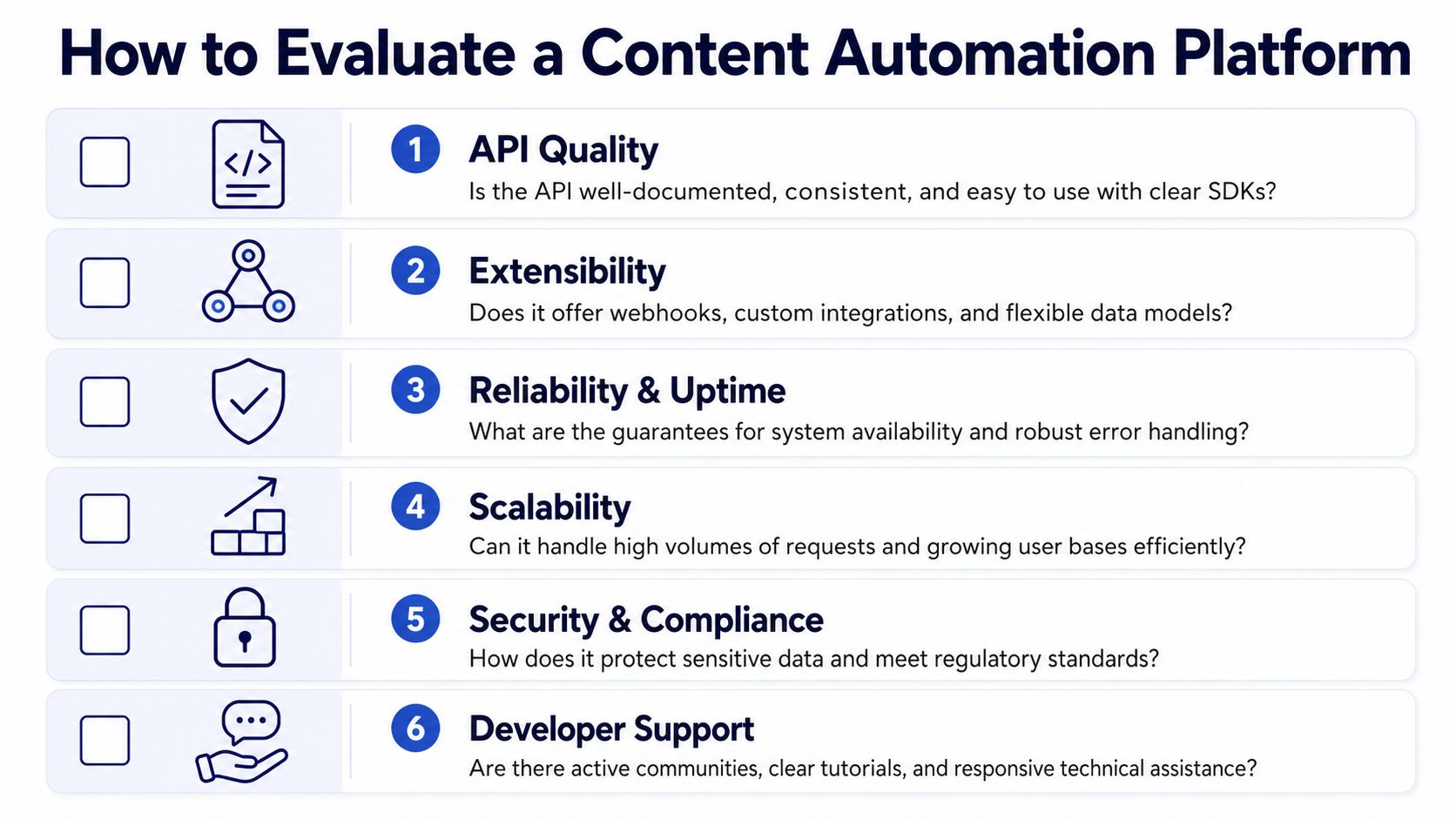 A checklist infographic outlining six key criteria for evaluating a content automation platform for developers.
What matters in the API
Start with the contract. If the platform's API feels inconsistent at the edge, assume the internals are worse.
Look for these signs:
Clear resource model: Accounts, connections, posts, media assets, schedules, and events should have distinct shapes and predictable relationships.
Capability visibility: You should be able to tell what each connected account can do without reverse-engineering errors at publish time.
Webhook-first thinking: A serious platform exposes state changes as events, not just request responses.
Usable docs: The docs should show actual request and response examples, failure modes, and auth flow expectations.
If you're comparing automation-friendly tooling more broadly, the framing in Make Com alternatives to scale business is useful because it pushes you to think beyond drag-and-drop convenience and look at extensibility, control, and operational fit.
What matters in operations
Here, “works in staging” products often break.
Ask practical questions:
Check | Why it matters |
How are retries handled? | Media workflows fail in partial states. Retry policy determines whether the platform is resilient or destructive. |
Are errors normalized? | Your app needs structured outcomes, not provider-specific chaos. |
Is auth managed for reconnects and refreshes? | If you still own the messy parts of token lifecycle, you're not really buying much abstraction. |
How is platform churn handled? | API version changes and policy changes are normal. The platform should absorb them, not expose them to your roadmap. |
A lot of teams shopping for tools are really making a build-vs-buy call. If that's the decision in front of you, developer-focused social media automation tool criteria is the right lens. The question isn't whether a dashboard looks polished. The question is how much unstable integration code you want to own for the next few years.
What matters in product fit
This part gets skipped too often. A content automation platform can be technically solid and still wrong for your use case.
Check whether it fits the shape of your product:
For embedded SaaS features: Does it support branded or white-label account connection flows?
For no-code teams: Are there official n8n or Make.com integrations, or are you expected to stitch everything together yourself?
For agent builders: Is there a protocol-friendly interface, not just REST endpoints designed for human-coded clients?
For multi-platform publishing: Does the platform expose content-type differences transparently, or does it pretend one payload can always do everything everywhere?
The right platform reduces your surface area of maintenance. The wrong one adds a second abstraction you still have to babysit.
If a vendor can't explain how they handle auth lifecycle, async media states, event delivery, and platform-specific capability differences, keep looking. Those are the parts that decide whether the integration survives contact with production.
Implementation Guidance and Measuring ROI
If you already built part of this in-house, don't rip it out all at once. Start by isolating the unstable pieces first. Auth handling, media processing, and publish orchestration are usually the best candidates because they create the most maintenance drag.
A low-risk migration path is to keep your existing content model and scheduling logic, but route publication through the platform behind a feature flag. That lets you compare outcomes, validate webhook handling, and update your support workflow before switching all traffic.
A sane rollout path
Use a narrow sequence:
Connect one platform and publish a simple post end to end.
Add webhook consumption so your app tracks real publish status.
Migrate media posts after the event model is stable.
Move more account types and tenants once failure handling is boring.
The ROI here usually shows up in engineering focus, not just infrastructure cost. You spend less time chasing token issues, adapting to provider changes, and patching broken workflow edges. You ship product work instead of integration maintenance.
A good way to measure that impact is qualitatively across three buckets:
Developer time saved: Fewer hours spent on auth bugs, retries, and provider-specific regressions.
Support burden reduced: Fewer tickets where the answer depends on reading provider error text manually.
Faster feature delivery: New publishing surfaces, workflows, and account support ship without rebuilding the integration core.
If the platform is doing its job, social publishing becomes a dependency you configure, not a subsystem your team keeps rescuing.
Stop Building Social Integrations Start Building Your App
A content automation platform is useful when you stop thinking of it as a posting tool and start treating it like infrastructure. The value isn't that it can send a caption to multiple networks. The value is that it absorbs the unstable parts of the problem: auth churn, async media handling, provider-specific errors, and the operational noise around all of that.
That shift matters because social publishing is rarely your product. It's a feature inside your product, or a step inside an automation, or an action an agent needs to perform. In all of those cases, the smartest move is usually the same one we make elsewhere in software. Don't build specialized plumbing unless the plumbing is the business.
If you need a concrete example, PostPulse is built around that exact idea: one integration surface for apps, automations, and AI agents that need to publish across multiple social platforms without owning every raw platform integration themselves.
If you're tired of debugging token expiry, stalled media containers, and platform-specific publish flows, PostPulse is worth a look. It gives developers a unified way to publish through a REST API, official n8n and Make.com integrations, or an MCP server, so you can spend your time on your app instead of maintaining social API glue.
About the Author

Founder of PostPulse — a social media scheduling platform for creators and teams. Software engineer with a passion for building developer tools and simplifying complex API integrations across social media platforms.