Best Days to Post on Facebook: Maximize Engagement
Published on
Tags:
Why do your Facebook posts keep disappearing into the void even though the content is solid and the automation is working? That's the annoying part, the pipeline looks clean, but the post lands at the wrong hour and gets treated like background noise. If you're publishing through an API, that timing miss feels especially wasteful because every scheduled call should be doing real work, not just burning a slot in the queue. The good news is that the best days to post on Facebook are not random, and you can use aggregate timing data to build a repeatable posting system instead of guessing. For a broader growth lens, this podcaster social media growth guide pairs well with the scheduling mindset here.
Table of Contents
1. Tuesday 9-10 AM The Peak Engagement Window
Tuesday morning is the cleanest starting point if you want a default posting window that behaves well across a broad audience. Sprout Social's 2026 Facebook timing study found the strongest overall posting window was Tuesday and Wednesday from 12 p.m. to 8 p.m. local time, and it also says Monday and Thursday show strong afternoon engagement, with midweek days consistently outperforming weekends across the dataset Sprout Social's Facebook timing study. Buffer's 2026 analysis of 14 million Facebook posts also puts Wednesday at the top overall, with Thursday at 9 a.m. as the strongest hour in that sample Buffer's 14 million post analysis. That's why Tuesday morning stays on the list as a practical benchmark, even when other datasets lean slightly differently.
Why Tuesday works so well
Tuesday has a “back in motion” feel. People have already cleared the Monday fog, they're checking notifications with less distraction, and they're more likely to interact with content that asks for a quick response. If you publish for professionals, B2B, or product updates, Tuesday morning tends to catch users when they're still in work mode but not buried yet.
That's also why teams often use Tuesday for launches, announcements, and time-sensitive offers. A release post or feature update needs attention quickly, and Tuesday gives you a better shot at immediate visibility than a sleepy Friday slot. If your audience is local, schedule around their time zone, not yours.
Practical rule: Start with 9 a.m. to 10 a.m. local time, then compare performance against your own Tuesday baseline before you move the schedule.
A lot of teams wire this into automation rather than manually babysitting the calendar. If you're using PostPulse, this is the kind of slot you'd push through n8n or Make.com, then publish the same message across channels when the campaign needs reinforcement. The point is to reduce friction, not to overcomplicate the calendar with hand-tuned one-offs.
Time-sensitive offers: Use Tuesday morning for launches, deadlines, or registration pushes.
Split testing: Compare 9 a.m. versus 10 a.m. to see which hour your audience responds to.
Cross-platform consistency: If the message matters, publish it alongside Instagram, LinkedIn, or X through the same REST flow.
Internal process: Tie the schedule to one repeatable automation so your team doesn't improvise every week.
For a deeper walkthrough on page operations, the internal playbook at Facebook page management fits this pattern well.
2. Wednesday 5-6 PM Mid-Week Momentum
Wednesday is the day that keeps showing up in the data, even when the exact winning hour changes by study. Buffer's large 2026 sample says Wednesday is the single best day overall on Facebook Buffer's 14 million post analysis. A broader roundup also points to a weekday morning window, with the strongest cluster around Wednesday between 9 a.m. and 11 a.m. Meetedgar's roundup of Facebook timing studies. Sprout Social's more recent timing work, on the other hand, highlights Tuesday and Wednesday from 12 p.m. to 8 p.m. local time as the strongest overall window Sprout Social's social media timing study. That spread tells you something important, peak timing varies by dataset, but Wednesday keeps landing near the top.
Why the evening slot matters
The 5 p.m. to 6 p.m. window is useful because it catches people as they shift out of work mode. They're less likely to be triaging inboxes and more likely to browse, react, and save content for later. That makes Wednesday evening a strong place for posts that need a little more patience, like storytelling, behind-the-scenes updates, or a product narrative that doesn't fit into a quick announcement.
If you're publishing entertainment, wellness, or food content, this slot often works because the audience is already in a consumption mindset. A fitness brand can post a midweek motivation clip, a restaurant can tease dinner plans, and a creator can drop a casual update that feels low-pressure. The trick is matching the hour with a format people can absorb while they're decompressing.
 A woman relaxing on a sofa looking at her phone, reflecting optimal engagement time on social media.
A lot of teams underuse Wednesday because Tuesday feels safer. That leaves room for less competition, which matters when the same content has to fight fewer posts in the feed. If you're using a structured scheduler, this is a good place to queue posts that need room to breathe instead of immediate hard-selling.
Wednesday is the kind of slot where a thoughtful post can outperform a louder one, because the audience is already slowing down.
For teams automating with PostPulse, this is a strong candidate for a reusable workflow inside social media posting best practices, especially if your content calendar includes video, narration, or community-led updates.
3. Thursday 11 AM - 1 PM Lunch-Break Engagement Peak
Thursday is one of the most interesting days because it sits in the middle of a crowded week without feeling overloaded. Buffer's dataset names Thursday at 9 a.m. as the strongest single hour in its sample Buffer's 14 million post analysis, while Sprout Social's broader Facebook analysis still places Monday and Thursday in the strong-afternoon group and says the overall best window spans Tuesday and Wednesday from 12 p.m. to 8 p.m. local time Sprout Social's Facebook timing study. That doesn't make Thursday weaker, it just means Thursday behaves like a versatile day with more than one plausible slot.
Lunch-break content needs a different shape
The 11 a.m. to 1 p.m. range is good for content people can sit with. Think how-to posts, educational graphics, concise product breakdowns, and anything that benefits from focused reading. Users often grab a lunch break or a quiet work pause here, which means they're more receptive to useful content than they are during rushed morning checks.
This is also the right day to publish material that bridges work-week thinking and weekend planning. A SaaS company can post a workflow tip, an online course can highlight a lesson preview, and a newsletter brand can push a useful lead magnet without it feeling out of place. Thursday gives you enough momentum to still look timely, but not so much urgency that the post feels frantic.
Use Thursday when the goal is depth, not just a fast tap-through. The audience is less likely to scroll past something useful if the value is obvious in the first screen. That's especially true for carousel-style breakdowns, step-by-step explanations, and practical educational posts.
Best fit: Tips, insights, tutorials, and professional content.
Best tone: Clear, useful, and low-fluff.
Best format: Carousels, how-to graphics, and short video explainers.
Best workflow: Queue the post ahead of time, then let the automation publish it during the lunch window.
If you're managing publishing at scale, a unified workflow proves its value. A single scheduler and consistent API surface make it easier to test Thursday without building a different release process for every platform, which is exactly the kind of headache social media automation tools should remove.
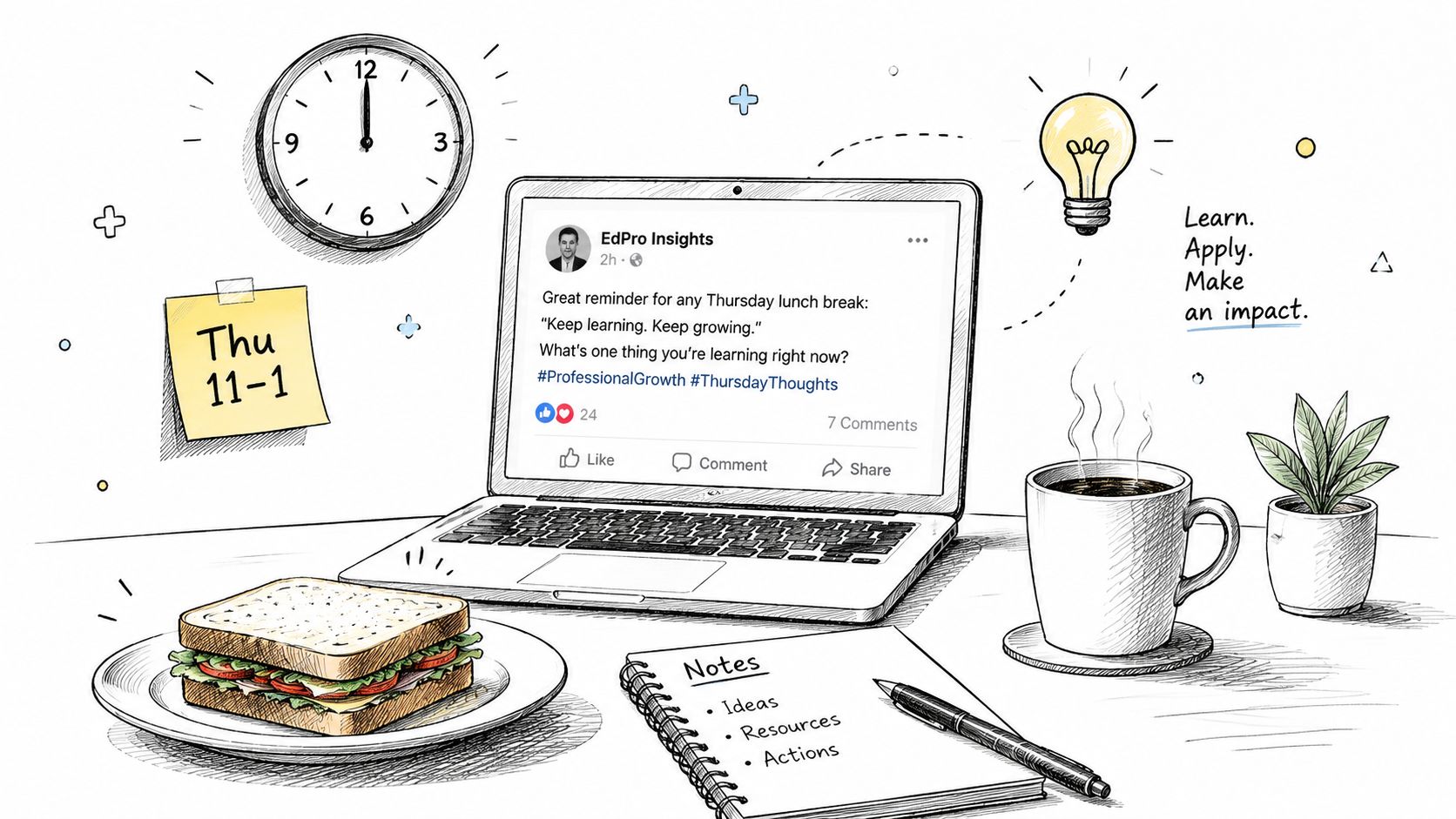 A hand-drawn illustration of a desk with a laptop, sandwich, coffee, and notes on professional growth.
4. Friday 2-4 PM Weekend Transition Engagement
Friday is not the strongest pure engagement day in the verified data, but it plays a different psychological game. Sprout Social's 2026 timing analysis still places weekdays ahead of weekends overall, with strong performance on Tuesday through Thursday as the safest starting point Sprout Social's Facebook timing study. Buffer's large sample likewise keeps the best outcomes in the midweek zone, while noting that Saturday underperforms relative to weekdays Buffer's 14 million post analysis. That makes Friday less of a default winner and more of a strategic transition slot.
Use Friday for lighter intent
The 2 p.m. to 4 p.m. block works because people start mentally leaving the work week behind. They're still online, but they're less interested in dense material and more open to something easy, visual, or entertaining. That makes Friday a strong fit for consumer brands, lifestyle content, and anything tied to immediate leisure.
A retailer can use Friday for a weekend promo, a travel brand can frame a last-minute booking opportunity, and a restaurant can push an evening reservation. The content should feel like a nudge, not a lecture. To achieve this, visual hooks matter more than heavy explanation.
Friday also works well for urgency without pressure. A post about limited spots, late access, or weekend availability can land because the audience already has one foot out the door. The tone should match that shift.
Keep Friday content short, visual, and easy to act on. If the reader needs a lot of context, you've probably missed the mood.
For automation, Friday is a good place to schedule campaign content that doesn't need a long lead time. The operational benefit is simple. You can pre-stage the message, let the system publish it, and avoid manual timing mistakes right when your team is trying to wrap the week.
5. Monday 8-9 AM Return-to-Routine Engagement
Monday gets ignored too often because people assume the feed is dead after the weekend. The verified data doesn't support that. Sprout Social says Monday still shows strong afternoon engagement in its Facebook timing study, and the broader social-media version of that analysis also says Mondays and Thursdays have strong afternoon spikes while weekends and early mornings are the weakest periods Sprout Social's Facebook timing study. That means Monday is still very much in play, especially for audiences that use social media as part of their work routine.
Monday works when the content has a purpose
Monday morning is best for posts that help people reset. Think motivation, planning, goals, productivity, or anything that supports a fresh start. The audience is already thinking about the week ahead, so content tied to action has a better chance of landing than loose, entertainment-first material.
This is a strong slot for fitness brands, productivity tools, career coaches, and wellness content. A meal-prep brand can post a weekly prep guide, a SaaS company can share a workflow shortcut, and a coach can open a challenge or enrollment window. The content should make the week feel more manageable, not more crowded.
Monday also gives you a clean place to drive commitment. If you want someone to sign up, download, or start a challenge, the “new week” mindset helps. The post should be practical and direct, with one clear next step.
Good Monday uses: Goal-setting, planning, productivity, and enrollment.
Good Monday formats: Simple graphics, short video, and downloadable offers.
Good Monday CTA: Ask for a commitment, not a vague reaction.
Good Monday rhythm: Publish early, then watch the first wave of comments and saves.
You don't need to force Monday into the same role as Tuesday. Use it for launch energy and reset energy, not for posts that need people to linger over a long explanation. If the content reads like a Monday checklist, it usually belongs here.
6. Saturday 9-10 AM & 7-9 PM Weekend Leisure Peaks
Saturday is where the audience changes behavior, and that matters more than the day label itself. The verified data says weekends are generally weaker than midweek for Facebook engagement in the Sprout Social timing study Sprout Social's Facebook timing study, but the broader cross-study roundup still points to a weekday morning window as the safer cluster overall Meetedgar's roundup of Facebook timing studies. That doesn't mean Saturday is useless. It means Saturday is selective.
Saturday rewards the right kind of content
Saturday morning works for browsing content, especially when people are relaxed, at home, or making weekend plans. Saturday evening fits a different pattern, where people are more settled and open to entertainment, visual content, and community posts. This is a better day for lifestyle, travel, food, fashion, and user-generated content than for dense B2B material.
A travel brand can post destination inspiration, a recipe creator can share a weekend meal idea, and a home brand can publish a project post for people with time to spare. The common thread is that the audience is not trying to sprint through a workday. They're browsing with more patience.
The downside is obvious. If your audience expects professional utility, Saturday can underperform fast. That's why content type matters more here than on Tuesday or Thursday. A polished visual can do well. A dry announcement usually won't.
 A split image showing morning coffee and travel planning alongside an evening of relaxing with movies.
For practitioners, the move is to treat Saturday as a test lane for leisure-led content, not a default publishing day. If your brand is visual, emotional, or community-driven, Saturday can still produce strong sessions. If it's technical, skip the assumption and let your own metrics decide.
Saturday is not a “post more” day. It's a “post the right thing” day.
7. Sunday 6-8 PM Evening Planning & Content Binge Peak
Sunday evening is one of the most useful underused windows because the audience is mentally shifting into the next week. The verified data says weekends and early mornings are the weakest periods in one timing study, but it also shows that Tuesday and Wednesday from 12 p.m. to 8 p.m. local time are strongest overall, which frames Sunday as a more selective opportunity rather than a universal win Sprout Social's social media timing study. The broader roundup still highlights a weekday morning cluster, which is why Sunday works best when the content has real depth Meetedgar's roundup of Facebook timing studies.
Sunday night favors depth and reflection
People don't usually want fast, disposable content here. They're more likely to read something longer, watch a video, or engage with a post that helps them organize the week ahead. That makes Sunday evening ideal for tutorials, educational posts, recap content, and anything that prompts comments instead of just taps.
This is a strong slot for course creators, podcast links, meal-planning brands, and motivational content. A weekly recap can pull in thoughtful engagement, and a guide post can keep readers around long enough to matter. The point is to let people settle in.
Sunday also gives you lower competition in a lot of feeds, which can help your content stand out even when the audience size is not at its peak. That makes it a good slot for durable content, the kind people can save, revisit, or share in a DM later. If the post has a discussion hook, Sunday evening is a smart place to use it.
Best use: Long-form guides, discussion prompts, and weekly planning.
Best format: Video, carousel, or multi-part educational content.
Best objective: Comments, shares, saves, and deeper reads.
Best tone: Reflective, helpful, and calm.
If your publishing stack already supports scheduled campaigns and downstream data collection, Sunday is a natural place to let automation do the boring part. You set the slot, let the post go live, then measure what comes back instead of trying to time it manually every week.
7-Point Comparison: Best Facebook Posting Days & Times
Window | 🔄 Implementation complexity | ⚡ Resource requirements | ⭐ Expected outcomes / 📊 Impact | 💡 Ideal use cases | Key advantages |
Tuesday (9–10 AM) | High, precise scheduling; high competition | Moderate, quality creative + A/B tests | ⭐⭐⭐⭐, highest engagement & CTR; widest reach 📊 | B2B announcements, time-sensitive promos, major launches | Statistically highest engagement across demographics |
Wednesday (5–6 PM) | Medium, evening timing; fewer competitors | Low–Moderate, video/story assets recommended | ⭐⭐⭐, solid evening engagement; relaxed consumption 📊 | Lifestyle, entertainment, behind-the-scenes, videos | Less competition than Tuesday; good algorithmic visibility |
Thursday (11 AM–1 PM) | Medium, timezone sensitivity for midday posts | Moderate, value-driven content (carousels, guides) | ⭐⭐⭐, second-highest engagement; focused reading 📊 | Educational/professional content, how-tos, LinkedIn posts | High engagement with notably less competition than Tuesday |
Friday (2–4 PM) | Low, casual timing; simpler scheduling | Low–Moderate, visual/video-first content | ⭐⭐, weekend-transition spike; strong for promos 📊 | Weekend promotions, entertainment, retail flash sales | Audience is relaxed and receptive; great for video/Reels |
Monday (8–9 AM) | Medium, potential feed backlog; consistent timing | Moderate, motivational/productivity assets | ⭐⭐⭐, ~80–90% of Tuesday; good professional engagement 📊 | Motivation, week-planning, product announcements | Captures "new week" mindset with lower competition |
Saturday (9–10 AM & 7–9 PM) | Low, two-slot management; content-dependent | Moderate, high-quality visuals & UGC preferred | ⭐⭐, lower overall reach but strong for right content 📊 | Travel, food, lifestyle, community & UGC posts | Very low competition; longer browsing sessions improve interaction |
Sunday (6–8 PM) | Low, single evening slot; easy scheduling | Moderate–High, long-form video or in-depth posts | ⭐⭐⭐, 70–80% of Tuesday with deep engagement 📊 | Long-form education, discussions, video binge content | Extremely low competition and higher-quality engagement (comments/shares) |
Stop Guessing: How to Find Your Own Best Times
These data points are your starting line, not the finish line. The big pattern is clear. Tuesday through Thursday are the safest starting days for broad Facebook reach, Wednesday keeps showing up as the most reliable overall performer in large samples, and weekends need more selective content choices to work well Sprout Social's Facebook timing study, Buffer's 14 million post analysis. But your audience still has its own habits, and no aggregate study can replace your own post history.
The right way to use timing data is as a hypothesis engine. Pick one primary slot, one backup slot, and one off-peak control. Then run the same content type across those windows for a few cycles so you can compare real engagement instead of arguing about preference. If you're publishing through APIs, that test is easy to systematize, because the schedule can be controlled, repeated, and measured without anyone manually logging in to “see what happens.”
PostPulse fits this workflow well because it turns timing into infrastructure. You can schedule posts through a REST API, via official n8n and Make.com nodes, or through an MCP server, then keep the publishing flow branded the way your team wants it. That matters when you're testing a new cadence, because the tool should disappear into the workflow instead of becoming another place where posts get delayed.
A practical testing loop looks like this. Publish Tuesday at one time, then the following week test Wednesday or Thursday with the same format. Keep the content style similar enough to compare, then look at the response by slot, not by gut feel. Once you see a stable pattern, automate it and stop paying the manual-tax every week.
For teams building a broader publishing system, the timing work belongs inside the roadmap, not in a random spreadsheet nobody updates. A good scheduling pattern is part of developing a social media roadmap, and it gets better when your publishing stack can enforce it consistently.
If you want to stop guessing and turn these posting windows into a repeatable system, build them into PostPulse and test them properly. Visit PostPulse to schedule Facebook posts through API, n8n, Make.com, or MCP, then use real engagement data to lock in the times that work for your audience.
About the Author

Founder of PostPulse — a social media scheduling platform for creators and teams. Software engineer with a passion for building developer tools and simplifying complex API integrations across social media platforms.