AI Social Media Posting: The Developer's Guide to Automation
Published on · Updated on
Tags:
At 3 AM, the alert usually isn't about the AI model. It's a LinkedIn token that expired, an Instagram media container stuck in processing, or a scheduler that marked three posts complete before the platform accepted them. The copy may be excellent. The production system still failed.
That's the hidden reality of AI social media posting. Generating a caption is a small part of the job. Reliable publishing requires OAuth lifecycle management, queue durability, platform-specific request flows, retries, observability, and a human decision about which content should go live. After integrating several social APIs, I've found that the teams with dependable systems treat social publishing like backend infrastructure, not like a glorified cron job.
Table of Contents
Why Your Social Media Integration Keeps Breaking
The first failure is often deceptively simple. A worker wakes up, loads a scheduled post, calls a platform API, receives an authorization error, and retries with the same invalid credential. The retry queue fills, the next post starts late, and the dashboard still says “scheduled.” By the time someone checks the account, the publishing window has passed.
OAuth tokens need explicit lifecycle handling. Your system should store expiry metadata, refresh credentials before they become invalid where the platform supports refresh, and distinguish authentication failures from transient network errors. A retry policy that treats both errors identically doesn't recover the system. It repeats the same mistake more efficiently.
The second failure comes from asynchronous media workflows. Instagram's official publishing flow creates a media container first with POST /{ig-user-id}/media, then publishes it with POST /{ig-user-id}/media_publish. Meta also documents checking container state through /{IG_CONTAINER_ID}?fields=status_code, so a production worker must model creation, processing, polling, publishing, and failure as separate states, rather than assuming one request equals one published post. Meta's Instagram publishing documentation describes that container-based sequence directly.
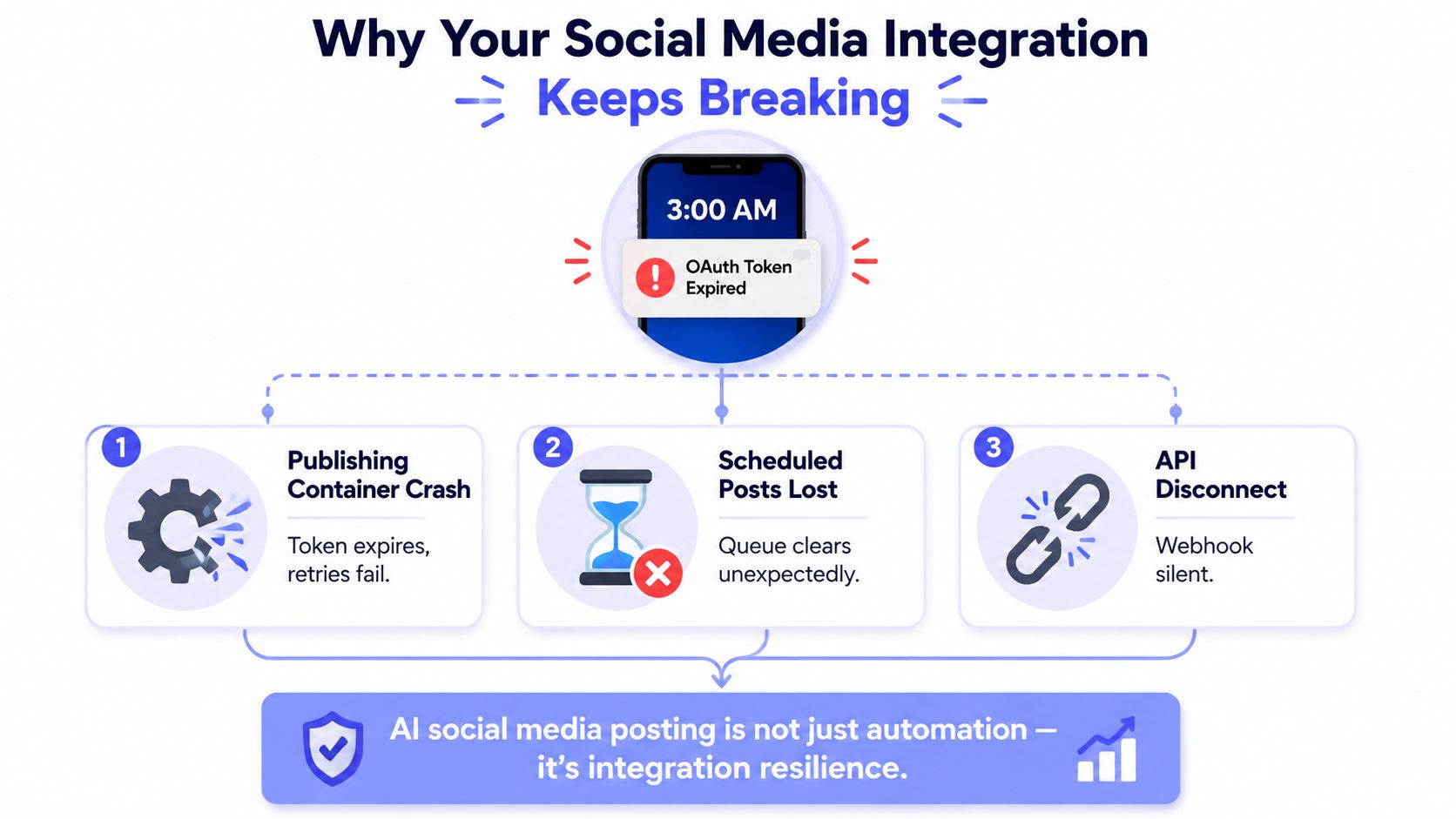 An infographic showing common reasons why automated social media integrations fail, including expired OAuth tokens and API disconnections.
The failure modes worth designing for
Credential failure: An expired, revoked, or incorrectly scoped token should move the job into an authentication queue, not consume every retry attempt.
Container failure: A media upload can be accepted before the platform finishes processing it. Persist the container ID and poll deliberately.
Queue failure: A process restart must not erase scheduled work. Store jobs durably and make publishing idempotent.
Rate-limit failure: Back off per platform and account. One noisy tenant shouldn't pause unrelated publishing.
Schema failure: Keep platform payload construction behind adapters so an API version change doesn't spread through the whole application.
A plain cron process has none of this by default. It wakes up, performs a call, and often loses the useful context when the process exits. A durable queue, dead-letter path, structured logs, and alerting around repeated failures give operators a way to recover instead of manually reconstructing what happened.
Teams building revenue-sensitive workflows can also study patterns used in revenue recovery integrations, where durable event handling and failure recovery matter just as much as the initial API request. For social systems specifically, document rate-limit behavior and retry boundaries alongside the implementation, using this API rate-limit guide as a practical reference point.
Practical rule: A post isn't successful when your worker receives HTTP success. It's successful when you can verify the platform accepted the publish operation and record the resulting identifier.
The Core Workflow Behind AI Social Media Posting
A reliable pipeline separates four jobs that are often collapsed into one button: generation, scheduling, execution, and feedback. Each stage should have its own data model and failure state.
1. Generate content, then validate it
Start with a platform-aware content brief. Include the channel, audience, objective, approved claims, brand voice, media references, and the desired call to action. Ask the model for structured output rather than a loose paragraph:
A second validation step should check length, prohibited claims, missing media, unsupported formatting, and whether the draft contains factual assertions that need review. Generate variants if you need options, but don't let the model decide which variant is safe to publish without policy checks.
For teams refining professional copy, guidance on editing AI LinkedIn posts naturally can complement the engineering workflow. The important boundary is that editing guidance improves the draft, while your validator protects the publishing system.
2. Schedule with durable time semantics
Store scheduled times in UTC and retain the user's intended timezone separately. Convert only at the presentation and scheduling boundaries. A queue such as Redis-backed BullMQ can hold delayed jobs, but the job payload still needs an account ID, platform, content version, media references, and an idempotency key.
Priority should reflect business impact, not insertion order. A campaign launch, a routine evergreen post, and a retry after a temporary outage shouldn't compete blindly for the same worker.
3. Execute through platform adapters
Each adapter should own authentication, payload construction, response parsing, and retry classification. YouTube documents videos.insert for programmatic video uploads through POST https://www.googleapis.com/upload/youtube/v3/videos, with optional metadata fields in the request flow. The official YouTube Data API documentation is the source of truth for that upload surface.
LinkedIn's UGC Post API documents member-authored organic posts through POST https://api.linkedin.com/v2/ugcPosts. Microsoft Learn's UGC Post API documentation provides the endpoint and its intended use.
Don't bury these calls inside a generic “publish” function. Return normalized states such as accepted, processing, published, retryable_failure, and permanent_failure, while preserving the original response for debugging.
4. Feed verified signals back into planning
Feedback should include publish outcomes and performance data, but it shouldn't rewrite your strategy automatically after one weak post. Use rolling observations to identify useful hooks, formats, and audience responses, then send those findings into a controlled prompt or scheduling revision process.
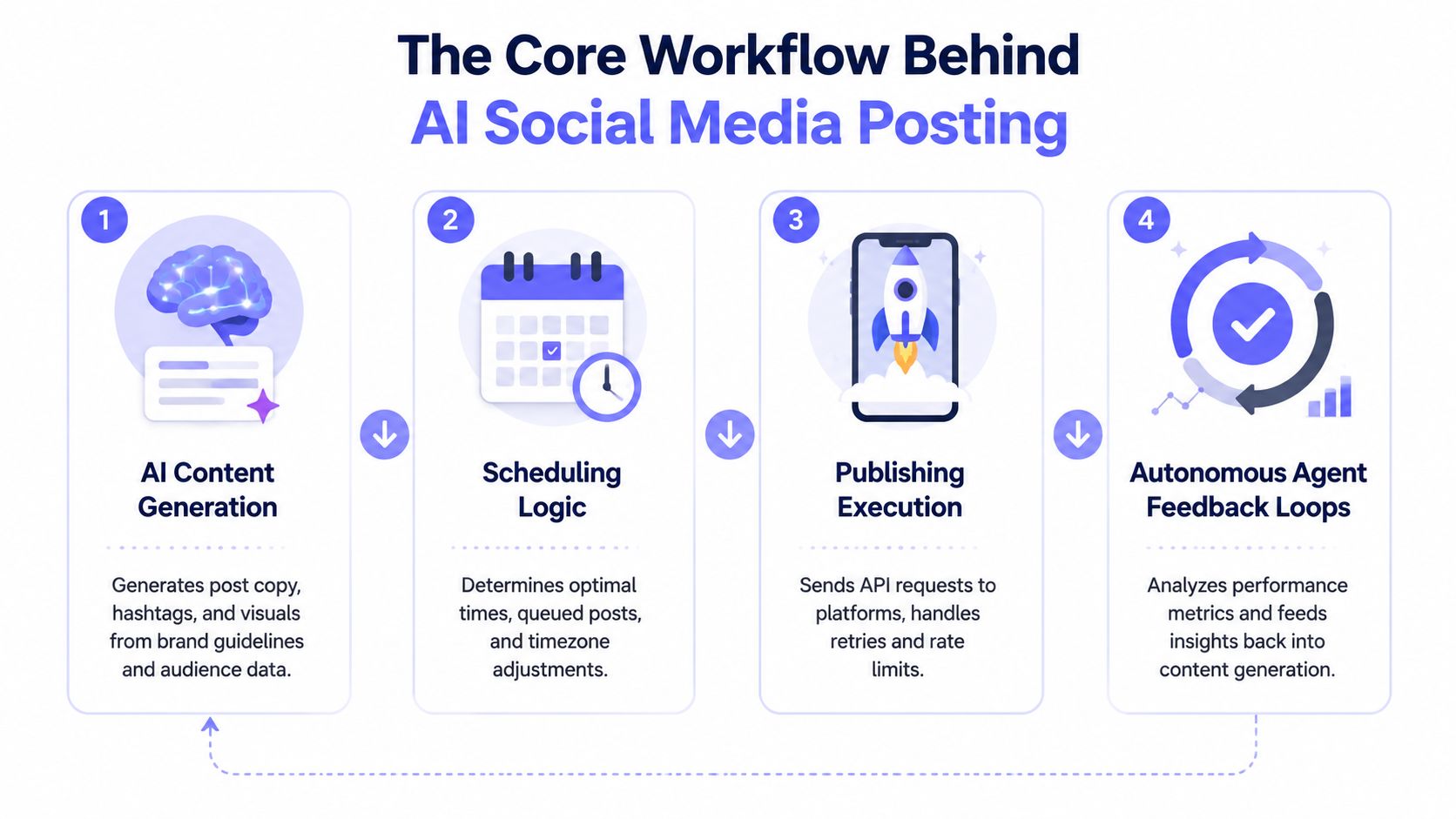 A four-step infographic illustrating the core workflow of AI-powered social media posting and automated content management.
Choosing Your Integration Architecture
Architecture choice determines where complexity lives. Direct REST integration puts it in your repository. Workflow tools move it into visual nodes and credential stores. MCP moves part of the interaction into an agent tool layer. None of these options removes platform behavior.
Architecture | Setup Time | Maintenance Overhead | Scalability | Debugging Complexity | Cost at Volume |
Direct REST API | Longer initial build | High, you own OAuth, adapters, retries, and changes | Strong when designed well | High, but fully observable | Infrastructure and engineering cost |
n8n | Fast for standard workflows | Moderate, especially for self-hosted upgrades and credentials | Good until workflow execution becomes a bottleneck | Visual tracing is useful, code-level tracing needs extra work | Hosting and operations cost |
Make.com | Fast for multi-step scenarios | Moderate, with platform-specific branching limits | Suitable for controlled fan-out | Easy for simple paths, harder for complex recovery | Scenario and operation usage cost |
MCP server | Fast when an agent framework already exists | Moderate, with tool contracts and authorization still required | Depends on agent runtime and publishing service | Requires tracing tool calls, prompts, and API results | Agent runtime plus publishing cost |
Direct REST integration
Direct REST is the right fit when publishing is a core product capability and your team needs precise control over tenancy, audit records, retries, and release management. You'll need separate platform adapters, OAuth callbacks, token storage, webhook handling where available, and tests for every asynchronous state.
The benefit is visibility. You can attach a correlation ID to the prompt, draft, queue job, API request, and final platform response. The trade-off is permanent ownership of maintenance.
n8n and Make.com
Self-hosted n8n works well when engineers want visual workflow inspection without giving up deployment control. It can connect credentials and nodes into a readable process, but production teams still need external log aggregation, durable database state, and a clear approach to failed executions.
Make.com is convenient for fan-out workflows. A single approved draft can branch into several platform operations, but complex retry policies and conditional recovery become harder to reason about as scenarios grow. Use it for orchestration, not as the only source of truth for publishing state.
MCP for agent-driven publishing
MCP lets an AI agent call publishing tools through a standardized tool-use interface. That makes it possible for an agent to select an account, prepare content, schedule a post, and inspect available operations within an agentic workflow.
The danger is unclear authority. An agent should receive narrowly scoped tools, explicit account context, approval requirements, and structured errors. It shouldn't receive an unrestricted “publish anything anywhere” capability.
The architecture should make the safe path easier than the clever path.
What the Engagement Data Actually Shows
The useful question isn't whether AI-generated content is good or bad. It's whether AI is acting as a drafting and optimization layer, with enough human judgment to preserve relevance and platform fit.
A large-scale analysis of 1.2 million social posts found a median engagement rate of 5.87% for AI-assisted posts, compared with 4.82% for non-AI posts, an implied lift of about 22%. The source also found platform-level variation, with one major network moving from 4.89% to 6.13% for AI-assisted content, which is a reminder that the result depends on platform and audience behavior rather than AI alone. Buffer's analysis of AI-assisted post performance supports using AI as an assisted layer, not as a substitute for editorial review.
Platform | Metric | AI-Generated | Human-Crafted | Delta |
Cross-platform dataset | Median engagement rate | 5.87% | 4.82% | About 22% implied lift |
One major network in the dataset | Median engagement rate | 6.13% | 4.89% | Platform-specific increase |
The distribution problem matters as much as the draft. An experimental study found that moving a post from the top of a feed to ranks 6 to 10 reduced engagement odds by about 40%, even though participants rarely recognized ranking position as the cause. The experimental ranking study suggests that scheduling logic should pay attention to early response, audience fit, and the structure of the opening line.
That doesn't justify inventing universal posting-frequency thresholds. The verified evidence here doesn't establish a safe number of posts per day, a universal first-half-hour benchmark, or platform-specific suppression rules for LinkedIn, X, or Instagram. Build your own baseline from reach, replies, saves, clicks, completion signals, and engagement decay, then compare content families rather than judging every post against a single average.
Metricool's 2025 global study found that 96% of social media professionals use AI tools, and 72.5% use them daily. It also reported that 66% said at least half of their content involves AI in some form, while common uses included idea generation at 78%, writing at 72%, and adapting content across channels and tones at 68%. Metricool's State of AI in Social Media report indicates that the operational baseline has already shifted toward assisted production.
The Case for Human-in-the-Loop Publishing
Fully autonomous publishing sounds efficient until the system makes a confident claim nobody approved, chooses the wrong tone during a crisis, or publishes a draft that violates a platform or brand rule. The model may have generated the text successfully. The organization still owns the outcome.
A 2026 industry survey found that 78.4% of marketers apply moderate or extensive edits before publishing, while 71.1% identified time savings as the biggest benefit and 44.7% said AI-assisted content performs better. A separate analysis of 10,000 posts reported that AI-assisted content with human review produced 31% higher average engagement than purely human-created content across Instagram, Facebook, LinkedIn, and X. Sociality's report on AI in social media marketing points to a middle ground: AI accelerates production, but review remains part of the performance model.
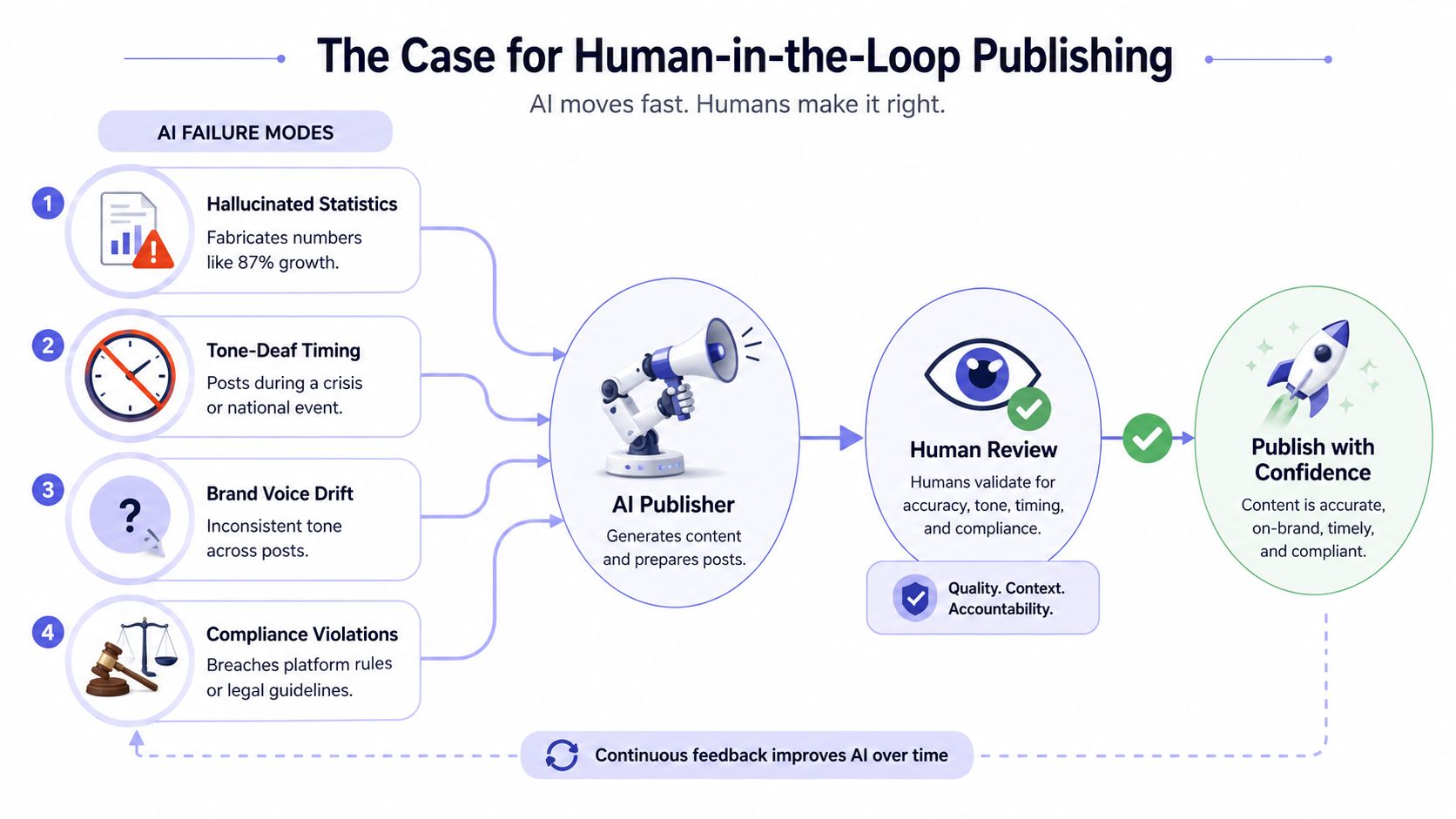 A diagram illustrating a human-in-the-loop workflow for AI social media publishing to prevent errors.
Build approval into the data model
Don't bolt approval onto the interface after the queue exists. Give each draft a state such as generated, validated, needs_review, approved, scheduled, published, and rejected. Store reviewer identity, review timestamp, content version, and the reason for rejection.
A practical approval service can expose a webhook to your internal dashboard or Slack workflow. The approval action should reference an immutable draft ID, not whatever content happens to be visible in a mutable editor.
Use risk-based gates
Low-risk evergreen copy can move through a lighter review path. Sensitive subjects, regulated claims, crisis-related keywords, customer complaints, and externally supplied statistics should require explicit approval. A confidence score can help route work, but it shouldn't become a magic number that overrides policy.
Rollback also needs definition. For a published post, store the platform post ID and the deletion or editing capability documented by that platform. If the platform doesn't support the operation you need, the recovery path may be a correction post, an account pause, or escalation to an operator.
Teams often lose trust after one public failure, then disable useful automation entirely. A visible audit trail, a kill switch, and a replayable queue make recovery concrete and help people adopt automation without pretending it's infallible. A detailed content approval process can help teams turn that principle into an operating workflow.
Building Your Publishing Stack with PostPulse
A practical integration layer sits between your content system and each platform adapter. In this model, the AI service creates a draft, a reviewer approves it when required, and the publishing layer handles account connections, scheduling, platform-specific requests, and resulting status events.
PostPulse can serve that integration role through a unified REST API, official n8n and Make.com connections, or an MCP server for agent workflows. It supports Instagram Business and Creator accounts, TikTok, YouTube, LinkedIn personal profiles, X, Threads, Bluesky, Facebook Pages, Telegram channels and chats, and Pinterest boards. Treat that as an integration surface, not a reason to skip your own approval and observability layers.
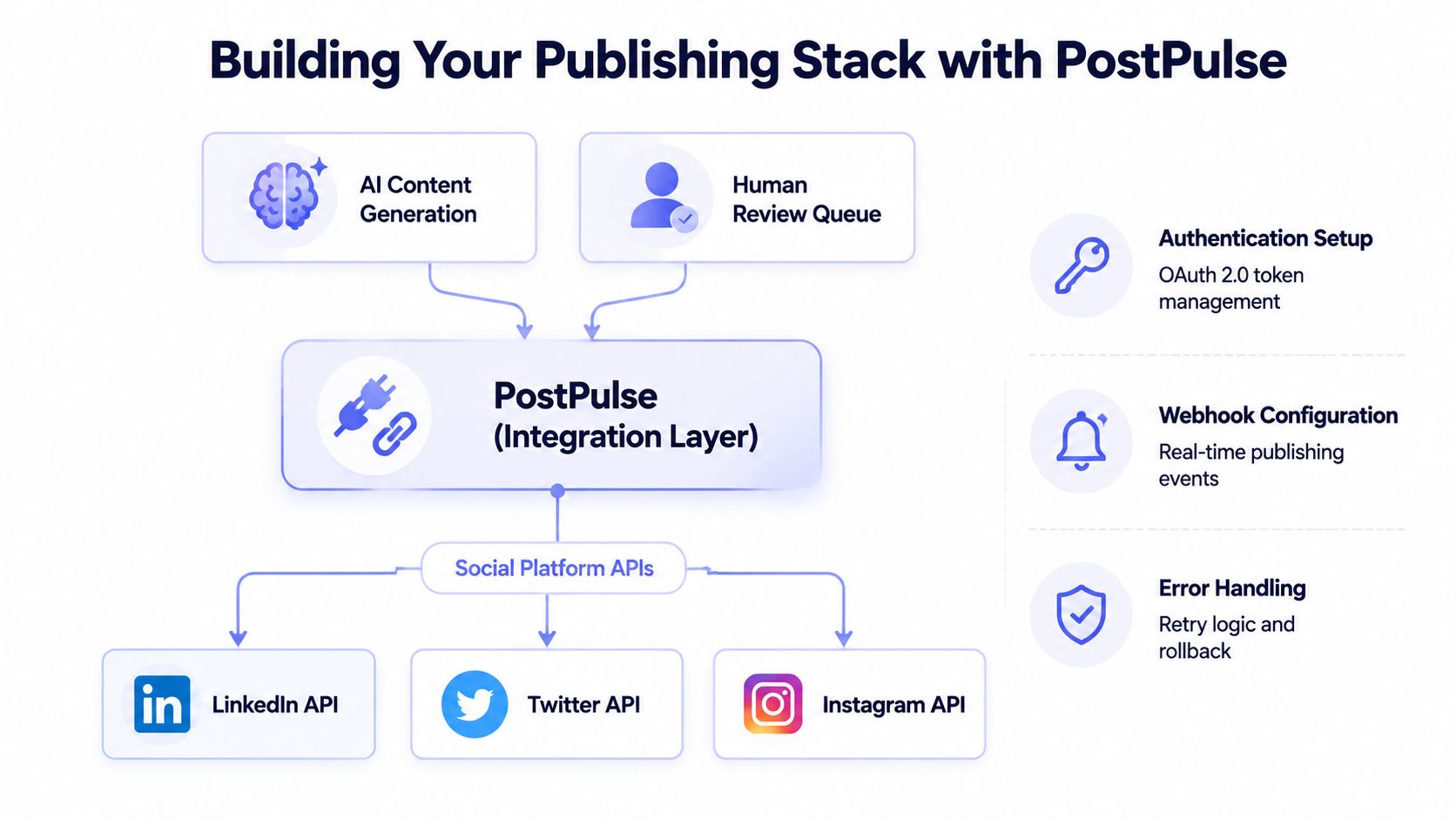 A diagram illustrating the PostPulse integration layer for automated social media content publishing and management workflows.
Choose where scheduling lives
Use native scheduling when the publishing layer owns the account connection and you want one queue for platform fan-out. Use an external scheduler when your application already owns campaign orchestration, but send an explicit idempotency key and persist the external job ID.
For a batch, keep platform adaptations separate:
A conditional workflow can validate media availability, check approval state, and stop the branch if a required asset hasn't completed processing. That's safer than publishing the same raw draft everywhere.
Plan for operational edges
Image processing timeouts need a retry limit and a dead-letter state. Character-limit failures should return to content adaptation, not retry unchanged. Timezone errors usually come from ambiguous local timestamps, so preserve the original timezone and the normalized UTC value in the job record.
Webhooks should update state, not trigger unbounded recursion. Add circuit breakers around a degraded platform, monitor per-account failure rates, and keep a manual replay action for operators. The PostPulse integration guides are a useful starting point for mapping those choices to a concrete implementation.
For teams that prefer visual automation, n8n or Make.com can hold the orchestration while your application remains the source of truth for content and approval. For an AI agent, MCP can expose account listing, media preparation, scheduling, and publishing as constrained tools. In all three cases, the same questions remain: who authorized the post, which version was approved, and how can an operator stop or replay it?
Monitoring and Governing AI-Generated Content
A sustainable system records the entire path from prompt to post. Capture the originating prompt, model version, input references, validation results, reviewer, queue event, platform response, and final post ID. Without that chain, a complaint becomes an investigation across disconnected logs.
Monitor more than published count. Track queue depth, retry rates, authentication failures, media-processing failures, cost per post, approval latency, and engagement decay by content template. A rising retry rate may indicate a platform change. A growing queue may indicate a worker problem. Repeatedly weakening engagement may indicate template fatigue rather than a scheduling issue.
Platform trust also deserves governance. A July 2026 study classified 81.2% of 5,000 long-form public LinkedIn posts as likely AI-generated, up from roughly half in late 2024, while broader reporting put the share of marketers saying more than half of their posts are AI-assisted at 28.2%. The reported AI social media tool statistics also highlight moderation risks, including over-removal and discriminatory outcomes, so content classification and human escalation belong in the design.
Use tags for claims, sensitive topics, media provenance, and approval status. Alert before publication when a draft contains unsupported factual language, unusual sentiment, or a policy-sensitive category. If your workflow also includes video, you can browse AI video creation guides while keeping the same review, provenance, and audit requirements.
Feed performance back into prompts carefully. Change one variable at a time, preserve a control group, and prevent a weak early result from automatically amplifying the same low-quality pattern across every channel.
PostPulse gives developers one publishing layer for REST, n8n, Make.com, and MCP-based AI-agent workflows, with scheduling and multi-platform account connections handled behind the integration surface. If you're tired of maintaining separate OAuth flows, media states, and publishing adapters, visit PostPulse to evaluate the architecture against your own stack.
About the Author

Founder of PostPulse — a social media scheduling platform for creators and teams. Software engineer with a passion for building developer tools and simplifying complex API integrations across social media platforms.