White Label Social Media Scheduler: Technical Realities In
Published on
Tags:
You've probably seen this failure sequence already. Instagram publishing works in staging, then a carousel remains stuck while processing. A token refresh succeeds for one worker and invalidates another worker's token. A YouTube upload suddenly returns a quota error, while TikTok accepts the submission but requires a separate status check before you can call the post complete.
That's the core problem behind a white label social media scheduler. The visible layer is your logo, colors, domain, and client experience. The difficult layer is OAuth, queues, media processing, permissions, retries, rate limits, and the platform-specific behavior your users never see.
The market is large enough that this infrastructure is no longer a niche experiment. One 2026 market estimate puts social media management software at USD 21.98 billion in 2026, with a projection of USD 42.76 billion by 2031 at a 14.20% CAGR, while another report estimates USD 28.58 billion in 2025 and USD 62.16 billion by 2030 at a 16.7% CAGR. These are projections from separate market reports, not guarantees, but they explain why agencies and SaaS teams increasingly treat unified publishing as product infrastructure. (OnlySocial's market context)
Table of Contents
Why Social Media API Integration Is Harder Than It Looks
The first integration usually feels manageable. You register an app, complete OAuth, upload media, publish a post, and put the success response in a database. Then a customer asks for TikTok, YouTube, LinkedIn, X, Threads, Bluesky, Facebook, and Telegram.
The work doesn't multiply neatly. Each platform introduces its own consent flow, token behavior, media rules, publishing model, permissions, review requirements, and error vocabulary. Instagram uses media containers. TikTok separates submission from status checking. YouTube exposes upload quotas. A system that treats every destination as “send this post to an endpoint” eventually loses track of what happened.
Practical rule: Treat each platform as a separate delivery system behind one product interface, not as a slightly different version of the same API.
That distinction matters for white labeling. Rebranding a dashboard is easy compared with giving every customer an isolated workspace, letting them connect accounts through an experience that feels like yours, and ensuring your team doesn't maintain nine separate integrations. A proper white-label product hides the infrastructure provider from the user while preserving reliable account ownership, auditability, and failure reporting.
The broader category has expanded beyond simple calendar features. Industry forecasts describe social media management software moving toward multi-channel publishing, approval workflows, analytics, and automation, including a projection from USD 33.46 billion in 2026 to USD 62.16 billion in 2030. Another forecast projects USD 26.64 billion in 2024 to USD 91.16 billion by 2032. Those projections help explain the commercial model, but the engineering lesson is more immediate: customers now expect one workflow to coordinate several networks. (Global Growth Insights' market analysis)
A useful primer on the underlying integration problem is this guide to social media APIs and publishing workflows. It's especially relevant if you're deciding whether to build a narrow internal tool or a reusable customer-facing platform.
The build-versus-buy decision comes down to where you want to spend engineering time. Building your own scheduler gives you control over the interface and business rules, but you also inherit every authentication change, platform review, retry policy, and media edge case. Buying a white-label social media scheduler gives you less control over the underlying engine, but it can keep your product team focused on the workflow your customers pay for.
The Technical Architecture Behind Multi-Tenant Social Publishing
A production scheduler needs more than a calendar and a cron job. It needs a multi-tenant control plane that knows which customer owns each account, which credentials belong to that account, which post targets which destination, and which workers are allowed to act on it.
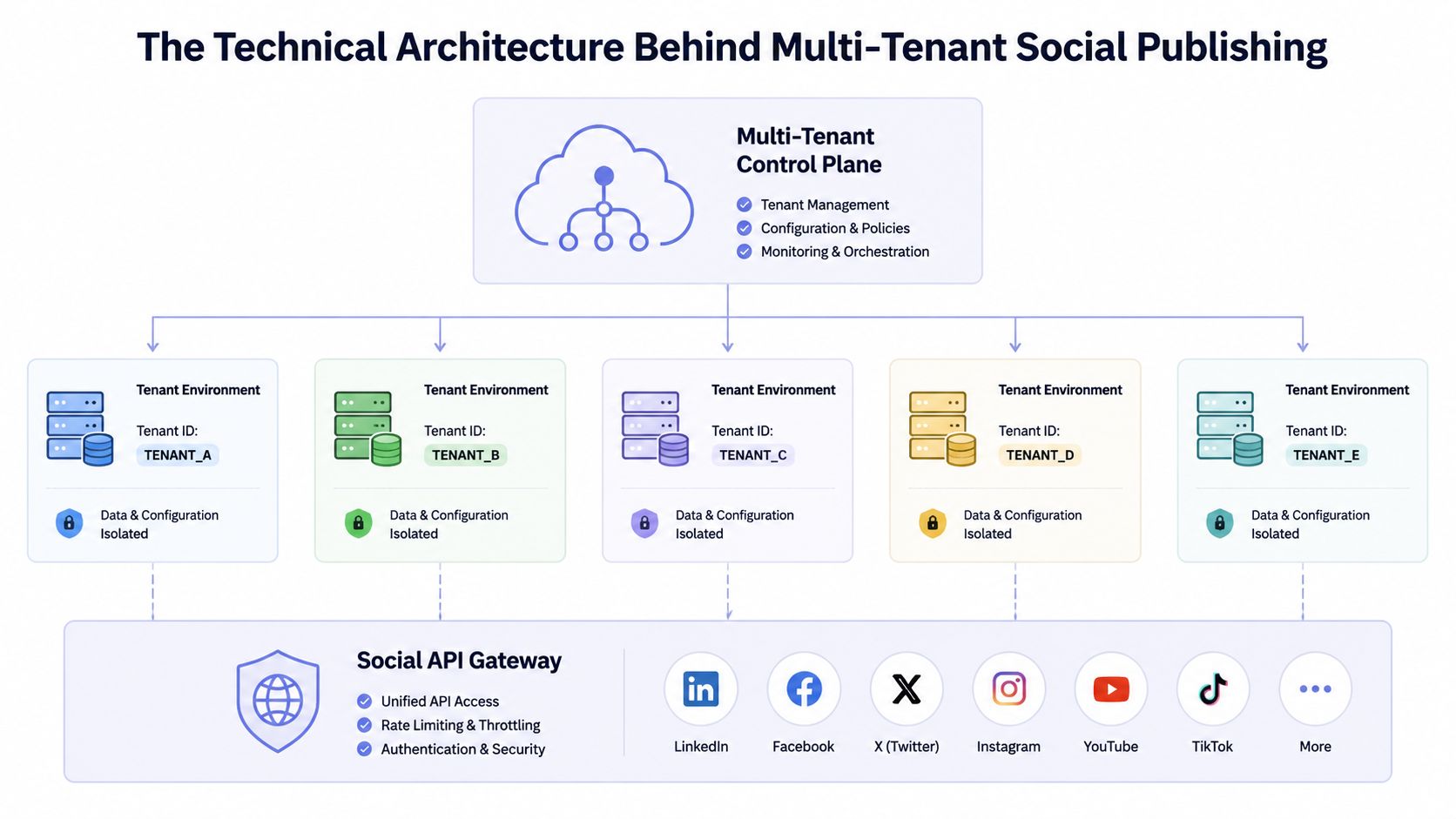 A diagram illustrating a technical architecture for a multi-tenant social media publishing platform using a control plane.
Isolation has to exist below the interface
Each customer workspace should have scoped credentials, scoped permissions, and a durable relationship to its connected accounts. Don't rely on a tenant ID passed from the browser as your primary security boundary. Resolve tenant ownership server-side, enforce it in data access, and make every publishing job carry its tenant context.
The control plane also needs a durable queue. An in-memory task list might survive a demo, but it won't reliably survive a worker restart, deployment, or temporary platform outage. A durable queue lets the system retry work without dropping a scheduled post.
The publish pipeline should use an explicit state machine:
Draft: Content exists but isn't eligible for delivery.
Scheduled: The post has a target time and destination accounts.
Processing: A worker is preparing media or calling a platform API.
Published: The platform returned enough information to record successful delivery.
Failed: Delivery stopped and the system retained the reason, response, and retry history.
This state model isn't decoration. It gives support staff a way to answer whether a post was never queued, was processing during a restart, was rejected by a platform, or published successfully but failed to return a final URL. Guidance on white-label architecture specifically emphasizes isolated workspaces, durable job queues, and auditable publish states for these reasons. (Multi-tenant white-label architecture guidance)
Workers need coordination, not just concurrency
Multiple workers improve throughput, but they also create race conditions. Two workers can claim the same post if job locking is weak. Two workers can refresh the same token at the same time. A retry can run while the original request is still completing.
Use idempotency keys where the platform or abstraction layer supports them. Lock job ownership for a bounded period, record attempt metadata, and make state transitions conditional. A worker should never overwrite a newer terminal state with an older retry result.
You'll also want operational visibility that follows the post across the system. Store tenant ID, account ID, platform, job ID, attempt number, timestamps, response category, and the final state. Avoid logging raw access tokens or sensitive authorization payloads. A vendor that can't show how it isolates tenants, locks jobs, and exposes delivery history is offering a branded demo, not production infrastructure.
OAuth Token Management Is the Real White-Label Challenge
Branding gets discussed because customers can see it. Token management gets neglected because customers usually only notice it when something breaks.
A white-label scheduler may manage many client accounts across several platforms. A common failure happens when two workers discover that a token needs refreshing. Both send a refresh request. One receives a new credential, the other receives an error or an older credential, and the database ends up with an invalid or overwritten value. The next publish attempt fails even though the account looked connected minutes earlier.
Refresh tokens need distributed locking
The safe pattern is straightforward in principle. Before refreshing, acquire a distributed lock keyed to the tenant, platform, and account. Re-read the stored token after acquiring the lock, because another worker may already have refreshed it. Only the worker holding the lock should write the new credential, and other workers should use the updated value after the lock is released.
You also need to handle refresh failures as a state transition, not as a generic 500 response. Mark the connection as requiring reauthorization when appropriate, preserve the failure reason, and provide a reconnect path that returns the user to the correct customer workspace.
Canonical redirect handling matters too. A redirect URL that changes between environments, domains, or branded entry points can break consent flows and expose the underlying provider's identity. The authorization initiation, callback validation, tenant resolution, and account attachment should all use a canonical, server-validated flow.
Ask vendors this question: “What happens if two publishing workers refresh the same customer token simultaneously?”
The answer should include locking or an equivalent coordination mechanism, encrypted credential storage, tenant-scoped account mapping, and a recovery path for invalid grants. Technical guidance on white-label OAuth specifically calls out vendor identity leaks in consent screens, canonical redirects, simultaneous refreshes, and invalid_grant failures. (White-label OAuth token lifecycle guidance)
Short-lived credentials make this more complicated. Meta's documentation and product materials define the supported Instagram publishing surface and account types, but your application still has to manage the full lifecycle around authorization, refresh, expiration, revocation, and reconnection. For a deeper treatment of Meta-specific authorization behavior, use this guide to the Meta OAuth token lifecycle.
A vendor evaluation should include a live reconnect test, a revoked-permission test, a simultaneous refresh test, and a tenant-isolation test. If the vendor only demonstrates the happy path, assume the unhappy path is yours.
Integration Approaches and Their Trade-Offs
The right integration surface depends on who is calling the publishing system and how much control that caller needs.
Approach | Good fit | Main advantage | Where it breaks down |
REST API | Custom applications and embedded SaaS workflows | Full control over UX, auth orchestration, and business logic | Your team owns request validation, state handling, and error mapping |
Official automation nodes | n8n and Make.com workflows | Visual configuration without maintaining a custom frontend | Complex branching and tenant-specific rules can become difficult to govern |
MCP | AI agents that discover and call publishing tools | Lets an agent work through a defined tool interface | Requires careful permission boundaries and approval policies |
Webhook triggers | Event-driven systems | External events can initiate workflows without polling | You still need idempotency, signature validation, and retry handling |
A unified REST API can reduce integration surface area, but it doesn't remove the need to understand platform outcomes. One request may produce several destination results, each with its own status. Your application should preserve those individual outcomes instead of returning a misleading all-or-nothing success.
Automation nodes suit teams that want a workflow editor. An n8n or Make.com flow can receive content, transform fields, request approval, and call a publishing action without requiring a custom application. The trade-off is governance. Once workflows multiply, you need naming conventions, credential boundaries, failure notifications, and a clear owner for every automation.
MCP is useful when an AI agent needs to discover publishing tools dynamically. It should not mean “let the agent publish anything anywhere.” Add account scopes, content validation, destination allowlists, approval gates, and an audit trail before autonomous publishing reaches customer accounts.
Webhook triggers are complementary rather than a complete publishing strategy. They're useful for events such as a product launch, approval completion, or content generation step. They don't replace durable queues or delivery state.
For teams comparing workflow products specifically for X, this guide to find the right X scheduling platform offers useful product context.
Choose the smallest surface that matches your product. A REST API is usually the right foundation for an embedded SaaS product. Nodes are practical for internal automation. MCP adds an agent interface. Webhooks connect the system to events.
Platform-Specific Publishing Quirks You Cannot Ignore
A scheduler can present one “publish” button while executing very different platform workflows underneath. The abstraction is useful only if it preserves the important differences.
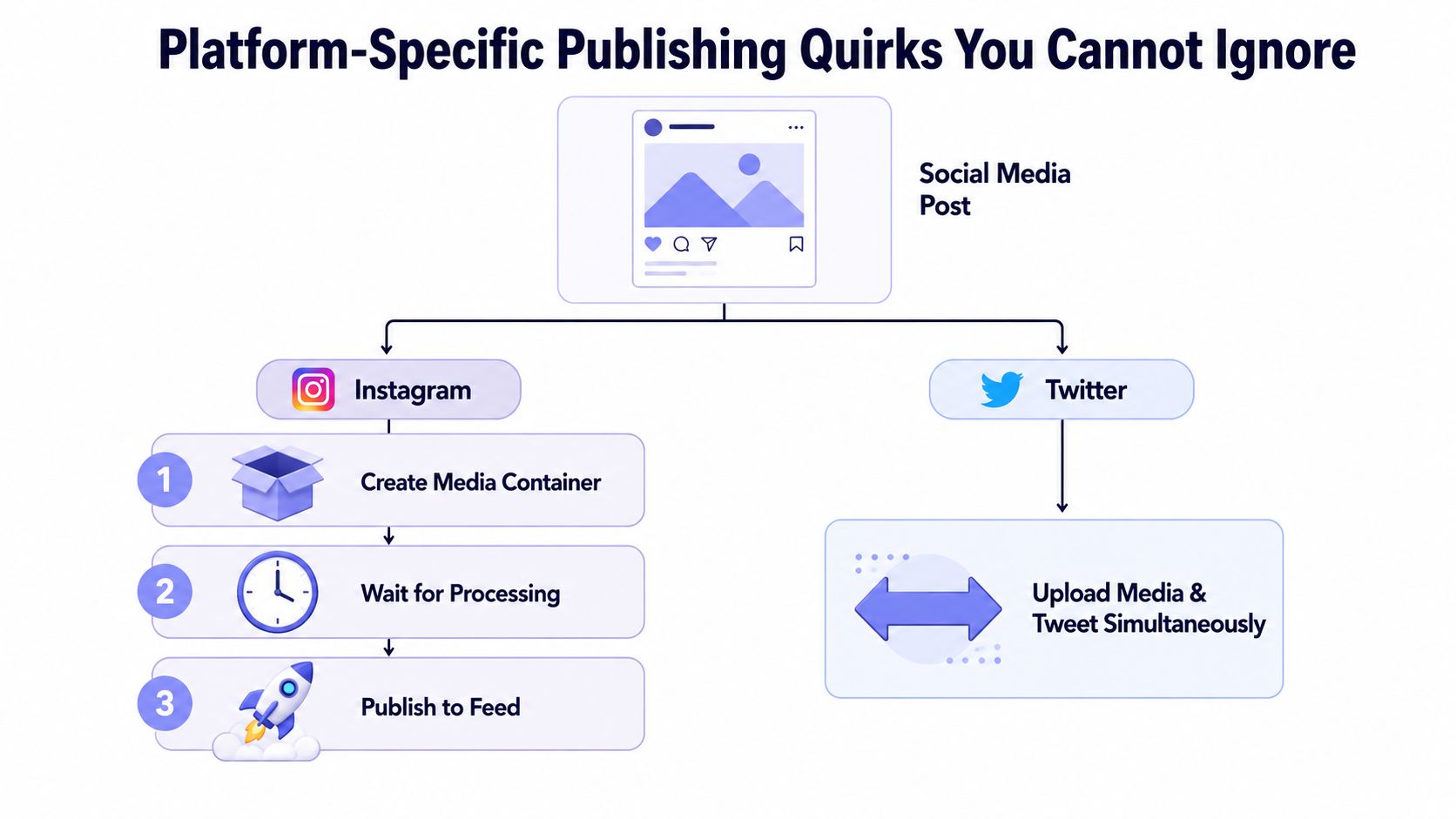 A diagram comparing the different media publishing processes for Instagram and Twitter social media platforms.
Instagram uses containers
Instagram publishing through Meta's Graph API is a two-step flow. First, create a media container with POST /{ig-user-id}/media. Then publish that container with POST /{ig-user-id}/media_publish. Meta states that the app user's access token is required for the publish call. (Meta's media_publish documentation)
That means your scheduler needs to retain the container ID, poll or wait for the media to become publishable where required, and associate failures with the original post. A simple request-and-forget implementation can mark content as delivered before Instagram has accepted the final publish action.
Meta's Instagram Content Publishing API is available for Instagram Business and Creator accounts, not personal accounts, and Meta describes it as a way for businesses to schedule and publish from developer applications. (Meta's Instagram API product documentation)
YouTube consumes quota on upload
YouTube's videos.insert method has a documented daily quota impact of 100 calls per day, and Google documents upload support for files up to 256 GB with video/* or application/octet-stream MIME types. (Google's videos.insert documentation)
That quota changes queue design. You can't treat every failed upload as an immediate retry, especially when the failure may consume quota or when a customer has a large backlog. The scheduler should separate upload preparation, request execution, quota-aware retry decisions, and final publication status.
TikTok separates submission from status
TikTok's official Content Posting API lets developers upload or share content from an application to a TikTok profile. Its documentation also provides /v2/post/publish/status/fetch/ for checking post state after submission. (TikTok Content Posting API documentation)
Your internal state shouldn't become “published” merely because the submission request returned successfully. Store the submission identifier, poll according to the documented workflow, and expose a pending state to the user when TikTok hasn't returned a final outcome.
The same principle applies across every supported network. Normalize the common concepts, but preserve platform-specific status, media requirements, and error details. A white-label social media scheduler earns its abstraction by handling these differences without hiding useful operational truth.
Rate Limiting and Scaling Under Load
Rate limits turn a reliable scheduler into a traffic-management problem. Publishing for many customer accounts creates bursts, especially when clients choose the same time and timezone for their content.
Per-platform handling should include exponential backoff and jitter. Exponential backoff spaces out repeated attempts, while jitter prevents every worker from retrying at the same instant. The queue should also understand account and platform scope, because a limit affecting one account shouldn't unnecessarily block unrelated tenants.
Some unified publishing APIs document ceilings such as 1,000 requests per minute and 100,000 requests per day per account. Those figures are examples of why a scheduler must queue and drain work rather than rely on naïve throttling. (Rate-limit handling guidance for social publishing APIs)
A practical queue separates at least three decisions:
Admission: Should this job enter the platform queue now?
Execution: Is the account currently eligible for a request?
Retry: Is the failure transient, permanent, or waiting on platform state?
Pricing can reveal whether a vendor has built this infrastructure seriously. A low per-publication price may suit variable volume, but it can also make retry behavior and failed attempts difficult to understand. An account-based subscription may be easier to forecast, provided the vendor clearly defines what counts as an account and how platform limits are handled.
For a deeper implementation checklist, use this guide to handling API rate limits. Ask vendors whether they expose queue status, retry history, per-platform errors, and delayed delivery behavior before you commit.
Pricing Models and What They Actually Mean
Pricing isn't just a finance question. It tells you how the vendor expects your workload to behave.
Model | Structure | Best for | Trade-offs |
Pay as you go | Charge per publication or delivery action | Variable volume and early validation | Costs can rise with retries, bursts, and customer growth |
Per connected account | Subscription tied to each connected social account | Predictable recurring usage | You may pay for idle accounts |
Platform fee plus active accounts | Base fee plus charges for accounts that publish | Agencies and SaaS products with many workspaces | “Active” needs a precise definition |
Custom enterprise agreement | Negotiated platform and support terms | Larger deployments with operational requirements | Harder to compare without a detailed usage model |
Per-publication billing is attractive when usage varies. It keeps commitment low, but you should clarify whether a failed attempt, retry, or multi-platform post counts as one publication or several.
Per-account billing is easier to model when customers publish regularly. It can become inefficient if many accounts connect during onboarding but remain idle afterward. Ask whether connected-but-unused accounts incur charges.
A platform fee with active-account billing can align better with a white-label social media scheduler. The key word is active. A vendor may define it as an account that publishes during the billing period, while another may charge as soon as the account connects. Those definitions produce very different economics.
Before migrating, map your expected account states and delivery volume:
Count connected accounts, not just customers.
Separate active, seasonal, paused, and test accounts.
Estimate how many platforms each customer connects.
Confirm how scheduled posts and retries are billed.
Request written definitions for failed, deleted, and disconnected accounts.
A vendor that supports startup programs may waive platform fees while a product is still being built or tested, but terms vary and should be confirmed directly. Don't choose from a feature checklist. Model your actual account lifecycle.
How PostPulse Maps to These Technical Requirements
PostPulse fits the API-first side of the market. Its stated product model provides one integration for publishing to nine platforms, with access through a REST API, official n8n and Make.com nodes, or an MCP server. The supported destinations include Instagram Business and Creator accounts, TikTok, YouTube, LinkedIn personal profiles, X, Threads, Bluesky, Facebook Pages, and Telegram.
The technical mapping is straightforward:
Platform maintenance: PostPulse provides verified Meta, TikTok, and Google apps, so an integrating team doesn't have to begin with each provider's developer-app review process.
Credential operations: OAuth, refresh handling, rate limits, and ongoing API version changes are maintained behind the integration.
Application control: Developers can use the REST API for an embedded product or internal tool.
Workflow access: n8n and Make.com nodes support visual automation, while the MCP server gives AI agents a tool interface.
Brand separation: The white-label tier is designed so end users interact with the partner's branded experience rather than PostPulse's interface.
The pricing structure also maps to different deployment stages. Private-label access offers pay-as-you-go publishing at $0.20 per publication, with no subscription, or a subscription of $5 per account per month and unlimited posts. White-label access has a $200 monthly platform fee plus $1 per active social account, where an account is active only if it publishes at least one post during that month. Startup support can waive fees until launch, subject to individual discussion.
That doesn't remove the need for application-level tenant isolation, approval rules, audit logs, and product-specific permissions. It does shift the platform-authentication burden away from your team, which is often the most persistent technical debt in an in-house build.
PostPulse offers a white-label publishing layer for SaaS products, automation builders, and AI agents that need branded social scheduling without exposing the underlying provider. Visit PostPulse to evaluate the REST API, n8n and Make.com nodes, MCP server, supported platforms, and pricing against your architecture.
About the Author

Founder of PostPulse — a social media scheduling platform for creators and teams. Software engineer with a passion for building developer tools and simplifying complex API integrations across social media platforms.