What Is MCP Server Technology and How AI Agents Publish
Published on
Tags:
An MCP server is the server-side program in the Model Context Protocol that exposes resources, tools, and prompts to AI clients over JSON-RPC, letting an agent discover and invoke capabilities without custom one-off integrations. MCP was introduced by Anthropic on November 25, 2024, and Anthropic later reported more than 10,000 active public MCP servers across the ecosystem.
You probably arrived here after watching an agent write a perfectly good social post, then fail at the last step. The token expires after an hour. A media container stays “in progress.” One platform wants a different OAuth flow, another rejects the video dimensions, and the agent has nine separate APIs to remember. The prose was easy. Publishing was the integration project.
Table of Contents
The Integration Problem MCP Servers Solve
An AI agent can draft a caption in seconds. Publishing that caption is a different problem. You need account authorization, media uploads, platform-specific payloads, retries, status checks, and a way to explain failures back to the agent. Each destination adds another contract to maintain.
The painful part isn't only the number of APIs. It's the shape of the work. Every new capability historically meant writing another custom connector, mapping another request format, and teaching your agent when to call it. The agent may understand “publish this campaign everywhere,” but your code still has to translate that request into a sequence of unrelated operations.
That's why the question what is MCP server matters more than the acronym alone. An MCP server is the program that exposes capabilities to an AI client through the Model Context Protocol. The server gives the client a standardized way to discover and invoke those capabilities, instead of forcing you to build bespoke glue for every AI application and external service. Anthropic describes MCP as an open standard for connecting AI applications to external systems and notes support from products and providers including ChatGPT, Cursor, Gemini, Microsoft Copilot, Visual Studio Code, AWS, Cloudflare, Google Cloud, and Microsoft Azure. Anthropic's announcement about MCP and the Agentic AI Foundation provides the broader adoption context.
The old integration shape
Suppose your agent needs to publish a short video, schedule a LinkedIn update, and send a notification to a Telegram channel. Without an intermediary, your application owns the logic for each service. It also owns the differences between reading an account list, uploading media, creating a post, and checking whether that post completed.
A server built around MCP changes the boundary. The agent sees named capabilities and their inputs. The server handles the implementation behind those capabilities. That doesn't make authentication, validation, or platform rules disappear, but it puts the integration machinery behind one consistent interface.
For a useful overview of the publishing side of the problem, see how social media publishing works across platforms. The important distinction is this: MCP isn't a replacement for the underlying APIs. It's a standard way for an AI application to use a server that knows how to work with those APIs.
The practical escape hatch: your agent should reason about the job, while the MCP server exposes the controlled operations needed to complete it.
What an MCP Server Actually Is
Think of an MCP server like a wall of standardized electrical outlets. Your AI host is the device you want to power, and the connected systems are appliances with very different internal designs. The standardized outlet doesn't turn a database into a file system. It gives compatible clients a predictable way to connect and ask what's available.
The architecture has three roles. The host is the AI application, such as Claude or Cursor. The host creates or manages one or more clients, and each client connects to an MCP server. The server is the capability provider. It isn't a generic chatbot endpoint, and it doesn't replace the model's reasoning.
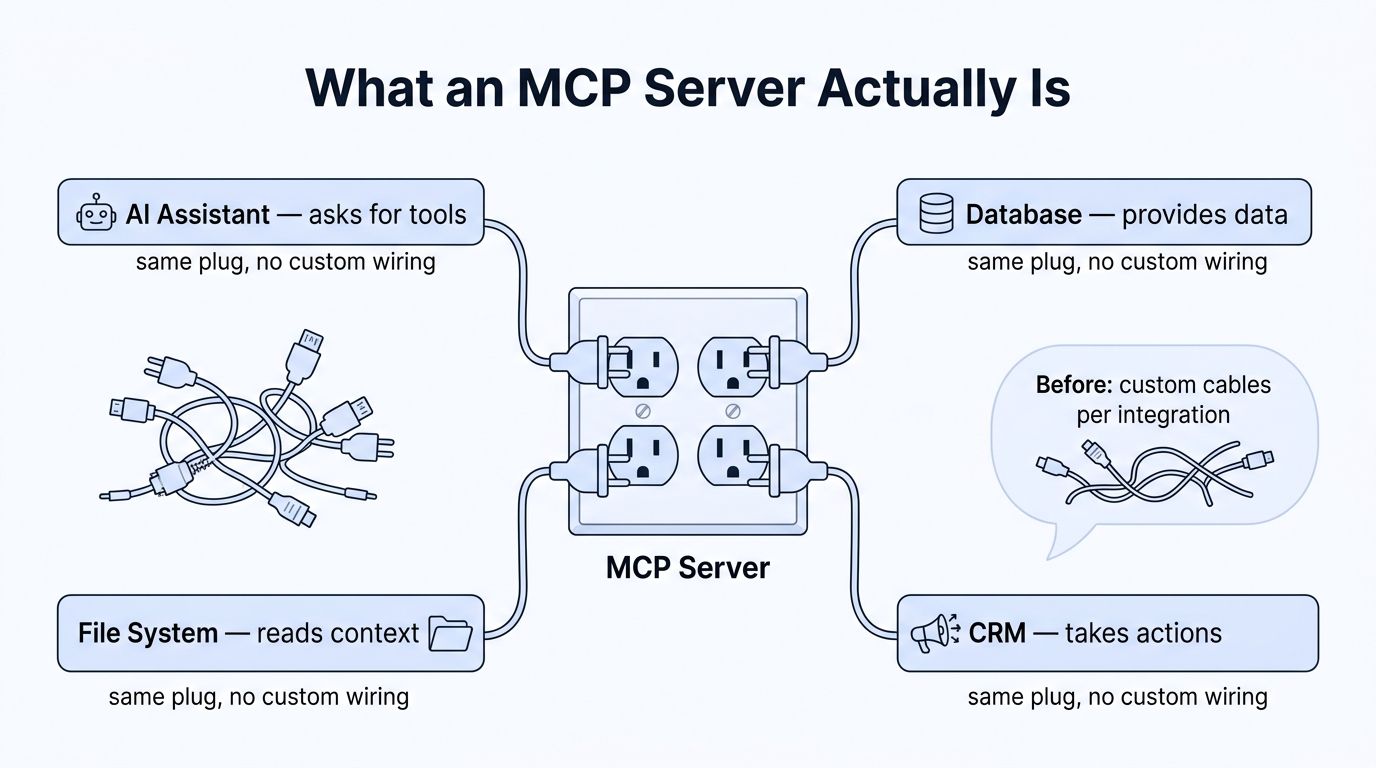 A diagram illustrating how an MCP server standardizes connections between an AI assistant and various data sources.
The MCP architecture documentation describes servers as components that can expose resources, tools, and prompts through the client-host-server model.
Three kinds of capability
Resources provide context. A server might expose a project document, a database result, or a piece of web content for the client to make available to the model.
Tools perform actions. A publishing server could expose an operation for uploading media, scheduling a post, or listing connected accounts.
Prompts provide reusable instruction templates. A server might offer a structured prompt for a code review or a particular content workflow.
These categories answer different questions. Resources answer, “What information can the agent read?” Tools answer, “What can it ask the server to do?” Prompts answer, “What reusable interaction pattern can help the model use those capabilities?”
The server's job is to describe these capabilities clearly and implement them safely. A tool description, input schema, and result shape matter because the client uses that information when deciding whether and how to invoke the tool. If a tool says “publish,” the surrounding metadata needs to make clear what content, destination, timing, and permissions it expects.
Developers who want another plain-language explanation can also consult the Agentable MCP guide. Keep the core distinction in mind: the server supplies capabilities, while the host and client provide the AI-facing connection.
How MCP Server Communication Works Under the Hood
At the wire level, MCP uses JSON-RPC messages. That means the client sends structured requests and the server returns structured responses, rather than relying on the model to invent an endpoint or payload format. The architecture specification also defines lifecycle, capability, and version discovery semantics.
A typical exchange starts with initialization. The client and server identify themselves, communicate the protocol version they support, and describe their capabilities. The client can then discover the available resources, tools, and prompts before deciding which operation fits the user's request.
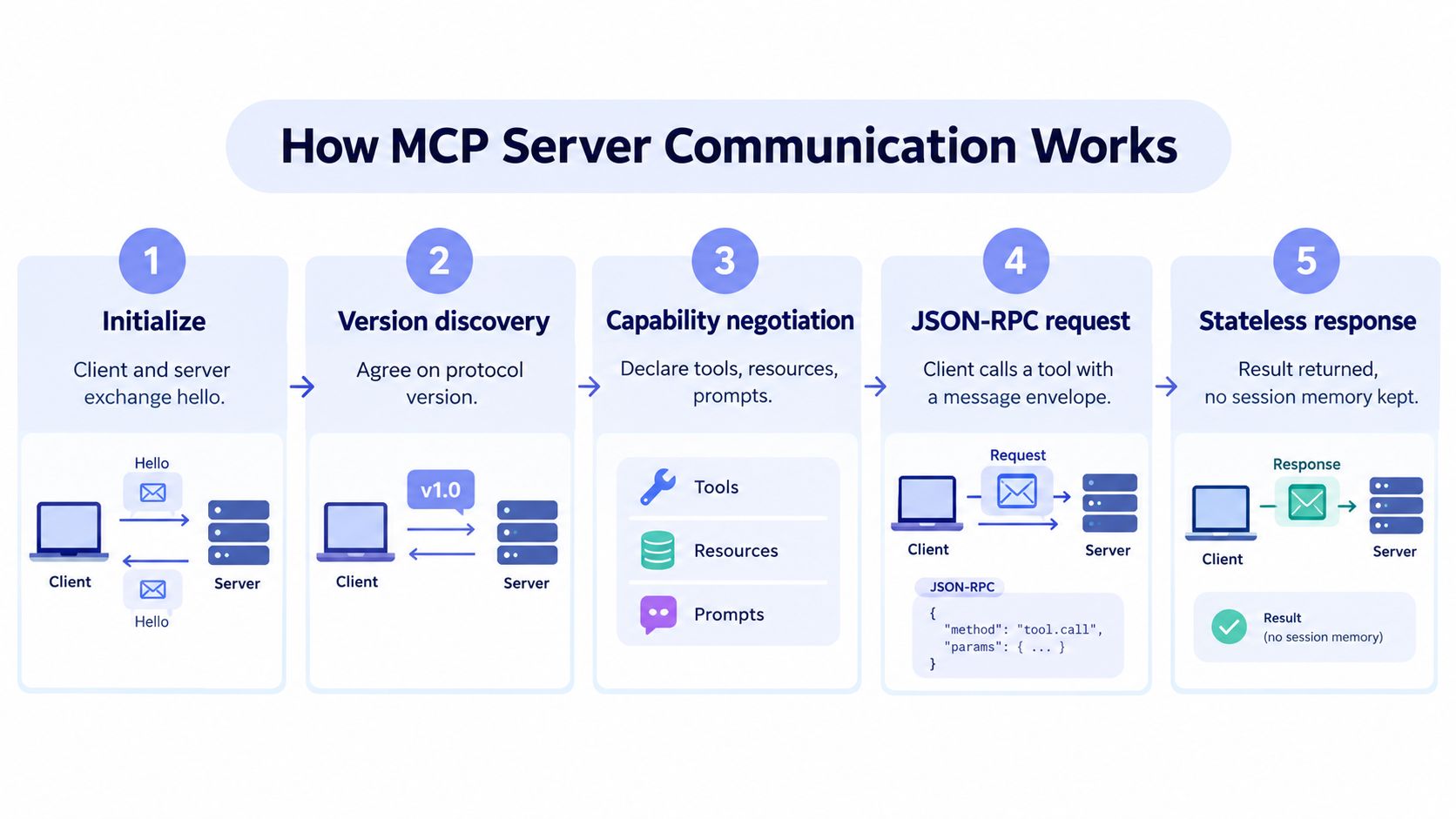 A diagram illustrating the five-step process of how an MCP server communicates with a client system.
What the request flow looks like
Consider an agent asked to schedule a post. The client may first learn that the server offers a scheduling tool, inspect its inputs, and then send a JSON-RPC request containing the selected tool and structured arguments. The server validates those arguments, performs its implementation, and returns a structured result or an error.
The latest architecture specification describes MCP as stateless, with each request carrying its own protocol version and capabilities. The transport layer handles connection establishment, message framing, and authorization. The current MCP architecture specification explains this session model and its consequences.
Stateless operation reduces coupling to server-side session memory. A remote server or proxy can process requests independently, which can simplify scaling and routing. It doesn't mean authentication becomes irrelevant. It means production systems need to design authorization and request context deliberately rather than assuming a long-lived server session will carry all state.
Structured responses matter
A tool doesn't always return a final answer. It may need more input, or it may return a result that the client can present to the model for another reasoning step. Structured responses let the client distinguish success, failure, and input-required situations instead of treating every response as a blob of text.
That pattern resembles the event-driven callbacks many publishing systems already use, although the protocols serve different purposes. If webhook concepts are unfamiliar, this explanation of webhooks and how they work is a useful companion. MCP defines the AI-facing capability exchange, while the underlying service may still use its own API and asynchronous processing model.
Real-World MCP Server Use Cases
The official MCP examples make the “small capability provider” idea concrete. The reference server list includes Everything, Fetch, and Filesystem. Those examples cover testing, web content ingestion, and secure file operations, rather than trying to create one giant server that does everything.
A Fetch server can give an AI client access to web content in a standardized resource flow. A Filesystem server can expose carefully defined file operations. Everything exists as a reference for testing and experimentation. Each server has a focused purpose, which makes its tools and permissions easier to understand.
From reading context to taking action
The same architecture supports action-oriented workflows. A server might expose a tool that creates a support ticket, queries a business system, or schedules content. The AI host doesn't need to know the internal implementation of that action. It needs an accurate description of the tool, the required inputs, and the result it can expect.
Social publishing is a natural example because the user's request is usually expressed as a goal. “Publish this campaign to my connected channels tomorrow morning” doesn't map cleanly to one universal platform endpoint. It maps to a sequence of account discovery, content preparation, media handling, scheduling, and status operations.
PostPulse provides an MCP server for this type of workflow. Its documented publishing surface can expose capabilities for listing social accounts, uploading media, and scheduling posts through an MCP-compatible client. The supported destinations are Instagram Business and Creator accounts, TikTok, YouTube, LinkedIn personal profiles, X, Threads, Bluesky, Facebook Pages, and Telegram channels and chats.
An agent connected to that server can interpret a natural-language request, select the relevant capability, and pass structured inputs to the publishing service. The server then acts as the boundary between the agent and the platform-specific operations. The model doesn't gain unrestricted access just because it can see a tool. The server still determines what the tool does and how authorization is applied.
This is the useful middle ground between a chatbot that can only draft text and an autonomous system wired directly into every platform. The agent handles intent and sequencing. The server exposes the operations that are available.
Security and Authorization Considerations
MCP can standardize access, but standardization isn't the same as safety. A server that only returns reference information has one risk profile. A server that can publish, delete, send, or modify records has a much larger one because a mistaken tool call can create an external side effect.
The official MCP roadmap and release notes highlight authorization hardening, closer alignment with OAuth and OpenID Connect, cacheable list results, and a formal deprecation policy. The Google Cloud MCP overview also frames MCP servers as bridges to external services and tools, which makes access control a production concern rather than a setup detail.
Questions your integration must answer
How are scopes managed? A tool should receive only the permissions it needs. Reading account information and publishing content shouldn't automatically imply permission to delete content or change account settings.
How are credentials rotated? Long-lived secrets create unnecessary exposure. Ask how access tokens, refresh tokens, client credentials, and revoked authorizations are replaced without interrupting every connected client.
What does user consent cover? Consent should identify the application, the requested scope, and the actions the client may take. A vague “connect” button isn't enough for a server that can write to external systems.
Where are actions logged? You need an audit trail for the client, user, tool, inputs, outcome, and time of each sensitive operation. Without that record, debugging and incident response become guesswork.
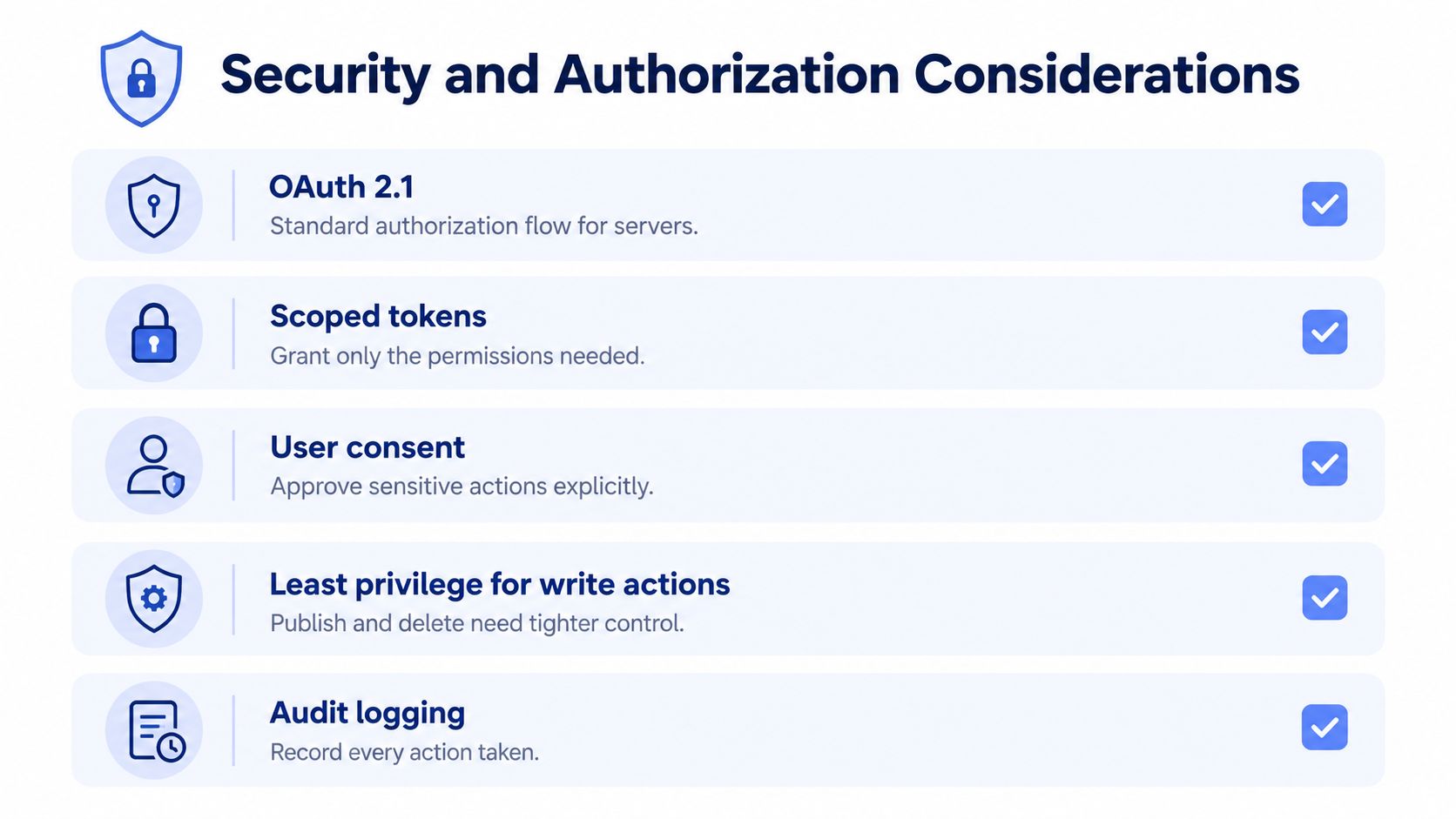 A list of security and authorization considerations for an MCP server, including OAuth 2.1 and audit logging.
Stateless doesn't mean context-free
Because the latest architecture treats requests as stateless, production authorization shouldn't depend on an assumed server-side conversation state. Each request needs enough verifiable context for the server and transport layer to enforce authorization correctly. That may include validated tokens, scopes, protocol information, and request-specific constraints.
A practical review before connecting an agent looks like this:
Inspect permissions: Separate read, publish, update, and delete capabilities.
Verify consent: Confirm the client shows what access the user is approving.
Test revocation: Disconnect an account and confirm old credentials stop working.
Review logging: Check that sensitive tool calls produce useful audit records.
Read tool descriptions: Make sure the model can't reasonably confuse a destructive operation with a read-only one.
Security rule: treat every write-capable MCP tool as an API endpoint with an AI choosing when to call it.
Publishing to Social Media Through One MCP Server
A developer building agent-driven publishing has two realistic paths. You can integrate each platform yourself, or you can connect the agent to a service that already provides a unified publishing capability through MCP.
Direct integration gives you control, but your team owns the platform apps, review processes, OAuth lifecycle, token refresh behavior, rate-limit handling, media rules, API changes, and failure recovery. The work isn't finished when the first post succeeds. It continues every time a platform changes its API or authorization requirements.
A unified MCP server changes the maintenance boundary. PostPulse documents a single publishing integration across the supported platforms, with platform application management and token handling provided as part of its service. That lets your agent interact with one capability surface instead of nine separate platform-specific integrations.
Comparing the build choices
Factor | Direct Platform Integration | PostPulse MCP Server |
Platform app setup | Your team creates and maintains each app | The service provides verified Meta, TikTok, and Google apps |
Authorization | You implement OAuth flows, refresh behavior, and revocation handling | Token handling is managed through the connected service |
API maintenance | Your team tracks platform changes and version updates | The service maintains the platform connections |
Agent interface | You design and expose your own MCP tools | You connect the agent to a hosted publishing capability |
Destinations | Each platform requires a separate integration | One integration reaches Instagram, TikTok, YouTube, LinkedIn, X, Threads, Bluesky, Facebook, and Telegram |
Cost model | Internal engineering and platform operations costs vary | Pay-as-you-go is $0.20 per publication, subscription is $5 per account per month, and white-label is $200 per month plus $1 per active account, as described on the PostPulse LinkedIn MCP server page |
The direct route makes sense when platform-specific control is the product. The connected route makes sense when publishing is a capability your product needs, but maintaining every platform integration isn't the product you want to build.
PostPulse's private-label plans include pay-as-you-go publication pricing or account-based subscriptions. Its white-label option adds a platform fee and charges for active accounts, while the startup support program can waive fees before launch on an individual basis. Verify current terms before making a commercial decision.
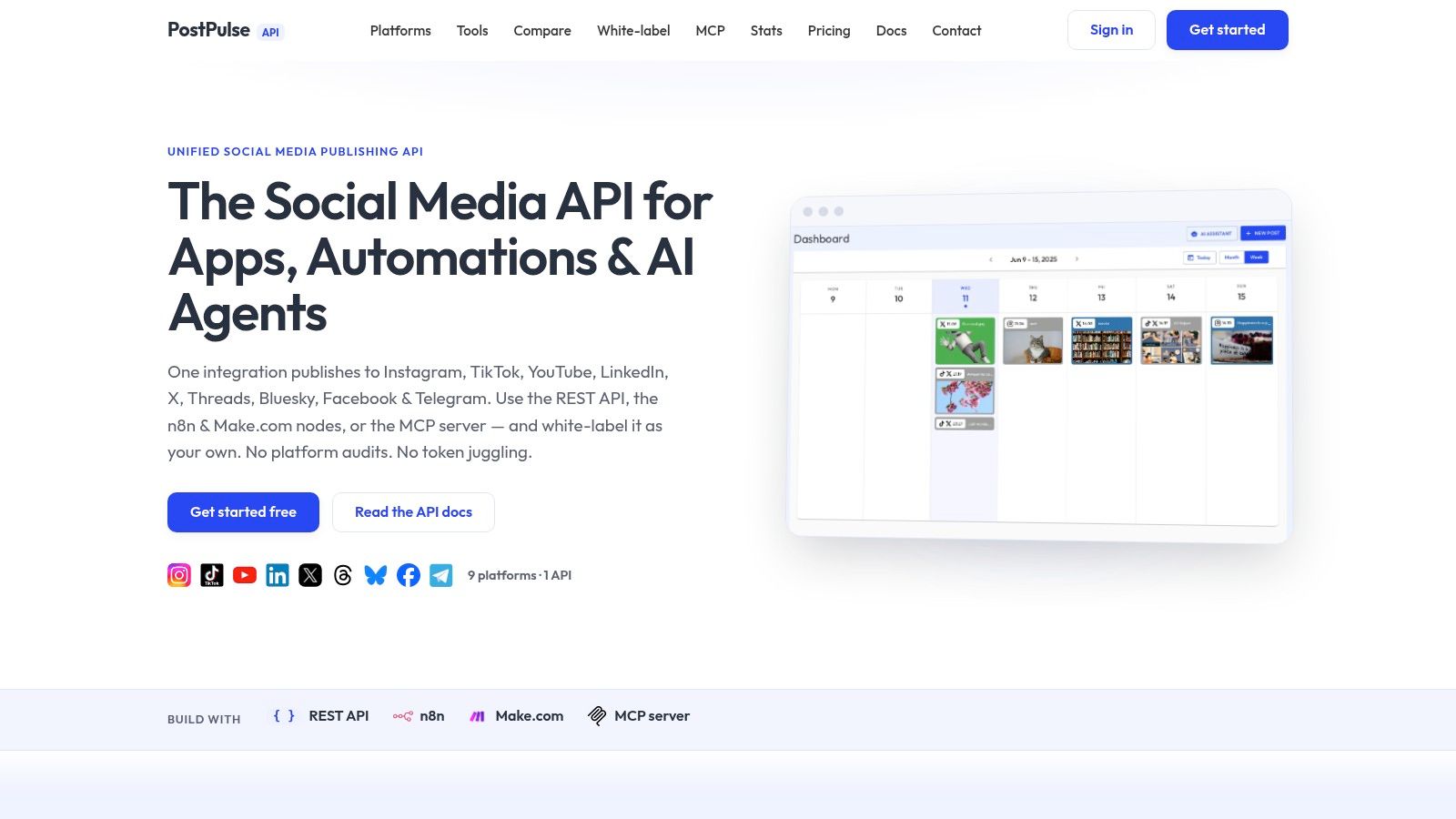 Screenshot from https://post-pulse.com
The evaluation shouldn't stop at price. Check whether the server exposes the exact tools your agent needs, whether destructive actions require confirmation, how failed asynchronous posts are reported, and whether you can revoke an account cleanly. A cheap connector with unclear authorization can cost more than a carefully maintained integration.
Key Takeaways for Working With MCP Servers
An MCP server is a capability provider in the Model Context Protocol's client-host-server architecture. It exposes resources for context, tools for actions, and prompts for reusable interaction patterns. The AI host connects through a client, discovers what the server offers, and chooses an appropriate capability for the task.
The communication layer uses JSON-RPC, with lifecycle and capability discovery built into the architecture. The latest specification describes stateless requests that carry their own protocol version and capabilities, while the transport handles connection setup, message framing, and authorization. That design can simplify remote integration and proxying, but it still leaves you responsible for careful access control.
A server is not automatically trustworthy because it uses a standard protocol. The ecosystem is expanding quickly, and one independent measurement study reported that more than 50% of MCP projects were low-value or abandoned in its analysis. Thoughtworks' discussion of MCP beneath the hype is a useful reminder to evaluate maturity, maintenance, and real utility rather than assuming every listed server is production-ready.
Use this checklist when you evaluate one:
Capability clarity: Can you explain every exposed resource, tool, and prompt?
Input discipline: Are schemas precise enough to prevent ambiguous tool calls?
Authorization: Are OAuth or OpenID Connect aligned flows, scopes, consent, and rotation documented?
Action control: Do publish, update, and delete operations have appropriate confirmation and least-privilege boundaries?
Operational evidence: Can you inspect failures, revoke credentials, and audit tool calls?
Maintenance: Is the project active, documented, and clear about deprecations?
For a publishing agent, the value of MCP is easy to state. Your model can reason about a campaign, while a purpose-built server handles the controlled operations needed to list accounts, upload content, and schedule posts. The protocol doesn't remove engineering. It gives that engineering a reusable boundary.
Pick one capability your agent needs, find or build an MCP server for it, and test it with read-only access first. Then work through the security checklist before granting permission to publish, delete, or send anything externally.
PostPulse provides a unified social publishing API, official n8n and Make.com integrations, and a remote MCP server for AI agents that need to connect accounts, upload media, and schedule posts across supported social platforms. Visit PostPulse to review the MCP publishing path and choose between private-label and white-label integration options.
About the Author

Founder of PostPulse — a social media scheduling platform for creators and teams. Software engineer with a passion for building developer tools and simplifying complex API integrations across social media platforms.