Pay as You Go Pricing Explained for Developers
Published on
Tags:
You know the feeling. The API looked cheap during planning, the launch went fine, then one campaign got traction and your invoice showed up looking like a bug report nobody reproduced in staging. That's when pay as you go pricing stops sounding like a finance choice and starts looking like an engineering decision.
For developers building social publishing, the pain usually isn't abstract. It's the one-hour token expiry, the post that sits stuck in progress, the retry loop that burns through budget, and the moment someone asks why a “simple” automation now costs more than expected. When usage can spike, the billing model has to match the workload, or the bill becomes part of the incident.
Table of Contents
The Moment Your API Bill Becomes the Bug
A social automation works beautifully in dev, then reality hits it. You schedule daily posts, a campaign gets shared more than expected, retries kick in after a transient failure, and the usage-based invoice lands higher than the budget you had in mind. That's not just a finance surprise, it's a production smell.
PAYG exists for exactly that kind of workload. It ties billing to consumption, which is why it's so common in SaaS, cloud services, telecom, and APIs, where the thing you're selling is measurable activity rather than a fixed seat or a static bundle of features. Stripe's own usage-based billing docs show how this gets operationalized with a meter, a usage-based price, and a unit price that can be as small as $0.04 per 100 units, billed on a recurring cadence like monthly usage aggregation Stripe usage-based billing model.
For social publishing, that matters because the product value is often tied to action. One post, one publication, one AI-generated publish, one client approval, one retry. If your platform charges per event, the customer feels the cost of usage directly, and if your platform charges for continuous resource consumption, you need to know exactly where the meters run.
That's why teams that build social infrastructure need a pricing model before launch, not after the invoice. The right model lets you ship before you know retention, absorb bursty demand without overcommitting, and avoid the trap where growth itself becomes a billing problem. If you're also wiring the system through an API proxy layer, this technical overview of API proxy service patterns is a useful companion read.
What Pay as You Go Pricing Means
Pay as you go pricing is a metered billing primitive, not a slogan. A recurring product is defined, a usage-based price is attached, a meter records the billable unit, and the invoice is computed from measured usage rather than from a fixed seat fee. Stripe's implementation guide makes that distinction clear, and its example of $0.04 per 100 units billed monthly shows how small increments can roll up into a predictable invoice Stripe usage-based billing implementation.
The meter is the center of gravity. If the unit is API calls, your billing engine needs event counts. If the unit is compute time or storage, you need continuous usage tracking. If the unit is social publications, the product logic has to decide what counts as one publication, what happens on retries, and whether connected but idle accounts should cost anything at all.
Pricing Model Primitives at a Glance
Model | Billing unit | What it rewards | Risk for the buyer |
Pay as you go | Continuous usage over time | Actual consumption and burst handling | Bills can drift upward with sustained use |
Pay as you use | Discrete action or event | Individual requests, posts, or transactions | Frequent actions can add up fast |
Subscription | Fixed recurring access fee | Predictability and budget stability | Overpaying when usage is light |
The distinction between pay as you go and pay as you use gets ignored too often, but it changes product design. PAYG tracks continuous usage over time, while pay-as-you-use bills discrete actions, like an API call or transaction Schematic on PAYG vs pay-as-you-use. That difference determines whether you build a running meter, an event counter, or both.
Practical rule: if the customer thinks in “how long” or “how much,” PAYG fits better. If they think in “how many times,” per-action billing is usually clearer.
For developers, the unit choice drives the rest of the stack. Caching, batching, idempotency, usage visibility, and alerting all depend on whether you're billing time, events, or some blend of the two. Get that wrong, and the billing model fights the product instead of supporting it.
Benefits and Hidden Costs Developers Miss
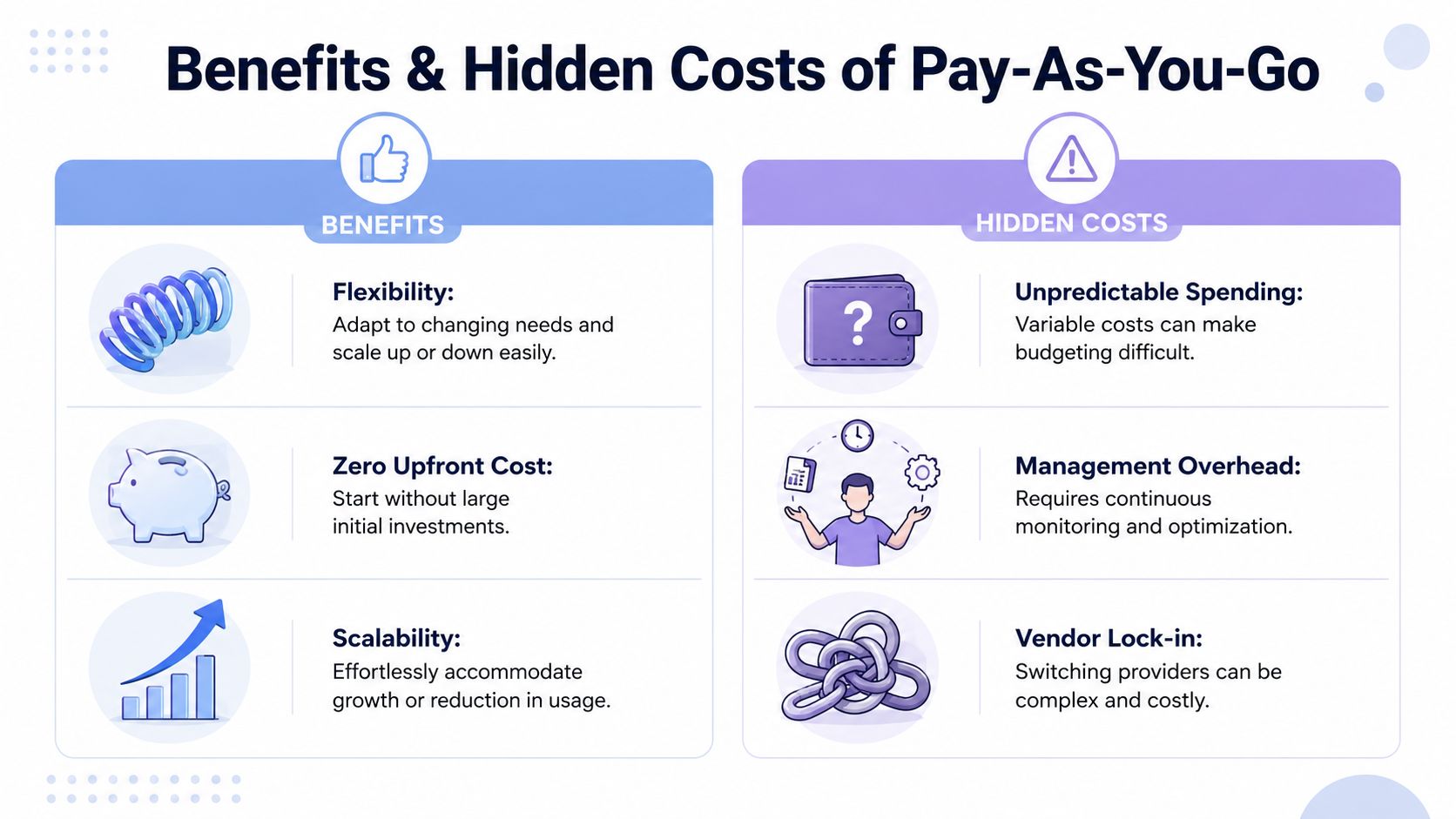 An infographic titled Benefits & Hidden Costs of Pay-As-You-Go detailing flexibility, costs, and management factors.
The best thing about PAYG is that it lowers the friction to start. You don't need to predict retention perfectly, and you don't need to force every customer into the same fixed commitment before they've seen value. That's why the model is so common in cloud infrastructure and developer platforms, where usage can spike and fall with customer behavior Stripe overview of PAYG usage.
What It Gives You Immediately
A PAYG model gives you zero upfront spend, which makes experiments easier to launch. It also scales naturally when traffic grows, because the bill follows consumption instead of forcing you to renegotiate a plan every time usage changes. In product terms, that makes it easier to ship early, learn from real customers, and keep the entry point low.
It also improves cost attribution. If one feature triggers most of the bill, you can see it. If one tenant or automation is noisy, you can isolate it. That visibility is useful for finance, but it's even more useful for engineering because it turns usage into something you can inspect and optimize.
What Usually Surprises Teams
Minimum billing durations can break naive assumptions about per-second economics. Alibaba Cloud's ECS documentation says pay-as-you-go can still incur minimum charges, with examples such as 10 minutes for some 1 vCPU instances, 5 minutes for 2 vCPU instances, and 2 minutes for 4 vCPU-or-larger instances when usage is shorter than those floors Alibaba Cloud ECS pay-as-you-go rules. That means bursty compute may cost more than a team expects if they assume perfect linearity.
Observability is the other hidden tax. If you don't meter the usage cleanly, you don't know what to bill, and if you don't know what to bill, you only find out after the invoice goes sideways. A runaway retry storm, a leaked API key, or an overactive cron job can turn a polite pricing model into a card-draining incident.
PAYG is a good default for new products, but only if usage is treated like a first-class system, not a side effect.
That's the core trade-off. PAYG gives you flexibility and alignment with value, but it also forces discipline around metering, alerting, and unit definitions. Teams that build that discipline early avoid the awkward moment where billing turns into customer support.
PAYG vs Subscription vs White-Label on PostPulse
PostPulse is a useful benchmark because it puts three common pricing structures side by side for the same publishing workload. In private-label mode, your users connect their accounts inside the platform while you publish through API, n8n, Make.com, or MCP, and the two published options are a pay-as-you-go plan at $0.20 per publication with no subscription, and a subscription plan at $5 per account per month with unlimited posts. In white-label mode, the structure changes to a $200 per month platform fee plus $1 per active social account, where active means at least one post in that month; a startup support program can waive those white-label fees until launch for teams still in beta what white-label software means.
How the Three Models Behave in Practice
PAYG fits spiky publishing. If you only publish when campaigns are ready, or when an AI agent has something worth sending, you only pay when something ships. Subscription works better when each connected account is consistently active and the cost per account is easy to justify against stable usage.
White-label is different again. The customer never sees PostPulse, which matters when the branded experience is part of the product, not just the transport layer. That makes it the right primitive when the business is selling a native social publishing feature, not an integration wrapper.
Useful split: PAYG buys flexibility, subscription buys predictability, white-label buys brand control.
The important thing is that these models are not just different prices, they're different product assumptions. PAYG assumes usage varies and should be billed directly. Subscription assumes the account itself is the billing unit. White-label assumes the platform is part of your own product surface and should disappear from the user's view.
For app developers, no-code builders, and AI agent teams, that difference is often more important than the raw number on the pricing page. A system that publishes on behalf of users needs to match the cadence of the workload, not the convenience of the vendor.
Worked Cost Examples at 50, 500, and 5000 Posts
The easiest way to see the difference is to run real workloads through the pricing. Below, the calculations use the published PostPulse private-label and white-label rates, with PAYG at $0.20 per publication, subscription at $5 per account, and white-label at $200 per month plus $1 per active social account.
Monthly Cost by Workload
Workload | Posts | Accounts | PAYG | Subscription | White-Label |
Indie hacker | 50 | 2 | $10 | $10 | $202 |
SaaS app | 500 | 10 | $100 | $50 | $210 |
Content automation agency | 5000 | 80 | $1000 | $400 | $280 |
A side project publishing 50 posts across 2 accounts lands at $10 under PAYG and $10 under subscription, while white-label is $202 because the platform fee dominates at low volume. That makes PAYG a clean on-ramp when you're unsure how often the product will publish.
A SaaS app pushing 500 posts across 10 accounts flips the math. PAYG lands at $100, subscription at $50, and white-label at $210. At that point, the account-based model is cheaper because the usage is steady enough that the fixed per-account fee beats the per-publication charge.
The agency case is where white-label starts to matter. At 5000 posts across 80 accounts, PAYG is $1000, subscription is $400, and white-label is $280. Since connected-but-idle accounts are free in white-label, seasonal client rosters can be much cheaper there than they look at first glance.
The takeaway isn't that one model always wins. The break point moves with cadence, not just volume. A team that publishes less often but to many accounts will usually favor PAYG or white-label, while a team with highly predictable per-account publishing usually benefits from subscription.
Which Customers Should Choose PAYG
PAYG is the right default when usage is still moving around. Early-stage products, indie hackers, AI agents that publish opportunistically, and tools with seasonal demand all benefit from not committing before the shape of usage is obvious. That's consistent with pricing guidance that says PAYG works well for variable workloads with idle time, while stable high-utilization workloads often belong on committed plans, with teams usually waiting 3-6 months of stable usage before locking in Infracost pay-as-you-go guidance.
Who Should Lean Toward It
Early-stage teams: If you don't know the retention curve yet, PAYG keeps the experiment cheap and honest.
Bursty workloads: Campaign-driven publishing, launch-day automation, and seasonal content all fit the model well.
Agentic systems: AI agents don't always produce value on a fixed schedule, so billing them like a flat seat often feels wrong.
Builders without forecasting data: If your usage pattern isn't stable enough to commit, PAYG buys time.
Who Should Probably Not Stop There
Stable per-account publishing usually favors subscription. If every connected customer posts daily, the fixed fee becomes easier to plan around and easier to explain to buyers. White-label is the better fit when the brand and native experience are part of the product promise, especially for SaaS platforms and agencies that want the publishing surface to feel fully owned.
If your customer asks, “What will this cost me next month?”, subscription or white-label usually wins. If the honest answer is “it depends on how much you publish,” PAYG is the cleaner choice.
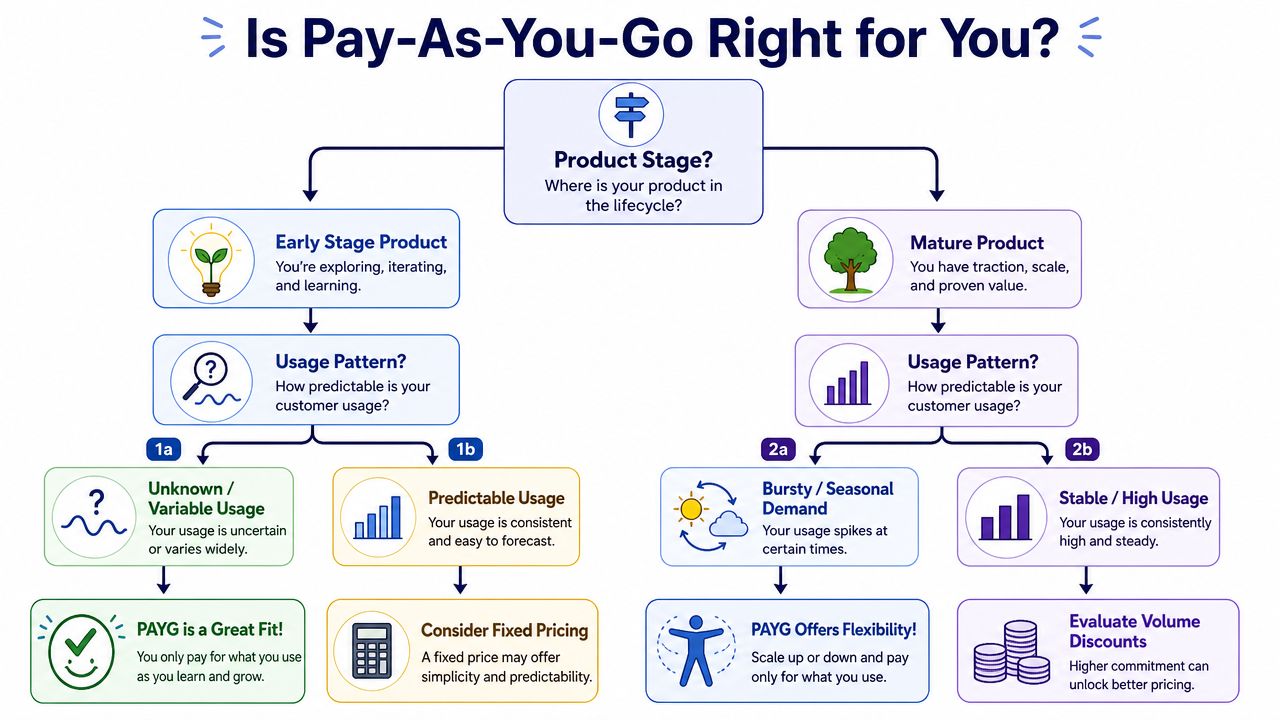 A decision flow chart titled Is Pay-As-You-Go Right for You evaluating product stages and usage patterns.
The quick rule is simple. Choose PAYG when usage is unknown or bursty, move to subscription when per-account publishing becomes stable, and use white-label when the product itself needs to own the publishing experience. That keeps the pricing primitive aligned with the workload instead of forcing the workload to fit the pricing.
Four Tips to Cut Your PAYG Bill Without Cutting Reach
The cleanest way to lower a PAYG bill is to reduce wasted billable activity, not to reduce publishing. That's an engineering problem, not a marketing one, and it starts with how you structure requests, retries, and quotas.
1. Batch publish meaningful work
Don't bill every internal step as if it were customer value. If one publication can represent the post, the assets, and the destination targets, you avoid paying for repeated internal calls that don't change the outcome. The idea is simple, one publication should be one publication.
2. Deduplicate media before it fans out
If your pipeline reuses the same image or video across runs, cache it and reuse the validation result instead of reprocessing it. That matters when the publishing layer has to inspect assets repeatedly, and the related media checks should happen before the billable path. Media validation guidance is worth keeping in the same mental bucket as rate limiting and retry hygiene.
3. Meter usage before launch
If you can't see billable activity in dashboards, you're flying blind. Put the meter in place before the surprise invoice, and make the cost visible in the same place you watch latency and error rates. Once the number is in front of the team, bad patterns get fixed faster.
4. Set hard quotas on your own keys
A metered dependency should never have unlimited trust. Per-key quotas, request caps, and rate limiting stop a runaway automation from draining a budget in hours, which is exactly the kind of guardrail you'd want on any production API. For a broader angle on reducing token-heavy AI spend, strategies for AI spend reduction is a useful reference point for thinking about limits and usage control.
FAQs and Final Recommendation
 A contemplative young man with glasses surrounded by hand-drawn sketches representing business challenges and uncertainty.
What happens when a post fails or gets rejected?That depends on how the billing layer defines a publication, so the safe move is to make the unit explicit before launch. If retries are billable, say so. If only successful publications count, make sure the event pipeline can tell the difference.
What if a connected account goes idle?In a subscription model, idle accounts still count if they're billed per account. In white-label, connected-but-idle accounts are free under the published structure, which changes the math a lot for agencies with inactive clients.
Can you mix PAYG and subscription?Yes, and that hybrid pattern is common in usage-based pricing generally. A base fee with usage-based overages often works better than trying to force every customer into one flat shape.
How does the startup support program work?It's aimed at teams still building or in beta, with fees waived until launch and the details handled individually. That makes it less of a public plan and more of an early-stage path for teams that aren't ready for the full white-label structure yet.
If your workload is unpredictable, start with PAYG and graduate to subscription once you've seen 3-6 months of stable behavior. If the product needs brand control and a native multi-tenant experience from day one, white-label is the better primitive. For teams building social publishing into apps, automations, or AI agents, PostPulse is worth a look when you want the billing model and the publishing workflow to stay in sync.
About the Author

Founder of PostPulse — a social media scheduling platform for creators and teams. Software engineer with a passion for building developer tools and simplifying complex API integrations across social media platforms.