OAuth Token Management for Social APIs
Published on
Tags:
You deploy a social publishing integration, test it successfully, and move on. Then production goes quiet. A scheduled post fails because the access token expired, a background worker keeps retrying a rejected refresh token, or one platform needs consent again while the others remain perfectly healthy. The frustrating part is that the code often looked finished.
That's the wrong mental model for OAuth. OAuth token management isn't a one-time login feature. It's an authorization lifecycle that has to survive expiration, rotation, revocation, changed scopes, provider-specific rules, concurrency, and user communication. After working through these problems across distributed systems, the reliable approach is to treat every connected account as a small state machine, not as a Boolean flag.
Table of Contents
The 1-Hour Expiration Trap
The first production incident usually looks harmless. A developer connects an account, receives an access token, publishes a few test posts, and confirms that the API responds correctly. The worker stores the credential and schedules future jobs. Later, often after the access token's short lifetime has elapsed, the next publication receives an authorization error. The dashboard still says “connected,” so the system retries the same request until the queue fills with failures.
OAuth 2.0 was standardized through RFC 6749's IETF publication history, published as an IETF Proposed Standard in October 2012. The framework separates access tokens, which authorize requests to protected resources, from refresh tokens, which are exchanged at the authorization server for replacement access tokens without asking the user to authorize again.
That split is useful, but it creates work. An access token is a temporary permission to call an API. A refresh token is a separate credential used to obtain another access token. Treating the first one as a permanent API key guarantees an outage as soon as the provider invalidates it.
Authentication ends before authorization does
Most introductory tutorials stop at the successful callback. They show the user approving scopes, the application exchanging an authorization code, and the API accepting a request. They often omit the operational loop that follows:
Store the access token and refresh token separately.
Track whatever expiration metadata the provider returns.
Use the access token for resource requests.
Exchange the refresh token when the access token expires or becomes invalid.
Persist the replacement credential safely.
Handle the case where no refresh token was issued or the refresh request is rejected.
Send the user through authorization again when silent renewal is no longer possible.
RFC 6749 defines four principal grant types, authorization code, implicit, resource owner password credentials, and client credentials, and describes refresh-token processing in Section 6. It doesn't prescribe a universal access-token lifetime or require every authorization server to issue refresh tokens. The authorization server decides whether to issue a refresh token and how long it remains valid.
That means your integration can't assume that every provider behaves like the provider used in a tutorial. A missing refresh token isn't necessarily a storage bug. It may be the provider's documented behavior, and your application needs a reconnect path rather than an endless retry loop.
Practical rule: Treat an access token as disposable state. Treat a refresh token as a high-value credential with its own lifecycle, ownership, expiration, and revocation status.
Why publishing systems feel the failure immediately
A multi-platform publisher amplifies token mistakes. One account may be connected to several APIs, and each provider can issue credentials with different refresh behavior. If the application stores one generic “social connection” record, it has no precise way to tell whether the failure belongs to one platform, one tenant, one scope set, or the entire authorization grant.
The failure should be isolated. One expired token should pause publication for that connected account, mark the account as needing action, and allow other destinations to proceed when their authorization remains valid. That requires secure storage, expiration handling, revocation, rotation, client-specific association, and recovery logic from the start.
Implementing Atomic Refresh Token Rotation
Storing a refresh token in an encrypted database column is a sensible baseline. It isn't a complete design for a multi-tenant system, especially when several workers can refresh the same account concurrently.
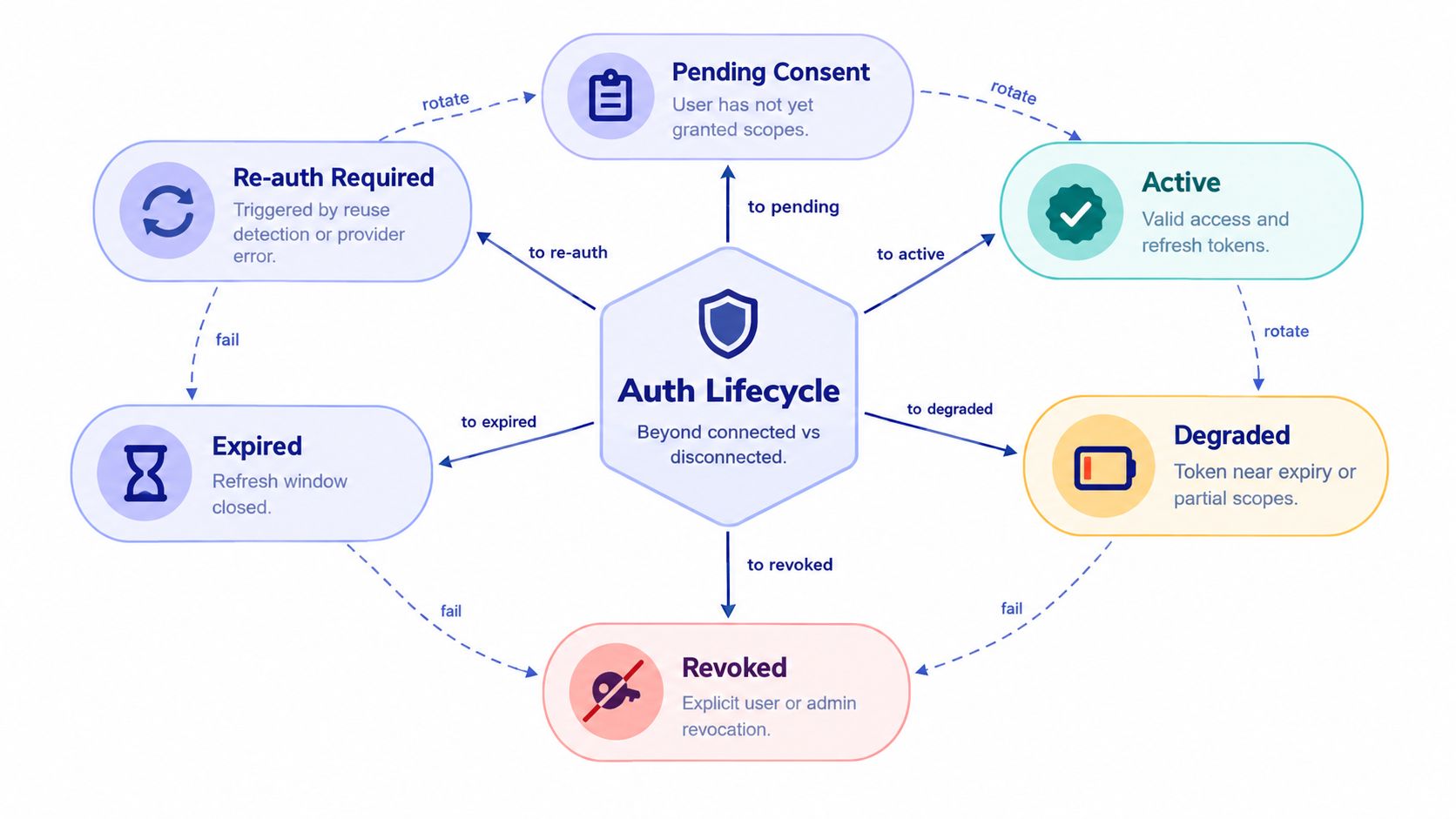 A diagram illustrating the OAuth authentication lifecycle, showing different token statuses like active, expired, and revoked.
RFC 9700, the IETF OAuth 2.0 Security Best Current Practice, requires refresh tokens issued to public clients to be sender-constrained or protected through refresh-token rotation. With rotation, a successful refresh exchange can replace the previous refresh token. If the old token appears again, the authorization server can detect reuse and revoke the active token family.
Store the credential as a versioned record
A useful token record needs more than access_token and refresh_token. Store each token encrypted or as a keyed hash, depending on whether the application must replay it, and associate it with:
Tenant and provider, so a failure stays scoped to the correct customer and platform.
Client identifier, because the authorization server binds refresh tokens to the client to which they were issued.
Scopes and resource servers, so later consent changes don't disappear into a generic connection flag.
Token-family identifier, which lets reuse detection revoke the related credential chain.
Issued-at and last-used-at timestamps, supporting expiry decisions and operational diagnostics.
Revocation status, including the reason and the action required from the user.
A version or compare-and-swap value, preventing an older worker from overwriting newer credentials.
Keep this data on the backend. Don't put bearer tokens, authorization codes, or complete token responses in application logs, browser storage, analytics events, or frontend state.
Make refresh one atomic transition
The refresh operation should be a controlled state transition:
A backend worker selects the current refresh token for the tenant, provider, and client.
A per-account distributed lock, or a compare-and-swap version check, prevents concurrent refreshes from using the same state blindly.
The worker sends the current refresh token to the provider's token endpoint.
In one transaction, the application invalidates the presented token and persists the newly issued token and metadata.
A later presentation of the invalidated token is rejected locally where possible, and the entire token family is revoked when reuse is detected.
The account enters a reauthorization state after family revocation, rather than retrying the same credential.
The transaction matters. Without it, Worker A can obtain a new token while Worker B still writes an older response over the latest value. A different race can leave two refresh tokens usable at the same time, undermining rotation and making incident analysis ambiguous.
RFC 9700 explains the difficult part of reuse detection: the authorization server generally can't know whether the legitimate client or an attacker presented the replayed token. Revoking the active token family and requiring a new authorization grant is therefore safer than guessing.
Make retries boring and observable
Transient provider failures need bounded retries. Permanent authorization failures don't. Use idempotent job keys, back off temporary network errors, and stop retrying credentials that the provider has rejected as invalid or revoked.
Track refresh success rate, reuse events, revocations, authorization prompts, and mean time to recovery. Alert on unusual reuse patterns by provider, tenant, and IP or device cohort, but never include the bearer credential in the alert payload. A token-management worker should fail narrowly, preserve the newest valid state, and leave a clear user action when automation can't recover.
Provider-Specific Expiration Rules
The phrase refresh token sounds permanent. It isn't. Google's official web-server OAuth documentation says a refresh token remains valid until the user revokes access or the token expires. Time-based grants can impose a defined expiration, and Google exposes remaining lifetime through refresh_token_expires_in during the authorization-code exchange. When that refresh token expires, the application must send the user through authorization again.
The practical distinction is important:
An expired access token usually calls for a refresh exchange.
An invalid refresh token calls for a provider-specific diagnosis.
An expired refresh token calls for interactive authorization.
A changed scope set may require consent or a narrower operating mode.
A provider-side revocation should stop automated retries and explain the reconnect action.
A comparison table prevents bad assumptions
Microsoft's identity platform documents a concrete split that demonstrates why generic OAuth defaults are unsafe. Its refresh tokens have a default lifetime of 24 hours for single-page applications and email one-time-passcode flows, while other scenarios default to 90 days, as documented in Microsoft's refresh-token guidance. For browser applications using a redirect URI registered as spa, the 24-hour lifetime is non-sliding. Refreshing an access token doesn't reset that clock.
Platform Context | Default Lifetime | Sliding Window Behavior |
Single-page applications | 24 hours | The documented browser window is non-sliding |
Email one-time-passcode flows | 24 hours | Don't assume renewal resets the original window |
Other Microsoft identity scenarios | 90 days | Follow the provider's documented replacement and expiry behavior |
Microsoft also states that refresh-token use returns fresh access-token and refresh-token pairs. Your token store must replace those pairs atomically, not update only the access token. For the browser scenario, each renewal remains limited by the original refresh-token window, so a successful refresh doesn't eliminate the need for a reconnect path.
Provider rules deserve provider-specific adapters. Don't hard-code one lifetime, infer expiry from a successful test call, or assume that a refresh token will be returned on every exchange. Persist documented expiry fields when available, interpret provider error responses, and schedule a reconnect prompt before the authorization window closes.
For a deeper treatment of Meta's behavior and lifecycle handling, see this Meta OAuth token lifecycle guide. The useful engineering pattern is the same across providers, but the actual validity rules belong in each provider's documentation and adapter.
Building an Authorization Lifecycle State Machine
A connected account isn't necessarily healthy. It may have valid credentials but incomplete scopes, a refresh token approaching expiry, a recent publication failure, or a provider response that requires user consent. Reducing all of those conditions to connected = true hides the information your workers and users need.
The state belongs to the provider account, not just the tenant. A customer can have a healthy LinkedIn connection, a revoked TikTok authorization, and a third platform with narrowed scopes at the same time.
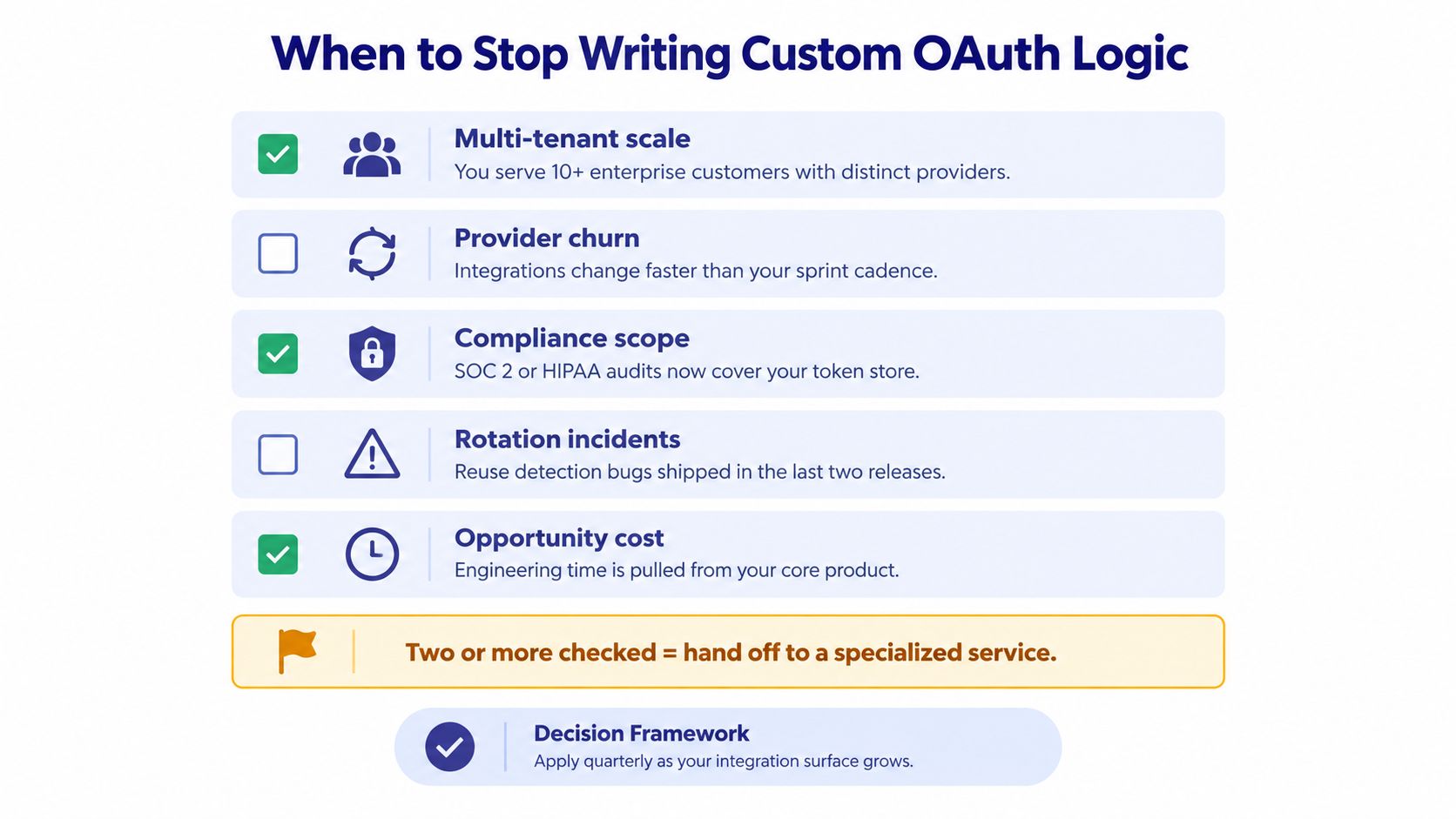 A checklist infographic outlining factors indicating when to stop building custom OAuth integration logic.
Model the states users can act on
A practical state machine can include:
Pending consent, when the user hasn't completed authorization.
Active, when the token set is usable for the approved scopes.
Degraded, when expiry is near, a recent refresh failed transiently, or only part of the requested capability remains available.
Revoked, when the user, administrator, or provider has withdrawn authorization.
Expired, when the refresh window has closed.
Reauthorization required, when reuse detection, invalid credentials, consent changes, or a provider error requires a new grant.
The state transition should carry evidence. Record the provider, granted scopes, last successful refresh, last publication, expiry confidence, revocation reason, and required user action. Keep secrets out of the frontend, but expose safe operational detail such as “Reconnect Instagram to restore publishing” or “This destination no longer has permission to publish.”
The current OAuth security guidance emphasizes that refresh tokens should be bound to the authorized scope and resource server, may be revoked after a security event, and should expire after provider-determined inactivity. A newer IETF draft also proposes explicit response parameters for refresh-token expiration and user-authorization expiration. The underlying principle is straightforward: a refresh token must not outlive the authorization that created it.
Preserve partial availability
Cross-platform publication should produce a per-destination result. If one provider rejects a token, the system should record that failure, transition only that account, and continue with destinations that remain authorized. The user should see which platform needs attention and why, rather than receiving a generic “publication failed” message.
Don't repeatedly retry a revoked credential. That wastes worker capacity, creates noisy alerts, and can make a real authorization incident harder to detect. A reauthorization prompt should be specific, bounded, and tied to the affected provider account.
Teams building agentic or tool-based integrations should also separate authentication concerns from tool permissions. NotFair's authentication reference is a useful resource for thinking about how an authenticated tool request differs from the underlying provider authorization. For broader implementation concerns, this guide to MCP server security best practices provides relevant context without turning provider tokens into agent-visible secrets.
The Build Versus Buy Decision for Multi-Tenant Apps
Building OAuth yourself gives you control over the consent experience, data model, provider contracts, and failure handling. It also makes your team responsible for every provider's app registration, review requirement, scope change, endpoint change, token rule, rate limit, and production incident.
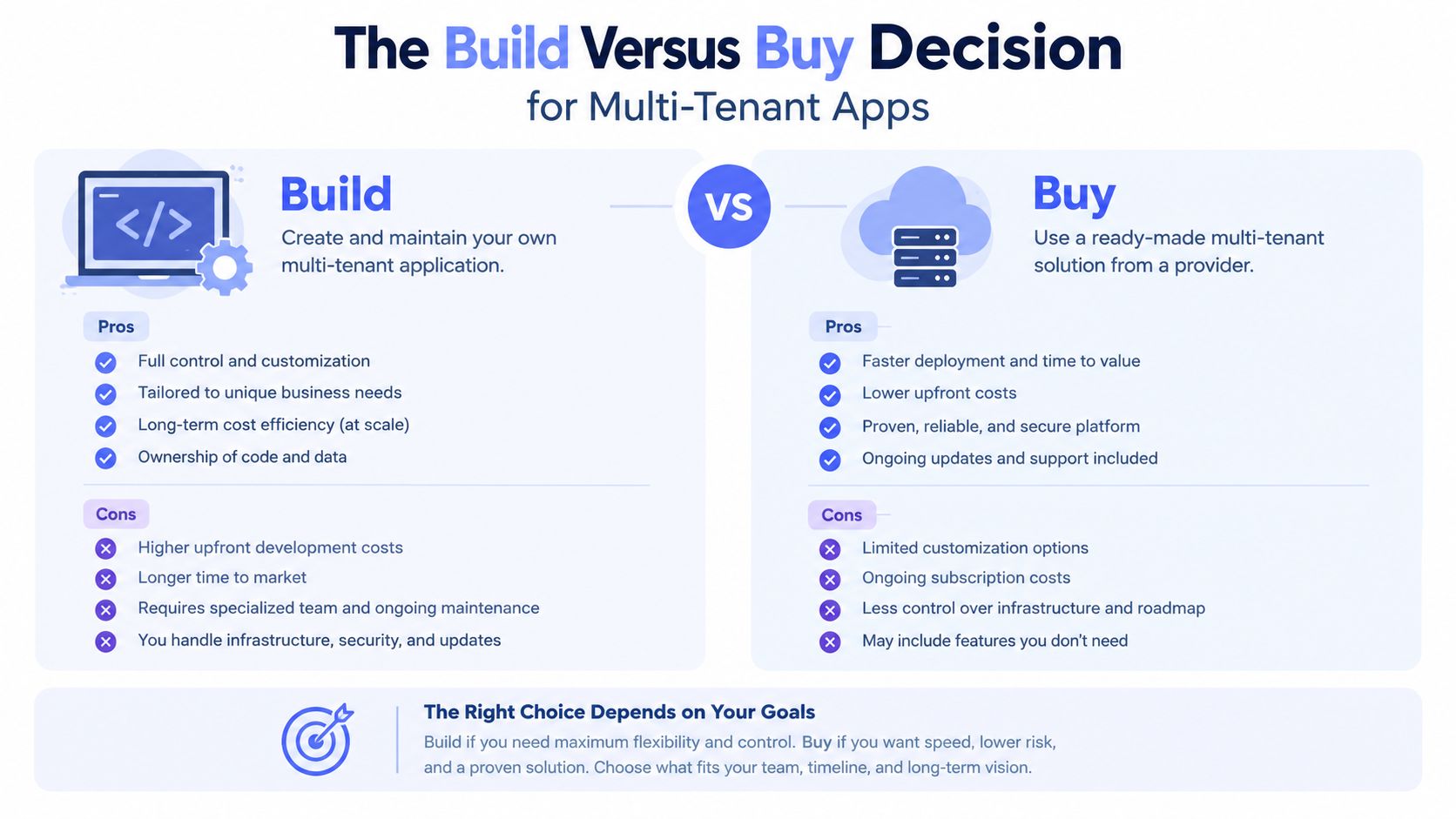 A comparison chart outlining the pros and cons of building versus buying a multi-tenant software application.
The DIY path makes sense when publishing is your core product and you need complete control over provider-specific behavior. It's also a useful learning exercise for a small integration surface with a single tenant model and a team prepared to own the security and maintenance burden.
The economics change when you're adding social publishing to an existing SaaS product. Meta and TikTok app reviews can become release dependencies, and provider API versions keep changing after the initial integration works. A successful proof of concept doesn't remove the need for production-grade rotation, revocation, scope handling, reconnect flows, and operational monitoring.
Compare the ownership boundary
Build directly | Use a unified publishing layer |
You implement each provider's OAuth flow and token store. | The service owns provider-specific authorization and token lifecycle work. |
Your team handles app reviews and API changes. | You integrate against one documented surface. |
You design account states, retries, and partial failure handling. | The publishing layer exposes a unified account and publication model. |
You retain maximum provider-specific control. | You trade some control for reduced integration maintenance. |
You own every incident involving connected credentials. | You evaluate the service's security, reliability, and data-handling practices. |
PostPulse is one example of the unified approach. It provides publishing to 9 platforms through a REST API, official n8n and Make.com integrations, and an MCP server, with white-label support for products that want their own branded experience. Its supported destinations include Instagram Business and Creator accounts, TikTok, YouTube, LinkedIn personal profiles, X, Threads, Bluesky, Facebook Pages, and Telegram channels and chats.
That approach doesn't make due diligence optional. Check how the service stores credentials, isolates tenants, handles revocation, reports provider errors, supports re-consent, and lets you migrate or delete connected accounts. Buying the integration is a decision to outsource a system boundary, not a decision to stop caring about it.
When to Stop Writing Custom OAuth Logic
The right question isn't whether your team can implement OAuth. Most competent teams can. The question is whether provider authorization is important enough to justify maintaining a specialized security and operations surface that sits beside your actual product.
Stop expanding custom logic when the integration has become a recurring source of incidents rather than a differentiator. The warning signs are concrete:
You support multiple social platforms with different token and scope rules.
Several background workers can touch the same connected account.
Customers expect white-label publishing inside your product.
You need to publish on behalf of tenants, not just your own organization.
AI agents or MCP tools must publish without exposing provider credentials.
Enterprise customers ask about revocation, auditability, isolation, and recovery.
Provider reviews and API changes repeatedly displace roadmap work.
Your team has implemented rotation, then had to debug reuse or stale-token incidents.
A failed destination currently blocks an otherwise valid cross-platform publication.
Before migrating, inventory existing connections and classify them by provider, tenant, scopes, last successful use, and reauthorization status. Build a compatibility map between your current records and the destination service's account model. Then migrate one provider or tenant cohort behind a feature flag, preserve the old reconnect path, and compare publication results before moving the rest.
A unified API is not automatically the right answer. If a provider-specific feature is central to your product, direct integration may remain justified. If publishing is supporting functionality, a maintained abstraction can keep your core team focused on the product users actually bought.
For teams comparing authentication approaches more broadly, this overview of API authentication methods helps separate machine-to-machine access from user authorization and provider account connections.
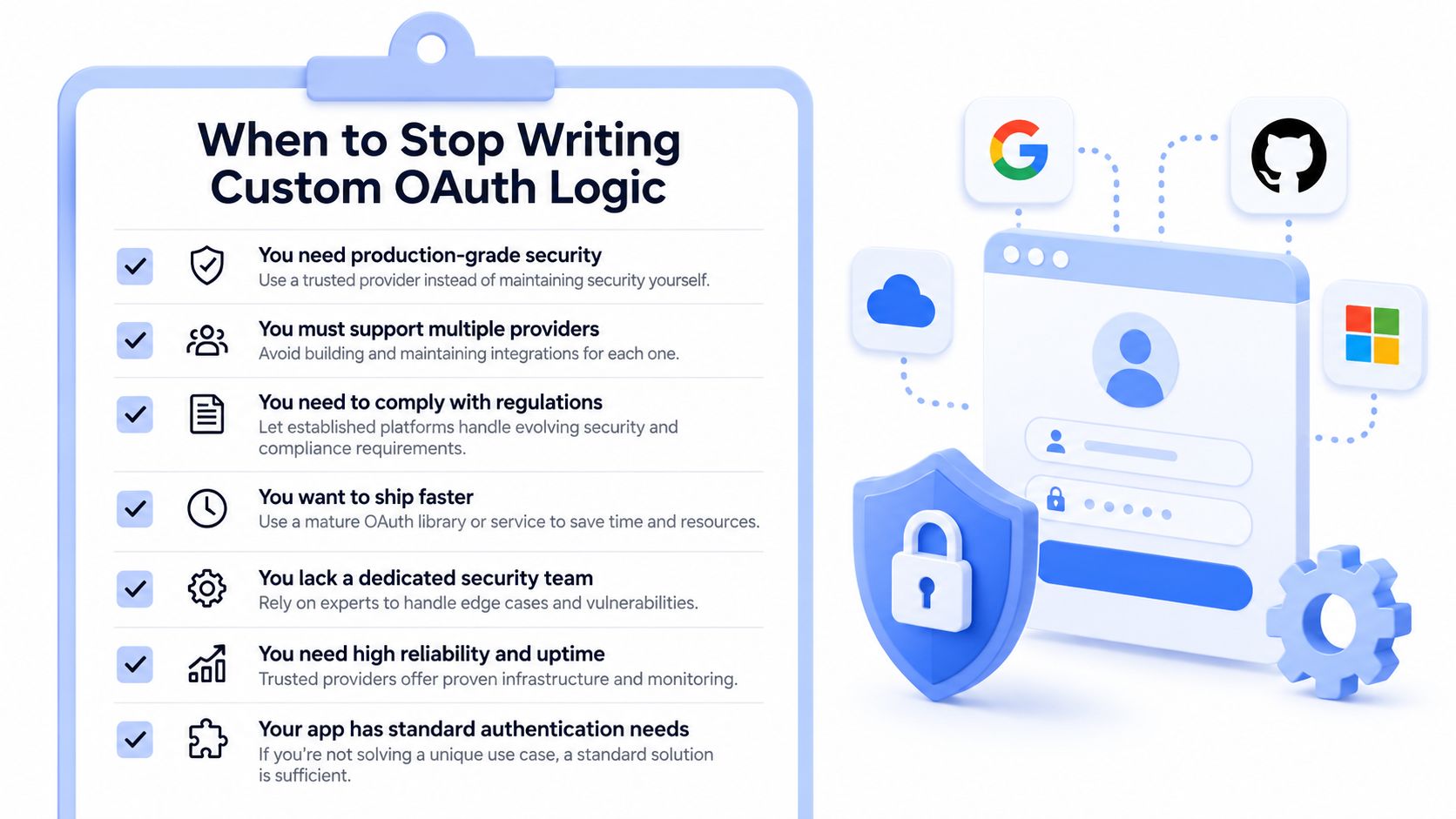 A checklist on a clipboard outlining seven key reasons to stop writing custom OAuth authentication logic.
If your current implementation still treats “connected” as a Boolean, start by adding provider-scoped states, atomic credential replacement, explicit expiry metadata, and a reconnect action. If those changes expose a growing platform-maintenance workload, move the publishing boundary to a specialized service rather than adding more retries and more exception cases.
PostPulse provides a unified social publishing API, official n8n and Make.com integrations, and an MCP server for apps, automations, and AI agents, with OAuth lifecycle handling kept behind the integration boundary. Visit PostPulse to evaluate whether its REST, automation, or white-label publishing model fits your current token-management architecture.
About the Author

Founder of PostPulse — a social media scheduling platform for creators and teams. Software engineer with a passion for building developer tools and simplifying complex API integrations across social media platforms.