MCP Server Security Best Practices for Developers
Published on
Tags:
A local MCP server can feel secure right up until you deploy it. The client connects, authentication works, tools return the expected data, and then production starts rejecting valid tokens, invoking tools you didn't expect, or logging requests from systems nobody on the team recognizes. The frustrating part is that each failure can look like an ordinary API bug.
MCP server security best practices need to account for more than bearer tokens and endpoint protection. An MCP server can expose tools that represent arbitrary code execution, participate in user-authorized workflows, and influence how an AI client interacts with other servers. That combination creates a trust model closer to a privileged integration runtime than a conventional JSON API.
Table of Contents
The MCP Deployment Reality Check
A deployment can pass every local check and still fail as soon as real traffic arrives. A developer builds an MCP server, connects it to a client, adds OAuth, and confirms that a tool can read a project record or publish an approved action. Behind a gateway, with additional tools and real users, the same server encounters different identities, proxies, caches, and trust decisions.
Production alerts rarely identify one clean vulnerability. A request carries a token issued for another service. A session identifier is reused because it was convenient to place in a cache. A tool runs after the user approved data access but not the action itself. Logs contain a client that never appeared in the test plan. Each choice can look defensible alone. Together, they widen the authorization boundary without anyone deliberately changing it.
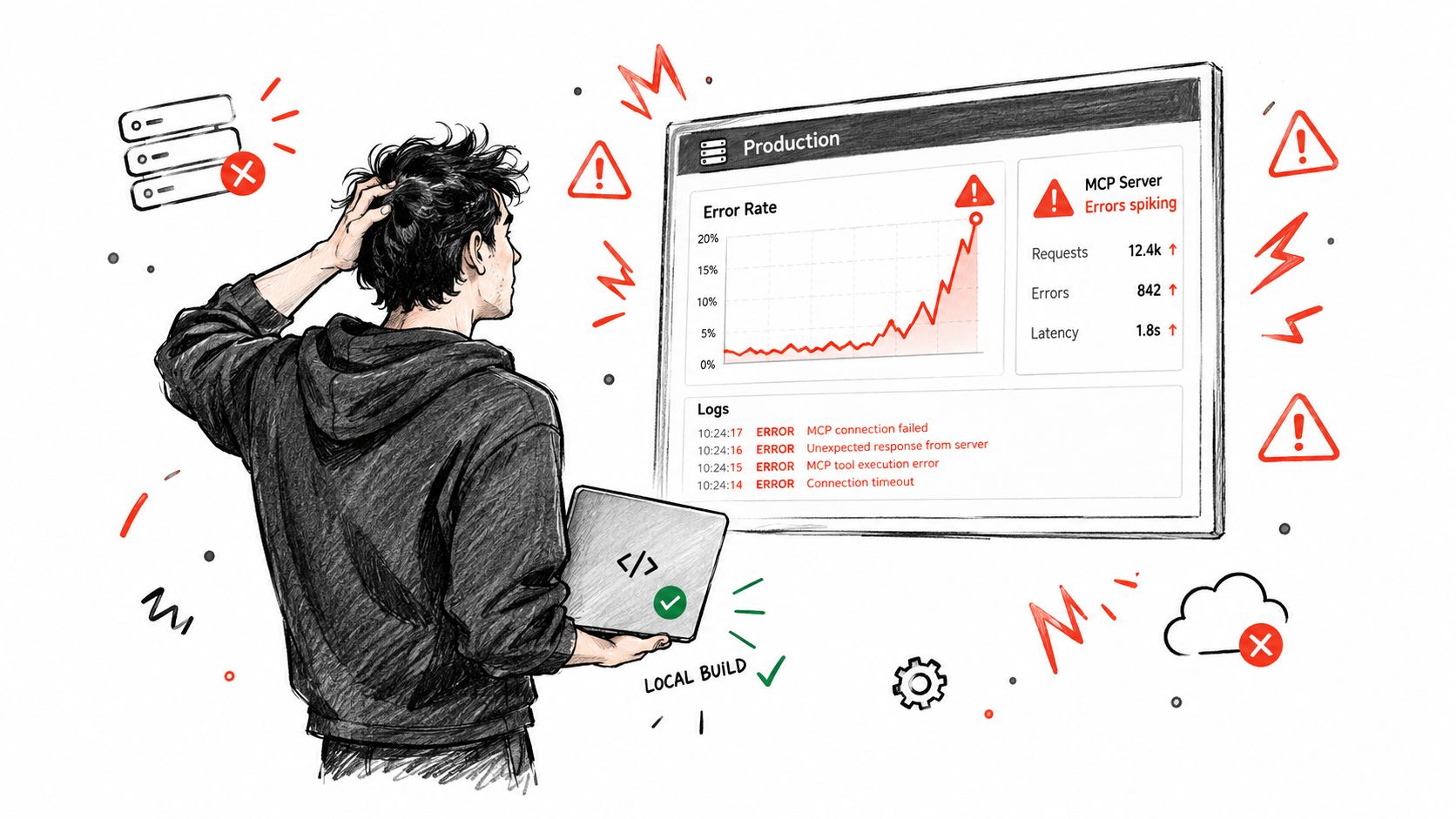 A concerned developer looks at a production dashboard showing critical MCP server errors and spiking logs.
Why the local demo gives false confidence
A local test often has one host, one server, one user, and a small tool set. A deployed environment may contain several clients, separate identity providers, reverse proxies, background workers, and servers that call other servers. Once these components share context or credentials, assumptions that were safe in isolation stop holding.
The MCP specification says hosts must obtain explicit user consent before exposing user data to servers and before invoking tools. That requirement matters because a tool can represent arbitrary code execution, not just passive data retrieval. The 2025 MCP specification formalized this consent-centered approach, alongside requirements that support authorization and defined trust boundaries.
The operational question is what authority does an approved server gain after connection? Authentication establishes who presented a token. It does not establish that every later tool call is permitted, that downstream influence is restricted, or that the server definition still matches what an operator reviewed.
Beyond token validation, the deeper risk is trust propagation. An approved server can influence tool selection, pass context to another server, or shape a multi-server workflow. That trust can spread farther than the original user decision, creating a protocol-level failure that local demos rarely surface.
Production rule: A successful handshake proves connectivity. It does not prove that the next tool call is safe.
The failures that survive code review
The following deployment problems repeatedly appear after the basic implementation passes review:
Broad credentials: One token is reused across servers to simplify configuration. A compromise then reaches resources outside the intended boundary.
Session-based trust: The server authenticates during connection setup and treats later calls as part of the same authorized context without checking the request again.
Unbounded tool authority: A server can reach files, models, data stores, or networks that its advertised tools do not need.
Weak observability: Logs capture application errors but omit the user, audience, scope, server identity, or tool involved in a request.
Implicit server trust: An approved server can influence tool selection or connected servers without continuous verification.
Document each server's tools, data sources, outbound destinations, required scopes, and runtime permissions. Review how identity and context move between servers, not just how each endpoint validates its own token. If those boundaries cannot be described precisely, production requests cannot be judged reliably. This guide to building an MCP server helps with implementation, but deployment requires controls that a local demonstration does not exercise.
Implementing Proper Authorization and Authentication
MCP authorization should be enforced at the point where a request can cause an effect. That means the server validates the request before it reads protected data or invokes a tool, rather than treating the initial session as permanent proof of authorization.
Start with the resource metadata flow
Configure the MCP server as a protected resource and publish OAuth 2.0 Protected Resource Metadata. The metadata gives a client the information it needs to discover how the resource expects authorization to work. The specification requires this metadata for MCP servers that implement authorization, so clients shouldn't have to guess which issuer, scopes, or authorization endpoint to use.
A practical request flow looks like this:
The client connects without a usable access token.
The server returns
401 Unauthorizedand points the client to its Protected Resource Metadata document.The client discovers the authorization server and requested resource details.
The user authenticates and explicitly consents to the data exposure and tool actions.
The client calls the MCP server with an access token intended for that server.
The server validates the token again before processing the request.
The MCP authorization tutorial documents the initial 401 Unauthorized discovery behavior. Don't replace it with a generic redirect or a client-specific shortcut that hides the resource metadata. Predictable discovery makes integrations easier to audit.
Validate every request, not just the connection
A server should validate the token's signature, issuer, audience, expiry, and scope before it performs request work. The critical check is audience binding. The official MCP authorization specification says a server must reject access tokens that weren't explicitly issued for it.
In middleware, the logic should be conceptually similar to:
Extract the bearer token from the request.
Validate its signature against trusted keys.
Check that the issuer is the configured authorization server.
Check expiry and any required token status.
Check that the audience identifies this MCP server.
Map the requested tool to the required scope.
Deny the call if any check fails.
Use a well-tested OAuth or JWT library rather than implementing cryptographic verification yourself. Keep the policy decision close to tool execution, because a valid token for a read operation shouldn't automatically authorize a write operation.
Make consent and enterprise identity explicit
The host must obtain user consent before exposing user data or invoking a tool. For enterprise deployments, identity systems should make that consent and the resulting scopes visible and reviewable. Teams evaluating identity architecture may also benefit from guidance on how to implement enterprise SSO and SCIM, especially when MCP access needs to follow existing user lifecycle controls.
Don't embed an authorization server in the MCP application unless you have a strong reason and the operational capacity to maintain it. Delegating authentication and token issuance to an established identity service generally keeps the MCP server focused on resource protection and policy enforcement. Your server still owns the authorization decision. External identity infrastructure doesn't remove the need to check audience, scope, and tool permissions on every call.
For broader API design context, compare the MCP flow with these API authentication methods, while remembering that MCP adds explicit consent and tool-execution concerns that ordinary API clients may not have.
Token Handling and Session Security Deep Dive
Token problems rarely stay confined to the token itself. A credential can be well encrypted at rest and still be dangerous if it works against the wrong server, remains valid longer than necessary, or is paired with a predictable session identifier.
The authorization requirement is precise: an MCP server must validate a token before processing the request and must accept only tokens explicitly issued for that server. Sharing one token across several MCP servers is convenient, but it destroys audience isolation. If one server is compromised, the attacker may gain a credential that other servers also trust.
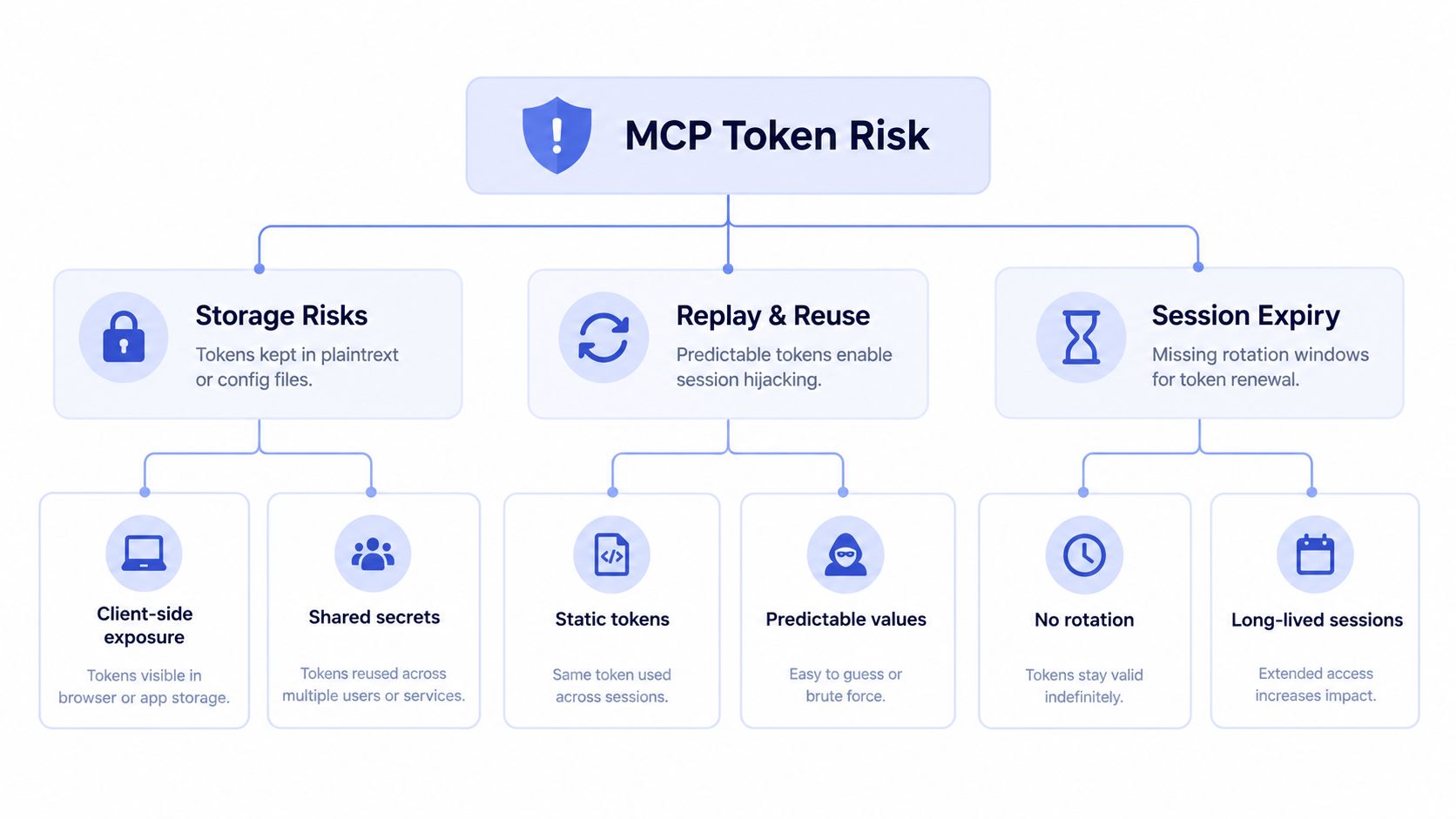 A diagram illustrating MCP token risks including storage vulnerabilities, replay attacks, and long-lived session expiry issues.
Separate credential scope from session state
OWASP recommends scoped, per-server credentials and explicitly advises against sharing tokens across servers in its MCP Security Cheat Sheet. That separation creates a meaningful containment boundary. A publishing server should have no reason to present a database server's token, and a data retrieval server shouldn't inherit a tool execution credential.
Session identifiers need similar care. MCP security guidance says servers must verify all inbound requests, must not use sessions for authentication, and should generate secure, non-deterministic session IDs with a secure random number generator. Bind session state to the relevant user context, but don't let possession of a session ID substitute for token validation.
A predictable identifier is not harmless bookkeeping. An attacker who can guess or reuse it may attempt to associate their request with another user's context. A random identifier also isn't enough by itself. The server must still validate the bearer token, issuer, audience, and scope for the current request.
Return the right failure
On an unauthenticated first connection, return 401 Unauthorized and provide the Protected Resource Metadata discovery path. Use authorization failure responses consistently after authentication when the token lacks the required permission. Avoid returning detailed token-validation diagnostics to the caller, because messages that distinguish an unknown audience from an expired credential can help attackers refine guesses.
Keep sensitive material out of logs. Record a token fingerprint or request correlation value instead of the token itself, then include the authenticated subject, server audience, requested tool, decision, and failure category in protected audit logs. The companion API key management guidance is useful for general secret-handling discipline, but MCP deployments still need the protocol-specific audience and request-level checks described above.
The central trade-off is operational simplicity versus isolation. Shared tokens and long-lived sessions reduce configuration work, but they make incident containment and forensic analysis harder. Per-server credentials, explicit scopes, and short-lived state require more identity plumbing. That work buys you a boundary you can reason about.
The Hidden Risk, Protocol Trust Propagation
Most MCP security reviews stop after checking OAuth configuration, secret storage, and sandbox permissions. Those controls matter, but they assume that an approved server remains a passive, bounded participant. In a multi-server workflow, that assumption can fail.
A trusted server may influence tool selection, inject prompts through server-side sampling, or inherit authority across connected servers. The user approved one integration, but the workflow can give that integration influence over other tools. The resulting problem isn't only a stolen token. It's trust propagation, where approval of one component causes the client or surrounding servers to extend authority beyond the original decision.
The trusted boundary is weaker than it looks
The National Security Agency's MCP security analysis identifies gaps involving capability attestation, origin authentication for server-side sampling, and trust boundaries in multi-server environments. The same analysis discusses research examining 67,057 servers across six public registries, with conditions that can enable server hijacking and invocation manipulation.
That finding changes the review question. It isn't enough to ask whether your server validates its own tokens. Ask whether the client can verify the identity and integrity of the server definition, whether the server can alter the context used to choose another tool, and whether a downstream server knows which original user consented to the action.
Registry vetting becomes part of deployment security. A registry entry, package, or server definition should have an identifiable owner, a controlled change process, and a way to detect unexpected modifications. Approval should attach to a specific definition and capability set, not to a vague server name.
Contain influence after approval
Use separate credentials and scopes for each server. Keep tool descriptions narrow and review changes as security-sensitive events. Deny a server the ability to reach other tools or resources unless that path is part of its documented purpose.
Continuous verification matters because approval is not permanent evidence of good behavior. Monitor new tools, altered definitions, unusual sampling activity, unexpected outbound requests, and calls that cross the server's declared boundary. If your client or gateway can't express those controls, treat the multi-server workflow as higher risk rather than assuming the protocol will enforce the separation automatically.
A trusted server should be treated as an approved capability set, not as a universally trusted control plane.
Many “secure” deployments break in this stage. The operator hardens the server's host, but the AI workflow still allows that server to shape what happens elsewhere. Registry provenance, signed definitions, capability review, and post-approval monitoring address that missing layer more directly than another secret rotation alone.
Hardening Your MCP Server Deployment
Authorization controls are necessary, but the runtime still needs to be constrained. A valid request can be abused if the server process has access to sensitive files, internal networks, model data, or credentials that its tools never require.
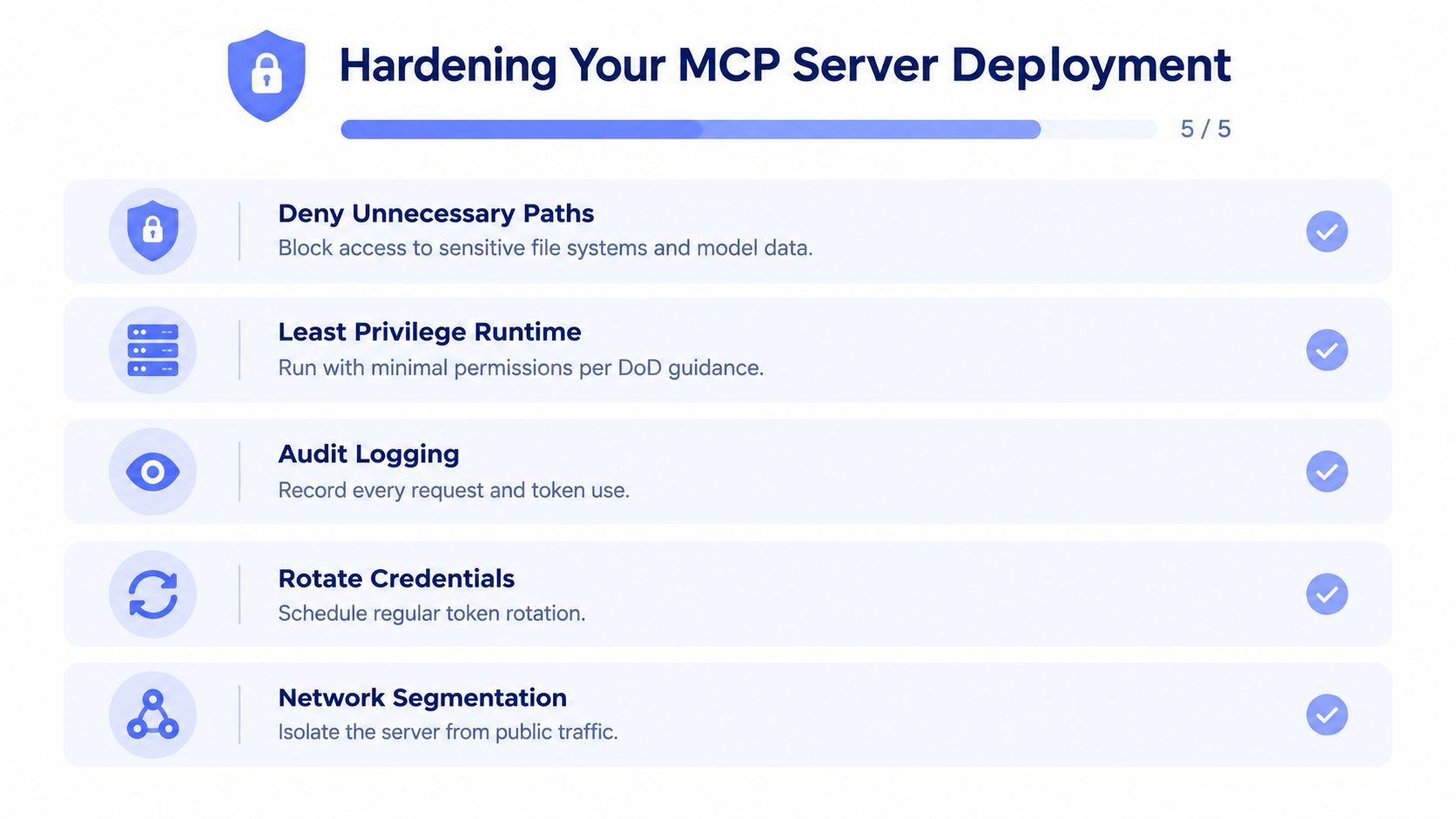 A checklist infographic titled Hardening Your MCP Server Deployment showing five essential security best practices.
Remove access before adding controls
The Department of Defense recommends denying unnecessary runtime access paths, including sensitive file systems, model and data files, and internal networks, in its MCP security design considerations. Start with a deny-by-default runtime and add only the directories, services, and network destinations required by the documented tool behavior.
A practical hardening pass should include:
Minimal runtime permissions: Run the server as an identity that can't modify unrelated application data or access administrative interfaces.
Filesystem isolation: Mount only required paths, preferably read-only where tool behavior permits.
Network restriction: Allow outbound connections only to documented dependencies and keep internal services unreachable by default.
Agent sandboxing: Separate tool execution from the host's broader process environment and prevent arbitrary command paths.
Request controls: Apply authentication, authorization, input validation, and rate limits before expensive or state-changing work.
The developers MCP server guide can help with implementation orientation, but deployment policy should come from your actual data classification and tool requirements, not from the fact that a server starts successfully.
Make operational evidence useful
Microsoft's guidance recommends sending MCP server logging to a central SIEM for anomaly detection. Cloudflare's guidance adds short-expiration state tokens, the Secure cookie flag, and HMAC integrity checks as operational safeguards. OWASP also emphasizes per-server credentials and scoped access.
Log enough context to reconstruct a decision without recording secrets:
Authenticated subject or service identity.
Token audience and granted scopes.
Server and tool name.
Request outcome and denial reason.
Correlation identifier and relevant downstream action.
Changes to tool definitions or authorization policy.
A rate limit won't fix a confused trust boundary, and a SIEM won't stop an overprivileged process. These controls work together. Runtime isolation limits damage, request-level policy limits actions, and centralized logs give responders evidence when behavior deviates from the approved pattern.
For autonomous publishing workflows, keep the publishing capability behind a narrowly scoped server and require explicit authorization for each account and action class. A platform such as PostPulse can provide one hosted MCP surface for social publishing across supported networks, but your integration still needs server-specific credentials, tool-level policy, audit logging, and a clear approval path for autonomous actions.
Building Your Security Posture Checklist
A server can pass a local demo and still fail its first production review. The useful checklist tests ownership, evidence, and failure handling, rather than repeating implementation steps from earlier sections.
Before production
Consent: Can the product owner show where users approve data access and tool use? Evidence: consent copy, UI flow, and an approval record. Owner: product and platform teams.
Protocol boundary: Can the platform team identify which checks belong to the MCP protocol and which come from deployment policy? Evidence: a reviewed control matrix linked to the release record. Owner: security engineering.
Trust propagation: Can reviewers trace authority from host configuration through registries, server definitions, capability changes, sampling, and downstream servers? Evidence: an architecture diagram and a test showing that an unapproved capability cannot gain authority. Owner: platform team.
Audience binding: Do gateway records prove that tokens issued for another resource are rejected? Evidence: a test result and a log entry showing the mismatched
audclaim. Owner: identity team.Session review: Can incident responders invalidate active sessions without treating a session identifier as proof of identity? Evidence: a revocation exercise and its runbook. Owner: platform team.
Permission boundary: Can each server owner list the credentials, files, model access, data, and network paths the process can reach? Evidence: an access inventory with an approved exception record for every broader permission.
Evidence quality: Can an investigator reconstruct a tool decision without seeing secrets? Evidence: a sample audit trail containing the subject, server, tool, outcome, denial reason, and correlation ID. Owner: operations.
Response readiness: Can the on-call engineer disable the server, revoke credentials, isolate its runtime, and identify affected calls? Evidence: a tabletop exercise with timestamps and assigned actions.
After approval
Recheck this evidence whenever tools, server definitions, capability declarations, or authorization policy change. Compare declared behavior with observed calls, then record the reviewer and decision. The secure delivery checklist can support the wider release review, while MCP-specific evidence stays in the deployment record.
PostPulse provides a hosted MCP server for social publishing with OAuth 2.0 and Auth0-based token verification. Teams can connect through PostPulse, then apply the same approval, access, and monitoring review to the surrounding workflow.
About the Author

Founder of PostPulse — a social media scheduling platform for creators and teams. Software engineer with a passion for building developer tools and simplifying complex API integrations across social media platforms.