
What Makes a Developer Friendly API in 2026
Published on · Updated on
Tags:
You're on call because a social post failed at 3 a.m. The access token expired, the refresh request returned an unhelpful error, and a webhook retry created a duplicate record. Meanwhile, another platform is still processing a media container, pagination skips an item in production, and the API documentation sends you searching through source code to discover what the endpoint expects.
That's the practical test for a developer friendly API. It isn't whether the landing page looks polished or whether the first request works in a tutorial. It's whether the integration remains understandable, recoverable, and maintainable after the first successful response.
APIs now consume a significant share of engineering time. Postman's 2022 State of the API Report found that 51% of respondents spent more than half of their organization's development effort on APIs, compared with 40% in 2020, and that more than 40% of backend developers spent over 20 hours each week working on APIs. Postman's State of the API research makes the implication clear: small design decisions around authentication, errors, and documentation become recurring costs for every team that integrates with you.
Table of Contents
The Integration Nightmare Every Developer Knows Too Well
It's Monday morning, and the task sounds harmless: sync contacts between HubSpot, Mailchimp, Stripe, and five other tools. By lunch, you've discovered that every vendor uses a different OAuth flow, names pagination differently, and documents webhook behavior with varying levels of detail. The ninth integration has a “temporary” limitation buried in a developer forum post.
The first failure arrives before production. One provider returns a refresh token that can be reused, another rotates it, and a third expects a different client configuration for token renewal. Your local test passes because the access token is still valid. The production worker fails later, and the only useful clue is a generic unauthorized response.
Webhooks create a different class of trouble. One platform signs payloads, another relies on a shared secret, and another documents retries without explaining whether the original event identifier stays unchanged. Your handler needs to tolerate duplicate deliveries, out-of-order events, and partial failures even when the vendor's examples show only a single happy-path request.
Practical rule: Treat every webhook as a message that may arrive more than once, later than expected, or in an order you didn't anticipate.
Then there's the operational baggage: a spreadsheet of credentials, a Slack thread full of integration bugs, separate monitoring dashboards, and a quiet sense of dread before every platform deprecation notice. Modern applications commonly rely on between 26 and 50 APIs, according to InfoWorld's coverage of API usage. Each additional surface adds another contract your team must learn and preserve.
The deeper issue isn't just poor documentation. Nine vendor surfaces force you to reinvent the same glue code for token refresh, retries, rate-limit handling, pagination, webhook verification, and error normalization. A practical overview of the social platforms is available through the social media API guide, while an integration directory such as the Lynkro.io integrations page helps show how many separate systems teams routinely connect.
A better API evaluation asks two questions. Can a developer make the first call without guesswork? Can the team still reason about the integration months later, after credentials rotate, endpoints change, and traffic becomes unpredictable? The most useful unified surfaces reduce that repeated mental work without pretending that every underlying platform behaves identically.
What Developer Friendly Actually Means in 2026
A developer friendly API reduces friction across the entire lifecycle, not just during setup. The lifecycle has four stages: first call, steady-state integration, error recovery, and long-term maintenance.
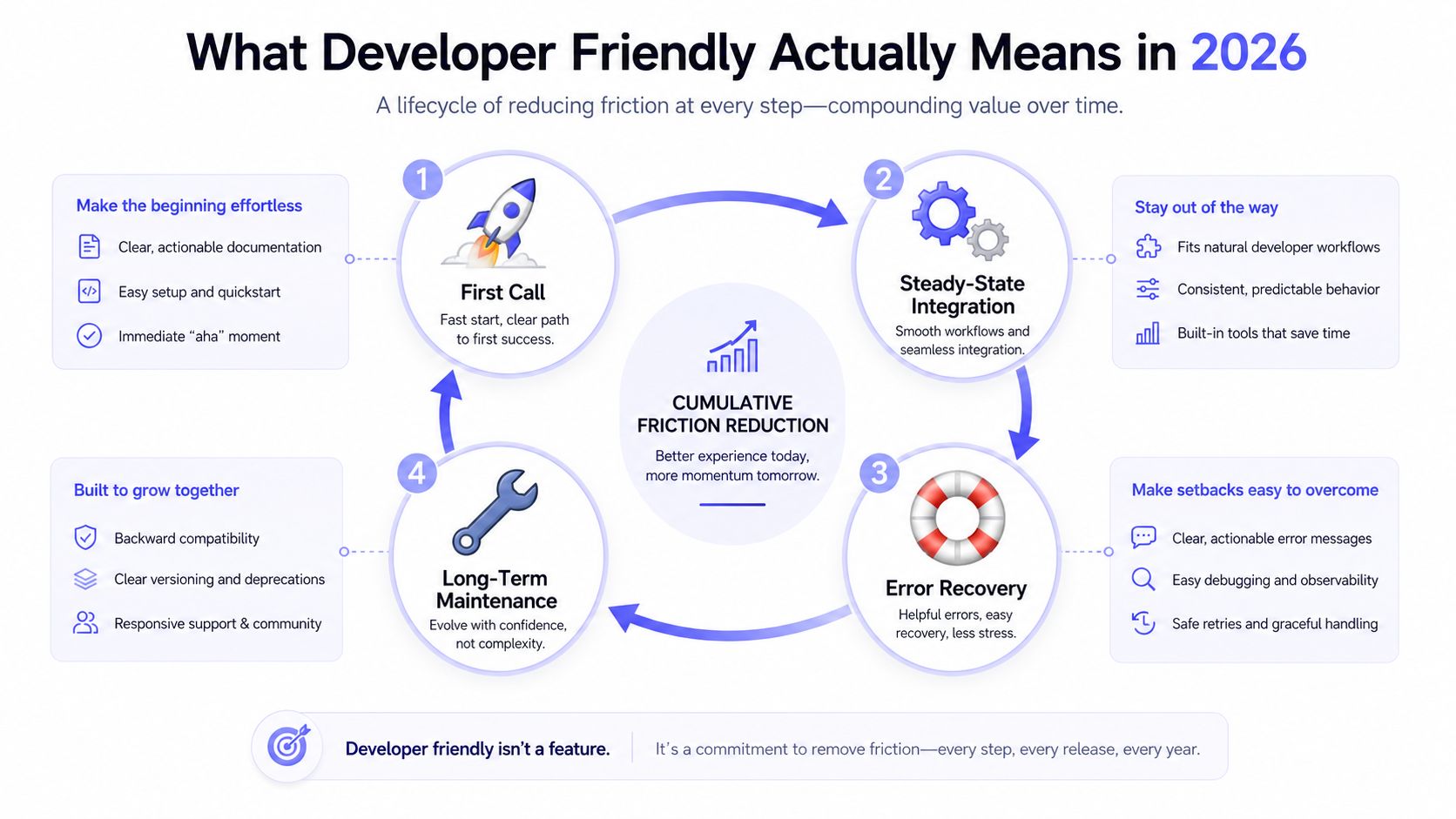 A diagram illustrating a four-step lifecycle for creating a developer-friendly experience by reducing friction over time.
A clear quick-start helps with the first call. It doesn't help much if production errors lack machine-readable codes or if a version change forces a rewrite. Surface niceness includes friendly documentation and a useful status page. Structural niceness includes predictable schemas, idempotent writes, consistent pagination, explicit versioning, and behavior that matches the published contract.
The distinction matters because developer friendliness is cumulative. An API that saves a few keystrokes at signup but creates hours of debugging later isn't friendly. It has merely moved the cost deeper into the integration, where it's harder to see and more expensive to fix.
Eight qualities worth testing
Use these qualities when you scan an API reference page or run a trial integration:
Consistent design: Resource names, HTTP methods, response envelopes, and pagination should follow patterns across endpoints.
Authentication clarity: The API should explain token creation, scopes, expiration, refresh behavior, and revocation without requiring source-code archaeology.
Documentation depth: Examples should cover realistic tasks, required parameters, error responses, edge cases, and complete field definitions.
SDK coverage: Official SDKs should match the current API contract and use types that expose invalid states early.
Webhook reliability: Signed payloads, event identifiers, retry rules, replay support, and delivery status should be documented.
Error semantics: A 400, 401, 403, 404, 409, and 429 response should each tell the caller what happened and what action is safe.
Onboarding speed: A new developer should move from credentials to a meaningful response without unnecessary approvals or hidden setup.
Transparent pricing: Usage units, quotas, overage behavior, account limits, and billing events should be visible before production adoption.
REST remains a useful foundation because its resource-oriented model, stateless requests, and compatibility with HTTP give teams a shared vocabulary. Roy Fielding formalized Representational State Transfer in his 2000 doctoral dissertation, and its influence still shows in the endpoint patterns developers encounter every day. For practical design guidance, REST API best practices offers a useful companion reference.
The contract is ultimately between the API team and the integrator. The API team controls schemas, status codes, documentation, and change policy. The integrator contributes the scarce resource, developer time. A friendly API respects that time by reducing cognitive load, especially when the happy path ends.
The Core Qualities That Separate Good APIs From Painful Ones
A developer-friendly API reveals its rules through repetition. After one successful request, you should be able to predict where another resource lives, which method changes it, how the response is shaped, and what a failure means. The test comes later, after the first call, when pagination, retries, permissions, provider quirks, and upgrades enter the integration.
Start with a consistent resource model
Resource-oriented URLs should use clear nouns, HTTP methods should keep stable meanings, and related operations should follow the same naming conventions throughout the API. Pagination needs equal care. Cursor-based pagination often fits changing datasets better than page numbers that shift as records are added, but the contract must explain cursor expiry, ordering, limits, and whether a cursor can be reused.
Authentication should be just as explicit. If the API uses OAuth 2.0 with PKCE, place the authorization flow, scopes, redirect behavior, refresh process, and token-revocation path together. Scoped tokens limit accidental access only when each endpoint's required scope is clear. A developer should not have to inspect a sample application to learn that reading and publishing require different permissions.
Documentation is part of the interface
An empirical study of API usability connected major usability flaws with unsatisfactory documentation. That finding matches integration work: missing parameters and vague errors turn an ordinary request into an investigation. Documentation is part of the API surface because it supplies the context that a schema alone cannot.
Useful material includes an OpenAPI specification, runnable examples in multiple languages, realistic request and response bodies, a sandbox that behaves like production, and a changelog that identifies behavior changes. SDKs should be official, typed where the language supports it, aligned with the API version, and maintained alongside the contract. A stale SDK is a second interface, and it teaches callers rules the server may no longer follow.
Design for failure, not just success
A successful response proves only that one path worked. Friendly APIs also explain what happens when a request is repeated, delayed, rejected, or delivered through an asynchronous event.
Webhooks need signed payloads, stable event identifiers, documented retry policies, and a replay mechanism. Write endpoints should accept idempotency keys when a retry could create a duplicate publication, payment, or record. Error bodies should provide a machine-readable code, a human-readable explanation, and a request ID that support teams can locate.
A rate-limited response should identify the limit and offer retry guidance. If the API returns 429, its Retry-After header should be meaningful, and the documentation should say whether the client should retry the same request, refresh credentials, or stop.
For application developers, no-code builders, and AI agents, a unified surface can reduce the long tail of integration work. PostPulse presents recurring concerns across ten platform integrations through one API boundary, while preserving provider context for diagnosis.
Dimension | Nine Separate APIs | One Unified Surface |
Authentication | Different OAuth flows, scopes, expiration rules, and refresh behavior | One documented credential model for the integration layer |
Documentation | Multiple references with inconsistent examples and terminology | One contract, one set of examples, and one troubleshooting path |
Pagination | Vendor-specific cursors, offsets, limits, and ordering rules | A common pagination pattern where the surface supports normalization |
Webhooks | Different signatures, event names, retry rules, and replay options | One event format and verification approach at the integration boundary |
Errors | Different status details and platform-specific codes | Normalized errors with provider context preserved for diagnosis |
Maintenance | Separate deprecations, SDK updates, and quota changes | One integration to maintain, while provider behavior still needs monitoring |
The unified column does not erase platform constraints. Teams still need to understand provider policies, particularly quotas and publishing rules. They also need a clear change policy. API versioning best practices can help teams document compatibility decisions before a breaking change reaches production.
Evaluating Any API With a Time-to-First-Call Checklist
Measure onboarding as a speed test. Start the clock when you create the account and stop when a real endpoint returns a successful response that proves authentication and permissions work.
Industry guidance uses five minutes as a time-to-first-call benchmark, with sub-two-minute onboarding classified as “Champion” and four to eight minutes signaling documentation gaps, according to this time-to-first-call API onboarding benchmark. The exact label matters less than the habit of measuring the path instead of trusting the marketing page.
Run the first-call workflow
Grab a key: Create credentials, identify the environment, and record the required scopes.
Hit an identity endpoint: Call
/meor the closest equivalent. This confirms that the credential works before you attempt a complex operation.Inspect the response: Check the status, headers, response envelope, account identifier, and available permissions.
Send a safe test request: Use a sandbox or a read-only endpoint when possible. For a write operation, use a clearly documented test object.
Trigger a webhook: Confirm that the event arrives, inspect its signature, and verify whether the payload includes a stable event ID.
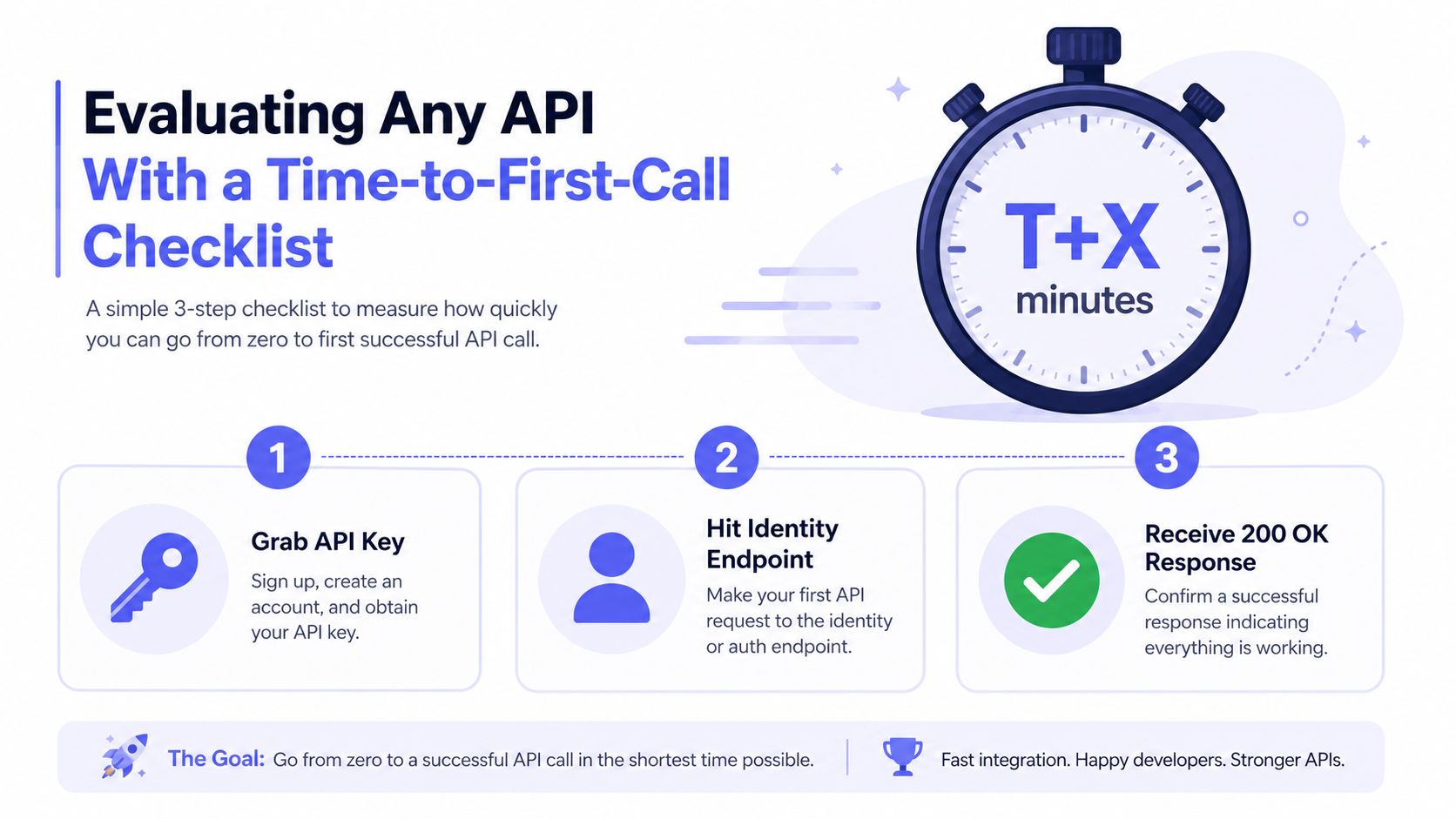 An infographic showing a three-step checklist to measure the time it takes to make an API call.
Use four short blocks to evaluate the result:
Setup: Is the authentication model clear, can keys be rotated, and does a sandbox exist? Yes or no, can a new developer begin safely?
Clarity: Are endpoint names, pagination, idempotency keys, and response envelopes documented? Yes or no, can you predict the next request?
Reliability: Are status codes, rate-limit headers, retry rules, and error payloads specific? Yes or no, can a client recover without a support ticket?
Longevity: Is there a versioning policy, changelog, current SDK coverage, and published uptime objective? Yes or no, can you maintain this integration?
A useful evaluation can fit into a short working session because each question produces observable evidence. Don't award points for promises. Run the request, force a controlled error, and read the headers.
For teams comparing tools that automate API discovery or extraction, a focused Firecrawl alternative comparison can provide additional context around how different integration surfaces expose their capabilities.
How PostPulse Delivers a Developer Friendly API Surface
For an app developer, the attraction of a unified publishing surface is architectural. Instead of implementing ten platform-specific integrations, the application can use one REST API, one authentication boundary, and one set of publishing objects. The provider-specific work still exists, but the application doesn't need separate code paths for every OAuth refresh, media workflow, or webhook format.
PostPulse is one example of that model. It exposes publishing to Instagram Business and Creator accounts, TikTok, YouTube Shorts and video, LinkedIn personal profiles, X, Threads, Bluesky, Facebook Pages, Telegram channels and chats, and Pinterest boards through a unified product surface. Its offering also includes official n8n and Make.com integrations, plus an MCP server for agent-driven workflows.
Three audiences, one integration boundary
App developers need control over branding, credentials, retries, and persistence. A unified REST surface can centralize idempotency, store provider references, and present one documented webhook format to the application. White-label support matters when the end user should experience the app's brand rather than a third-party dashboard.
No-code builders need the same underlying capability expressed as a visual workflow. A Make.com app or n8n node can expose endpoint inputs, payload previews, connection handling, and retry behavior without asking the builder to maintain OAuth code. The important test remains the same: can the workflow show why a request failed and whether rerunning it is safe?
AI agents need schemas and operations they can discover without relying on informal explanations. An OpenAPI description, deterministic error codes, stable JSON fields, and explicit write semantics give an agent a better basis for planning and recovery. The agent still needs permission boundaries and rate controls, but the surface should make those constraints visible.
Dimension | Ten Platform APIs | PostPulse |
Setup | Separate applications, approvals, credentials, and environments | One integration boundary for the supported publishing destinations |
Authentication | Provider-specific OAuth and token behavior | A unified account connection and API workflow |
Documentation | Different schemas, media rules, and error conventions | One developer-facing REST surface |
SDKs and automation | Separate client libraries or custom HTTP steps | REST access plus official n8n and Make.com nodes |
Webhooks | Provider-specific events and signatures | A common integration boundary for application workflows |
Errors | Platform-specific status details and quota responses | Unified handling with provider context needed for diagnosis |
Pricing | Separate vendor billing and usage policies | A single PostPulse commercial relationship, subject to supported plan terms |
The word “unified” shouldn't be confused with “identical.” YouTube quota behavior and TikTok throttling still belong to their official platform policies. The value of an abstraction is that it gives the application one place to enforce its own rules, log provider responses, and decide when to retry.
Why AI Agents Change What Developer Friendly Means
A developer can study several documentation pages, remember an exception, and add a workaround. An autonomous agent needs a tighter contract. It must treat each endpoint like a defined function, with explicit inputs, outputs, permissions, and failure modes.
AI agents add a security requirement to API usability. The supplied industry research reports that 51% of developers are concerned about unauthorized or excessive API calls from AI agents. That concern changes the API surface itself. Scoped permissions, rate controls, auditability, and deterministic behavior need to be visible parts of the product, rather than assumptions hidden in infrastructure.
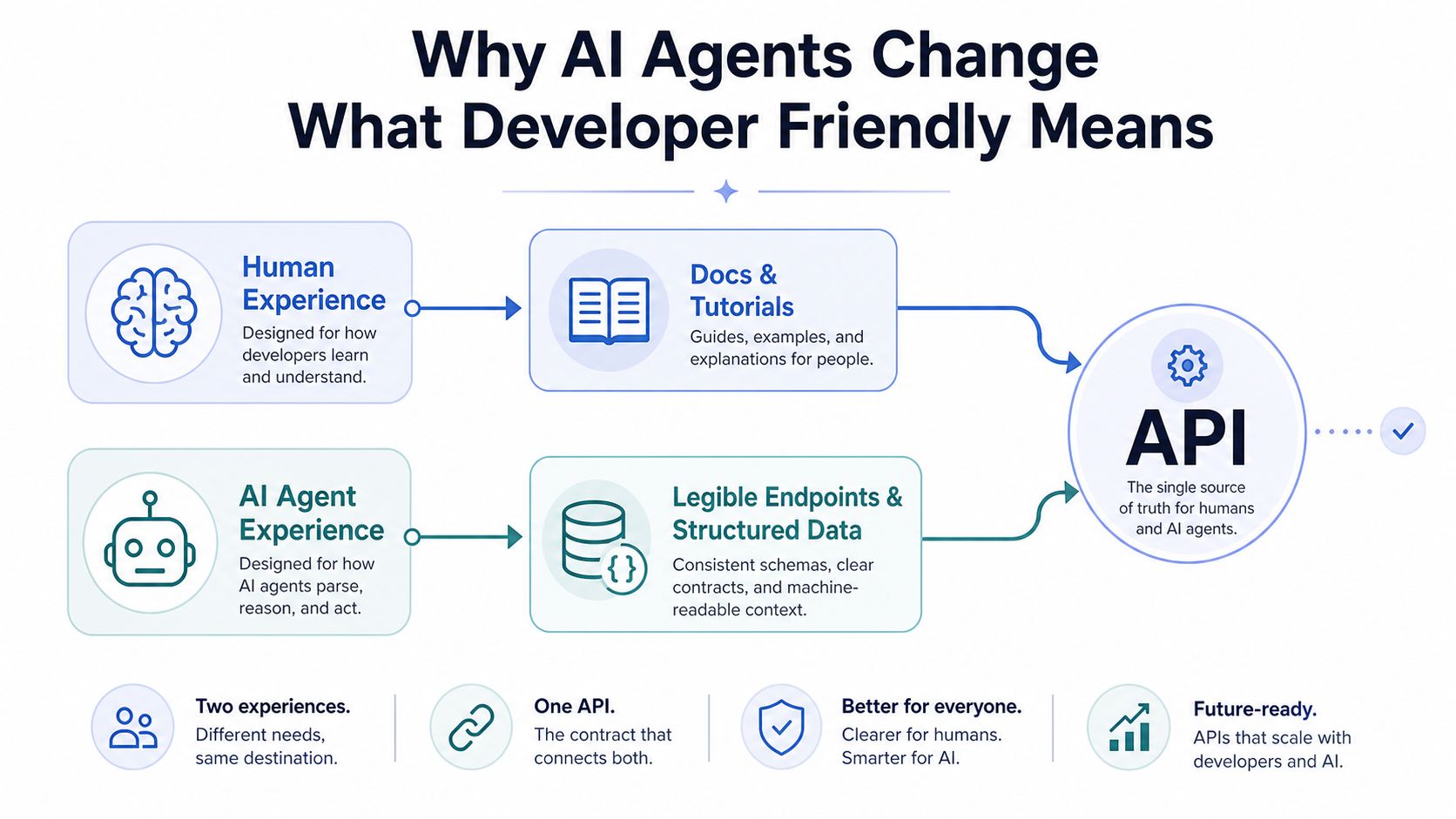 A diagram illustrating how API design for human developers and AI agents converges into one source of truth.
Four requirements for machine-first use
Deterministic schemas: Mark nullable fields explicitly, distinguish omitted values from empty values, and keep response types stable.
Structured errors: Return codes that support branching. “Try again later,” “request approval,” and “fix the payload” should lead to different handling.
Retry-safe writes: Idempotency keys let an agent retry after a timeout without knowing whether the first operation succeeded.
Machine-readable contracts: OpenAPI or JSON Schema gives tools a formal description they can ingest, validate, and use for function calling.
Human-friendly and machine-friendly design share an emphasis on consistency and clarity, yet they serve different needs. Prose tutorials explain intent to a person. Typed responses and predictable pagination help a tool select and validate an operation. An SDK may serve a developer well while remaining unavailable to an agent that can access only a schema.
The long tail of developer experience matters here. A polished product tour can show the intended path, but an agent workflow also needs the exact fields, permissions, and recovery rules behind each step. Resources such as Rendemo's agent integration guide can explain the human-facing experience, while the API must expose the structured contract the agent will call.
Every endpoint may be invoked by an unfamiliar system at machine speed. Permission scopes, request limits, audit records, and precise failure responses keep one ambiguous result from becoming a loop of repeated side effects. For app developers, no-code builders, and AI agents, a consistent API surface reduces the number of platform-specific assumptions they must carry over time. PostPulse applies that idea across its supported publishing integrations, while provider rules still determine what each destination accepts.
Myths, Mistakes, and the Final Checklist
Myth one, polished documentation guarantees a good experience. It doesn't. Documentation can describe every parameter and still leave developers stranded when webhook retries duplicate records, error codes don't distinguish invalid scopes from expired credentials, or the sandbox behaves differently from production. The empirical API usability research cited earlier supports the importance of documentation, but documentation is one part of the contract, not the whole contract.
Myth two, REST is obsolete. GraphQL and other models solve real problems, especially where clients need flexible read shapes. REST remains valuable when developers and agents need predictable resource endpoints, conventional HTTP semantics, cacheable reads, and straightforward tooling. The right question isn't whether a style is fashionable. It's whether the contract makes common operations easy to discover and safe to repeat.
Myth three, one monolithic API always wins. A unified surface can remove duplicated integration work, but abstraction can also hide provider-specific constraints. Teams still need quota visibility, platform capability matrices, and a way to inspect the underlying response when a provider rejects a request. Use one surface where it reduces repeated work, and preserve enough context to debug the source system.
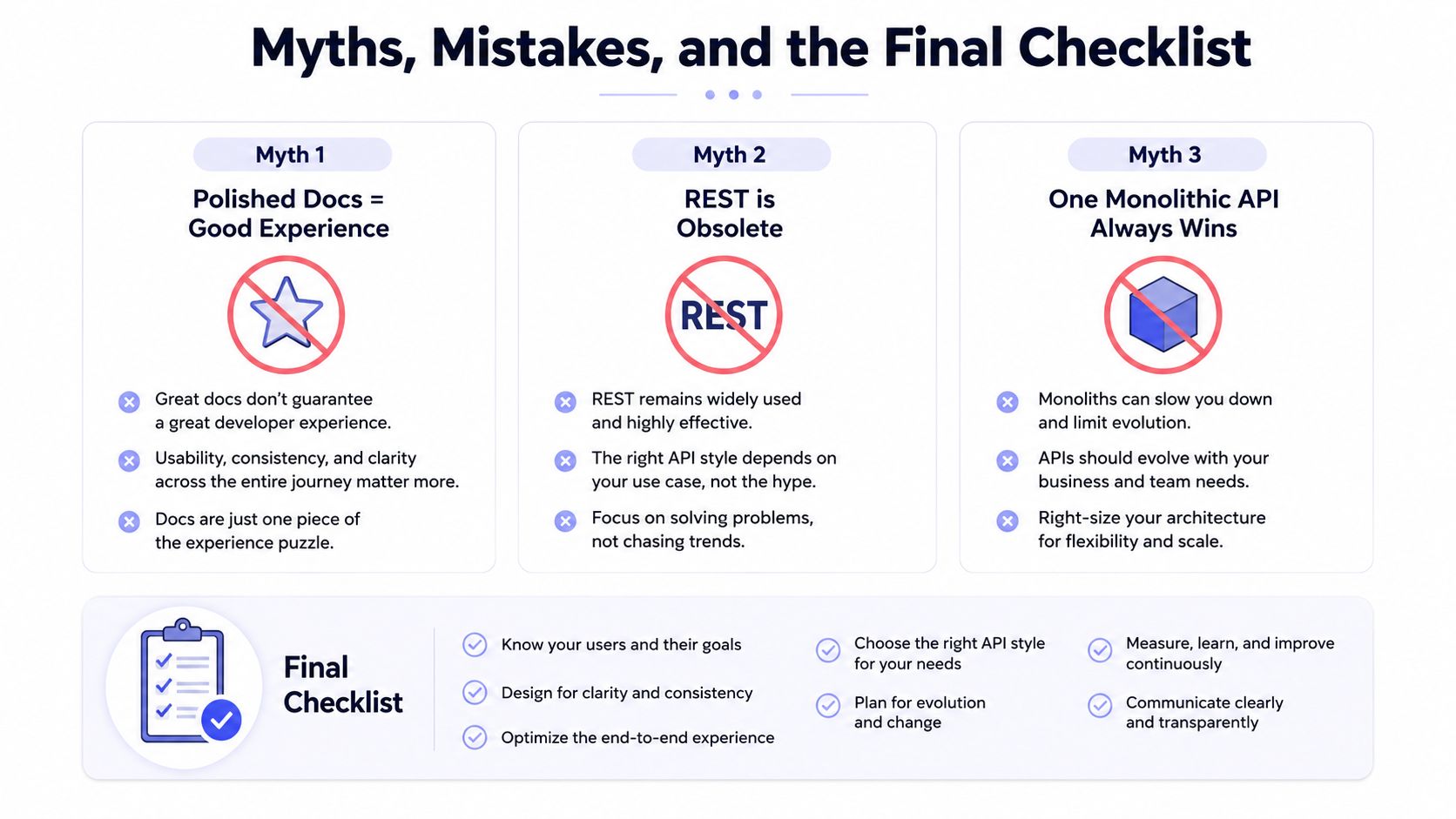 An infographic titled Myths, Mistakes, and the Final Checklist, outlining common API development misconceptions and best practices.
Copy this checklist into your evaluation notes:
Authentication clarity: Can a developer explain token creation, scopes, refresh, rotation, and revocation?
Error semantics: Do failures include actionable codes, stable structure, and request identifiers?
SDK coverage: Are official libraries current, typed where appropriate, and aligned with the API version?
Webhook reliability: Are signatures, retries, event IDs, replay, and idempotency documented?
Sandbox availability: Can the team test safely without creating production side effects?
Pricing transparency: Can you identify the billable unit, quota behavior, and overage policy?
Quota visibility: Does the API expose limits and retry guidance before production traffic arrives?
A developer friendly API earns trust at the keyboard. The brochure can start the evaluation, but the first call, the forced error, the webhook replay, and the maintenance workflow decide whether the integration deserves to stay.
PostPulse gives app developers, no-code builders, and AI agents one REST surface for publishing across nine supported social platforms, with official n8n and Make.com nodes and an MCP server for agent workflows. Visit PostPulse to review the API and choose a publishing integration that matches your application, automation, or agent architecture.
About the Author

Founder of PostPulse — a social media scheduling platform for creators and teams. Software engineer with a passion for building developer tools and simplifying complex API integrations across social media platforms.