7 Banned Hashtags on Instagram to Avoid in 2026
Published on
Tags:
A batch of scheduled posts goes out cleanly. The API returns success, media containers publish, and nobody sees an error. A week later, one account's reach has fallen off a cliff. The logs show successful publication, but they don't explain whether a hashtag page hid the post, recommendations stopped carrying it, or the content missed its audience.
Hashtag problems are difficult to isolate in bulk workflows because the post can publish while discovery surfaces behave differently. Instagram's history includes blocked searches, limited result displays, warning screens, and “no posts yet” states, so “banned hashtag” doesn't always mean a permanently forbidden word. Academic research on Instagram's moderation history documents these separate restriction mechanisms.
Start with a simple check. Search the hashtag in Instagram, inspect whether results are dominated by bot spam or irrelevant posts, and log every tag used by each post. That's a useful heuristic, not proof of a ban. Instagram doesn't publish a permanent official blacklist, and a failed programmatic lookup can also result from API access, authentication, or rate limits.
Table of Contents
1. #FreeFollowers and the Engagement Bait Trap
Treat #FreeFollowers as a high-risk engagement-bait signal, not as a confirmed permanent ban. The available evidence doesn't establish that this exact hashtag always triggers a specific account penalty, shadowban, or removal. What it does establish is the broader risk around artificial engagement language. Instagram has used restrictions to reduce spam and harmful discovery, and its enforcement can affect search visibility independently from publication.
That distinction matters for a fitness creator posting a transformation photo, a SaaS founder trying to bootstrap an audience, or a dropshipper uploading product images in bulk. The post may publish successfully while the hashtag contributes little or nothing to discovery. You shouldn't report that outcome as an account-wide shadowban without controlled testing.
Practical rule: A hashtag-page failure is a distribution problem to diagnose, not proof that the account itself is blocked.
Search the tag from an account that doesn't follow the publisher. Record the timestamp, account type, media type, hashtag set, and whether the post appears. Then compare non-follower reach with the account's baseline. Independent testing found that restricted hashtags didn't reliably prove an account-level shadowban, which is why publication success, hashtag discoverability, and recommendation reach should remain separate metrics. The Markup's controlled investigation is useful background for that diagnostic model.
For a publishing workflow:
Block known engagement-bait language: Add a review rule before an n8n, Make.com, or REST request is submitted.
Use relevant alternatives: Try community and subject-specific tags rather than promises of free followers.
Review historical usage: Audit your Instagram growth approach before reusing an old hashtag bank.
Keep the result qualified: Flag the tag as risky or inconclusive unless a current test supports a stronger conclusion.
2. #Follow4Follow and the Reciprocal Spam Marker
#Follow4Follow describes a coordinated exchange, but the supplied evidence doesn't verify that Instagram has maintained a permanent blacklist for this exact tag since a particular year. Avoid hardcoding that claim into product copy. A safer engineering classification is compliance risk, because the language explicitly encourages non-authentic interaction and may attract spam networks.
A small creator seeking rapid growth, a micro-brand in a crowded niche, and an international account unfamiliar with Instagram's enforcement language can all make the same mistake. The workflow sees an ordinary string and submits it. Instagram sees the post, the surrounding caption, account behavior, and discovery context. Those are different layers.
The 2025 academic evaluation of hashtag-level moderation illustrates the trade-off. Researchers manually labeled 500 Instagram posts containing banned hashtags and reported 6% precision, meaning roughly 94% of posts classified through that mechanism were misclassified as problematic in that evaluation. About 20% of the posts contained prosocial or recovery-related material. The study's published record doesn't justify treating every hashtag match as proof of wrongdoing.
Build the validator around language and context:
Detect reciprocal phrases: Match variants such as “follow for follow” and similar exchange language before publication.
Show a warning: Let users replace the tag instead of altering their content without notice.
Separate states: Store
allowed,risky, andinconclusive, rather than pretending the API provides a universal ban field.Audit recent batches: If reach changes, compare the exact tags and timestamps against non-follower reach.
For practical account diagnostics, review who doesn't follow you back without turning reciprocal following into the publishing strategy.
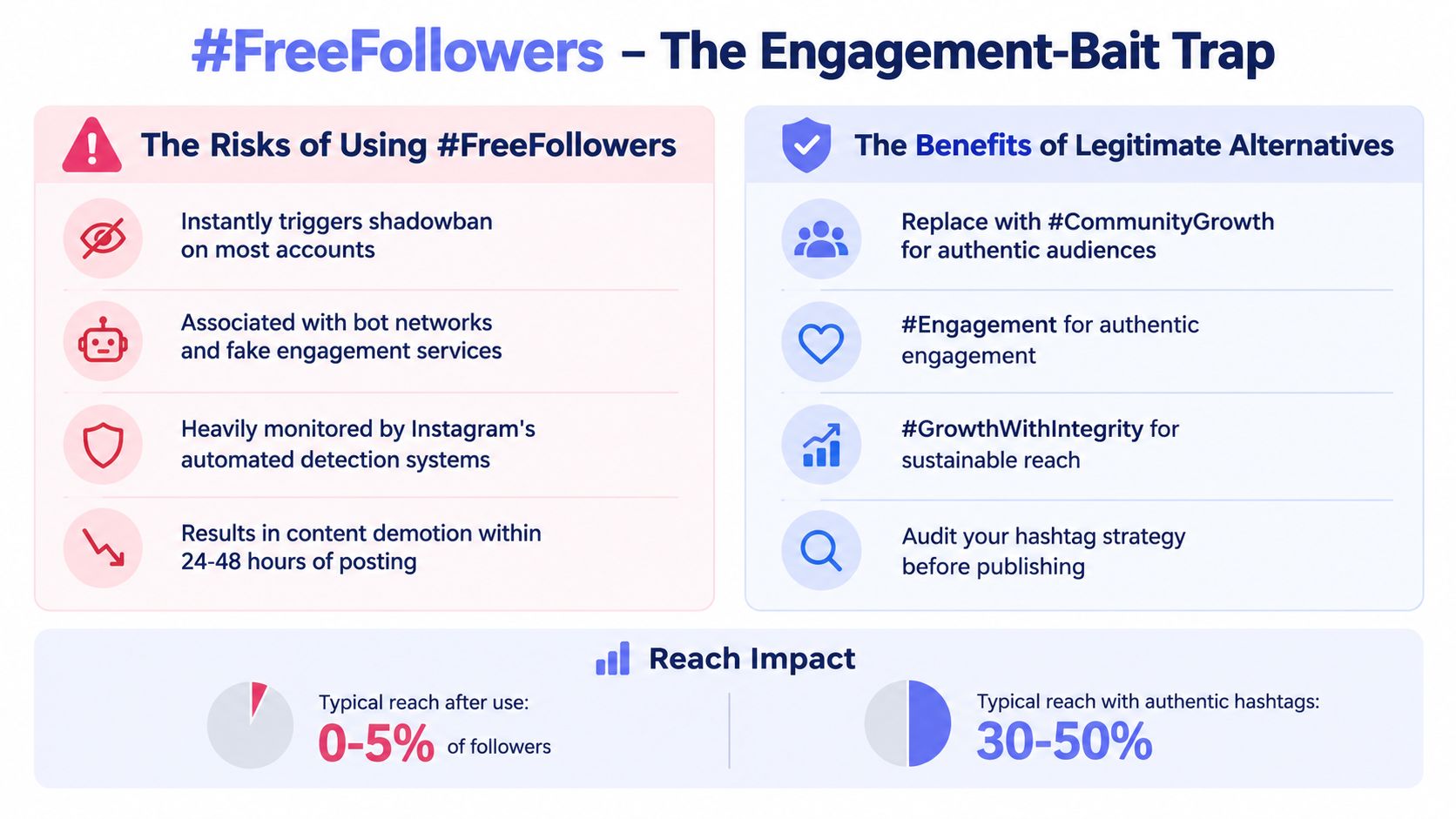 An infographic comparing the risks of using banned hashtags like #FreeFollowers versus using authentic hashtags on Instagram.
3. #LikeForLike and the Coordinated Engagement Trap
The problem with #LikeForLike isn't merely the spelling of the tag. It states an exchange condition. That makes it a poor fit for a publishing system that should help users attract genuine responses rather than manufacture a predictable interaction loop.
There's no verified basis here for claiming that Instagram uses a particular like-share threshold, applies an automatic suspension, or identifies every account through a specific timing pattern. Don't encode those assumptions into an analytics dashboard. Measure what you can observe instead.
A photography account using engagement pods may see a sudden spike from familiar profiles. A micro-influencer may publish the same exchange language across several posts. A brand might mistake reciprocal activity for evidence of campaign quality. Those patterns deserve review, but they don't prove that a hashtag alone caused reduced distribution.
Use a simple event model:
Log the complete set: Save the normalized hashtag list, caption, media type, account, and publication time.
Compare sources: Distinguish follower activity from non-follower reach and recommendation outcomes.
Flag repetition: Reused exchange language across automated batches deserves a human review.
Avoid automatic accusations: Label unusual reciprocity as an anomaly, not as proof of bots or a penalty.
Artificial engagement can inflate a report while weakening the signal you actually need, genuine audience interest.
A useful workflow can pause a suspicious batch for review, but a blanket “24-hour embargo” or a precise reciprocal-like threshold would be an invented policy. Rate limiting can protect your own system from accidental bursts, yet it can't guarantee Instagram will interpret a post favorably.
 A hand-drawn illustration depicting a social media user tracking, profile scrutiny, and potential account restrictions.
4. #Engagement and the Overly Broad Suppression Risk
#Engagement isn't verified here as a permanently banned hashtag. It's also too broad to carry much diagnostic meaning by itself. A post can underperform because the creative is weak, the audience isn't active, the recommendation system doesn't select it, the hashtag is restricted, or several factors interact. Calling that a “soft ban” without evidence turns a debugging problem into folklore.
Consider an agency post asking people to “drop an emoji,” a bot-generated motivational quote, and a specific B2B tutorial. They may all use the same broad tag, but their content quality and audience intent differ. A developer should test the post and its distribution surfaces, not infer a fixed reach ceiling from the hashtag name.
Older hashtag-count advice is especially unreliable. One third-party analysis reported the highest average reach around 20 to 30 hashtags, while another analysis of 18 million posts reported the strongest average reach around 20 hashtags. Those historical correlations don't prove that adding tags causes reach. Instagram guidance reported in late 2025 reduced the allowed number of hashtags on posts and Reels to five, making older volume tactics operationally obsolete. The analysis and its discussion of the changing limit should be read as period-specific evidence, not a universal rule.
For a cross-platform publisher:
Use platform-specific templates: Don't copy an Instagram tag set into LinkedIn or Threads.
Track post-level outcomes: Store the hashtag set beside reach and recommendation indicators.
Prefer relevance: A narrow subject tag is easier to interpret than a generic demand tag.
Test current constraints: Run comparable experiments within the rules that apply at publication time.
You can also use a practical hashtag strategy guide as a starting point, then validate the result against your own account data.
5. #Clickbait and the Credibility Problem
There's no verified evidence in the supplied sources that #Clickbait itself is a banned hashtag or that Instagram assigns an account-wide “trust score” because of it. The stronger, defensible point is editorial. A tag that openly signals sensational framing can make a post look less relevant to the person searching for a useful answer.
An ecommerce store might publish “This one trick will change your life.” A SaaS team might promise that competitors hate a simple automation. A fitness creator might tease an unbelievable transformation. The hashtag doesn't prove that the claim is misleading, but the combination creates a credibility risk for readers and a quality-review risk for your own workflow.
Build copy controls before you build hashtag controls:
Check claims against the source: Require evidence for performance statements and comparisons.
Reject unsupported superlatives: Flag “shocking,” “secret,” and “you won't believe” for review.
Measure outcomes beyond clicks: Compare qualified actions, saves, replies, and conversions where your analytics support them.
Keep platform experiments separate: A caption that performs on LinkedIn doesn't establish how Instagram will distribute it.
Don't use a hashtag validator as a substitute for honest copy. The caption and the tag need separate checks.
For Make.com or n8n, a caption template can require a source URL when it detects a claim pattern. An AI agent can draft alternatives, but a human or policy layer should decide whether the statement is supportable. The same approach works for product announcements, affiliate promotions, and educational posts.
 A conceptual illustration depicting censorship and age restrictions on LGBTQ+ content on social media platforms.
6. #Promo and the Compliance Flag
#Promo should not be classified as a confirmed permanent ban. Instagram enforcement evidence does not support automatically replacing it with another promotional hashtag. A safer system checks the post's commercial context, disclosure wording, and review status before publication.
An affiliate promotion, influencer collaboration, ecommerce sale, or agency post for a client can require different disclosure decisions. The hashtag alone does not establish compliance. The relationship between the parties, the wording, its placement, and the applicable jurisdiction all affect the correct treatment.
Before routing promotional content to review, check the FTC guidelines on influencer disclosure so the workflow checks wording and placement. Verify legal requirements against the official FTC source rather than relying on third-party summaries. Jurisdiction and relationship type determine which label is appropriate.
A pre-publish workflow can:
Detect commercial phrases: Flag “sponsored by,” “affiliate,” “paid partnership,” and discount-code language.
Require a disclosure field: Ask the publisher to confirm the commercial relationship before submission.
Preserve user intent: Do not automatically replace
#Promowith#Ador another tag.Record the decision: Store the caption version, approval state, account, and publication timestamp.
The API layer adds a separate failure mode. Meta documents hashtag search as a restricted Business feature. Hashtag search is available through the Instagram API with Facebook Login, while the Instagram API setup with Instagram Login does not list it as supported. The endpoint also uses Platform Rate Limiting, rather than the standard Instagram Business Use Case rate limit. A failed lookup therefore cannot prove that #Promo is permanently banned. Treat the result as an API or access error until the workflow confirms the enforcement state. Meta's hashtag reference provides the relevant endpoint details.
7. #Instagay and Age Gating Claims You Shouldn't Automate
#Instagay and identity-based hashtags shouldn't be labeled banned without current evidence. The supplied sources don't verify that this tag automatically loses a stated percentage of reach, disappears from Explore for all younger users, or receives a universal age-gated treatment. Those claims may resemble user reports, but they aren't safe engineering facts.
An LGBTQ+ creator sharing a coming-out story, a community organization publishing advocacy content, and a Pride campaign may all use identity tags for legitimate discovery. A checker that marks the hashtag “forbidden” can erase useful speech, especially when moderation systems already make contextual mistakes. The academic evaluation discussed earlier found that restricted hashtag mechanisms can misclassify legitimate and recovery-related material, so broad suppression needs careful measurement.
Test the actual distribution path:
Check search separately: See whether a post is visible from a non-following account.
Check recommendations separately: Compare available recommendation indicators with the account baseline.
Record unsupported contexts: Stories and consumer-account content may fall outside documented API access.
Offer human review: Don't remove an identity term just because an automated classifier is uncertain.
Meta's Public Content Access documentation says approved apps can use hashtag search for purposes such as discovering campaign content and measuring public sentiment. It requires successful App Review and business verification, and it documents endpoints including /ig-hashtag-search, /ig-hashtag, /ig-hashtag/recent-media, and /ig-hashtag/top-media. Meta's Public Content Access documentation also explains why consumer-app visibility doesn't guarantee programmatic access.
Meta's rejection guidance adds two important blind spots. Hashtag access through Public Content Access doesn't support hashtags used in Instagram Stories, and Instagram Graph API management is limited to Professional accounts, Businesses and Creators. The official rejection guidance says a no-result response should be marked unsupported or inconclusive in those contexts, not converted into a ban verdict.
7-Point Comparison: Banned Instagram Hashtags
Hashtag | Complexity to mitigate 🔄 | Resources required ⚡ | Expected outcomes 📊 | Severity / Account risk ⭐ | Key mitigation tip 💡 |
#FreeFollowers – The Engagement-Bait Trap | Medium–High: needs pre-publish blocklist + account monitoring | Moderate: hashtag microservice, publishing hooks, audit logs | Shadowban or removal; demotion within 24–48h; weeks to recover trust | ⭐⭐⭐⭐⭐ | Pre-publish hashtag verification; replace with authentic tags (#CommunityGrowth) |
#Follow4Follow – The Reciprocal Spam Marker | High: requires caption scanning, regex filters and policy enforcement | High: moderation workflows, manual-review handling, user warnings | Posts often removed within hours; manual review and possible suspension | ⭐⭐⭐⭐⭐ | Block reciprocal-follow patterns, warn users, enforce pre-flight checks |
#LikeForLike – The Coordinated-Engagement Trap | High: needs engagement-source tracking and anomaly detection | High: analytics, Insights API integration, alerting and rate limits | 30–60 day reach suppression or account suspension; long recovery | ⭐⭐⭐⭐⭐ | Track engagement sources, rate-limit coordinated posting, encourage organic tactics |
#Engagement – The Overly-Broad Shadowban | Low–Medium: swap hashtags and run A/B tests | Low: hashtag performance DB, A/B tooling, monitoring | Soft-ban: reach cut to ~5–15% (vs typical 30–50%) on Instagram | ⭐⭐⭐ | Use niche/mid-tier hashtags and maintain hashtag performance data |
#Clickbait – The Credibility Killer | Medium: requires copy-review/sentiment checks and templates | Moderate: headline heuristics, copy templates, publishing prompts | Account-wide trust damage; deprioritization; recovery ~4–6 weeks | ⭐⭐⭐⭐ | Flag sensational language pre-publish; replace with authentic messaging (#RealResults) |
#Promo – The Paid-Promotion Detector | Medium: build compliance-first publishing pipeline | Moderate: keyword detection, auto #Ad insertion, audit logs | Reach hit ~20–35%; manual review delays 1–4 hours unless properly disclosed | ⭐⭐⭐ | Enforce #Ad disclosure automatically; avoid using #Promo; log for audits |
#Instagay – The Age-Gated Content Suppression | Medium: requires platform-aware publishing and cross-post strategy | Moderate: analytics by tag, multi-platform publishing tools | Algorithmic age-gating reduces reach ~40–60%; limited Explore distribution | ⭐⭐⭐⭐ | Combine identity tags with broader community tags and cross-post to other platforms |
Build a Blocklist and Check Before You Publish
Don't maintain a list of seven names and assume the problem is solved. Maintain a dated blocklist with an enforcement type for every entry: hard ban, soft suppression, compliance flag, or age-gated distribution. Those labels are operational categories, not promises that Instagram exposes the same states through an API.
Run the check before every publication request in your script, n8n flow, Make.com scenario, REST integration, or MCP workflow. For bulk posting, run it again before each batch. A tag that passed last month may be restricted now, and a reusable AI prompt can spread one questionable tag across many accounts before anyone reviews the output.
A practical record should include:
Hashtag and normalized form: Store capitalization-independent text without losing the original display value.
Observed status: Record whether search showed results, warnings, limited content, or no discoverable post.
Test context: Save the account type, observer account, media type, timestamp, and market where relevant.
Publication outcome: Keep API success separate from hashtag-page discovery and recommendation reach.
Review decision: Mark the result as allowed, risky, blocked, unsupported, or inconclusive.
Verify every status against current official Meta and Instagram documentation before changing your production blocklist.
Don't treat a static third-party list as authoritative. Meta's documented access restrictions mean that a failed API request may reflect the wrong login product, missing business verification, App Review status, unsupported Stories data, or rate limiting. A checker should explain those possibilities instead of returning “banned” for every empty response.
Review hashtag-level reach at least monthly, using the same account baseline and post context. That won't reveal Instagram's internal decision process, but it gives you an auditable trail. PostPulse can sit in the publishing layer, while the validation logic remains yours and can work with any social tool.
PostPulse gives apps, n8n and Make.com workflows, and AI agents one REST API, official nodes, or an MCP server for publishing across nine platforms, with OAuth, token refresh, rate limits, and platform changes maintained for you. Put your hashtag validation and dated blocklist in front of that publishing layer, then visit PostPulse to connect the workflow without integrating every platform separately.
About the Author

Founder of PostPulse — a social media scheduling platform for creators and teams. Software engineer with a passion for building developer tools and simplifying complex API integrations across social media platforms.