MCP Server Hosting Explained: Options, Costs, and Trade-offs
Published on
Tags:
A token expires halfway through a publishing run. An Instagram carousel stays stuck at “in progress.” The agent retries, and suddenly the same article appears twice on one platform while another platform rejects the payload with an error nobody can reproduce. By the time someone checks the logs, the local MCP process has stopped because it was running on a developer's laptop.
That's the point where MCP server hosting stops being a deployment preference and becomes an operational decision. The hard part isn't making an MCP endpoint reachable. It's proving which identity may invoke which tool, keeping customer credentials isolated, and recovering cleanly when one of several downstream platforms fails.
Table of Contents
Why Hosting Your MCP Server Suddenly Matters
A local MCP server is a great way to validate an integration. One developer starts a process, connects an MCP-compatible client, lists the tools, and confirms that the basic workflow works. The trouble starts when somebody else needs the same capability. Their machine has different environment variables, a different OAuth state, a different version of the server, or no access to the private API at all.
The first workaround is usually harmless. Someone shares setup notes. Another person copies a local configuration. A third person runs the server from a laptop during a demo. Then refresh tokens begin expiring, agents retry requests after timeouts, and nobody can tell whether the failure happened in the MCP layer or in the downstream platform.
Publishing makes the situation less forgiving. An agent may submit a request, lose the connection before receiving the response, and retry what it believes was an unsuccessful operation. If the server has no idempotency mechanism, the retry can create a duplicate post. If nine destinations process the same request differently, a single success response cannot accurately represent the outcome.
Practical rule: A local server proves that a tool works. A hosted server must prove who used it, what it was allowed to do, and what happened after the request left your system.
Anthropic introduced the Model Context Protocol as an open standard on November 25, 2024, with a specification, software development kits, local server support in Claude Desktop, and an open-source collection of MCP servers (Anthropic's original MCP announcement). That history matters because the protocol was designed to replace separate application-specific integrations with a common interface.
A personal script can assume one user, one machine, and one credential context. A shared service can't. Once an MCP server brokers internal tools, social accounts, databases, or customer data, hosting becomes a question of identity, tenant isolation, availability, and partial-failure recovery. Bandwidth is usually the easy part.
What MCP Server Hosting Actually Is
MCP server hosting has two distinct layers. The first is the protocol layer, which defines how an MCP client discovers capabilities and communicates with a server. The server can expose tools, resources, and prompts, while the client handles the interaction through the protocol's message contract.
The second layer is the service an operator runs. That service contains your tool implementation, authentication checks, downstream API clients, logging, retry behavior, and deployment configuration. The protocol is like USB-C for AI clients and tools. Hosting is the physical port, the power supply, and the rack where the port operates reliably.
For local use, STDIO lets a client launch or connect to a process on the same machine. Credentials commonly come from the process environment, and the trust boundary is usually the developer's workstation. This is convenient for experiments and local development, but it doesn't give a team a shared, remotely reachable service.
A networked deployment uses Streamable HTTP or, where legacy clients require it, SSE. Streamable HTTP is the more suitable default for a remotely hosted service because it fits ordinary HTTPS infrastructure and can sit behind an identity-aware gateway. SSE may still matter for compatibility, but choosing it just because an older tutorial uses it can create avoidable connection and scaling constraints.
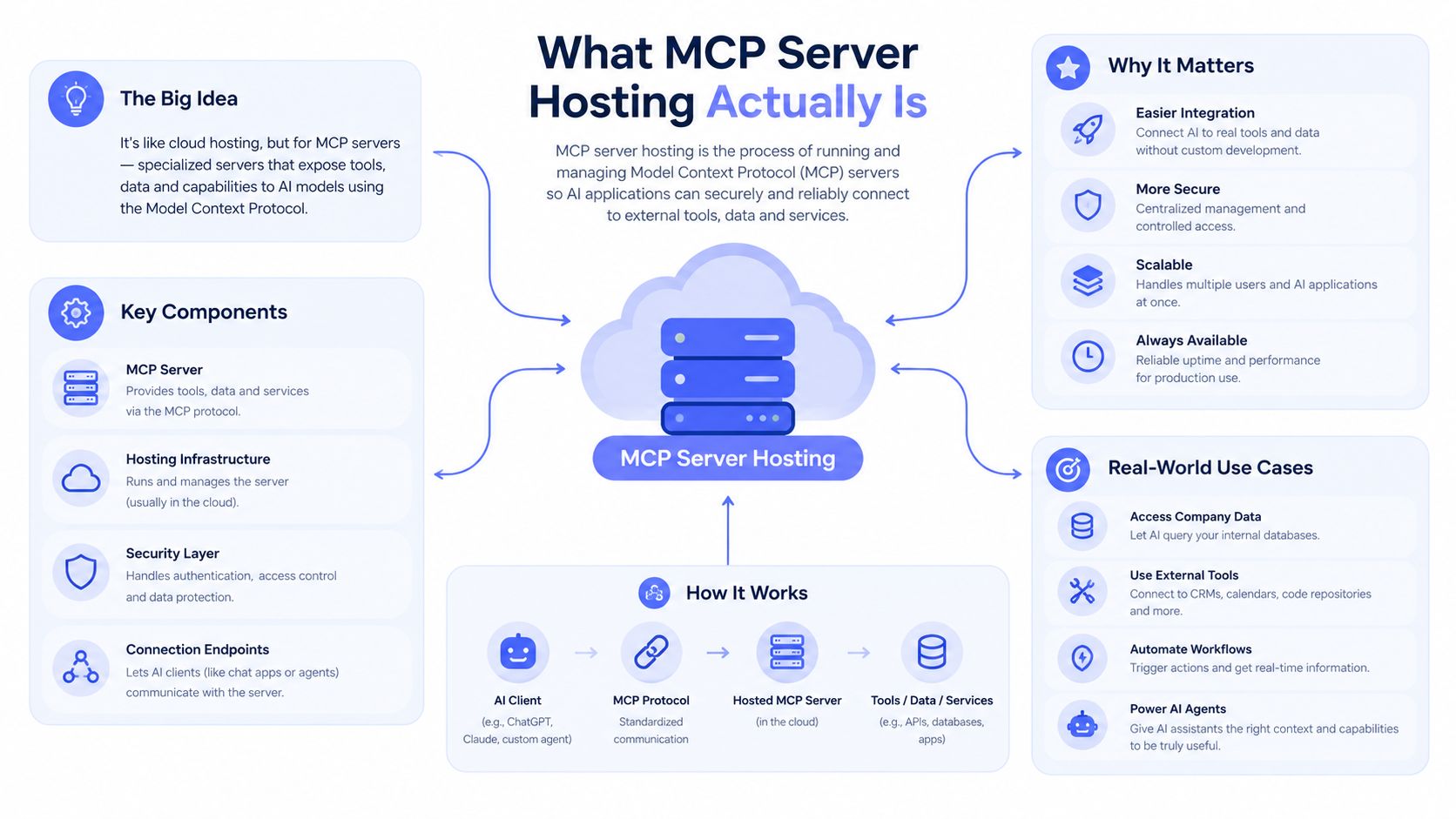 An infographic explaining MCP server hosting, showing its key components, benefits, workflow, and real-world applications for AI.
The protocol is not the whole service
Generic tool API hosting exposes HTTP endpoints. MCP hosting adds protocol-specific concerns such as tool discovery, capability negotiation, transport behavior, and session handling. The server also has to protect the meaning of its tool descriptions, because an agent may use those descriptions to decide what action to take.
The MCP server overview from PostPulse is useful background for separating the server's protocol role from the external systems it connects to. For a broader introduction to how teams can bridge AI tools with MCP, Writingmate provides a practical integration perspective.
A hosted MCP service therefore isn't just an API wrapper with a health check. It's an application tier that must authenticate callers, authorize individual tools, protect credentials, and report durable outcomes when downstream work is asynchronous.
Self-Hosted Versus Managed MCP Hosting
The self-hosted and managed options solve different problems. Self-hosting gives your team direct control over the runtime, network path, deployment process, and observability stack. Managed hosting removes much of that machinery, but you accept the provider's deployment model, supported transports, authentication boundaries, and limits on what you can inspect.
Axis | Self-Hosted | Managed |
Control | Full control over runtime, network, releases, and data placement | Provider controls much of the runtime and platform behavior |
Operations | Your team owns deployments, incidents, scaling, and upgrades | Provider handles more infrastructure operations |
Cost shape | Infrastructure and staff costs are relatively predictable | Usage-driven charges may vary with calls, seats, or execution |
Security responsibility | You own identity, secrets, isolation, logging, and patching | Provider carries platform responsibilities, while you still own application authorization |
Scaling | You plan capacity and operate the scaling mechanism | The platform may scale automatically within its service limits |
Auditability | You can inspect the full request and infrastructure path | You may receive platform logs without full underlying visibility |
Self-hosting is attractive when your organization already operates containers, gateways, secret managers, and incident response. It's also the better fit when you need unusual authorization logic or strict control over where sensitive data travels. The trade-off is that your MCP server joins the existing on-call burden. A container that looks cheap on paper still needs upgrades, alerting, credential rotation, and someone who can investigate a failed publish at an inconvenient hour.
Managed hosting is often sensible for a small team that needs a remote endpoint without building a platform around it. It's less attractive when the provider can't support your required transport, your compliance controls, or your latency budget. Convenience doesn't remove application-level responsibility. You still need to decide whether a caller may use a tool and whether the requested account belongs to that caller.
Choose according to the boundary you must control
Small teams without an on-call rotation should be cautious about taking on self-hosting for a workflow that can perform irreversible actions. Conversely, a regulated workload may need a level of auditability and custom authorization that a managed service can't provide.
The useful decision question isn't “Which option is cheaper?” It's which boundary must your team control directly. If that boundary is the infrastructure and data path, self-hosting may justify the operational cost. If it's getting a reliable integration into production without building another platform, managed hosting may be the more responsible choice.
Before deploying, map that decision to the server's actual responsibilities in this guide to building an MCP server. The implementation details determine whether a simple managed service is enough or whether you need a gateway, queue, worker tier, and dedicated authorization layer.
System Requirements and Deployment Patterns
The smallest useful deployment depends on what the server does. A lightweight tool that validates input and calls a fast API needs little compute. A publishing workflow that handles retries, media processing, OAuth refresh, and durable job state needs more room and benefits from separating request handling from background work.
For a low-throughput service, a single container with 1 vCPU and 1 GB of RAM can be a reasonable starting point. A publish-heavy service with retries and media transcoding should target 2 vCPU and 2 GB of RAM as an initial planning baseline. Those figures are starting points, not guarantees. Measure memory pressure, queue depth, response time, and downstream failures before increasing capacity.
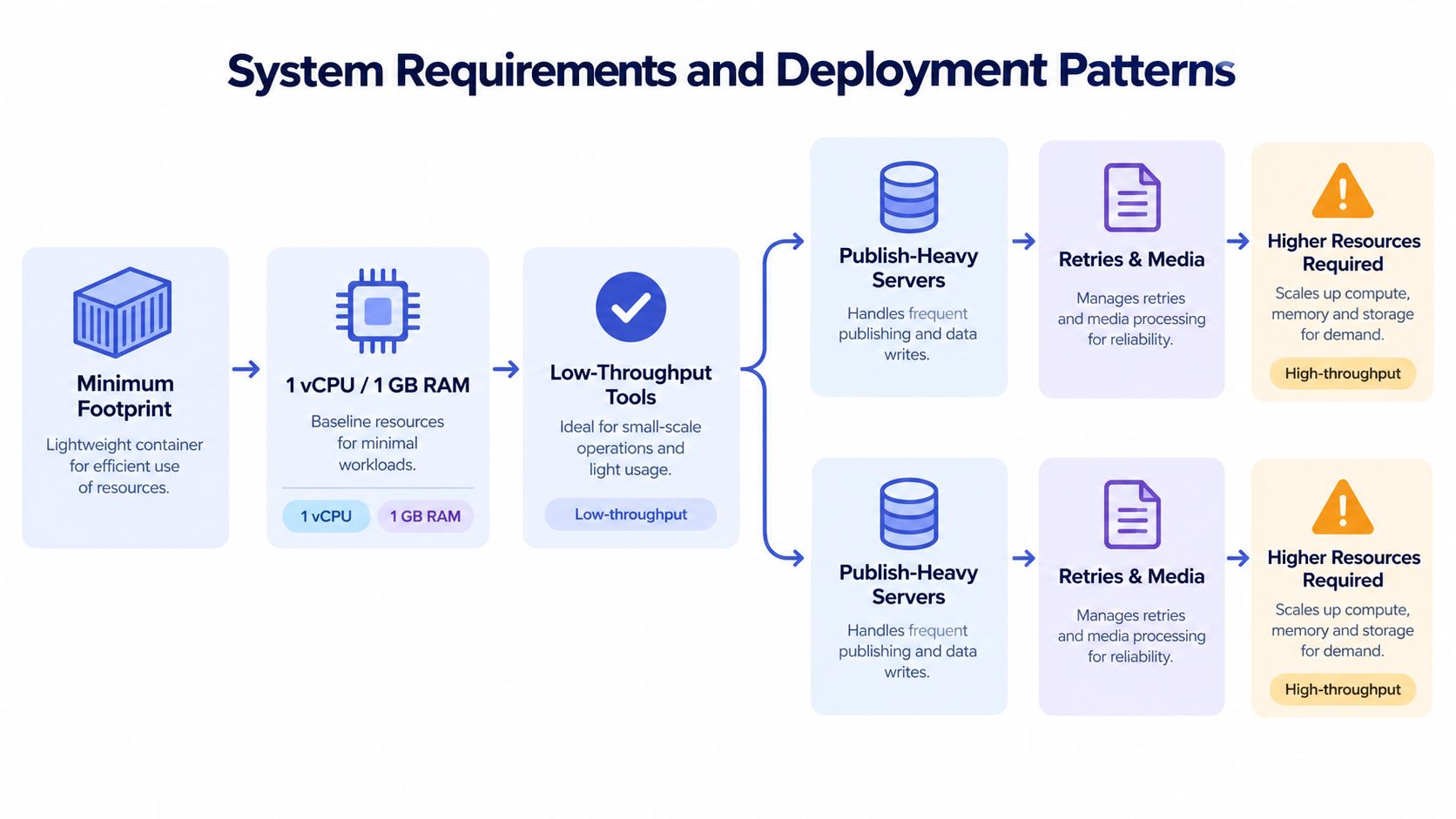 A diagram illustrating system requirements and deployment patterns for low-throughput tools and high-throughput server scaling.
Select the transport for the trust boundary
STDIO: Use it for local-only tooling and development. It's the wrong default when several users, agents, or services need a shared endpoint.
Streamable HTTP: Use it for remote clients, team access, and production traffic. Put it behind TLS termination and an identity-aware gateway.
SSE: Keep it for clients that require legacy compatibility. Don't choose it for a new deployment without confirming the client and hosting platform support the same connection model.
A solo builder can usually start with one Docker container behind a reverse proxy. The proxy handles TLS and basic gateway controls, while the container runs the MCP application. This arrangement is easy to understand and debug, but it becomes fragile when the same process also owns long-running publication jobs.
For multi-tenant traffic, use a deployment shape with a Kubernetes Deployment, a dedicated gateway such as Kong or Envoy, a queue, and workers. The gateway should be placed in front of the MCP endpoint, not between the MCP server and every downstream API. The MCP layer needs to apply caller and tenant policy before it invokes those APIs.
Configure health checks around meaningful readiness. A process that accepts TCP connections while its secret manager, queue, or required downstream dependencies are unavailable isn't ready to receive publishing work. Keep liveness focused on whether the process is functioning, and keep readiness focused on whether it can safely accept the class of requests you expose.
Scaling, Uptime, and Cost in Production
Production sizing fails when teams scale the wrong signal. CPU tells you that a process is busy, but it doesn't necessarily tell you that publication work is waiting. For an asynchronous publisher, queue depth, job age, and downstream response time are often more useful scaling signals than CPU alone.
A single-container deployment has a lower infrastructure footprint and a simpler failure model. A Kubernetes deployment with autoscaling introduces more moving parts, but it can separate stateless request handling from workers that process media and platform jobs. Managed MCP services can reduce infrastructure work further, though their pricing model may add a per-seat or per-call fee.
Deployment | Monthly Cost | Uptime Target | Ops Burden | Best Fit |
Single container | Lower fixed infrastructure cost | Set by your runtime and hosting arrangement | Low to moderate | Solo builders and low-throughput tools |
Managed Kubernetes | Higher baseline infrastructure cost | Defined through your platform and operating model | High | Multi-tenant services with platform expertise |
Managed MCP service | Usage-based or subscription pricing | Subject to the provider's service terms | Lower infrastructure burden | Teams prioritizing speed and reduced operations |
Treat 99.9% availability as an operational budget, not a marketing phrase. That target allows roughly 43 minutes of downtime per month, according to the standard availability calculation. For a tool that only answers questions, that may be acceptable. For an agent publishing across nine destinations, the more important question is whether the system preserves state and retries only the work that failed.
Authentication is another common source of production instability. For HTTP deployments, the MCP authorization model calls for HTTPS authorization endpoints, secure token storage, expiry and rotation, exact redirect validation, and inbound request validation (MCP authorization specification). Store refresh tokens in a secrets manager, never in logs or casually exposed environment values, and validate issuer, audience, expiry, and intended resource on every request.
Use idempotency keys for publish operations. Persist failed jobs in a dead-letter path rather than dropping them after a timeout. An SLA can provide escalation, availability commitments, and an agreed response process, but it won't fix an authorization bug or decide whether a duplicate post should be deleted.
PostPulse publishes through a hosted integration surface for applications, automations, and AI agents, with the available commercial details described on its pricing page. Whether you use that kind of service or operate your own stack, the design principle is the same: make authentication and job state explicit.
Treating the Server as a Policy-Enforcing Tier
A publishing MCP endpoint shouldn't be a thin proxy that forwards whatever an agent asks for. The server is the last trustworthy place to enforce who may invoke a tool, which account they may target, and whether the requested action is allowed.
That policy must use the authenticated principal, not an account identifier supplied by the agent. If a request says “publish to account A,” the server should first map the caller to its permitted social-account set. Only then should it invoke the platform client. Azure's MCP security guidance recommends audience-bound tokens, strict redirect matching, least-privilege RBAC, per-caller authorization, gateway rate limiting, and auditing (Microsoft's MCP security guidance).
Make retries safe
Agents retry for understandable reasons. A network connection closes, a downstream API takes too long, or the model decides that no confirmation means the action failed. For a read operation, a retry is usually harmless. For publishing, it can repeat an irreversible action.
Use an idempotency key derived from the logical publication request, not from an individual network attempt. Persist the request, the target platform, the target account, and the current status before dispatching the job. A worker can then recognize a repeated request and return the existing result instead of submitting another publication.
A single request to publish across nine networks must not produce a single vague success value. Store and return platform-level states such as queued, submitted, confirmed, or failed. If one platform succeeds and another times out, retry the failed destination only. Keep the original caption and media reference so recovery doesn't accidentally mutate the content.
Keep policy separate from execution
The request layer should validate identity, tool scope, tenant ownership, and idempotency. A queue should hold durable publication work. Workers should own platform-specific OAuth refresh, retry rules, media handling, and rate-limit behavior.
That separation is the difference between a demo and a service that survives a busy publishing window. PostPulse is one example of a hosted publishing surface that exposes platform-specific publishing through an MCP server while centralizing the surrounding account and platform concerns. The broader lesson applies to any implementation: agents should request an approved operation, not reinvent OAuth, quotas, retries, and account authorization inside every prompt-driven workflow.
The official Instagram publishing documentation describes a multi-step flow in which media must be publicly accessible, a container is created, status is checked separately, and the container expires if it isn't published within 24 hours. That is exactly the kind of downstream state machine the MCP server should represent instead of hiding behind a synchronous response.
YouTube has its own constraints. The official videos.insert documentation requires OAuth with an upload-capable scope, accepts video media types, supports files up to 256 GB, and documents an upload-method quota impact of 100 calls per day alongside a one-unit Video Uploads quota cost. A policy-enforcing server can expose a stable tool while keeping those platform-specific requirements out of the agent's control loop.
Picking the Right Path for Your Stack
There isn't one correct MCP hosting pattern. The right choice depends on the number of tenants, the sensitivity of the credentials, the amount of downstream work, and the boundary your team can operate consistently.
Team Profile | Recommended Path | Primary Trade-off | Isolation Boundary |
Solo builder | Small managed container or a Fly.io-style regional deployment | Lower operational effort, less infrastructure control | One application and its credentials |
Agency with multiple brands | Self-hosted Docker behind an identity-aware gateway | More control, more responsibility for upgrades and incidents | Per-client principal, account set, and secret |
SaaS product | Kubernetes with HPA and dedicated nodes | Stronger scaling and isolation, greater platform complexity | Tenant-aware request, queue, worker, and data boundaries |
Solo builders
A single client integration rarely needs a platform team. Start with a small managed container or regional deployment, use Streamable HTTP, and put authentication in front of the endpoint. Keep the tool surface narrow. If the workflow later gains asynchronous jobs, add durable state before adding more compute.
Agencies
An agency managing several brands needs explicit per-client credentials and account scoping. Self-hosted Docker behind a gateway can work well when the agency already operates its own infrastructure. Don't share one broad token across clients, and don't let an agent choose an arbitrary account identifier without a server-side authorization check.
SaaS products
A product embedding MCP into a multi-tenant data plane should treat the server as another production application tier. Kubernetes with horizontal pod autoscaling and dedicated nodes can provide a clearer boundary between request handling and worker execution, but only if the team can operate the platform. Scaling the pods won't solve a missing idempotency model or an unsafe credential store.
Before deploying, answer one diagnostic question: How does the server identify itself to each upstream system, and what's the blast radius if one tenant's credentials leak? If the answer is vague, the architecture is still a hobby container, regardless of whether it runs on a cluster.
PostPulse provides a hosted MCP server for AI agents and automations, alongside publishing access for apps through its API, n8n, and Make.com integrations. If you want to keep OAuth handling, platform-specific retries, and multi-network publishing outside your own MCP infrastructure, visit PostPulse and evaluate whether its hosted approach fits your isolation and operational requirements.
About the Author

Founder of PostPulse — a social media scheduling platform for creators and teams. Software engineer with a passion for building developer tools and simplifying complex API integrations across social media platforms.