
Rate Limiting Best Practices for Modern APIs
Published on · Updated on
Tags:
Your integration passes every test, then production traffic picks up and the API starts returning 429 Too Many Requests. A social publishing workflow stalls halfway through, a scheduled job retries every request at once, and suddenly you're debugging a failure that never appeared locally. The worst part isn't the error itself. It's discovering that your client had no idea how close it was to the limit.
Rate limiting best practices are less about blocking traffic and more about coordinating capacity between providers and consumers. A provider needs to protect shared infrastructure, prevent abuse, and give tenants fair access. A consumer needs clear signals, disciplined retries, and enough observability to slow down before a hard failure interrupts a workflow. The durable solutions handle both sides.
Table of Contents
Why Your API Calls Keep Failing at the Worst Time
A rate limit usually stays invisible while traffic is low. Your test account makes a few calls, each response succeeds, and the integration appears reliable. Production changes the conditions. Several workers may process the same queue, multiple users may trigger the same endpoint, and a scheduled batch can create a burst that looks very different from normal interactive traffic.
The server isn't necessarily broken when it returns 429. HTTP 429 Too Many Requests means the client has exceeded an allowed request rate, and the response may include Retry-After, which tells the client how long to wait before trying again. That makes the response recoverable, provided the client pauses instead of immediately sending the same request again. MDN's HTTP 429 reference provides the standards-oriented explanation of that behavior.
Production reality: A 429 often means your integration needs better coordination, not that the provider is unavailable.
The failure becomes more severe when every worker handles the response independently. One worker retries immediately. Another retries after a fixed delay. A third starts a new batch while the first two are still retrying. Those calls collide at the same limit, producing a synchronized retry storm that creates more rejected traffic and obscures the original capacity problem.
Why simple tutorials fall short
Many implementation guides stop at “catch 429 and retry.” That advice misses the operational details that determine whether a client recovers or makes the incident worse. The client must read the server's timing signal, apply backoff when necessary, avoid retrying unsafe writes blindly, and expose enough telemetry for operators to understand which consumer and route are consuming capacity.
The provider also has responsibilities. A generic server error hides whether the client should retry. A limit that exists only in undocumented infrastructure forces every consumer to discover it through failure. A useful starting point is the developer rate limit guide, which gives developers context for understanding limits as part of normal API integration rather than as an exceptional surprise.
Rate limiting also isn't only a security control. It protects downstream databases, queues, third-party services, and shared compute. A client that consumes every available slot can make a platform unreliable for smaller or less active tenants. That's why the strongest designs combine enforcement with fairness, transparent headers, and client behavior that spreads work over time.
Choosing the Right Rate Limiting Algorithm
A request spike can expose a poor algorithm before application code shows any fault. Fixed windows are easy to explain, yet they allow an awkward burst when one window closes and the next begins. A token bucket permits controlled bursts while enforcing an average rate. A sliding window evaluates recent traffic more smoothly. A leaky bucket converts incoming work into a steady processing flow, which suits downstream systems that need predictable pressure.
Match the algorithm to traffic shape
Algorithm | Best For | Trade-offs |
Token bucket | Bursty traffic that should be accepted within a bounded capacity | Allows bursts, but requires careful bucket sizing and shared-state coordination |
Sliding window | More even and precise enforcement across a rolling period | Produces fairer decisions, but usually needs more state and computation |
Fixed window | Simple policies and straightforward implementations | Window boundaries can permit sudden bursts |
Leaky bucket | Workloads that need a steady processing rate | Smooths traffic well, but can add queueing and may reject excess work when capacity is full |
For bursty traffic, token bucket and sliding window are practical defaults. The token bucket lets a client spend accumulated capacity without allowing unlimited sustained traffic. The sliding window avoids the sharp reset behavior of a fixed window, so it fits shared capacity where clients must compete fairly. Default to the token bucket when bursts are acceptable and to the sliding window when clients compete for shared capacity. API Scout's rate-limiting guidance recommends token-bucket or sliding-window approaches for bursty traffic.
The algorithm is only half the decision. Client identity determines who receives the available capacity. A stable API key, account identifier, tenant identifier, or authenticated principal usually gives the limiter a better subject than a network address. IP enforcement can group unrelated users behind one shared network, while addresses may change frequently. Use IP signals for abuse detection, not as the sole identity for ordinary quotas.
Centralize decisions across instances
An in-memory counter is accurate only when the receiving instance owns the complete view of a client's usage. In a multi-instance API, each node can see usage below the limit while the fleet collectively exceeds it. A shared store such as Redis provides a common counter and decision point. Centralized counters also introduce a dependency, so define behavior for latency, store failures, and stale state instead of treating the backend as invisible plumbing.
A practical build order is:
Choose a stable client key. Decide whether the policy applies to a tenant, user, token, API key, route, or combination.
Study traffic shape. Select burst-friendly or smoothing behavior from actual request patterns.
Store shared state centrally. Use a shared backend when multiple instances enforce one policy.
Separate expensive operations. A search, upload, or write may need a different quota from a lightweight read.
Return actionable headers. Tell clients what they have used and how to respond when capacity is exhausted.
Headers are part of the algorithm's operational interface. Without remaining-capacity and reset information, clients discover quotas through failures and can synchronize retries around the same boundary. Clear signals let client libraries schedule work before a 429 appears, which reduces retry storms and gives observability systems a usable record of capacity pressure.
The server should reject excess traffic with 429 and provide a retry signal rather than dropping calls or disguising throttling as an unrelated server error. RFC 6585 formally defined 429 for this purpose, and the API rate-limiting pattern reference explains why Retry-After gives clients the timing information needed to avoid synchronized retries.
Building Resilient Client-Side Retry Logic
A client receiving 429 has one immediate job: stop adding pressure. The response can include Retry-After as a number of seconds or as a date. Parse that value, wait for the specified period, and only then consider another attempt. Treating 429 as an ordinary exception and immediately rerunning the request is how a manageable limit turns into a retry storm.
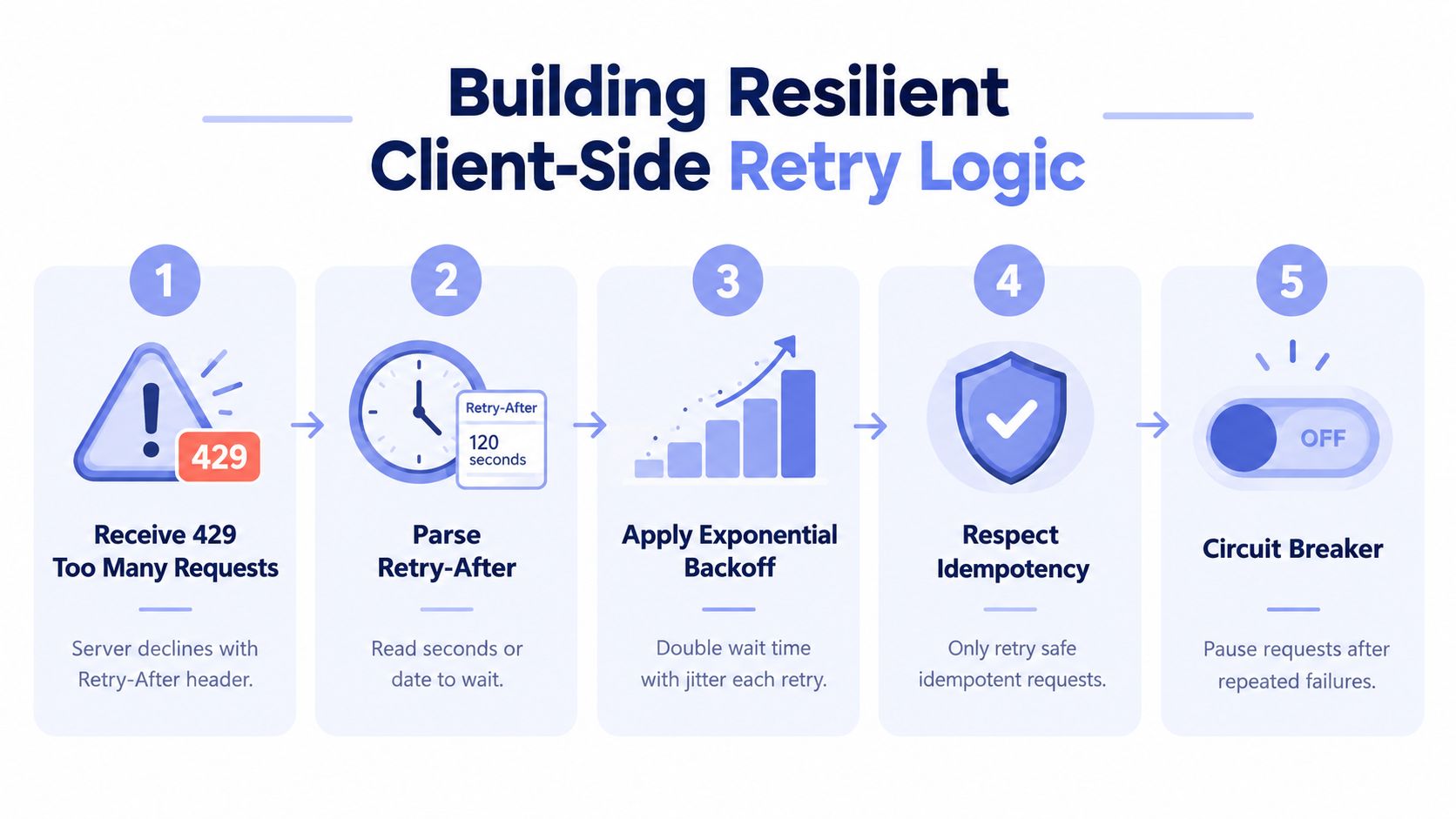 A five-step infographic explaining how to build resilient client-side retry logic for API rate limiting.
Respect the server before calculating your own delay
The retry order should be explicit:
Read
Retry-Afterfirst. If the provider supplies a delay, use it rather than guessing.Support both formats. A value may express seconds or a calendar date, so the parser needs to handle both.
Apply a safety floor. Protect against malformed, negative, or unexpectedly small values.
Use exponential backoff when no signal exists. Increase the delay after each rate-limit response instead of repeating at a constant interval.
Add jitter. Randomize the final wait so many clients don't wake up together.
Google Cloud guidance recommends a retry loop with exponential backoff when a quota is reached, with enough time for the quota bucket to refill. The Google Cloud-related 429 guidance explains that the wait should account for quota recovery rather than merely inserting an arbitrary pause. Google's quota documentation also describes progressively increasing wait times up to a maximum backoff time as the standard strategy for network applications. Cloudflare's 429 documentation documents that exponential backoff pattern.
A retry wrapper therefore calculates a server-directed delay when available. Otherwise, it derives a growing delay from the attempt number and adds random jitter. It should also record the attempt, endpoint, response status, selected delay, and eventual outcome. Without those fields, an operator can see failures but can't tell whether the client respected the provider's instructions.
Retry only work that can safely run again
Backoff doesn't make every request safe to repeat. A read is generally easier to retry than a write, but even a write can have side effects before the response reaches the client. Use idempotency controls where the API supports them, or design the operation so the server can recognize a duplicate request. Don't automatically replay a publication, payment-like action, or state transition just because the network response was ambiguous.
The retry policy also needs an exit. Persistent 429 responses should move the job to a delayed queue, open a circuit breaker, or surface a clear failure to the caller. A circuit breaker prevents a failing dependency from consuming every worker and gives the system time to recover.
For integrations spanning several providers, a shared abstraction can keep this behavior consistent. PostPulse's API rate-limit article is relevant when a publishing workflow needs one place to manage provider-specific responses rather than duplicating retry rules across every platform adapter.
Communicating Limits Before They Break Things
A publishing queue can look healthy until a provider starts returning 429 responses during a traffic spike. By then, the client has already missed its chance to defer background work, slow intake, or warn the user. An API that communicates limits only through errors forces consumers to discover policy through failure. A better contract exposes usage on successful responses too, giving clients time to adjust while work is still progressing.
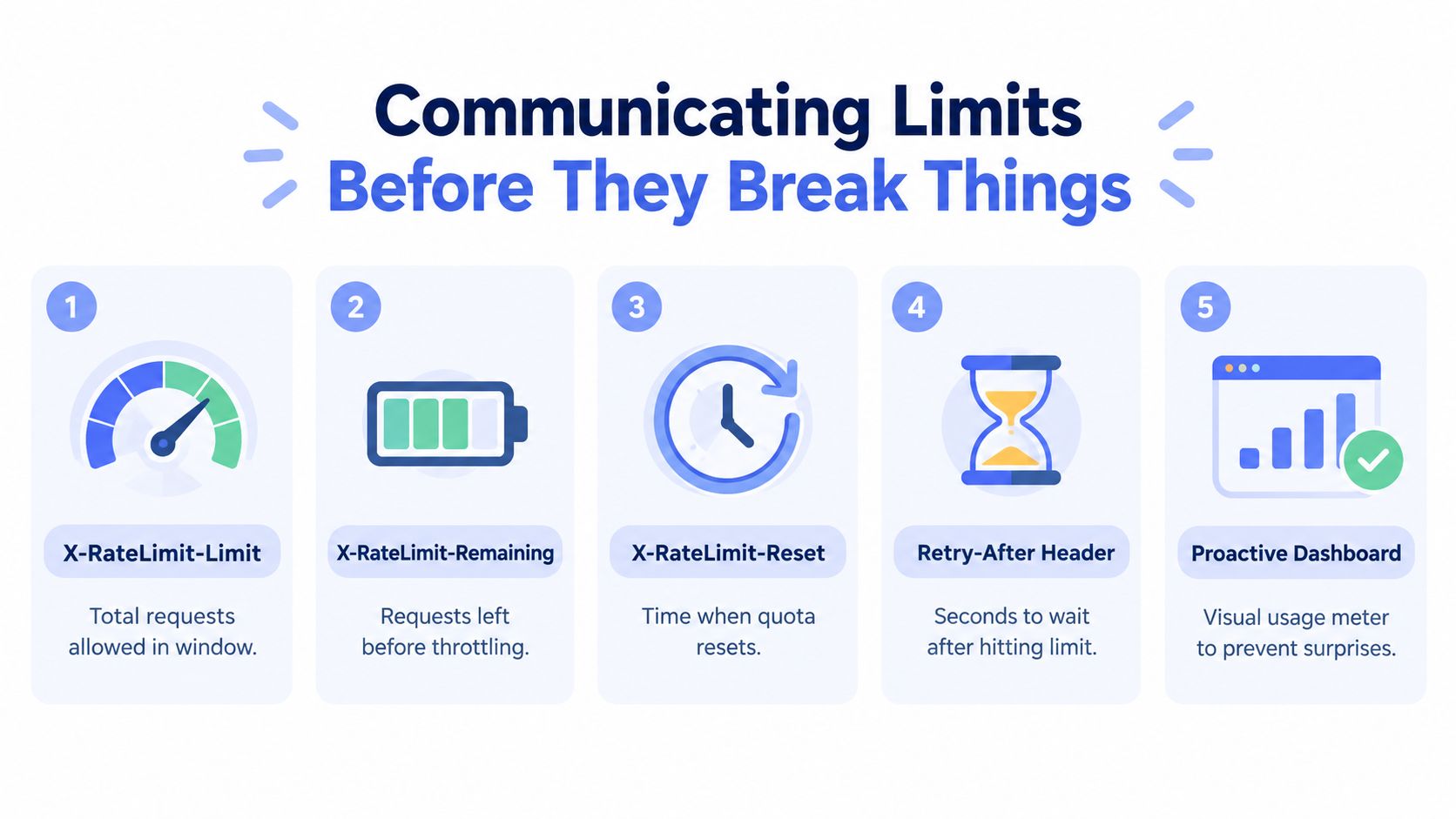 A diagram outlining five best practices for communicating API rate limits to users before errors occur.
Make the headers useful
Three headers provide the basic client-facing picture:
X-RateLimit-Limittells the consumer the configured allowance for the relevant policy.X-RateLimit-Remainingshows how much capacity remains in the current period.Retry-Aftertells the consumer how long to wait after the server rejects a request.
Many APIs also expose X-RateLimit-Reset, which indicates when the current quota period resets. Document whether that value is a timestamp or a duration, because clients handle those units differently. The exact meaning and units need clear specification, and the API documentation best practices guide covers how to define these details for consumers. API7's rate-limiting guidance also describes using rate-limit headers to guide client behavior.
Return limit and remaining values on successful responses whenever the policy allows it. A worker can pause background synchronization before the allowance reaches zero. A dashboard can show which tenant or route is approaching its ceiling, while a client library can adjust queue intake without waiting for an exception.
Turn headers into operational signals
Header visibility has value only when systems act on it. Capture the values in client telemetry, grouped by consumer, route, provider, and operation type. Alert when usage reaches about 80% of quota, then investigate sustained growth before users encounter hard failures. Treat that threshold as an operational trigger, not a promise that every client will receive the same warning window.
A useful dashboard should answer practical questions:
Who is close to the limit? Identify the tenant, API key, or user.
Which route consumes capacity? Separate reads, writes, searches, and media operations.
Are clients backing off? Compare 429 responses with retry attempts and retry delays.
Is a downstream service saturated? A local quota can hide pressure in a dependency.
Is the limit too strict? Look for legitimate work repeatedly queued or rejected.
Operational rule: Queue non-critical work before the hard limit, and reserve capacity for user-visible or recovery operations.
The response body should explain the condition without exposing internal implementation details. Include a stable error type, the affected policy when appropriate, and the expected recovery signal. Clear documentation lets client libraries, dashboards, and PostPulse-style provider abstractions respond consistently instead of turning every provider's quota behavior into a separate production incident.
Designing Fair Limits for Multi-Tenant Systems
A single quota per IP or API key treats unlike workloads as if they cost the same. That's a poor fit for a multi-tenant API where one request might be a cheap read and another might trigger heavy computation, multiple downstream calls, or a long-running media operation. A tenant that sends frequent lightweight requests can also crowd out a smaller tenant if the platform only enforces one global cap.
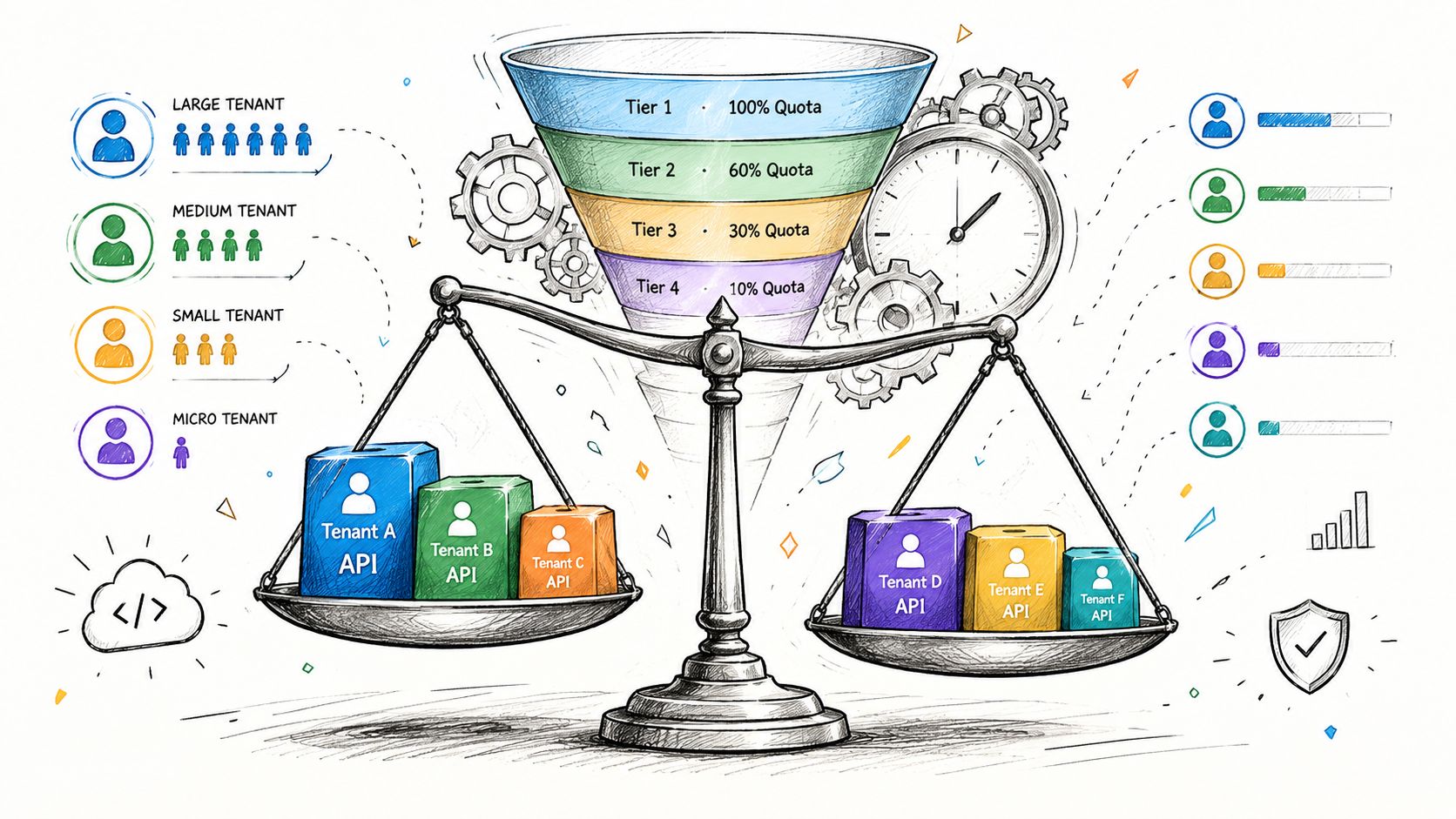 A conceptual illustration of multi-tenant API rate limiting, showing tiered quotas and balanced resource allocation.
Use layers instead of one blunt gate
Fairness starts with separate enforcement points:
Edge layer: Absorb obvious floods and reject traffic before it reaches application workers.
Application layer: Apply tenant, user, route, and operation policies where identity and cost are known.
Shared-state layer: Coordinate decisions across instances and protect globally scarce resources.
Downstream layer: Slow or reject work when a database, queue, or external provider approaches saturation.
Layering doesn't mean multiplying arbitrary restrictions. Each layer should have a clear responsibility and telemetry that explains which policy made the decision. A request rejected at the edge needs a different response from one delayed because a downstream publishing provider is saturated.
Weight cost and criticality
Cost-aware limiting assigns more capacity consumption to expensive operations than to cheap ones. The exact weights should come from measured resource use and service objectives, not intuition. A platform can also reserve capacity for critical tenant operations or user-facing paths while placing bulk exports and background synchronization into a lower-priority queue.
This approach protects small tenants without pretending every tenant has identical needs. It also gives operators more control during incidents. If a downstream dependency slows, the system can reduce costly operations first while preserving essential reads or carefully selected writes.
Let SLOs influence throttling
Rate limits should protect the service level users experience. Monitor latency, error rates, queue depth, and dependency health alongside request volume. If latency rises while the request count remains within a nominal quota, the quota may be too generous for current capacity. If the service is healthy but a tenant repeatedly encounters rejections, the policy may be too narrow or the client may be producing avoidable bursts.
The fairness-focused discussion of API rate limiting highlights why layered, weighted policies are more appropriate for mixed workloads than a single global cap. Adjust limits from traffic patterns and error trends, while keeping the policy understandable enough for consumers to predict their behavior.
Letting PostPulse Handle the Rate Limit Headaches
Building this infrastructure yourself makes sense when rate limiting is part of your product's core control plane, when you own the dependencies, or when your compliance model requires every decision to remain inside your system. It becomes a different calculation when your application must coordinate OAuth refreshes, provider-specific quotas, publishing queues, response headers, and API version changes across several social networks.
PostPulse provides one publishing surface for Instagram, TikTok, YouTube, LinkedIn, X, Threads, Bluesky, Facebook, Telegram, and Pinterest. Its unified REST API, official n8n and Make.com integrations, and MCP server let an app, automation, or AI agent send publishing work through one integration instead of maintaining a separate adapter and retry policy for each platform. The PostPulse integration guides are the practical starting point for choosing that connection model.
Decide what belongs in your stack
Delegation is useful when your team would otherwise maintain:
OAuth and refresh handling, including provider-specific token lifecycles.
Per-platform queues, so one provider's limit doesn't stall every destination.
Backoff and quota checks, including server-directed retry timing.
Version-change maintenance, when providers alter their API behavior.
A consistent developer interface, so your product code doesn't expose nine different publishing models.
PostPulse's private-label options include pay-as-you-go publishing at $0.20 per publication or a subscription at $5 per account per month, according to the publisher's pricing information. A white-label setup adds a $200 per month platform fee plus $1 per active social account, with connected but idle accounts excluded from the active-account charge. Those costs should be compared with engineering time, operational ownership, support burden, and the risk of implementing each provider's edge cases independently.
The abstraction doesn't remove the need for good product behavior. Your application should still queue non-urgent work, show users meaningful status, and record provider outcomes. It does move the provider-specific rate-limit mechanics into a service designed to maintain those integrations, which can be a sensible trade when social publishing is a feature rather than the product itself.
PostPulse gives apps, automations, and AI agents one API for publishing across ten social platforms while handling OAuth, refresh cycles, rate limits, and provider changes. Visit PostPulse to connect your publishing workflow through the REST API, n8n, Make.com, or MCP, and spend your engineering time on the product instead of retry storms.
About the Author

Founder of PostPulse — a social media scheduling platform for creators and teams. Software engineer with a passion for building developer tools and simplifying complex API integrations across social media platforms.