
How to White Label Products Without Burning Your Brand
Published on
Tags:
You've got a product idea, a willing audience, and a growing sense that the hard part isn't the offer, it's everything between the offer and a launch that holds together. The first version of how to white label products usually dies in that gap, where supplier email chains stall, contracts leave de-branding unclear, or the API side breaks because a token expired at the wrong time. White labeling works when you treat it as two jobs at once, physical sourcing and technical integration, then manage both with the same discipline.
Table of Contents
The Real Problem With Most White Label Guides
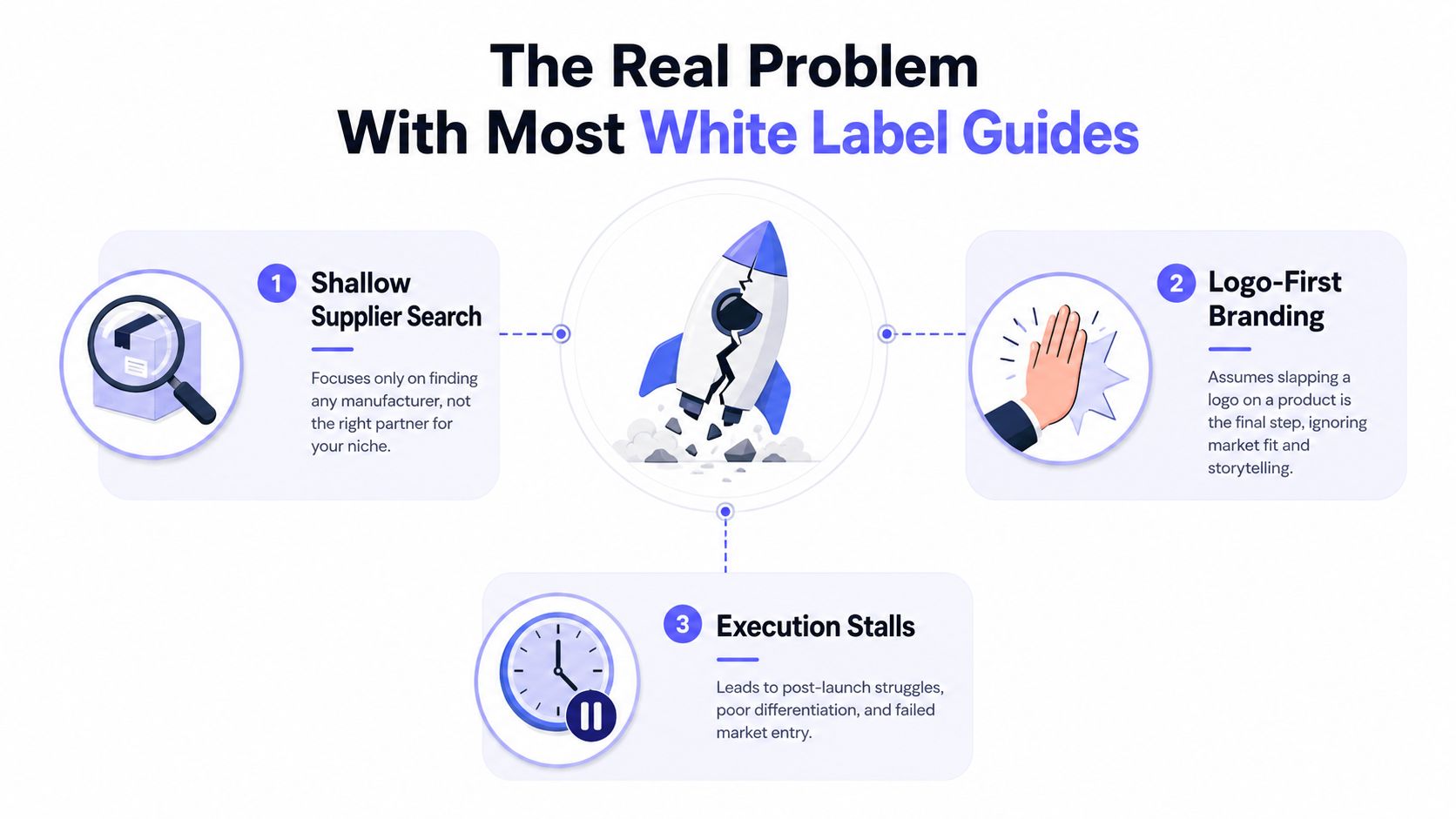 A graphic showing three common pitfalls when starting a white label business including supplier and branding errors.
Most guides reduce white labeling to “find a supplier, add a logo, ship it.” That's why so many launches look productive on paper and feel stuck in real life. The work is usually split across two tracks, physical product sourcing and software or API integration, and both can fail for boring reasons like weak supplier vetting, identity handoff mistakes, or a token flow that isn't designed for retries.
White labeling itself is simple at the core. One company makes or provides the product or service, another company rebrands and sells it under its own name, whether that's a physical item or a software platform (Shopify's overview of white label business models). The problem is that a simple model still needs a serious operating plan.
Practical rule: don't start with branding decisions. Start with the bottleneck that can kill the launch first, demand, supplier quality, contract scope, or auth flow.
A workable playbook usually follows the same order. Validate demand, shortlist the right suppliers or platform partners, lock down branding and compliance, price the offer with real margin math, and design onboarding so customers don't have to think about the plumbing. For software-heavy offers, the launch also needs a clean identity model, token handling, and a support path that doesn't collapse the first time a user reconnects an account.
If you're trying to decide whether your project is sourcing-heavy, integration-heavy, or both, the answer is usually in the customer experience. A skincare line needs packaging, claims, and production control. A social publishing layer needs OAuth, brand surfaces, and error handling. The best starting point is to map the failure mode before you order inventory or write code, which is exactly why what is white label software matters as context before you touch the build.
Validating Demand and Shortlisting Suppliers
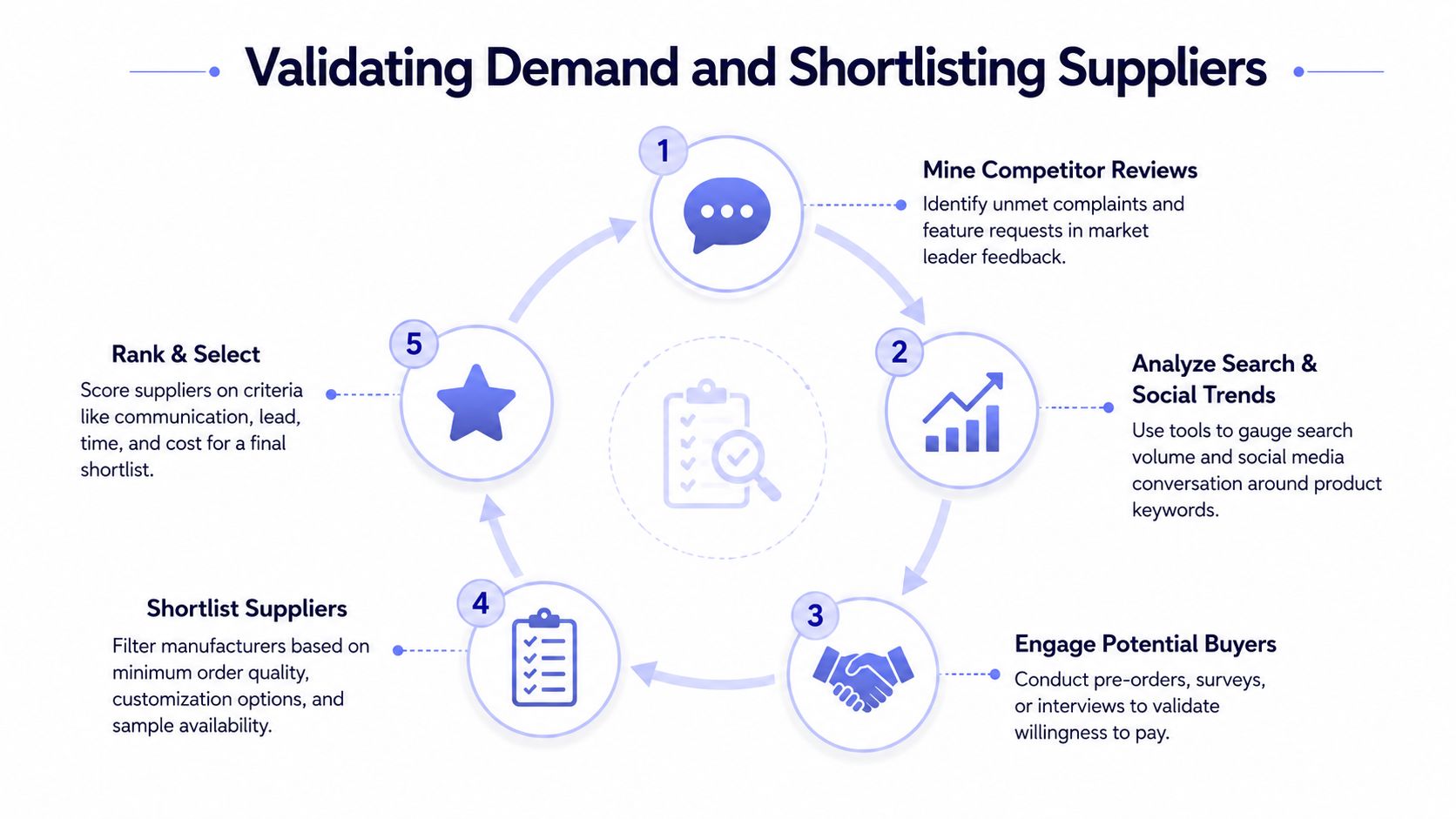 A cyclical process diagram illustrating five steps to validate demand and shortlist suppliers for businesses.
The strongest white-label launches usually start before anyone debates packaging, label colors, or supplier logos. Start by looking for repeated complaints in competitor reviews, scanning forums for buying intent, and putting up a simple landing page to see whether people will raise their hand before you commit to inventory or a platform build. That validation-first approach lines up with startup idea validation methods, which matters because a lot of founders think they are choosing a supplier when they are still proving whether the market wants the offer at all.
A buyer-facing test beats a supplier deck
I've seen teams spend weeks on sample requests before they answer the only question that matters, who buys this, and why now. A landing page with a clear offer, a waitlist, or a pre-order signal will tell you more than polished supplier PDFs. For software, the same logic applies. A prototype against a few platform providers tells you whether the flow is viable before you argue about theme colors or dashboard layout.
Once demand looks real, the supplier shortlist gets much narrower. Industry guidance recommends requesting samples from 3-5 manufacturers, comparing quality, packaging, and texture, and calculating the true landed unit cost before you commit, because the factory quote is never the full story. Another sourcing workflow recommends sourcing 5-10 suppliers, ordering and comparing samples, and only placing the first order after the production sample matches the approved branded sample over roughly 8-12 weeks (Epic Sourcing's white-label product guide).
Don't accept a supplier just because they reply fast. Fast replies help, but bad packaging, vague MOQs, or weak quality control will cost you more than slow email ever will.
If the offer has any software layer, this is also the point to review integration guides for white-label launches. That check keeps the physical and technical sides aligned, so you do not approve a partner who looks good on paper but cannot support the user experience you plan to sell.
Small batches protect the launch
The first production run is where founders often get reckless. A small initial batch of about 200-500 units is commonly used to reduce inventory risk while demand and margins are still being tested. That is discipline, not hesitation. Small batches force you to validate sales velocity, refund rates, and fulfillment friction before the business gets trapped in dead stock.
For software white labeling, the equivalent is a limited beta. You can trial 2 or 3 platform providers, compare developer experience, and confirm that the user-facing surfaces can be rebranded the way your customers expect. If a provider cannot expose the surfaces your users see, the deal is not ready, no matter how polished the demo looks.
A simple shortlist usually comes down to four checks.
Quality fit: samples match the experience you promised.
Communication fit: the supplier answers clearly when something changes.
Cost fit: landed cost still leaves room for margin.
Launch fit: the provider can support the first batch or beta without drama.
The point is not to chase the perfect partner. It is to find the first partner that will not break your launch when demand starts to show up.
The Technical Layer APIs SDKs and Token Plumbing
White-label software lives or dies on plumbing people do not see. The logo swap is the easy part. The harder work is choosing whether you are integrating through a REST API, an SDK, or a no-code layer like n8n or Make.com, then making sure the auth path survives real users, not just test accounts. If a customer logs in at 9 a.m. and their publishing session dies at 10:05 because the token was not refreshed cleanly, the brand story you worked on stops mattering.
Auth flows need to survive bad timing
For social publishing, the common pattern is simple on paper and annoying in production. A user authenticates, an access token is issued, it expires, a refresh step should keep the session alive, and rate limits still have to be respected. That is why platform partners matter. You need to know who owns the verified apps, who handles OAuth, which surfaces can be rebranded, and where the system hands off if an auth step fails.
The operational question is not whether the API connects. It is whether you can connect once and keep that connection healthy without putting every platform quirk on your support team. That matters even more when platform policies and API versions change. If you are building this yourself, you are also taking on the maintenance for those changes, along with retry logic, webhook handling, and the error states that show up at the worst possible time.
Build around the customer journey, not the endpoint
A white-label implementation needs to map the full journey, from login to purchase to access to support. One practical guide recommends deciding what systems matter, what should sync, and how often, then testing the whole customer path so the experience does not break at the seam between your app and the provider's infrastructure. That is the part many teams skip. They test the API call, but not the customer experience that sits on top of it.
For a developer or product lead, the questions are straightforward:
Scope: which screens or surfaces are branded?
Identity: who owns the auth app and the refresh logic?
Reliability: what happens when a token expires or a webhook fails?
Support: who sees the error first, your team or the provider?
If the provider cannot explain token lifecycle and fallback behavior in plain language, the integration is not ready for a customer-facing launch.
One option in this space is PostPulse, which provides a social publishing layer that can sit behind your own brand and exposes the core workflow through API and automation tooling. The reason that matters here is operational simplicity. When a provider handles auth maintenance, rate limits, and platform changes, your team gets to focus on the experience your users touch instead of rebuilding connector logic every quarter.
For a more tactical take on the wiring, integration guides are useful because they force the same questions you should ask any platform partner before you sign.
Pricing Models That Actually Fit White Label Offers
Pricing white-label offers is harder than pricing a normal product because you're pricing two things at once, your margin and your customer's operating economics. If the model is too flat, you eat usage spikes. If it's too variable, customers struggle to forecast spend. The right structure usually depends on whether value comes from volume, connected accounts, or a platform relationship that sits underneath both.
Three pricing shapes show up most often
A pure pay-as-you-go model works when usage is occasional. A per-account subscription is cleaner when customers connect a stable number of accounts and expect predictable monthly billing. A platform fee plus active-account fee makes sense when many accounts may be connected, but only a subset are actively publishing during a given billing cycle.
Model | Example Pricing | Best Fit |
Pay-as-you-go | $0.20 per publication | Customers post occasionally and want variable spend |
Per-account subscription | $5 per account per month | Customers post regularly and want simple forecasting |
Platform fee plus active account | $200/month platform fee plus $1 per active account | Customers connect many accounts, but only some publish each month |
The active-account rule needs to be strict. Only count an account as active if it published at least one post during that billing cycle. That keeps the pricing tied to actual usage instead of idle connections, and it avoids punishing customers who connect accounts early but don't launch every profile on day one.
Choose the model from buyer behavior, not from your cost sheet
The three structures map to different buying motions. Occasional posters care most about low commitment. Agencies and teams with predictable publishing cadence usually prefer the per-account subscription because it's easy to explain internally. Larger customers with sprawling account graphs often tolerate the hybrid platform-plus-active model because it tracks value delivered more closely.
The best packaging is the one a buyer can understand without a sales call. If your offer is usage-heavy, keep the unit visible. If it's account-heavy, keep the math boring. If it's platform-heavy, separate the base fee from the variable component so finance can approve it quickly. That simplicity matters more than clever bundle names.
A lot of white-label pricing fails because the founder anchors on what competitors charge instead of what the customer is trying to forecast. Price the model around the customer's usage pattern, then protect your own margin with clear definitions.
Legal and Compliance Traps Most Guides Skip
White-label deals often break after launch, not before. The usual failure isn't that the product never worked. It's that a label claim was too broad, a disclosure was missing, a packaging tweak violated category rules, or a contract left no clean path to de-branding when the relationship ended. Mainstream guides tend to mention compliance in passing, but that's exactly where the expensive mistakes live (Inflow Inventory's white label overview).
Physical products need category-specific review
For physical goods, the questions are boring but critical. What claims are allowed in this category? Which country-specific labeling rules apply? Who is responsible for tax registration once you're the brand of record? Are supplier certificates current, and do they still match the version of the product you're selling?
Those questions change by category and market, so a generic checklist isn't enough. You want your lawyer or compliance reviewer to look at the exact product, packaging, and sales channel before launch. If the supplier's paperwork is stale or the packaging language drifts from what the market allows, the problem usually shows up after the first order is already in circulation.
Contracts need a clean exit path
For software and service white-label deals, the contract is just as important as the code. It should define the exact scope of what gets rebranded, which customer-facing surfaces are included or excluded, what brands or entities are covered, where the offer can be sold, and what support means operationally. It should also spell out IP and licensing boundaries, quality or acceptance criteria, escalation paths, commercial terms, and termination plus de-branding behavior (AI Lawyer's white-label agreement guide)).
Red flag: if the contract doesn't say how de-branding works on exit, you're not buying a flexible partnership, you're buying a future cleanup project.
A simple pre-sign checklist helps. Ask who owns customer data flow, who approves branding changes, what happens when a supplier or platform is acquired, and how fast you can remove the provider's branding if the relationship ends. If the answers feel vague, the deal is still incomplete.
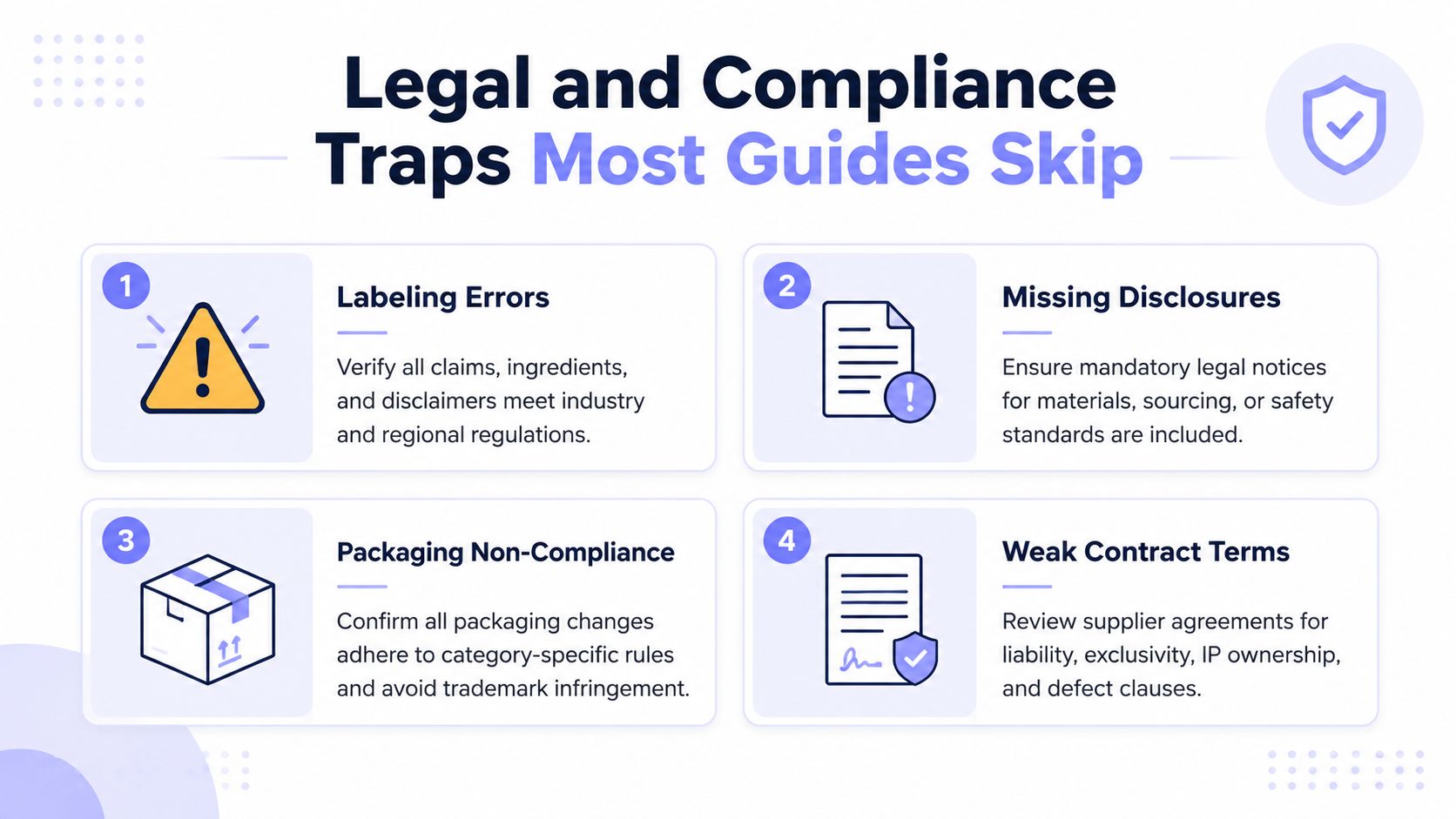 An infographic titled Legal and Compliance Traps listing four key pitfalls when managing product manufacturing and branding.
Onboarding Support and Monitoring After Launch
The customer experience is the white-label experience. If the login flow is awkward, support replies drift, or publishing fails without a clean alert, your brand takes the hit even if the underlying provider caused the issue. Good operations make the product feel boring in the best possible way. Everything works, the customer barely notices the machinery, and support only steps in when something needs attention.
Launch week should feel controlled, not heroic
A clean launch week starts with branded onboarding on your domain, your colors, and your help docs. The account connection flow should be obvious enough that customers don't need a walkthrough, and the support path should be clear when a publish fails or a user gets stuck. In a social-publishing setup, that usually means a status webhook for failures, a nightly token-refresh check, and a quiet alert when an account sits idle for too long.
That kind of monitoring is less about dashboards for their own sake and more about catching patterns before customers open tickets. You want to know whether engagement is happening, whether activation is healthy, whether retention is holding, and whether support volume is creeping up. Those are the signals that tell you if the white-label experience is durable.
Design for cancellation as carefully as activation
De-branding matters here too. If a customer leaves, they shouldn't need a support escalation just to unwind the experience cleanly. The cancellation path should remove the visible brand surfaces, stop the syncs, and leave the account in a predictable state. That's not just a legal safeguard. It's also a trust signal for the next buyer who asks whether your platform can be switched off without a mess.
For a reporting-heavy workflow, social media reporting is the kind of operational thinking that keeps the post-launch experience useful. The same mindset applies whether you're publishing content, syncing data, or shipping a physical product with customer-facing software attached.
The cleanest white-label launches look almost unremarkable from the outside. That's the goal. If customers talk about your onboarding, you probably have too much friction.
The right support model isn't flashy. It's predictable, documented, and easy for your team to route without debate.
Your 30 60 90 White Label Playbook and Top Pitfalls
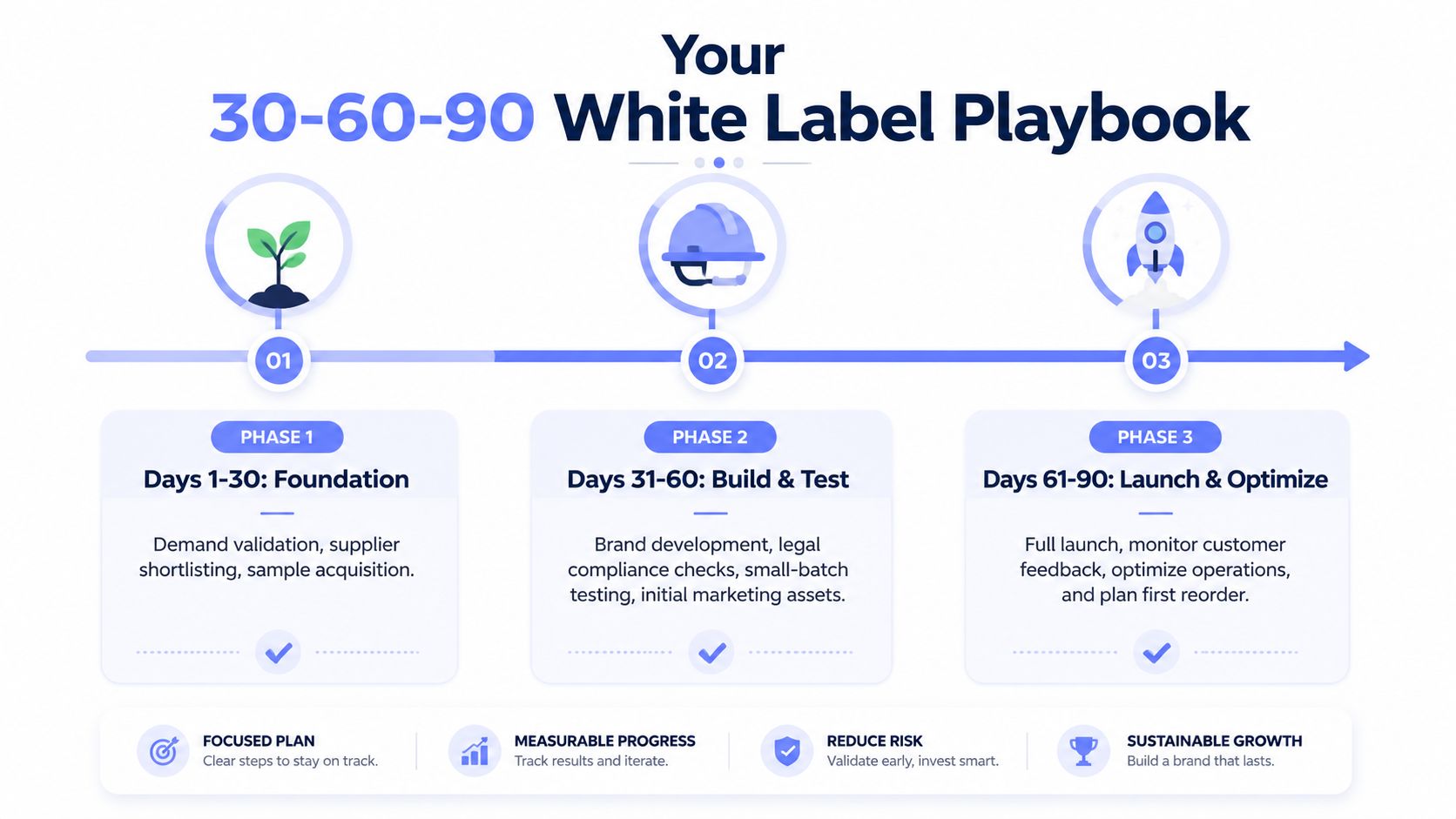 A 30-60-90 day white label business development playbook graphic outlining foundation, build, test, and launch phases.
Days 1 to 30 are for demand validation, supplier or platform shortlisting, and sample or sandbox access. Days 31 to 60 are for branding, contract review, integration, and a closed beta with a small customer set. Days 61 to 90 are for pricing experiments, support routing, dashboards, and the decision to scale, switch partners, or kill the offer.
The five mistakes that sink most launches are simple. Skipping sample comparison, fix it by comparing at least a few options side by side. Underestimating landed cost, fix it by calculating the full delivered unit economics before the first order. Ignoring token expiry and audit timelines, fix it by testing auth refresh and partner readiness early. Glossing over de-branding clauses, fix it by insisting on a written exit path. Measuring success only by signups, fix it by tracking active accounts and actual usage.
If you're turning a white-label idea into a real product, PostPulse gives you the publishing layer under your own brand, with API-based account connection and the operational plumbing already in place. Visit PostPulse if you want to see how a branded social workflow fits inside a broader product or automation stack.
About the Author

Founder of PostPulse — a social media scheduling platform for creators and teams. Software engineer with a passion for building developer tools and simplifying complex API integrations across social media platforms.