How to Integrate APIs Without Breaking Production
Published on · Updated on
Tags:
Your integration works locally. Then a production token expires after an hour, an Instagram media container stays stuck in processing, TikTok publishing returns a publish_id that nobody checks, and the next retry creates a duplicate post. The HTTP request was never the hard part. The hard part is keeping authentication, asynchronous work, rate limits, schemas, retries, and platform changes under control after launch.
By 2025, APIs had become a business operating model rather than a niche engineering choice. Postman's 2025 State of the API Report found that 82% of organizations had adopted some level of an API-first approach, while 25% were fully API-first, a 12% increase from 2024. The same report found that 65% of organizations generated revenue from APIs, and among those organizations, 74% earned at least 10% of company revenue from API programs. That changes the question from “how do I connect these systems?” to “how do I operate this connection reliably?”
Table of Contents
Why API Integrations Break After Day One
A social publishing integration often fails in a predictable sequence. The first request authenticates correctly, the test post appears, and the team considers the work complete. Later, the access token expires, the refresh path fails, or a provider changes a response field that the parser assumed would always exist.
Asynchronous publishing creates a different class of failure. Instagram media workflows can involve creating a container, waiting for processing, and then publishing it. TikTok's Content Posting API returns a publish_id, then expects the developer to poll the publish status endpoint. If your worker treats the initial response as proof of publication, your database can say “published” while the platform is still processing, or has already returned a failure state.
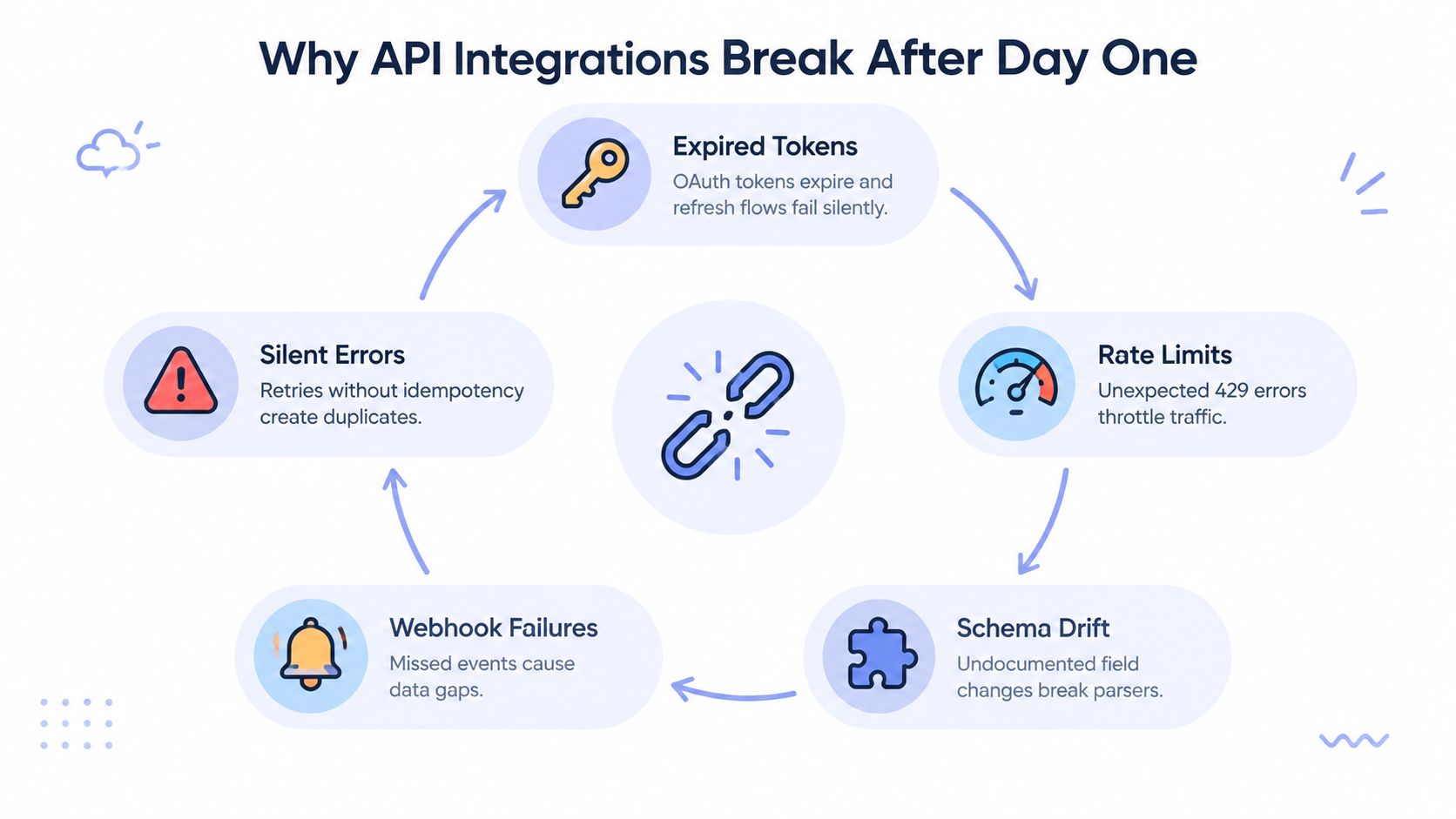 A diagram illustrating five common reasons why API integrations fail after initial deployment in a cycle.
The operational problems usually sit in five connected areas:
Expired tokens: OAuth credentials have a lifecycle, and refresh failures need explicit alerts.
Rate limits: A sudden
429response can stop a queue even when the API itself is healthy.Schema drift: A changed field, enum, or error shape can break a strict parser.
Webhook failures: A missed event can leave local state behind the provider's state.
Silent errors: Unbounded retries can create duplicate writes or hide a permanent authorization failure.
The industry's move from SOAP toward REST made integrations easier to build, but it didn't remove the need for operational design. SOAP became a W3C Recommendation in June 2003, and by 2025 93% of API developer teams used REST, according to the historical account and Postman's API usage reporting. The same report recorded webhook usage among 50% of API developer teams, which shows that modern integration depends on event delivery and workflow coordination as much as on HTTP requests.
Practical rule: Treat every integration as a long-running service with failure states, not as a successful curl command.
Before writing the first adapter, define what happens when credentials expire, a request is throttled, a job remains in progress, a webhook arrives twice, or a provider adds a new API version. A unified layer such as PostPulse can provide one publishing surface across Instagram, TikTok, YouTube, LinkedIn, X, Threads, Bluesky, Facebook, Telegram, and Pinterest, while your application still needs clear internal states and monitoring. For direct implementations, document the failure behavior yourself. The rate-limiting best practices guide is a useful companion for that part of the design.
Planning Your Integration and Handling Authentication Right
The most expensive authentication bugs come from decisions made before the first request. Start by writing down the resource actions your application needs, then request only the scopes that support those actions. A publishing tool may need permission to create media and inspect publishing status, but broader access increases review, security, and governance work.
Choose the authentication model per provider rather than forcing every connection into one pattern. OAuth 2.0 fits delegated access where a user grants an application permission. An API key can suit a server-to-server service that doesn't act on behalf of a user. Mutual TLS may be appropriate when both sides need certificate-based client identity. Keep the decision in the integration contract, alongside token endpoint details, scope names, expiry behavior, revocation behavior, and error formats. The API authentication methods guide provides useful terminology when comparing those choices.
Build the token lifecycle before the request layer
Store client secrets and refresh tokens in a managed secret store, not in source code, logs, browser storage, or job payloads. Encrypt sensitive values at rest, restrict access to the worker that needs them, and redact authorization headers from traces. Your token service should expose a simple operation such as “get a valid access token,” while hiding whether it loaded a cached value or refreshed one.
Cache and reuse access tokens instead of requesting a new token for every API call. Salesforce's rate-limiting guidance recommends requesting no more than one access token every 20 minutes, using the token's expires_in value, and refreshing only when the token is close to expiry. That approach removes unnecessary round trips and reduces the chance that your own token endpoint becomes a bottleneck.
Meta's Instagram documentation gives a concrete example of why provider-specific rules matter. Short-lived Instagram User access tokens expire after 1 hour, while exchanged long-lived tokens last 60 days. Meta also documents that a valid long-lived token can be refreshed for another 60 days only when it meets the documented age and permission conditions, and a token that isn't refreshed within its validity period expires permanently. Your database should therefore record expiry timestamps, refresh eligibility, the granted scopes, and the last successful refresh.
Write down the contract
A useful planning document includes:
Scopes and ownership: Record who authorized the connection and exactly what the application can do.
Refresh behavior: Define when workers refresh, how they serialize concurrent refreshes, and what happens after revocation.
Provider versions: Store the API version used by each adapter and the deprecation contact or review process.
State transitions: Separate “accepted,” “processing,” “published,” and “failed” instead of collapsing them into one boolean.
Recovery ownership: Decide whether a user, a scheduled job, or an operator resolves each failure.
A platform such as PostPulse can abstract much of the OAuth refresh and provider-version maintenance behind a unified publishing API. That can be a sensible choice when the product value is social publishing rather than owning nine separate authentication and compliance implementations.
Making Reliable REST Calls Batching and Async Status Checks
A REST integration can connect successfully and still fail under retries, large collections, or delayed provider processing. Define request semantics from the provider contract: use GET for retrieval, POST for creation, and the documented update method. Every write also needs an idempotency plan. If the provider accepts an idempotency key, persist it with the job. Otherwise, store a client-generated operation identifier and check for an existing result before retrying.
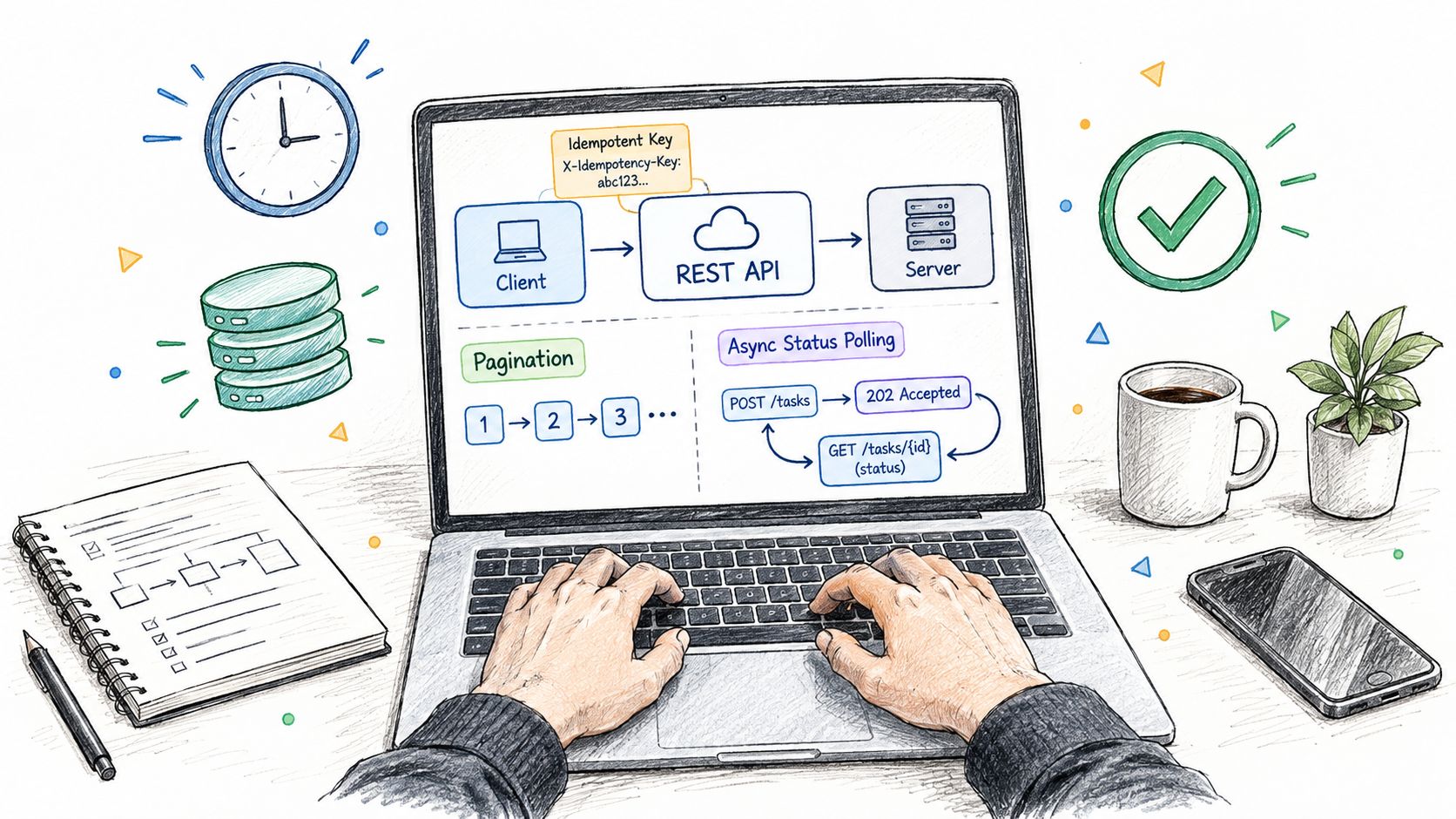 A hand-drawn illustration showing a person typing on a laptop displaying REST API design concepts like pagination.
Pagination requires the same care as authentication. The first response may contain only part of a collection, so follow the provider's cursor or page token. Persist the cursor only after the returned records are safely written. A checkpoint then gives a worker a known recovery point after a crash, reducing the risk of both skipped records and duplicate processing.
Batching lowers request overhead, but it introduces its own failure modes. Providers may impose maximum batch sizes, return partial failures, or make individual retries difficult to identify. Keep a result for each item, retry only failed items, and preserve the original operation identifier. For publishing workflows, one durable queue job per destination usually provides clearer visibility than an opaque batch.
Poll asynchronous work deliberately
An asynchronous endpoint acknowledges work before the operation finishes. Persist the returned identifier, schedule a status check, interpret every documented state, and stop polling when the provider reports success or failure. A bounded delay prevents a worker from consuming its quota while the provider is still processing.
TikTok documents the publish_id polling model and lists states including PROCESSING_UPLOAD, PROCESSING_DOWNLOAD, SEND_TO_USER_INBOX, PUBLISH_COMPLETE, and FAILED. Its official documentation also limits each user access token to 30 requests per minute, so the polling loop must include a delay and account for that quota. See the TikTok Content Posting API status documentation for the state definitions.
A practical control flow is:
Submit the publish request.
Persist
publish_idand mark the job as processing.Poll after a bounded delay.
Keep the job open for documented processing states.
Mark it complete only after
PUBLISH_COMPLETE.Record the provider error and stop after
FAILED.
Instagram container workflows require the same separation between creation and final publication. If processing must finish first, do not publish immediately after creating the container. Store its identifier, inspect its status, and make the final publish action idempotent within your job system.
For a concise distinction between the general API concept and REST-style integrations, see ThirstySprout on API vs REST. Webhook-driven completion can reduce polling, provided the provider supports dependable events and your receiver handles verification, duplicate deliveries, and missed notifications. The guide what is a webhook and how it works covers that event pattern.
This video offers a visual introduction to REST design and request flow:
PostPulse can reduce repeated orchestration for social publishing by exposing one call for multiple destinations while handling platform-specific publishing workflows behind its API. Your system still needs its own job state and observability, but it avoids rebuilding separate container, upload, and status models across ten platforms. That trade-off is useful when shipping a unified publishing workflow matters more than owning each raw REST integration.
Choosing Between Webhooks SDKs and Raw HTTP
The right integration surface depends on how much control your team needs and how much provider-specific maintenance it can own. Raw HTTP offers the clearest behavior and the fewest abstractions, but your team must implement authentication, serialization, retries, pagination, version changes, and observability. An SDK can accelerate the first release, yet it may lag behind a provider's newest endpoint or expose errors through an abstraction that makes debugging harder.
Webhooks and polling solve different coordination problems. Use a webhook when the provider reliably emits the event you need and your system can expose a secure receiver, verify signatures where documented, deduplicate deliveries, and replay missed events. Use polling when the provider exposes status through an endpoint, events aren't available, or you need a reconciliation process that can repair missed notifications. In practice, long-lived systems often use both, with webhooks for low-latency updates and polling for reconciliation.
Surface | Best For | Trade-off |
Raw HTTP | Teams needing direct control over requests and responses | Highest maintenance responsibility |
Provider SDK | A single provider with a stable, well-supported client library | Version lag, abstraction overhead, and provider-specific behavior |
Webhooks | Event-driven updates and near-real-time state changes | Requires verification, deduplication, replay, and delivery monitoring |
Polling | Asynchronous jobs and reconciliation | Uses requests continuously and must respect quotas |
n8n or Make | Workflow builders connecting business systems quickly | Less control over complex state, testing, and failure recovery |
MCP server | AI agents that need a structured action surface | Requires careful tool permissions and execution observability |
Unified API layer | Products integrating several similar providers | Adds a dependency, but centralizes auth, mapping, and operational logic |
PostPulse offers a unified REST API, an official n8n node, a Make.com app, and an MCP server for AI agents. That makes it a practical option when the team wants one publishing contract across social platforms rather than separate platform audits and adapters. A hub-and-spoke model also keeps your product logic focused on content and business outcomes, while the integration layer owns provider mapping.
The point-to-point approach can work for one provider and a narrow internal tool. It becomes harder to justify as each additional connection introduces another authentication contract, schema map, retry policy, webhook receiver, and monitoring dashboard. Independent guidance on common API integration challenges also highlights documentation and communication as major sources of schedule risk, which is why a central contract can be valuable even when the underlying HTTP calls are simple.
Testing Staging Monitoring and Security That Actually Holds Up
A staging environment should exercise the same authentication path, queue behavior, callback handling, and data contracts as production. Provider sandboxes can differ from production, so test both documented happy paths and deliberately bad inputs. Keep test accounts and media separate from customer data, and make cleanup part of the test job rather than an afterthought.
Contract tests should validate more than a 200 response. Check required fields, nullable fields, enum values, pagination tokens, error bodies, and status transitions. Run them when adapters change and when providers announce version updates. A parser that accepts unknown fields is often safer than one that crashes because an otherwise irrelevant field appeared, but critical missing fields should fail loudly.
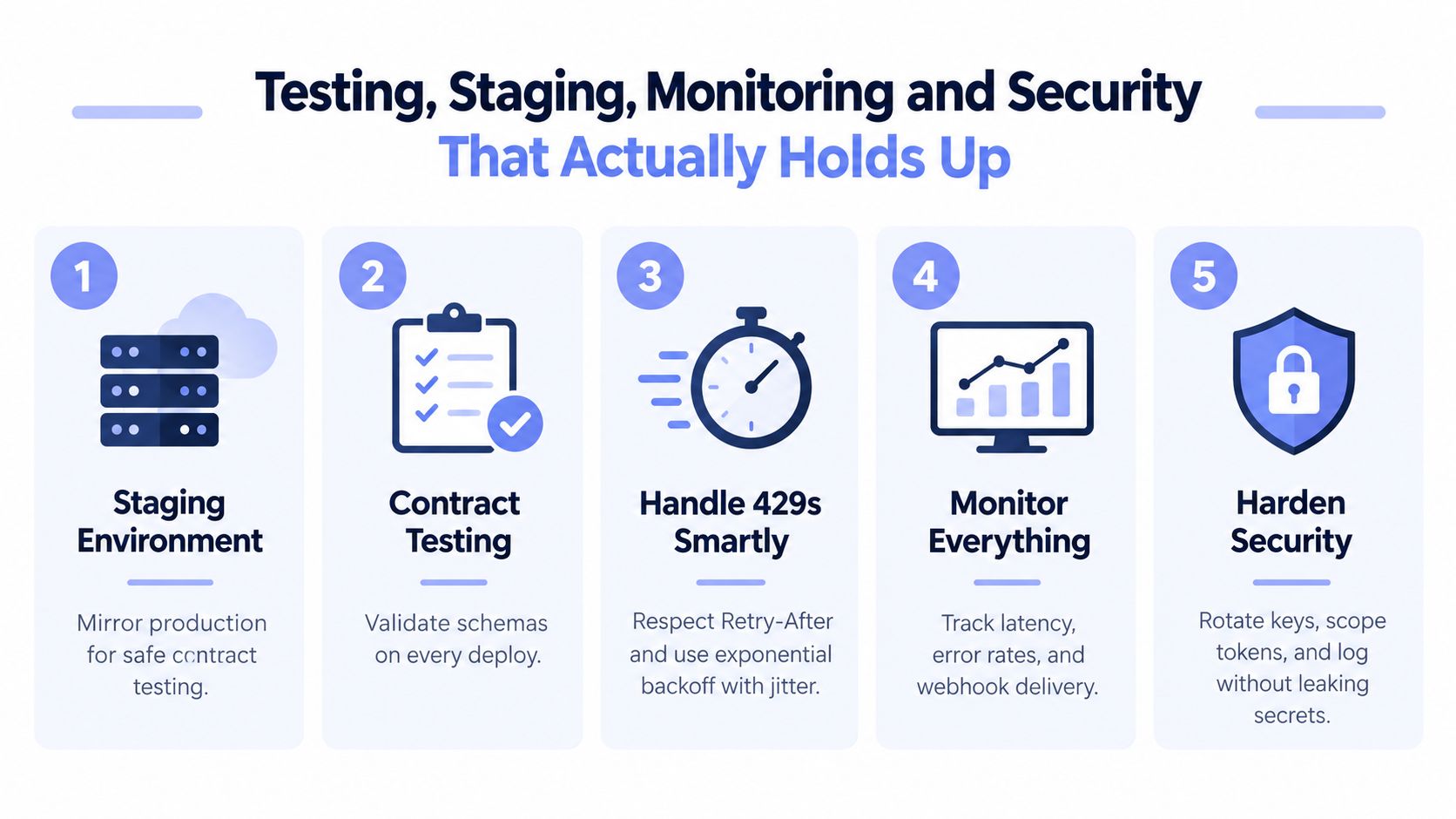 A diagram outlining five key steps for API stability, including staging, contract testing, and security hardening.
Make throttling a controlled state
Treat HTTP 429 as a control signal, not as a generic server error. Honor Retry-After when the response includes it. If it doesn't, use exponential backoff with jitter, cap the delay, and place the job back into a queue rather than running a tight retry loop.
OWASP's API protection guidance warns that missing or misconfigured request limits can contribute to denial-of-service conditions. It also recommends limits for requests per client or resource, payload size, and response page size. Your client and your own API gateway should enforce sensible boundaries so one account, workflow, or malformed request can't exhaust shared capacity.
Observe the whole job
Log a correlation ID, provider, endpoint category, internal job ID, response status, retry count, and final state. Don't log access tokens, refresh tokens, full authorization headers, or sensitive user content. Track webhook delivery, queue age, processing duration, permanent failures, token refresh failures, and reconciliation discrepancies.
When a customer says “the post disappeared,” operators need to answer whether your system never submitted it, the provider rejected it, the provider is still processing it, or your webhook receiver missed the final event. A single success counter can't distinguish those cases.
Harden permissions and recovery
Use least-privilege scopes, rotate client secrets, revoke disconnected accounts, and record consent changes. The 2025 API report identifies governance gaps such as missing authentication contracts, missing 429 handling, and overly broad scopes. Those gaps matter more as low-code workflows and AI-driven actions allow integrations to execute with less manual review.
Recent reliability guidance also calls out token expiry, cursor checkpoints, rate-limit handling, retries, and observability as common failure points at scale. PostPulse can centralize token management and rate-limit handling for its supported publishing destinations, but your application still needs alerts, customer-facing recovery messages, and an audit trail for business outcomes.
Your Next Integration Shipped Without the Headaches
Reliable API integration is a sequence of deliberate decisions. Define the permissions and data contract first, model token expiry before launch, make writes recoverable, persist asynchronous status, choose webhooks or polling based on the provider's actual behavior, and monitor the complete lifecycle rather than only the initial request.
Use this checklist before shipping:
Authentication: Can the system refresh, revoke, and reauthorize without a manual database edit?
Writes: Can a retry prove whether the original operation already succeeded?
Async jobs: Does the worker persist provider identifiers and handle every documented terminal state?
Throttling: Does it honor
Retry-Afterand back off with jitter?Recovery: Can an operator replay a missed webhook or resume from a saved cursor?
Security: Are scopes narrow, secrets protected, and logs safe to share?
Ownership: Does someone know who responds when a provider changes its contract?
Raw REST is a good fit when you need precise control and are integrating a small number of providers. n8n and Make.com work well when workflow composition matters more than custom runtime behavior. MCP is appropriate when an AI agent needs controlled publishing tools. A unified layer becomes more attractive when your product needs several social destinations and you don't want every release tied to separate audits, OAuth refresh implementations, and API-version reviews.
For teams weighing integration architecture alongside payments or AI execution, SpecStory, Inc.’s discussion of payment and AI integration tradeoffs provides useful context. The same principle applies here: minimize the infrastructure that doesn't differentiate your product, but keep ownership of the business rules, permissions, and observability that do.
Start the next integration by writing its failure states before its happy path. That one habit prevents “works on my machine” from becoming your production operating model.
PostPulse gives apps, automations, and AI agents one REST publishing surface for Instagram, TikTok, YouTube, LinkedIn, X, Threads, Bluesky, Facebook, Telegram, and Pinterest, with official n8n and Make.com options plus an MCP server. Visit PostPulse to connect publishing workflows without maintaining separate platform audits, token refresh logic, and rate-limit handling for every destination.
About the Author

Founder of PostPulse — a social media scheduling platform for creators and teams. Software engineer with a passion for building developer tools and simplifying complex API integrations across social media platforms.