Best Practices for API Security: Secure Your Apps in 2026
Published on · Updated on
Tags:
Tired of Your API Security Feeling Like a Leaky Sieve? You've built a killer integration, but mysterious errors keep popping up. Tokens expire at the worst moment, a platform starts returning 429s, and you still remember that one old GitHub commit with a hardcoded key that should never have existed. If you work with social APIs, internal services, or third-party webhooks, security rarely fails in one dramatic way. It usually fails as a pile of annoying little problems that become one big incident.
That's why the best practices for API security can't live only in a policy doc. They have to show up in the places where engineers get burned: token refresh flows, retries, input validation, webhook verification, and monitoring that catches bad behavior before your users do. As of 2024, API breaches account for 42% of all application attacks, up from 17% in 2019, and the average cost of an API breach now exceeds $4.5 million, according to the StackHawk-cited Portnox 2024 API security overview.
If you build publishing or automation products, you've probably felt this already. You spend more time on edge cases than on product work. That's one reason platforms like PostPulse exist. It hides a lot of the ugly parts around OAuth, refresh cycles, and version churn. But even if you never use it, the patterns below still apply.
For broader reading beyond this guide, UpTime Web Hosting cybersecurity insights has useful context on data protection and operational security.
Table of Contents
2. Rate Limiting, Backoff Strategies, and Backend Egress Control
10. Maintain API Security Documentation and Incident Response Plan
1. Use OAuth 2.0 with Proper Token Management
Why your token worked yesterday and fails today
This is one of the most common API headaches. A user connects Instagram, TikTok, or LinkedIn, everything looks good in staging, and then production starts failing because the token expired, the refresh flow broke, or the app asked for the wrong scope.
For user-centric APIs, authentication should rely on OAuth 2.0 or OIDC, not raw API keys, and fine-grained scoped tokens are the safer model because they limit what any one token can do. CyCognito's API security guidance also calls out a practical rule many teams still ignore: API keys should not be used for authentication, only for things like quota enforcement or billing in systems that support that pattern, while delegated access should use OAuth-style tokens with expiration and scope controls through CyCognito's API security recommendations.
Practical rule: If a token can do more than the current feature needs, it's over-scoped.
What actually works in production
Store refresh tokens in an encrypted database, not in client-side code, not in localStorage, and definitely not in mobile app bundles. Refresh a little before expiry so concurrent workers don't race each other into a bad state, and log every refresh failure with enough context to trace platform-side changes.
A pattern I trust looks like this:
Use narrow scopes: Ask only for what the workflow needs, such as posting or reading engagement, not blanket account access.
Separate auth from app logic: Put token refresh and revocation in a dedicated service so retries and fallbacks stay consistent.
Disconnect aggressively on repeated refresh failure: If refresh fails multiple times, stop pretending the account is healthy and mark it for reauth.
Test expiry in staging: Manually force expiration and refresh paths before release.
If you've had to wrestle with Meta token edge cases, PostPulse's Meta OAuth token lifecycle breakdown is a useful implementation reference. For broader auth patterns, this secure API development guide is also worth reading.
2. Rate Limiting, Backoff Strategies, and Backend Egress Control
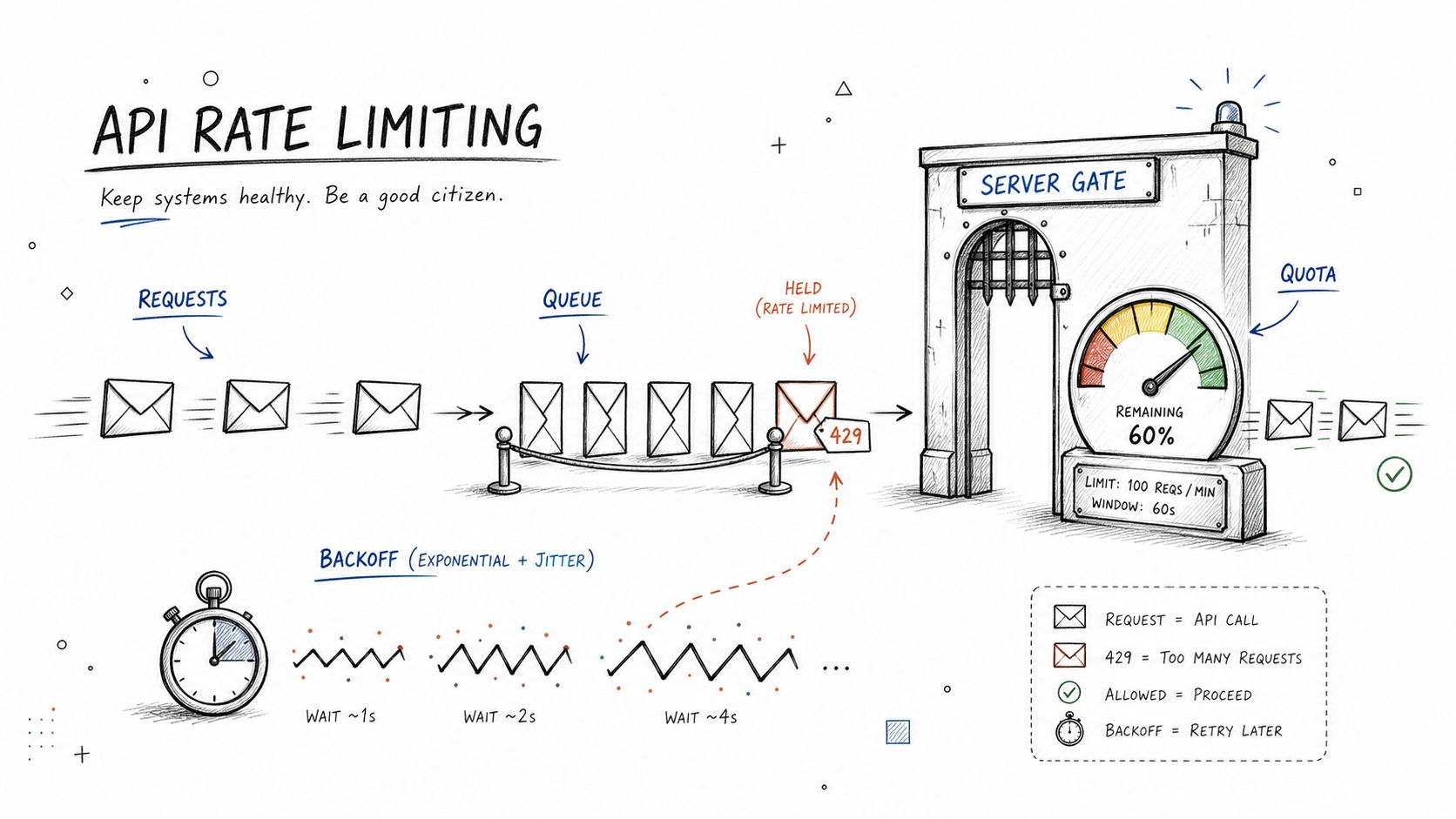 An illustrated diagram explaining API rate limiting concepts including requests, queues, backoff strategies, and server gate quotas.
Why am I getting 429s
You usually don't get 429s because your app is popular. You get them because retries are naive, workers are uncoordinated, or one tenant is hammering the same endpoint hard enough to consume shared quota.
Rate limiting isn't only about defending your API from attackers. It also protects your outbound integrations from your own bugs. Security guidance for 2025 explicitly recommends strict thresholds on authentication endpoints, including roughly 5 to 10 requests per minute per IP, with temporary blocking or throttling when credential stuffing patterns show up, according to Security Online's API security guidance.
Build limits on both sides of the wire
Handle platform limits and your own backend egress limits separately. If TikTok or another provider returns 429 with Retry-After, honor that header. Don't invent your own delay when the API already told you what to do.
Then add your own controls:
Per-user outbound quotas: One user shouldn't be able to trigger a flood of publish attempts that affects everyone else.
Global egress caps: A retry loop in one worker pool should hit a hard ceiling before it melts your quota.
Exponential backoff with jitter: Add randomness so a fleet of workers doesn't retry in lockstep.
Circuit breakers: If one platform keeps rate-limiting you, pause traffic for a cooling window and let the queue breathe.
For high-volume integrations, a proxy layer helps centralize this logic. That's exactly where something like PostPulse's API proxy service approach fits well.
Backoff without jitter is how healthy systems create their own traffic spike.
3. Validate and Sanitize All Input Data
Why bad input becomes a security incident later
You usually notice this one as an integration headache first. A webhook payload works in staging but fails in production. A caption with odd Unicode passes one endpoint and breaks another. A client sends an extra field your backend ignores, and three weeks later that "harmless" mismatch turns into a bug you have to trace through logs, retries, and partial writes.
A lot of API security failures start there. Input handling drifts, assumptions pile up, and attackers get to explore every gap between what your docs say, what your gateway accepts, and what your application processes.
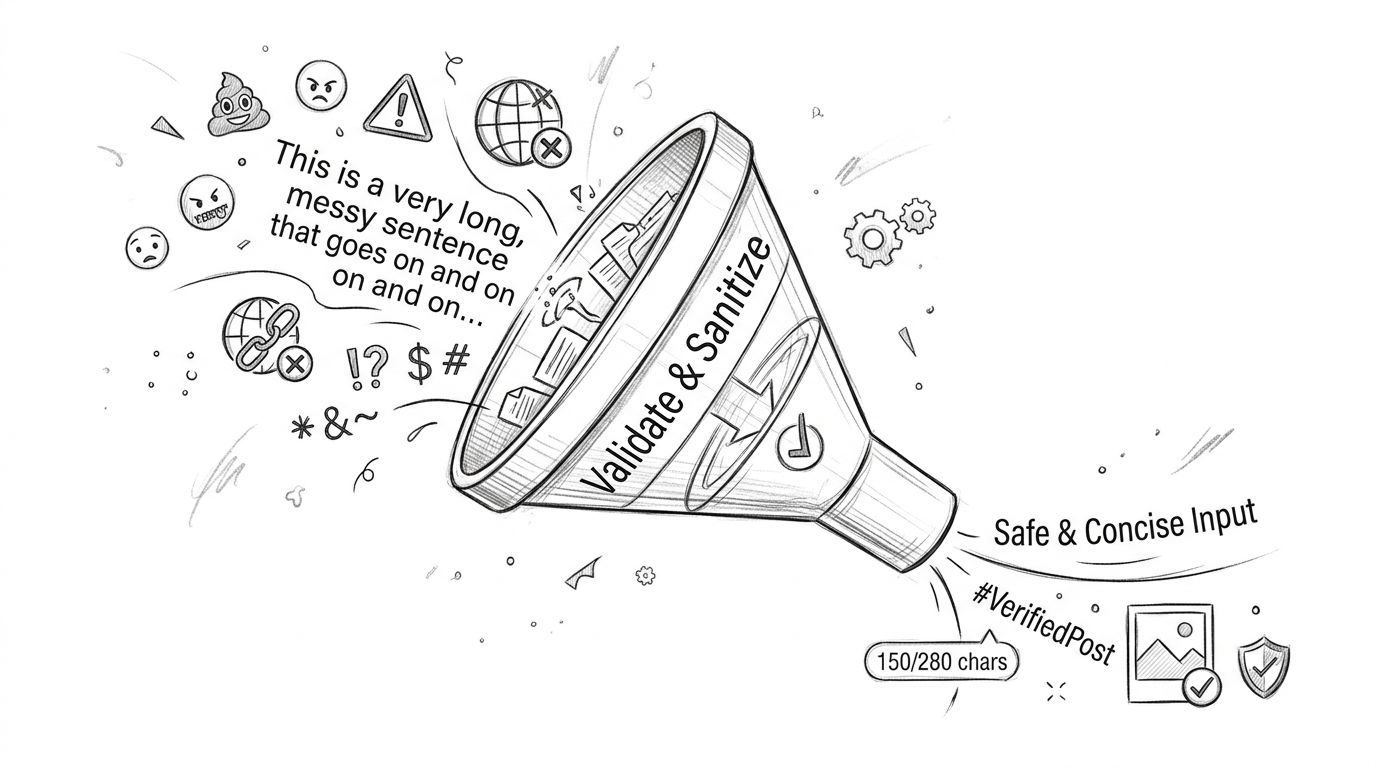 A diagram of a funnel illustrating the process of validating and sanitizing long, messy input data.
Start with the contract, not scattered if-statements
Validate requests before they hit queues, workers, or business logic. If a post body, hashtag, media reference, or callback URL is malformed, reject it at the edge with a clear 4xx response. That saves compute, avoids side effects, and makes client bugs easier to fix.
Schema-first validation works because it forces consistency. One OpenAPI schema, enforced the same way across environments, beats hand-written checks spread across controllers and background jobs. It also makes change review less risky. If a new field appears, you decide whether to support it instead of automatically accepting it.
A few practices hold up well in production:
Use allowlists: Define accepted formats, enums, lengths, and ranges.
Reject unknown fields: Silent acceptance hides client bugs and creates parsing ambiguity.
Normalize Unicode: NFKC normalization reduces edge cases with lookalike characters and combining marks.
Validate size and structure early: Put hard limits on body size, array length, nesting depth, and string length before expensive processing starts.
Sanitize for the destination, not generically: Escaping rules differ for SQL, HTML, logs, search queries, and shell commands.
That last point matters. I still see teams "sanitize input" once and assume they are done. They are not. Safe storage is different from safe rendering, and safe rendering is different from safe query construction.
Solve the real problem: inconsistent trust boundaries
Frontend validation helps users. Backend validation protects systems.
If your mobile app blocks invalid values but your API still accepts them, an attacker can skip the app and talk to the API directly. If your gateway validates JSON shape but your service trusts nested fields without checking ownership or type constraints, you still have a security problem.
Treat every boundary as hostile input. Query params, headers, multipart uploads, webhook bodies, callback URLs, and imported CSVs all need validation rules that match their risk. File uploads deserve special attention. Check MIME type, extension, size, and scanning policy separately, because client-declared content types are easy to fake.
For teams tightening this up, it helps to pair request validation with disciplined API key management and rotation practices, so rejected traffic is easier to attribute and abusive clients are easier to contain.
If your team only validates in the frontend, you're decorating.
4. Enforce HTTPS and Secure API Endpoints
Why https alone is not the whole answer
Developers often say “we use HTTPS” as if that settles transport security. It doesn't. I still see internal tooling with certificate checks disabled in development, webhook consumers that trust unsigned payloads, and services that technically support TLS while keeping old protocol versions enabled.
That's risky because all API traffic should be encrypted in transit using TLS 1.2 or preferably TLS 1.3, with older protocols such as SSLv3 and TLS 1.0 disabled. Fortinet's API security guidance also ties transport security to a larger operational model that includes centralized visibility and policy enforcement through Fortinet's API security best practices ebook.
What secure transport looks like in practice
Use verify=True, validate certificates, and only consider certificate pinning for endpoints you control. Don't pin third-party social platform endpoints unless you enjoy emergency updates for reasons outside your control.
For inbound traffic, webhooks are where many teams get lazy. Validate HMAC signatures on every event, hash the exact raw request body, and reject tampered payloads before your app touches business logic.
Redirect all HTTP to HTTPS: Don't leave mixed transport paths hanging around.
Enable HSTS: Browsers should learn that your domain is HTTPS-only.
Check TLS config regularly: Tools like
testssl.shcatch obvious misconfigurations fast.Verify webhook signatures: Signed callbacks are not optional for state-changing events.
PostPulse webhooks follow this same operational pattern. If your app trusts incoming publish or status events, signature verification needs to be part of the default path.
5. Implement Proper API Key Management and Rotation
Why one leaked key turns into a messy incident
A single exposed key can create a lot of damage fast. It's not even always dramatic. Sometimes a contractor still has an old production credential. Sometimes a debug log captured a secret. Sometimes someone copied a .env file into the wrong support bundle.
The fix is boring, which is why teams skip it. But boring is what works.
Treat keys like credentials not config
Never commit keys to source control. Never log full keys. Never share one key across environments or services if you can avoid it. Production, staging, workers, and internal admin tools should have separate credentials so you can revoke one path without breaking everything else.
A sane key strategy includes:
Store secrets in a vault or environment-backed secret manager: Config files and wikis are not secret stores.
Mask keys in logs: Show only a small prefix and suffix when debugging.
Rotate on a schedule and on suspicion: If a key might be exposed, assume it is.
Support overlapping key versions: Accept old and new keys briefly during rotation so you don't create downtime.
If you want a practical implementation model, PostPulse's API key management guide covers the operational side well.
Keys become dangerous when they outlive the engineer who created them.
6. Add Request Signing and Webhook Verification
Why your webhook endpoint is a trust boundary
Webhook endpoints look simple, which is exactly why they're dangerous. If your endpoint accepts “post published” or “schedule updated” events and you don't verify who sent them, you've effectively built an unauthenticated command channel.
This matters even more in systems with automation and agents. Aikido's 2025 discussion of AI-agent API security highlights a newer class of issues around persistent session context, shadow access, and agent-to-API interactions that don't re-check scopes consistently through Aikido's API security guide. Even if your own product isn't AI-native, more clients calling your API will be.
The minimum signing model worth shipping
Use HMAC-SHA256 signatures for inbound and outbound messages. Include a timestamp in the signed payload, reject requests that are too old, and compare signatures with constant-time functions such as hmac.compare_digest().
A good verification flow has four steps:
Read the raw body exactly once: Signature mismatches often come from parsing first and hashing later.
Sign body plus timestamp: That gives you tamper detection and replay resistance.
Use constant-time comparison: Don't leak timing differences on failed checks.
Allow secret rotation: Support multiple active secrets during rollout.
One practical replay scenario: an attacker captures a valid webhook and replays it repeatedly to trigger the same workflow. Timestamp checks and idempotency keys stop that becoming a real incident.
7. Encrypt Sensitive Data at Rest
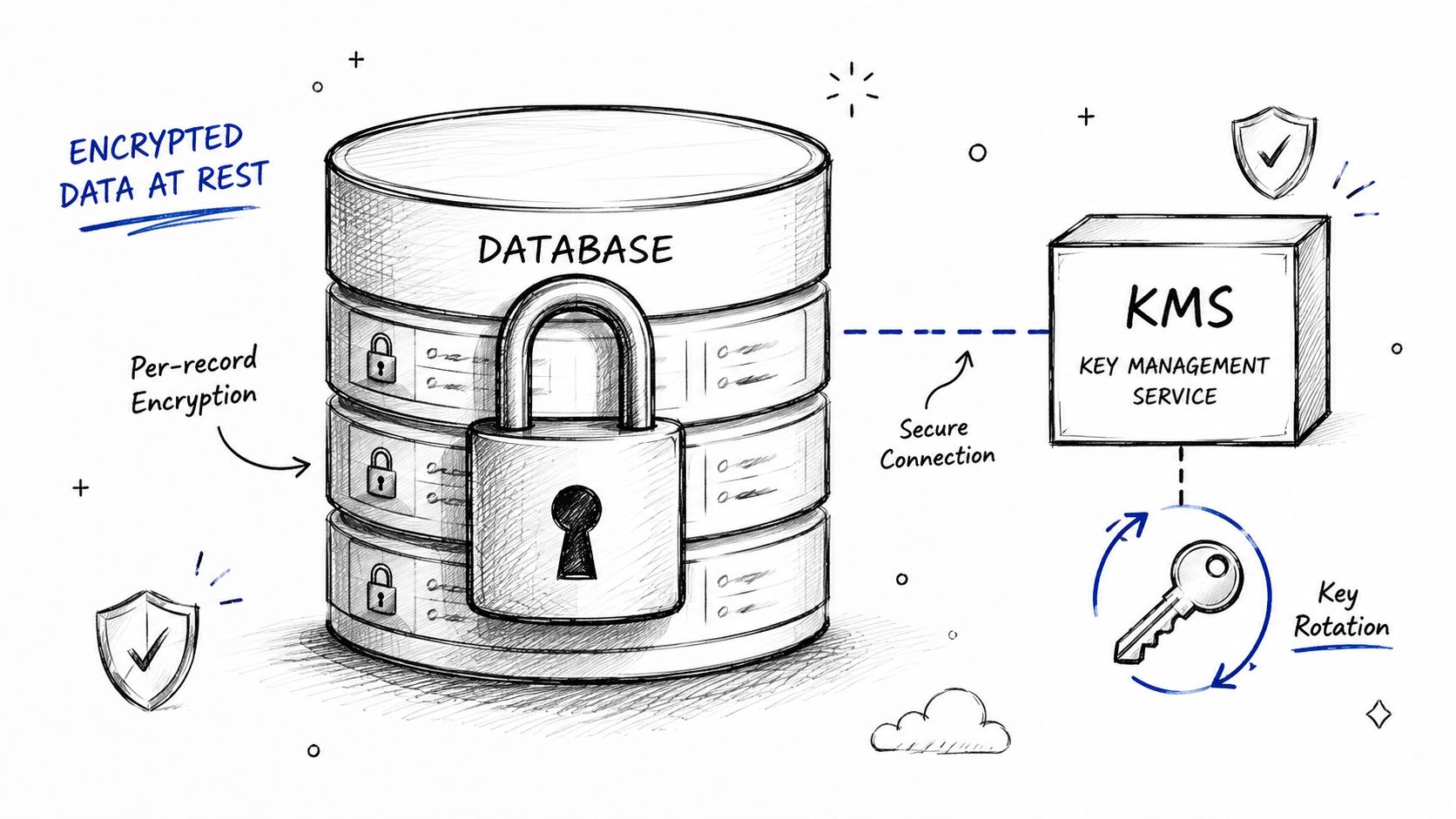 A hand-drawn illustration showing a database with per-record encryption connected to a key management service for security.
Why database access should not equal plaintext access
If someone gets a database dump, plaintext tokens and API secrets turn a bad day into a catastrophic one. Encrypting at rest won't save you from every breach, but it does reduce what an attacker can use immediately.
Use authenticated encryption for sensitive fields such as OAuth refresh tokens, API keys, webhook secrets, and any metadata that could help reconstruct account access. AES-256-GCM is a common practical choice because it provides confidentiality and integrity.
Use layered encryption not wishful thinking
Database-level encryption helps, but application-level encryption is the stronger pattern for highly sensitive fields. Keep encryption keys in a separate KMS such as AWS KMS, Google Cloud KMS, or HashiCorp Vault, not alongside the encrypted data.
A solid pattern looks like this:
Encrypt field-level secrets in the app: Don't rely only on disk or volume encryption.
Version your encryption keys: Old records still need to decrypt during rotation.
Use bcrypt or Argon2id for passwords: Passwords should be hashed, not encrypted.
Limit blast radius: Per-record or per-tenant key strategies reduce exposure if one path is compromised.
If a developer accidentally logs encrypted token blobs instead of raw secrets, you still have a problem. But you have a much smaller problem.
8. Monitor API Usage and Implement Alerting
Why the first signal is often a customer complaint
A common failure pattern looks like this. A retry loop goes bad, one tenant starts hammering an endpoint, auth failures climb, and nobody notices until support asks why users are seeing duplicate actions or failed syncs.
That delay is the problem. Broken authorization, token abuse, and integration bugs rarely announce themselves with one obvious outage. They show up as odd request patterns, rising 403s, slower responses, or one client behaving very differently from the rest. If you only watch uptime, you miss the security story.
What good API monitoring actually needs
Start with structured logs that are useful during an incident. For each request, capture timestamp, endpoint, method, request ID, actor or tenant ID, status code, duration, source IP, and the auth context that explains how the request was authorized. In distributed systems, trace IDs matter because a suspicious request usually crosses several services before it does damage.
Then alert on behavior, not just server health.
Spikes in 401 and 403 responses: These often point to broken deployments, expired credentials, permission drift, or active probing.
Changes in request volume by token, IP, or tenant: Useful for catching compromised keys, retry storms, and scraping.
Error-rate jumps on sensitive endpoints: Watch auth, admin, billing, export, and webhook handlers more closely than generic read endpoints.
Latency regressions: Slow authorization checks and database lookups often show up before a visible outage.
Unusual access patterns: A token reading far more objects than normal, or accessing objects outside its usual scope, deserves attention.
One practical trade-off matters here. If you log too little, investigations stall. If you log raw tokens, request bodies, or personal data, your monitoring stack becomes another place secrets can leak. Log identifiers and security-relevant metadata. Redact payloads by default, then allow temporary higher-detail logging only during controlled incident work.
Good alerting should help the on-call engineer answer three questions fast. What changed, who is affected, and is this isolated or spreading? That is the difference between catching abuse early and finding out from a customer thread two hours later.
9. Implement CORS and CSRF Protection
Why a browser can become your attack path
If your API is used by browser-based apps, CORS and CSRF are not optional cleanup tasks. They are part of your auth boundary. The classic mistake is allowing Access-Control-Allow-Origin: * while also assuming the browser will somehow keep authenticated requests safe.
It won't. If your app uses cookies or browser-held credentials, state-changing endpoints need explicit CSRF protection and tight origin controls.
Here's a quick visual refresher before the implementation details.
The safe defaults most teams should start with
Use an allowlist of exact trusted origins. Don't reflect arbitrary origins back in CORS headers. Don't allow credentials across broad origins. And require CSRF tokens for POST, PUT, and DELETE when the browser can automatically attach session cookies.
The baseline setup is straightforward:
Allow only known origins: Set
Access-Control-Allow-Originto your real frontend domains.Prefer
SameSite=Strictwhen possible: Fall back toLaxonly when the user flow requires it.Issue short-lived CSRF tokens per session: Validate them server-side on every state-changing call.
Test from the browser console: CORS bugs often hide until a real browser sends a preflight request.
Teams often spend hours on auth bugs that are CORS bugs with security consequences.
10. Maintain API Security Documentation and Incident Response Plan
Why incident response falls apart at 2 a.m.
The painful version is familiar. An API key is exposed, alerts are firing, and the first 30 minutes disappear into basic questions. Which service used that key? Who can revoke it? Will rotation break a webhook consumer or a scheduled job? Which logs answer whether anyone abused it?
Good teams still lose time here because the knowledge lives in Slack threads, one engineer's memory, or a stale wiki page. Security documentation earns its keep during the first hour of an incident, when speed matters more than perfect prose.
Write down the stuff you do not want to guess under pressure
The minimum useful plan is short. It should tell an on-call engineer exactly what to do for the incidents you are likely to have, not the incidents that look good in an audit.
For API-heavy systems, that usually means keeping these items current:
Secrets inventory: Which credentials exist, where they are stored, which apps depend on them, and who can rotate them.
Provider-specific revocation steps: The exact path to revoke and replace tokens, API keys, signing secrets, and service accounts.
Logging and scoping notes: Which logs show token use, request origin, affected tenants, and unusual spikes after a suspected leak.
Dependency ownership: Who approves updates, how patches ship, and what the rollback path is if a security fix breaks production.
Incident contacts and comms templates: Who gets paged, who talks to customers, and what details must be confirmed before sending an update.
One more trade-off is worth stating clearly. The more distributed your integration surface is, the more dangerous "tribal knowledge" becomes. A tiny startup can sometimes survive with a shared mental model. A team with multiple providers, rotating engineers, and background workers cannot.
OWASP's API Security Top 10 is still a useful shared vocabulary for training and reviews. What matters in practice is turning that vocabulary into repeatable operational steps. Keep the runbook close to the code, review it after every incident, and run drills often enough that rotation is muscle memory instead of improvisation.
Top 10 API Security Best Practices Comparison
Item | Implementation complexity 🔄 | Resource requirements ⚡ | Expected outcomes 📊 | Ideal use cases 💡 | Key advantages ⭐ |
Use OAuth 2.0 with Proper Token Management | High, auth flows, refresh & revocation logic 🔄 | Secure backend storage, KMS, refresh schedulers, logging ⚡ | Reliable delegated auth, fewer failed publishes, platform compliance 📊 | Multi-platform user posting, delegated access workflows 💡 | Users don't share passwords; fine‑grained scopes; easy offboarding ⭐ |
Rate Limiting, Backoff Strategies, and Backend Egress Control | Medium–High, queuing, distributed state, tuning 🔄 | Message broker/queue, Redis or store for counters, monitoring ⚡ | Prevents account blocks, graceful spikes, fewer retries/failures 📊 | High throughput publishing, automation, bursty traffic 💡 | Protects quotas, isolates runaway retries, scalable throttling ⭐ |
Validate and Sanitize All Input Data | Medium, per‑platform rules and normalization 🔄 | Validation libraries, platform rule maintenance, test suites ⚡ | Fewer 400/422 errors, improved UX, fewer abuse flags 📊 | User-generated content, cross-posting to many platforms 💡 | Prevents invalid data and XSS; catches user mistakes early ⭐ |
Enforce HTTPS and Secure API Endpoints | Low–Medium, TLS config, HMAC/webhook checks 🔄 | Certificate management, monitoring, HMAC verification tools ⚡ | Mitigates MITM, meets compliance, trustworthy transport 📊 | All external API calls, webhook endpoints, production systems 💡 | Prevents interception; required for modern APIs and PCI/HIPAA ⭐ |
Implement Proper API Key Management and Rotation | Medium, secrets lifecycle and rollout processes 🔄 | Secrets manager (Vault/KMS), CI/CD integration, audit logs ⚡ | Reduced exposure, quick recovery after leaks, auditability 📊 | Teams with many environments, third‑party integrations 💡 | Limits blast radius; easy revocation and compliance trail ⭐ |
Add Request Signing and Webhook Verification | Medium, crypto handling, timestamping, comparisons 🔄 | Shared secrets, clock sync, signature libraries, rotation ⚡ | Detects tampering, prevents replay, stronger authenticity 📊 | Webhook consumers, high‑security APIs, critical actions 💡 | Confirms authenticity beyond TLS; low perf overhead ⭐ |
Encrypt Sensitive Data at Rest | Medium–High, encryption design and KMS integration 🔄 | KMS (AWS/GCP/Vault), encryption libs, key versioning ⚡ | Protects data in breaches, meets regulatory requirements 📊 | Storing OAuth tokens, API keys, PII, media metadata 💡 | Limits damage of DB compromise; supports key rotation and compliance ⭐ |
Monitor API Usage and Implement Alerting | Medium, logging, tracing, anomaly detection 🔄 | Log aggregation, tracing, alerting tools (Datadog/ELK), storage ⚡ | Early detection of breaches/bugs, performance insights, audits 📊 | Production services, SOC, large user bases 💡 | Fast anomaly detection, traceable incidents, operational insights ⭐ |
Implement CORS and CSRF Protection | Low–Medium, header policies and token validation 🔄 | Server config, CSRF token logic, SameSite cookie settings ⚡ | Prevents unauthorized cross‑origin actions and CSRF exploits 📊 | Browser‑based clients, public web APIs, embedded widgets 💡 | Blocks CSRF and illicit cross‑origin requests with minimal overhead ⭐ |
Maintain API Security Documentation and Incident Response Plan | Medium, process writing and regular drills 🔄 | Time for docs, regular audits/drills, exec support, training ⚡ | Reduced MTTR, consistent handling, compliance evidence 📊 | Organizations with teams, regulated environments, on‑call ops 💡 | Clear playbooks for incidents, audit readiness, team accountability ⭐ |
From Checklist to Culture Making API Security Stick
The hard part about API security isn't learning the list. It's making the list survive contact with a real product, a real backlog, and real deadlines.
API security failures often don't result from skipping every best practice. Rather, they stem from half-implementing the important ones. OAuth exists, but token refresh is brittle. HTTPS exists, but webhook verification doesn't. Logging exists, but nobody alerts on auth failures. Input validation exists in the UI, but not in the API. That middle state is dangerous because it creates false confidence.
If you want this to stick, start with the controls that collapse the most risk at once. Token handling is near the top of that list. So are schema validation, rate limiting, secret management, and production monitoring. Those areas solve both security problems and day-to-day engineering pain. They reduce mystery failures, bad retries, support load, and ugly one-off patches.
Automation is where things get easier. Rotate keys with version support instead of doing surprise cutovers. Validate OpenAPI contracts in CI instead of discovering drift in production. Centralize request logs and alerts so a single bad tenant or broken deploy is visible quickly. If your team is small, this matters even more. You don't have time to manually babysit every integration edge case.
This also applies to newer workflows around AI agents and MCP servers. A lot of older guidance assumes explicit human login flows and obvious token boundaries. That assumption breaks down when agents keep long-lived context, call multiple APIs in sequence, or cache access in ways your team didn't expect. The security model still comes back to the same fundamentals: narrow scopes, per-request authorization checks, signed requests, short-lived trust, and strong observability.
PostPulse is a good example of where abstraction helps. If you're building social publishing into a SaaS product, automation stack, or agent workflow, there's real value in not owning every platform-specific OAuth quirk, refresh edge case, and API version change yourself. But even then, the underlying discipline still matters. Whether you build the stack in-house or buy part of it, you still need good defaults, clear ownership, and incident muscle memory.
Secure APIs don't just protect data. They make your product calmer to operate. Fewer ghost errors. Fewer support escalations. Fewer surprises at midnight. That's usually the strongest argument for doing this well.
If you're building a product that needs social publishing, PostPulse is worth a look. It gives app developers, no-code builders, and AI agent teams one integration for publishing to Instagram, TikTok, YouTube, LinkedIn, X, Threads, Bluesky, Facebook, Telegram, and Pinterest through a REST API, official n8n and Make.com nodes, or an MCP server. The practical win is simple: you skip platform app reviews, avoid maintaining OAuth and token refresh logic for each network, and get a white-label or private-label path depending on how much of the user experience you want to own.
About the Author

Founder of PostPulse — a social media scheduling platform for creators and teams. Software engineer with a passion for building developer tools and simplifying complex API integrations across social media platforms.